Showing posts with label Ancient Near East. Show all posts

Saturday, July 3, 2010

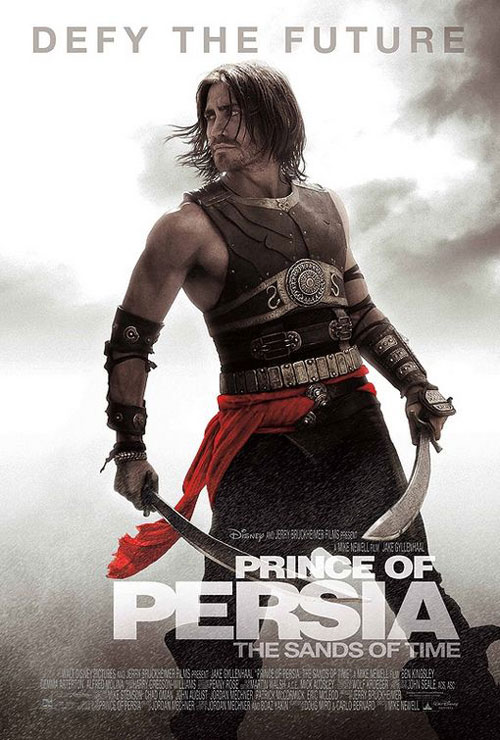
Prince of Persia and Shrek Forever After


Prince of Persia: The Sands of Time (dir. Mike Newell 2010) and Shrek Forever After (dir. Mike Mitchell 2010).

I’m in the city for the week so we had a big cinema outing today to see both these films. Strangely enough though, Brother did not want to see The Twilight Saga: Eclipse – odd, that...

Prince of Persia was better than we expected, which was a nice surprise. I did not agree with Brother that it was as good as The Mummy, but it was good fun, sufficiently intricately plotted that I tried to avoid leaving to use the bathroom and very, very pretty (oh, the costume porn!).

As far as I know, King Sharaman is not a real Persian king, and none of his family is real, so there’s absolutely no way of knowing at which point in the history of the Persian empire this is supposed to be set, apart from a brief glimpse at a map at the very beginning that confirms we’re in the Achaemenid, or Persian, Empire, between 550 and 330 BC. It’s not something to get worked up about, though, as this is not a film that’s too interested in placing itself firmly, historically or geographically. Aesthetically, it embraces all the sorts of things usually associated with Persia – rich fabrics, camels (yay!), those helmets with turbans and pointy bits that I’m not sure where they come from and women wearing bras and baggy trousers and belly dancing (no cats though. I think I did spot a carpet at one point). The king does have a rather beautiful and, from what I could see, vaguely Persian-looking gold death mask at one point. For the most part, though, this is almost as much in fantasy-land as Xena: Warrior Princess.

I’m hoping to do a post on 300 some time in the near future, and while I was watching Prince of Persia, I was reminded of an argument Brother and I had on the way back from seeing 300 a few years ago. I’ll go into more detail when I’ve re-watched the film and can post on it properly, but basically the argument centred around the depiction of the Persians in the film and, well, whether it was OK or not.

In Prince of Persia, we were told a story about a powerful nation who attacked a smaller one because spies had told them the smaller nation were hiding powerful weapons. However, they couldn’t find any weapons, and in fact, there were none, because the spies were under the control of an important politician who wanted a valuable substance that was buried underneath the smaller country. This story will sound familiar.

Then put the bigger country in the geographical area covered mainly by modern Iran. (Goodness knows where the smaller country is, somewhere near the border with India possibly).

I don’t think Prince of Persia is aiming at desperately incisive, biting political satire. But it makes a point, in a similar way to the bit in The Day After Tomorrow where the Mexicans refuse to allow anyone to cross the border. And in both cases, no matter how heavy-handed and possibly a wee bit inappropriate these bits are, I rather like that the scriptwriters put enough thought into their blockbuster script to include a bit of political irony.

We also saw Shrek Forever After. The Shrek series doesn’t include much in the way of classical references, as its fairy tale world tends to be derived from European folk tales and nineteenth century literature. However, there was one bit where we think we spotted a classical reference, though we couldn’t quite decide whether the costume was supposed to look vaguely Roman or Scottish. Whichever it was, as Shrek explored the ruined town, he passed by a small area where the Gingerbread Man was being forced to fight Wild Animal Biscuits (or possibly Wild Animal Crackers). This looked distinctly like a gladiatorial arena to me! (Couldn’t find a proper You Tube clip but there’s a game version clip here). I loved crazy fighter Gingerbread Man and thought the Animal Biscuits thing was especially fun and quite clever.

Also, Fiona’s army of ogres are mostly a cross between Braveheart and Robin Hood’s Merry Men, but I thought there was a touch of Boudicca to Fiona herself as well, as she lead her army with red hair blowing dramatically in the wind. The image of the red-haired warrior woman still has a certain power, or it does if you’re British anyway – it’s possible the American filmmakers didn’t intend it to look that way and it only seems that way to me because I’m British. (A blonde warrior woman, by the way, would look like a Viking, while a dark-haired warrior woman would look, um, possibly like Xena).

Both films were pretty good, I laughed during both (especially during Shrek) and both were well made and held the attention (especially Prince of Persia). And the costumes in Prince of Persia, historical accuracy or lack thereof notwithstanding, really were very pretty!

Monday, June 7, 2010

Pinocchio (Disney, 1940), for World Oceans Day


Cris over at Here, There and Everywhere is hosting a Blog-a-Thon about oceans and oceanic wildlife as part of World Oceans Day, which is June 8th, and asked me if I’d liked to take part, so here I am! (Spartacus review to follow early Wednesday).

There’s loads I could say about ancient ideas about the sea, the ocean and marine wildlife and the idea of ‘ocean’ rather than sea is especially interesting. In myth, Oceanus was a Titan, son of Sky and Earth, while geographically speaking the ocean was the water that surrounded the whole Earth – for, in ancient conceptions of the world, the Mediterranean sea sits in the middle, the three continents (Europe, Asia and Africa) sit around it and Ocean/us flows around them all.

The Babylonian map of the world, the oldest we know of, showing the ocean that surrounds the world - the world being, here, Mesopotamia. Later, Greeks and Romans would include the three continents of Europe, Asia and Africa, but they still surrounded all three with Oceanus

The problem for this blog, though, was that I needed to find a representation of a Classical idea about the ocean in modern popular culture. I had a few ideas, most of which I don’t have time to do in a day, but then I remembered that the theme for this year’s World Oceans Day is oceanic life, and people are being asked to choose their favourite ocean creature to write about. Well, my favourite oceanic life form has always been the whale, thanks to a primary school project (specifically the Blue Whale, but any whale will do!) and that’s what led me to Pinocchio.

The 1940 Disney film of Pinocchio is based, reasonably faithfully, on a 19th century moralising story by Carlo Collodi. Two of the incidents in the film draw particularly on ancient references: the whale, which I’ll come to in a moment, and the transformation of the boys on Pleasure Island into donkeys. Although the film explains this as the result of the boys acting ‘like jackasses’, the concept is much older.

The two best known transformations of man into donkey in literature are that of Bottom in A Midsummer Night’s Dream, and that of the protagonist Lucius in the Latin second century AD novel Metamorphoses, also known as The Golden Ass. Bottom is the victim of the fairies’ quarrel, but Lucius, like the protagonist of the earlier, Greek, story ‘Lucius, or the Ass’ which The Golden Ass is loosely based on, is turned into a donkey as the result of his own foolish curiosity. He watches a witch turn herself into a bird by magic and wants to try the same thing, so that he can fly, but is accidentally turned into a donkey instead. The only cure is to eat roses, but finding some roses to eat proves more difficult than he’d anticipated and, in The Golden Ass, he misses his chance and has to wait a whole year until roses bloom again before he can be returned to human form. Like Lucius, Pinocchio is almost transformed into a donkey (in the book he is actually transformed) because of his own foolishness, though in Pinocchio’s case curiosity is combined with indulgence. Lucius is eventually saved by the goddess Isis, who points him in the direction of some roses, just as Pinocchio is saved by the Blue Fairy.

The reason this post is appearing for World Oceans Day, though, is the whale. The most obvious forerunner to this is, of course, the Biblical story of Jonah and the Whale. Both Jonah and Pinocchio find redemption in the belly of the whale. Jonah is swallowed up while trying to escape his duty and eventually agrees to obey God is order to escape the whale, repenting and being forgiven. Pinocchio, on the other hand, goes to find the whale in order to save Gepetto, and proves that he is brave and true in the process, and when he sacrifices his life for Gepetto he is redeemed and turned into a real boy by the Blue Fairy. Pinocchio is, then, rather more proactive than Jonah in his story and self-sacrifice is added to obedience as a required quality, but it is a similarly redemptive, new-birth type experience from the belly of the monster.

The part where Gepetto lives inside the whale on his ship also reminds me of another ancient Greek work of fiction, the 'True Story' by Lucian. The title is ironic – this is a fantasy adventure involving trips to the moon, and to the land of the dead, and to the island of dreams. Among the hero’s other adventures, he spends over a year living inside the belly of a whale that has swallowed his ship. As in Pinocchio, the story imagines that whole ships can float around inside the whale’s stomach and eat the smaller fish the whale swallows (how the whale doesn’t starve to death I’m not sure) and in the 'True Story' there’s even a battle between different ships that have been swallowed and the whale’s stomach contains forests and islands. The story may have been a direct influence on Pinocchio, as Lucian’s hero also escapes by lighting a fire, though in this case the fire is not designed to make the whale sneeze – rather, the creature is slowly burned to death from the inside. Eeeew.

Despite the obvious essential problem that we now know that anyone who had been swallowed by a large mammal would be killed by its stomach acid, and despite the knowledge that many large whales only eat plankton, and killer whales would probably bite rather than just swallow, the motif of people being swallowed by whales is still around. The stomach acid problem can be side-stepped most easily by not allowing our heroes to get further than the mouth, like Marlon and Dory in Finding Nemo and, most recently, the Doctor and Amy in ‘The Beast Below’.

‘The Beast Below’ is indicative of another oceanic trend – now that we know more about the oceans, space is the new area of choice for marine-flavoured fantastical adventures. Other planets may be the new frontier, but space itself is often depicted like a giant ocean, and in Star Trek, Starfleet is clearly based on naval motifs (even bell-bottomed trousers in some of the films!) and many of the battles work like submarine battles. The whale-swallowing-people idea, meanwhile, is taken to its furthest extreme by that most extreme of sci-fi shows, Farscape. The whole series is set inside a giant space-whale (the species is usually referred to as Leviathons). When my friends first told me this and insisted that I watch the show I thought it sounded completely ridiculous, and it took a while to get used to, as there’s a lot of suspension of disbelief involved (what do they breathe? Where is the stomach acid? Just.... how? And who thought of flying around space inside another animal in the first place?). I got over it eventually, as Farscape is a great show which, deep down, is based on real, human emotions – but you do have to look very determinedly past the giant space whale, the fart gags, the puppets and the make-up to see it.

Of all the people-swallowed-by-whale stories, Pinocchio is one of the best – more emotionally satisfying than Jonah, slightly more logical than Lucian, more exciting than the whale section of Finding Nemo, definitely more logical than Farscape. It fits this allegorical, moralising fable that it ends with a Biblical allusion, and an allusion to one of the most obviously mythical, allegorical parts of the Bible at that, but Pinocchio takes the story of Jonah and makes it something more affirmative, and less oppressive, than the Biblical story. The only unfortunate thing about it is that the whale, Monstro, must be a monster, aggressive and unpleasant, when in fact many whales are relatively gentle creatures – ‘The Beast Below’ has the edge there, depicting the ‘Star Whale’ as a gentle, kindly being. That’s a minor niggle though – after all, the giant animal that swallows our heroes is rarely the good guy!

Friday, November 20, 2009

Bonekickers: The Cradle of Civilisation


Obligatory opening bit filmed by the legendary cameramen of the ancient world: Babylon, 331 BC. Bother – I thought this episode was going to look at ancient Mesopotamia – as in, something from the nearly 3,000 years of history that doesn’t get mentioned often enough in popular culture – but it looks like it will be about Alexander the Great, or something related. Not that there’s anything wrong with Alexander the Great, of course. The next title says ’50 miles south of Baghdad’. This is probably necessary – I’m not sure how many people realise where these places actually were. (One of my favourite ways to make small talk at parties where I can’t think of anything to say is to point out that civilization began in Iraq. People are always surprised). Something weird happens involving a digital special effect. Huh?

Modern day – soldiers everywhere, obviously (this show is very recent, made in 2008). A press van is shot at and a journalist hides in a hole in the ground, where he finds a skeleton and a box with a vase in it. Which no one else had noticed before (like the random ship on Breen).

Back in England, Taggart is pestering her mother about a stolen notebook. The journalist (an American) has made it back that far and is still playing with the pot.

A delegation from Iraq are visiting a Babylonian collection in Bath (I’m pretty sure no such thing exists). They include an archaeologist. The show is referring to as many exciting Babylonian things as it can – the Ishtar Gate and so on – but since it doesn’t explain what they are, it doesn’t mean much.

The archaeologist is an old friend of our lot and stops by for a chat. They all talk a lot about how wonderful ancient Iraq was and about the terrible problems caused by war and looting – all of which is absolutely true and I heartily agree with, but it’s delivered so earnestly as to be very dull and not very engaging. The archaeologist (Kahmil) says he has a brick from the Hanging Gardens of Babylon, and AL insists they were mythological, but for once I don’t agree with him – they may well have been real. But it turns out that the real problem is that Taggart slept with Kahmil six days after AL dumped her, so neither of them is really focused on the archaeology. There’s also a debate running about the interest level of Neolithic toothpicks vs the wonders of the ancient Mediterranean and Middle East, which would be more valid if Taggart hadn’t summarily dismissed Stonehenge as a rock garden.

The journalist sells the stuff to an old man who seems to be trying to sound like DelBoy but looks like the old guy from the Werther’s Original advert. He says the thing shows Tiamat, goddess of evil – and once again we chorus, No, No, No, No, NO! ‘Evil’ is largely a Judaeo-Christian concept and Tiamat was a goddess of the sea, of primordial chaos and, after being killed in a war of the gods by Marduk, her body made heaven and earth. All of which has nothing to do with the modern concept of ‘evil’. And the journalist can’t pronounce ‘cu-ne-i-form’.

Somehow, our guys track down the Werther’s Original guy – I have no idea how. Also, for some reason, every time they say Alexander’s name, they feel the need to say something borderline, sometimes actually, offensive about him being bisexual. I’m not denying that Alexander was bisexual, but the way they keep bringing it up all the time when it’s not relevant definitely borders on homophobic, especially given their tone.

NIJ explains to Viv about how rich and influential Kahmil is. Bizarrely, Viv thinks Kahmil is a lech but isn’t bothered by the ever-horny NIJ. NIJ also manages to find a link with Taggart’s bizarre ‘gleam’ thing, as he thinks meteoric rock could have made her magic sword. Taggart now thinks Alexander made it.

The digital effect is let loose on the Werther’s guy. Kahmil finds him and calls Taggart – Werther’s guy was bitten (fatally) by something (a snake, I’m guessing, judging by the low camera angle on the digital effect and I think someone mentioned a snake earlier). There’s more about Babylon as the cradle of civilization – again, true, but this is TV – show, don’t tell. Like the slavery episode, it’s falling over its own earnestness.

Taggart (talking to a small girl for some reason) thinks that history is a puzzle to solve. And I eat my own arm in frustration – history is not a puzzle you can solve, for pete’s sake, it’s a very long argument between academics trying to understand what the world might have been like in the past but without ever being able to ‘solve’ anything, at least until someone invents a time machine.

According to Kahmil, the ‘Followers of Tiamat’ are here and killed Werther’s guy. (He’s talking to someone in New York, represented by a fancy, modern looking hotel room!). Taggart refers to the possible Werther’s culprits as ‘cultists’ – huh? Who are these people anyway – I’m pretty sure the worship of Tiamat died out a good while ago. The journalist thinks Tiamat was ‘the serpent who enslaved the world’. Presumably they’re getting this from her association with sea serpents.

No, AL, Tiamat-worship is not like Babylonian devil-worship. No, NIJ, she is not ‘evil’. Grr, argh. Then there’s some stuff about the Enuma Elish and a tablet with a prophecy from a god. The Babylonian Ten Commandments, according to NIJ. Huh? They had the Code of Hammurabi… They haven’t even given the thing a good name – they’re calling it the ‘tablet of destinies’. We’re deep into fairyland here.

Neo-Assyrian 7th century BC cuneiform tablet telling the Epic of Creation

We get further in to fantasyland when Kahmil reveals that he thinks that the tablet predicts that he will reunite Iraq. Apparently he hopes that if people believe it, it will unify them, despite Taggart’s attempts to point out that they already have a religion, and it doesn’t involve Marduk.

Viv is watching a documentary about Alexander made by the media whore, but is dragged out to rescue Taggart by AL – which is good, as Taggart is being stalked – or slithered after – by the digital effect. And bugged. The digital effect is finally revealed to be, in fact, a snake – I’m not sure what kind (the computer-generated kind, mainly). NIJ gets it with a stick and it’s off to find the tablet of destinies – i.e., visit the journalist’s caravan. And break in. When the journalist returns, he pulls a gun on them, but is attacked by the snake (how did the snake get there? Who can say?). He shoots it, our guys get away, he dies. Taggart and Kahmil pick up the little girl, because the guy who’s supposed to be protecting her was following them, and I’m quite lost now but I’m afraid I don’t care enough to work out what’s going on!

The little girl works out from the documentary that the pot has the same markings as something else, and she can decipher it. Just when we thought it couldn’t get any more Harry Potter, they sneak into a museum to read it. Why on earth do they have to sneak in? They’re professional archaeologists! The little girl solves the ‘puzzle’ (they’ve taken the word ‘code’ waaaay too literally) and Kahmil is not impressed with the answer. Then Viv and the little girl are attacked on the way to the toilet – I bet that got messy.

A member of the delegation then attacks Kahmil for putting them all in danger and he is bullied into handing over the box, but our guys get it back. The there’s a melodramatic showdown involving the phrase ‘I live on thin ice, love’ and AL waving a phone around as Taggart talks about a voice from ‘on high’. Basically, Kahmil = good but prone to pulling guns on people when stressed, his New York based brother = bad, Alexander = bad for hiding the tablet to stop people having hope, delegation woman played by the actress who always plays politician’s aides = bad, Taggart = quite clever for once (albeit reckless with archaeology), kidnapped girl = rescued.

The Crescent, in Bath

Taggart turns down the chance to work with the tablet to go back to Neolithic tooth picks. Kahmil kisses Viv and says ‘I know’, which is very weird and presumably relates to her still-mysterious backstory. Someone leaves Taggart a note with a picture of a sword – it’s a bit like the episodes of Buffy where Angelus is stalking her. She plans to attack the intruder with an Etruscan spear – the woman seriously needs a knuckle-duster and some spray. But whoever it was, they're not there. End of episode.