Showing posts with label Rome. Show all posts

Thursday, July 21, 2011

Rome: Son of Hades


I have a new, light-hearted, article up at Sound on Sight, on Ten Films to Watch now that Harry Potter's Finished.

Things are not all well in Rome, as The Godfather chucks The Other Godfather's head on the floor without even bothering to find a wastepaper basket. On the upside, he's stopped rocking. Eirene complains that The Godfather's house is a house of death and will adversely affect any children they might conceive, and Dodgey promises to think about getting them out of it. However, The Godfather is sitting in bed sulking (given that he's caused the deaths of his wife, children and Caesar, this is understandable) and refuses to budge, or to get rid of the now rotting head in the corner of the room.

Cleopatra is in town and Antony pretends not to be interested in her to Atia, who doesn't approve of him having sex with anyone who outranks her. Octavian demands the money he's inherited from Caesar, and Antony evades the issue. He leaves to meet with Cleopatra, who is dressed in a more Roman style than usual, albeit with a very large Egyptian ankh pendant round her neck. He notes that she's changed (probably because she appears to be sober this time). She claims she doesn't remember him. Posca tries to bring the meeting back to the point - the preservation of Cleopatra's throne as a client kingdom - and he and Cleopatra's nurse/companion neogtiate the deal while Antony does his level best to have sex with her with his eyes alone.

Cleopatra demands an official declaration of Caesar's paternity of Caesarion, but while she is willing to prostitute herself for a good cause, she demands payment up front, and Antony has to confess that he'll never make Caesarion Caesar's legal son (he's got enough trouble with Caesar's legally adopted son as it is). When he tries to touch her, she slaps him (which is rather satisfying). The whole scene very effectively sets up Antony and Cleopatra's relationship, in Rome's narrative; he is besotted with her, and she is using him. It's also notable for the being the longest she appears to be sober in the series.

Cicero tries to tell Antony some true but dull and unpleasant facts about famine, mob wars, riots and so on. Antony shows him a list of candidates for the elections Posca claims to have found among Caesar's papers and Cicero notes how many of these Posca seems to turn up, while referring to the candidates themselves as wretches. Cicero's dialogue here really nicely reflects the real Cicero's dry wit, and Bamber is excellent as usual. He also points out Antony can't kill him because he needs him to run the Senate, and Antony has to point out that won't be the case forever. Poor, foolish Cicero. Meanwhile, Antony hasn't paid Posca either.

Dodgey grabs Antony on the street and asks him for help dealing with The Godfather, and rather surprisngly, Antony agrees and goes to get him out of bed personally. Antony has a right royal go at him over the whole letting-Caesar-die thing, demanding to know why he hasn't committed suicide like a good Roman (The Godfather's excuse is rubbish, by the way), then orders him to sort out the mob wars he's started, thus solving one of his own problems at the time. It's a lovely bit of reverse psychology and is actually genuinly nice of Antony, even if he is helping himself as well.

Antony and Atia share a bath in which, unusually, they are in water up to their necks. He insists repeatedly that he's not interested in Cleopatra and Atia really should have noticed that he's protesting too much, though she is reassured that he refused to raise Caesarion above Octavian. It's quite a sweet scene and it seems that Antony and Atia really like each other, as opposed to their many other relationships, which tend to be based on sex alone.

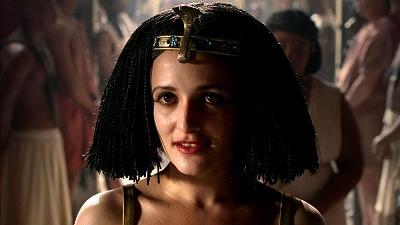
Next day they hold a fancy dinner at which Atia enjoys humiliating Servilia until Octavian rats out her plan to have the woman murdered to Antony and she has to cancel it. Cleopatra turns up in full Egyptian Queen garb - short black dreadlocks wig and all - and Antony makes it even more obvious that he would really, really like to have sex with her. Everyone eats in as aggressive a manner as possible and they all stare at each other even more intensely than the cast of I, Claudius during Claudius' opening this-is-who-everyone-is narration.

Timon, Atia's torturer, hitman and occasional lover, goes home, where it turns out he is Jewish and has a wife, children and a recently returned brother. This is part of a sub-plot that eventually had to be hastily concluded when the show was cancelled early and it doesn't really go anywhere, so I'll skim over it for the most part, though it does lead Timon to an interesting personal crisis later on.

Cleopatra tells Atia to kiss her because she's her friend for life and Atia hisses at her to die screaming, which is mildly amusing but not a terribly good idea politically.

There's yet another new Godfather in town - let's call him The Don - who is putting people in sacks with snakes and that sort of thing. An announcement goes out for a big meeting of the captains of the collegia where they are all to try not to kill each other for a few hours, as they will be under Lady Concord, meaning violence would be extra specially naughty. The Godfather turns up, freshly shaved, and they all settle down to meet and I swear, I half expect a helicopter to appear in the doorway and gun them all down. The Godfather announces that since he killed the previous godfather and he's BFFs with Mark Antony, he'll be taking over mob rule in the city. When a few object, he smashes up the statue of Concord, snaps that he's a son of Hades and f*cks Concord in her a*se, and draws his sword, ready to kill anyone who doesn't do what he says. It's a pretty effective strategy.

Atia is nagging Antony about Cleopatra and Octavian is nagging him about his money, which he needs so he can give the people the money Caesar promised them in his will, for starters. Octavian has hired a lawyer and Antony is forced to tell him outright that he's not giving him the money. (Amusingly, throughout all this, Octavia calmly eats lunch and makes polite requests for the fruit salad). Atia insists that they need Antony's protection and sneers at Octavian's suggestion that he can protect them (it's fun for TV writers to give characters lines they'll seriously come to regret later). Later, Octavian tells Octavia his plan to, essentially, take over the world, and she laughs at him (something else she'll regret later).

Octavian has the town crier announce that he will fulfil the terms of Caesar's will and give everyone money, the result of selling his own property and borrowing three million sesterces. Antony and Atia are very cross and Octavian explains that he's decided to enter public life and this is his way of doing it. He suggests that he and Antony make a public display of unity and makes a very sensible argument in favour of this plan, but the other two are distracted by the whole borrowing-three-million-sesterces business and a full on brawl ensues in which Antony nearly kills him (largely because Octavian hit Atia and called her a whore - it's sort of sweet, or it would be if Octavian wasn't Atia's son). Atia manages to stop Antony actually murdering her son, just about, but Octavian is distracted by the fact she's taken Antony's side and has to be comforted by Octavia.

Dodgey is a bit nervous about The Godfather's lack of respect for the gods, but sticks with him anyway. He hires a brothel supervisor with bad attitude called Gaia to work for them, thus putting one of this season's least satisfying storylines in motion. He also hires another old comrade from the Thirteenth called Mascius.

Servilia and Cicero are celebrating Antony's problems and Cicero dismisses Octavian, but Servilia points out Caesar chose him, and they probably shouldn't ignore him. Cicero persuades her that Brutus shouldn't come home yet, which upsets her.

Octavian leaves to stay with his friend Agrippa in Campania and prepare for his political career and we see him ride away, covered in bruises from Antony beating him. The camera pulls away to reveal, in a cartload of slaves on the same road, Niobe's sister and all The Godfather's children, still very much alive but thoroughly miserable. End of episode.

This is the last we see of Max Pirkis as Octavian, which is a great shame. Since Pirkis was still in his mid-teens at the time of filming and Octavian needed to age from nineteen (his age at Caesar's death) to, as it turned out, 33, over the course of season 2, the change is understandable, but it's still annoying, as Pirkis had done such a good job with the character. His portrayal of Octavian as a slightly weedy but hyper-intelligent and thoroughly ruthless young man is spot on and the audience can both understand why everyone underestimates him, and see how very wrong they are to do so. Simon Woods, who plays the older Octavian, takes his cue from Pirkis' performance and maintains his character interpretation pretty well, but for me, the character belongs to Pirkis.

Essentially, this episode is composed of set-up for season 2, following on from episode 1, which dealt with the fall-out from season 1. Antony and Cleopatra, Octavian's ambition, The Godfather becoming The Godfather and Dodgey's relationships with Eirene and Gaia are all moving into new stages. As such, there's not so much to say about this episode itself - it does its job nicely, but everything in it has to be understood as part of what is to come in later episodes. One thing I do like very much about season 2, though, is that I think we get slightly more of the actual history; or at least of historical characters, if not history itself, which takes a beating from several directions and for several different reasons as the series goes on.

All my Rome reviews are listed here

Wednesday, July 13, 2011

Rome by Jacob Philipp Hackert (1737-1807)

Innumerous artists painted several classical sites in Rome, namely Jacob Philipp Hackert (1737-1807).

Inúmeros artistas plásticos pintaram diversos locais clássicos de Roma, nomeadamente Jacob Philipp Hackert (1737-1807).
Jacob Philipp Hackert (1737-1807)-'fireworks over Castel Sant' Angelo in Rome'-gouache-1775 Hamburg-Kunsthalle

Jacob Philipp Hackert (1737-1807)-'St Pieter's seen from the Milvian Bridge'-oil on canvas-1777 Frankfurt am Main-Städel Museum

Jacob Philipp Hackert (1737-1807)-'view of Rome from the Ponte Molle'-drawing-ca 1800 in Hans Wahl, Anton Kippenberg; Göethe und seine Welt, Insel-Verlag, Leipzig (1932), S 115

Jacob Philipp Hackert (1737-1807)-'view of Villa Albani in Rome'-oil on canvas-1779 Dessau-Anhaltische Gemäldegalerie

Jacob Philipp Hackert (1737-1807)-'Rome viewed from the Baths of Caracalla'-watercolour-(1779-1780) Hamburg-Kunsthalle

Tuesday, June 14, 2011

Rome: Passover


Previously on Rome, Season 1: Death. Sadness. A total lack of Shakespearian dialogue.

As this episode opens, Mark Antony emerges from the Senate, fresh from Caesar's murder, looking shell-shocked. We know what a substantial proportion of the audience is expecting; a Shakespearian speech. No sign of that yet, though, as he's too busy fighting off assassins sent by Cassius. This is actually much more historically accurate than Shakespeare - in fact, the whole episode is much closer to some kind of amalgamation of the various accounts than most depictions of this particular event. This, I suspect, is because the long, drawn-out process that was Caesar's funeral and Antony's popular victory over Brutus is much better suited to a slowly building television episode than to a film or even a novel. (There is one major inaccuracy, which is Octavian's presence - he wasn't even in Italy at the time. But they make it work, story-wise, so I quite like it).

Brutus is having a Lady Macbeth moment, madly washing his face and shaking like a leaf. Everyone's feeling Shakespearian today. Servilia tells him he must be strong but the poor guy looks in need of a valium.

Posca weeps over Caesar's body and this moment is truly tragic - and is blended straight into a shot of the Godfather, still holding Niobe's body and weeping too. Then the pesky child who caused all the trouble by being born makes the mistake of showing his face and the Godfather attacks first him, then his daughter who actually hadn't done anything wrong at all (except lying). Unusually for a Roman father, he is actually angry because his daughter didn't have sex outside marriage. Luckily Niobe's sister reappears from nowhere to comfort the daughter as the Godfather storms off, cursing them all. As he wanders off he hears all the cries of 'Caesar is dead!' in the streets, at which point he realises he's really f*cked up this afternoon.

Atia is actually crying and being comforted by her old slave woman, though whether she's upset or panicked is hard to say. Octavian sensibly points out to Octavia that the fact it's partly their fault should not be mentioned. Atia has called Timon to get them out of the city. Octavian suggests waiting to see what Antony does but Atia is convinced he must be dead because he hasn't come to get her. Atia orders the slaves to fetch the money and household gods (yay for random bits of historical accuracy and a sort of allusion to the Aeneid!) at which point, much to Timon's irritation, Antony actually does turn up and immediately strips (he does have blood on him, to be fair).

Antony thinks the Godfather was paid off, but Atia somehow knows what really happened. She then proceeds to rip into Antony for not taking on half the Senate with his bare hands. Antony's plan is to raise an army in the north, which Atia objects to because it's 'ghastly'.

The Godfather has a strange encounter with a weird old soothsayer who nuts him on the head, presumably to rob him. Dodgey, meanwhile, blissfully unaware of what's going on, is busy proposing to Eirene, who accepts, apparently on the strength of his promise to buy her lots of shoes.

Antony and his gang go to get Calpurnia, because it'll look bad if they run off promising to avenge Caesar and leave his wife behind. She is watching a wet nurse squeeze milk into Caesar's dead mouth, and I'm sure some researcher got this from some obscure ancient source but seriously, did anyone really do that? What if there weren't any handy lactating women around? Hmm. Calpurnia is puzzled as to why no one has come to pay their respects to Caesar, which suggests either she's lost it through grief or she was bizarrely clueless in the first place. She refuses to budge and insists that they must read Caesar's will (Hayden Gwynne is excellent here by the way).

Posca reads the will and it reveals that Caesar has adopted Octavian and left him everything, except Posca himself, who has been freed. Mark Antony is Not Impressed (to such an extent that this requires Capital Letters). He takes up a defeatist attitude and declares that none of it will count because Brutus, Cassius and the rest will take it all, but Octavian points out that the name 'Caesar' is still his, no matter what happens. This prompts him finally to take charge as head of the family and put his foot down, insisiting they stay where they are and giving Antony, who wants to eat Brutus et al's livers (with fava beans and a nice Chianti?), detailed instructions on how to keep them all alive. In the end, as Posca and Antony argue, it's Atia who has the final say, swayed by the idea of lots of money and this greatest of victories over Servilia. They stay.

Ian McNeice, the town crier, unsug hero of the series, I think. Fabulous use of traditional rhetorical gestures.

News of Caesar's death finally reaches Dodgey and Eirene and they ride for Rome. The Godfather wakes up in a puddle with a head wound while Niobe's sister (Esther Hall, best known these days for those annoying BT ads, putting in a great performance of silent weeping while she tries to comfort the daughter and dresses Niobe's body) and the kids get a visit from the local mob.

Cicero enthusiastically congratulates the conspirators and tells them how disappointed he is that they didn't include him (as he really did in his letters). He assumes they've killed Mark Antony and points out what a bad idea it is to leave him alive, to which Brutus sulkily tells him to kill him himself. Cicero, a man who knows which side his bread is buttered, immediately tries to run away - unfortuantely, right into Antony, who's just walked in.

Dodgey finds the Godfather, who has made it back to his house and gone catatonic. He tells Dodgey he was going to kill Niobe before she did it herself (I still don't think he would have). Now, while he was in a funk and after he cursed them, all the children and the sister have disappeared. Kevin McKidd's performance is wonderfully jittery, and for once Dodgey is the sanest person on the scene, which is worrying in itself.

Cicero straight away gets Brutus to confirm to Antony that he wasn't involved in the assassination (goodness that man is a weasel!). Antony points out that killing Caesar does not appear to have been a popular move (he says many people 'will worship Caesar until they die' which is a rather nice line considering Caesar's later deification). He further points out that if all Caesar's actions are nullified, none of them hold their positions any more (as Octavian had pointed out to him earlier). He tells them he wants peace and stability and James Purefoy finds a wonderful way to enable the audience to hear the fact that Antony's lying, knowing Octavian has put him up to this, but sounding convincing enough to swing Brutus and Cassius. He pretends he wants to retire and persuades them to organise Caesar's funeral jointly with him, so they don't have to fight and kill each other.

Cassius, Servilia and Cicero (in his roundabout way), try to persuade Brutus to kill Antony, but Brutus, unaware that Octavian is pulling the strings, doesn't see brutish Antony as a threat. They hug and Antony gives him a kiss that's Judas Iscariot and Micheal Corleone all rolled into one. It's a wonderfully tense scene and for a moment you wonder if, against all historical record, Brutus really is going to kill Antony. Purefoy's expression as he walks away speaks volumes and you really feel the idiocy of Brutus, thinking this man is not a threat. Antony does stop to murder Pompey's illegitimate son on the way out, to make himself feel better.

Dodgey cleans the Godfather up and it finally occurs to him maybe he shouldn't have cursed his own children. Dodgey tries to reassure him that they'll come back, blissfully unaware they've been taken and sold into slavery by the mob.

Caesar's funeral, complete with eulogies by Brutus and Mark Antony, is announced for the next day. Servilia comes to pay her respects to Caesar and Calpurnia spits on her (yay!). Then she spits on her again (yay again!). Then she lets her past (boo!).

Octavian fills Dodgey in on the whole sorry saga, which unfortunately involves admitting to the fact the whole business with Niobe and the Godfather was his fault. Since he's quite powerful, Dodgey forgives him and offers to help him avenge Caesar. The Godfather, meanwhile, is rocking.

Next morning, Antony is feeling confident and his threat to have sex with Atia's old nurse is really quite amusing (especially Atia's response, that she'd eat him alive). This is a really heavy episode, and the moment of lightness, in anticipation of what much of the audience knows is indeed going to be a pretty successful day for him, is very welcome. Also, Atia's funeral dress really suits her, but that's neither here nor there.

The Godfather is still rocking and wants to wait for the children before having Niobe's funeral, which is not a good idea in a relatively hot country. Luckily he has Dodgey, and it's really nice to see Dodgey looking after him for a change, rather than vice versa.

 Solemn Funeral Face

Funerals happen and everyone looks appropriately solemn (except Dodgey, who's... drinking). Then doors are opened to the crowd, and it's finally time for some speeches - this is where, historically, the famous 'Friends, Romans, Countrymen!' speech comes in and much of the audience knows it and is waiting for it.

Except we don't get to hear it.

In a sense, I can see why the writers didn't want to include the actual speech - who wants to take on Shakespeare?! But to be honest, I can't help feeling they've chickened out a bit. Antony goads Brutus with what a successful speech he's made and insists Brutus must leave the city, but it's hard to enjoy his success when we haven't heard a word of the speech. (Servilia refuses to leave and Antony is fine with that because he wants to crow over her in person). The speech must have been quite something because Cassius is hugging himself as he's been kicked in the stomach and he's taken over rocking from the Godfather, but still - without hearing it, we're not feeling it.

Dodgey and the Godfather come home to find a neighbour looting the place ('only for things I lent!') who tells them that the mob have taken the children. The Other Godfather is in the pub, where one of his friends is describing Brutus and Antony's speeches, including the display of Caesar's bloody toga and everything. This would have been so much more impressive if we'd actually seen Antony do it, rather than hearing the badly-accented mob minion's drunken version. The Other Godfather did not enjoy the speeches and insists on 'observing the decencies' and we're all waiting for him to explain the importance of 'respect', but he doesn't.

His irritation doesn't last long, as Dodgey and the Godfather show up and murder them all. The Godfather looks like a demon from Hades, all covered in blood with mad eyes, and he responds as one might expect to The Other Godfather's calm assertion that he raped and murdered the children. The episode ends as he carries The Other Godfather's head towards the river to dispose of it.

Well, that was a cheerful hour! Thank goodness for Antony's voracious sexual appetite, it was the only smile in it - as was to be expected, but that doesn't make it light viewing, nonetheless. This is a very good episode, really tight, effective, well paced, maintaining an extraordinary level of tension, with stunning performances all round. Just don't watch it in a bad mood, it'll only make it worse.

The title of the episode is very interesting - 'Passover' means freedom from slavery to Jews (suggesting a certain sympathy with Caesar's killers?), the sacrifice of one to save many to Christians (the sacrifice of Caesar which will eventually be to the benefit of Octavian and, through the Pax Augusta, all of Rome?) but I think the most relevant connotation of the word is the notion of sparing the first-born son. By passing over Antony and Octavian, now Caesar's son, the conspirators have signed their own death warrents.  

Mmm, James Purefoy.

I still think some part of Antony's speech should have been shown (personally, I would have shown visuals of the crowd lapping up the speech and Antony displaying Caesar's bloody toga while playing the score loudly over the top so we couldn't hear the words). Without any kind of visual, it's hard to really appreciate its impact, and if you looked away from the screen for a few moments, you'd wonder what on earth put Antony ahead of Brutus. On the other hand, the seeds of Antony and Octavian's eventual split are very effectively shown with a few words and a few more facial expressions, and among the excellent performances, Max Pirkis' ever calm, calculating Octavian stands out, a man who knows exactly what he's been given the minute he hears Posca read Caesar's will...

Tuesday, May 31, 2011

Rome: Kalends of February


I was wrong in my last review; it turns out that, somewhat counter-intuitively, this actually is the episode in which Julius Caesar gets murderlised. There is a reason for this - it's on the Kalends of February that, in the Rome version of events, Caesar announces he will be creating a hundred new senators, which proves to be the final straw for the conspirators and, indirectly, the downfall of Niobe. In real life, Caesar would have filled the vacant seats in the Senate (caused by all those messy civil wars) much earlier than a month before he died, but we probably shouldn't let that bother us.

As the episode opens, Dodgey Soldier and The Godfather (formerly known as Boring Soldier) have become minor celebrities, thanks to their dramatic exit from the arena last week. Dodgey is still recovering from his wounds, but The Godfather is busy having it away with his wife in front of an audience as part of a truly peculiar ritual on their new land while she expresses surprise that Caesar (who has just given them the land, hence the ritual) might be a bit put out that The Godfather took it upon himself to rescue a condemned criminal.

Pullo makes a bid for freedom from the 'hospital' (I'm pretty sure the Romans didn't have those) and is brought back to The Godfather's house to make even more of a nuisance of himself. Niobe catches Eirene holding a knife to this throat and points out this would not end well for Eirene herself, who would definitely be the prime suspect if Dodgey were to be found murdered. She then orders Eirene to look after Dodgey, possibly as some kind of punishment? It doesn't make much sense. Eirene spits in Dodgey's food. Good for her.

Caesar has decreed that a hundred new senators will be created and tells The Godfather that he will be one of them. Caesar did fill vacant seats with his own supporters, including centurions and men who'd fought for him, but as I said, I suspect he did it a lot earlier than a month before his death. The reason for the placement of The Godfather's promotion here, of course, is to tie his and Niobe's story to Caesar's for the finale. The Godfather is Caesar's most feared bodyguard, thanks to his antics in the arena, so the conspirators have to get him out of the way, so they spill the beans about Niobe's affair to him just as they're murdering Caesar. It's an ingenious way of tying the stories together (even if it is a bit reminiscent of Carry of Cleo in the set-up) and works rather well, and according to Cassius Dio Caesar did have a bodyguard of knights and senators. The only minor problem with this is that it does mean one of the more fascinating aspects of Caesar's personality and behaviour towards the end, his supposedly casual attitude towards the possibility of his own assassination, has to be left out, which is a shame.

We are reminded of Caesar's close relationship with both Antony and his slave/freedman (never have quite worked out which he is) Posca which will make the scenes of Posca trying to save Caesar and Antony finding his body that much more poignant. I particularly like Caesar and Antony's exchange, in which Antony wants to know why Caesar trusts him. Caesar tells him 'If you were going to betray me, you'd have done it long ago' and Antony replies 'Don't think I wasn't tempted,' which is a nice reminder of how ruthless they all are while also, strangely, reinforcing Antony and Caesar's mutual loyalty.

I'm delighted to see Calpurnia's ominous dream get reasonably full treatment - we don't see the dream itself, but her concern and Caesar's dismissal of it as just a dream feel both sweet and true. Brutus and Servilia, meanwhile, are attempting to gain the favour of some god or other for their assassination attempt, in a slightly odd scene that seems intended to be generally portentous.

Dodgey goes out to get a prostitute/floozy/one-night-stand but sends her away when Eirene spots them heading into the house together. Miraculously, from this point on, Eirene softens towards him. Yes, girls, when a man has brutally murdered your lover, all he has to do is refrain from sleeping with a prostitute in front of you and you will find yourself suddenly drawn to him, so eventually all will be forgiven. (Please note all readers of any gender: This Is Sarcasm).

The conspirators and Cicero stand symbolically high up and sneer at the new senators, while Caesar waves at them, looking like he knows something's up. Later on, they discuss the knotty problem of getting The Godfather out of the way for the main event without killing him and therefore making themselves unpopular. Brutus insists on the importance of killing Caesar on the Senate floor because this somehow makes it honourable and not murder, which is especially ironic given that Caesar wasn't killed on the Senate floor, the Senate were meeting in the Theatre of Pompey that day and he was killed there (underneath the statue of Pompey, as depicted in Shakespeare's version).

Niobe and The Godfather have a sweet bedroom scene together because Niobe is Doomed and this is Poignant and Tender. Servilia sleeps alone because all her lovers realised what a psycho she is and left her. She suddenly remembers that she knows all the gossip about The Godfather because Octavia told her, having heard it from Octavian during their secret-swapping, and that this may prove useful in getting him out of the way. She then invites Atia and the kids over for Murder Day, while Dodgey tells Eirene he's going out to a shrine to ask for forgiveness and asks her to come with him. Eirene does, because she's clearly insane.

The town crier (who, by the way, uses the most fantastic gestures which I assume come from Quintilian's description of the gestures used in legal speeches) informs us that the Senate is in session and the plinky-plonky Music of Doom informs us that Sh*t is About to Go Down. Some old woman claiming to be working for Atia comes up to The Godfather and tells him the truth about Niobe's baby and he runs off in a fury, leaving Caesar to the knives. Mark Antony is also dragged off and Posca can't go into the Senate anyway.

Caesar's murder finally gets under way, starting with a remarkably undignified scuffle but carrying on in suitably bloody fashion while Brutus watches with his mouth gaping open like a fish. Finally, Cassius shoves a knife into Brutus' hand and forces him to put the last cut into a dying Caesar. Caesar, having received multiple wounds to the lungs, says nothing, though he does give Brutus a rather heartbreakingly sad look. He then pulls his toga over his head, which is both historically accurate and genuinely sad.

I can see why the writers decided to leave That Line out. Saying it in Latin would sound daft because very little Latin is used in this series. Saying it in English means having to choose between Shakespeare's 'Brutus' or Suetonius' teknon, which could be translated as 'child', 'boy' or 'son', words which all have different connotations in English. Not all ancient sources attribute any last words to Caesar at all so it's perfectly acceptable to assume he said nothing (especially given all the stab wounds in the chest area). The scene is also rather effectively played so that you can almost hear Caesar saying The Words as he stares at Brutus, even though he doesn't actually say them. I have to confess, though, that if it were me, I would have had him say 'And you?' (leaving out the vocative 'Brute?'). Those words are just so expected, thanks to Shakespeare, that it's almost disappointing not to hear them, or some of version of them.

We interrupt this assassination fallout to return to Niobe and The Godfather. He rants and rages and waves a knife at her. She tells him she thought he was dead and promptly throws herself off the balcony. Since Niobe was one of my favourite characters, this is rather upsetting, but story-wise it works. We suspect The Godfather would never actually have stabbed her, but he had the legal right to do so and presumably she was also motivated by guilt and worry about their future. The first time I saw it, I was torn between feeling that this was a suitably tragic and dramatic end to this particular plot, and worrying that I wasn't remotely interested in The Godfather (formerly known as Boring) without Niobe.

Cassius gloats over Caesar's body and Brutus continues to look like someone just ran over his puppy, as if he can't quite believe what he's done. Mark Antony makes it in to the historically inaccurate scene of the crime, sees the body, and backs away, looking angry, sad and probably a little bit nervous as well, though none of them go after him.

Servilia explains all this to Atia as if it were her personal triumph over Atia and nothing to do with dictators or politics at all (perhaps she's right). She also informs Atia that she's going to make her suffer, presumably blissfully unaware that Caesar adopted Octavian in his will and she will, therefore, come to regret this bit of crowing quite a lot. Octavian is certainly not impressed with this turn of events.

We see The Godfather cradling Niobe's body and looking at the unfortunate toddler like he doesn't know what to do with him, which he probably doesn't (the child actor here looks impressively like Niobe).

And after all that fantastic drama, what do we finish on? Dodgey and Eirene walking away from a roadside shrine, hand in hand. I suppose it's nice to end on a more peaceful image, one that's about forgiveness and love rather than death and destruction, but it's a bit frustrating after such a fantastic climax to end on the one note that, for me, really doesn't ring true.

This is a great season finale, which ties up Niobe and The Godfather's story nicely while leaving the historical story on a note that certainly represents an ending, but also creates something of a cliffhanger, as Mark Antony walks away into Shakespearian fame. The double climax of Niobe and Caesar's deaths is very effective and the decision to deal with Caesar first and Niobe second works as well - the audience know what happens to Caesar, so his death is dramatically satisfying but without the thrill of the unexpected, ensuring that Niobe's quieter death has maximum impact, as the audience have no idea what it going to happen to her, so her story keeps their attention even after the big events at the (inaccurate) Senate have taken place. The acting all round is great and of course it's a necessary shame to see Ciaran Hinds' Caesar go, he was brilliant in the role. James Purefoy as Mark Antony is probably the most impressive, in his combination of calm, anger and distress conveyed entirely through a facial expression, but Hinds' dying moments are also tragically beautiful. For me, the only shame is that Dodgey and Eirene's story, which I find peculiar and totally implausible, has to intrude on an otherwise excellent finale, but on the upside it does give us a prettier image to go out on, ready for more blood and guts in season two.

Saturday, May 14, 2011

Rome: The Spoils


So, when we last left Rome, before Spartacus: Gods of the Arena started, Dodgey had just demonstrated why he's called Dodgey, Boring was being boring, Caesar had Triumphed and Atia was trying to persuade Octavia she's not a psycho, with limited success. This episode opens with Dodgey murdering someone, so presumably he's now a hit-man on top of everything else. Boring, however, is now a magistrate and has started to meet his clients as patron, which involves sitting in a chair, throne-like, surrounded by his family. Quite why his entire family want to watch all the proceedings I'm not sure, but he's pulling off the big man in town thing rather well (being mean to former friends etc) so I think the time is right to re-christen him The Godfather.

The Godfather (formerly known as Boring) insists that Pullo is 'dead to him' and tries to persuade his old friend that he can't help Caesar's disgruntled veterans. Dodgey is not doing so well, getting robbed by prostitutes and turning down tasty mouse for lunch.

Caesar invites The Godfather and Niobe to one of Atia's dinner parties (he calls it a symposium, but those were men-only-except-dancers-and-prostitutes Greek dinner parties, so he's being misleading there). Caesar also has himself declared Dictator for Life and has the fifth month named after himself, which causes Cassius to look like he's swallowed something sour. Brutus, meanwhile, is just mildly amused at a bunch of graffitti showing him stabbing Caesar, to emulate his ancestor who killed the last king. Brutus notes that the plebs like to see the rich fight because 'it's cheaper than the theatre and the blood is real' and I can't help thinking he probably has a point there.

It's time for Cassius and Brutus to start having Shakespearian conversations about Caesar, death of, the future of the Republic, etc. but they stay impressively far away from actual Shakespearian dialogue for the moment (it's just so tempting for writers, when such juicy dialogue is right there ready to use).

Dodgey is getting really sloppy and I can't help thinking maybe he's attempting the Roman version of suicide by cop. He's going soft, letting old ladies live and hallucinating them afterwards. The Godfather has managed to get something for Caesar's veterans and for his old friend but the bit of land in question does not please, so the old friend continues to whinge and I kind of wish we could set Dodgey on him. Although I've seen the series before so I know what happens, I can't help thinking that maybe this should be Dodgey's purpose from now on - he can just be unleashed on anyone who's excessively annoying.

Mark Antony enlists Octavia to help him get back in Atia's good graces, which is interesting considering the two of them (him and Octavia, that is) will end up married with a daughter someday. Niobe is terribly nervous which is rather sweet, while the others talk about her in the way that the characters in Gosford Park talk about the girl with only one evening dress. Octavian approaches The Godfather to ask him to help Dodgey, who's on death row for murder, having murdered one of Caesar's enemies (so Caesar can't help because he doesn't want the blame). Caear absolutely forbids them to help him, so of course they will.

Atia and Mark Antony have make-up sex and even they come across as quite sweet fo once. Poor Niobe is less happy, having overheard the comments about her dress. Octavian sends Timon to find a lawyer for Dodgey and quite frankly I'm amazed that Timon is still alive, I'd have thought he'd be a goner ages ago. Having a lawyer does Dodgey no good, of course, because he's guilty as sin, though it's quite fun seeing the court case. I especially liked seeing an open air court case, as many of them were in ancient Rome (on Roman law-courts in general, see Caroline Lawrence's excellent summary here). And it isn't a proper Roman drama without a court case, though name-checking Cicero and then doing a court case he's not in is just a tease (even I, with my all-consuming hatred of Cicero, would be intrigued by seeing him in action in the courts, though probably no actor could live up to his reputation). The Godfather turns up so that his old friend can whinge at him again and explain his plan to save Dodgey, which The Godfather has to talk him out of. Dodgey is condemned to death in the arena, to no one's surprise.

Caesar and Brutus have slightly double-edged dialogue about fathers and sons (still umming and aahing around the possibility of Caesar being Brutus' father) and Caesar asks Brutus to deal with a problem he has in Macedonia, which Brutus refuses because it's hard to stab someone in the back from a distance of several hundred miles. Caesar admits he doesn't entirely trust Brutus, which Brutus has the cheek to be annoyed about. Caesar points out he can order Brutus to go and Brutus just gets crosser until eventually he gets so cross that he resorts to sarcasm.

Dodgey prays for Eirene and The Godfather to Janus, Gaia and Dis, which actually kind of makes sense for someone who's about to die (Janus, god of doorways, of ends and beginnings, Gaia is earth, in which the dead are buried, and Dis is the underworld). He's then sent into an arena which is much, much smaller and less impressive than anything seen on Spartacus: Blood and Sand or Gods of the Arena. This is probably reasonably accurate, since Rome had no permanent arenas at this time, though I would have thought the capital city would have had a slightly bigger and more impressive temporary arena, all the same.

Dodgey is no Spartacus, or Maximus; he just sits on the ground and tells the other gladiators to kill him, no matter how much they taunt him. This is all very dull for the audience and is wasn't planning suicide-by-lawyer before, he is now. That is, until the gladiators insult the Thirteenth Legion as a whole. That gets him going, and he's up and chopping. I have a feeling this scene looked more impressive the first time I saw it, before Spartacus: Blood and Sand - now it can't help but look kind of tame by comparison.

I do fondly remember the next bit though, one of the highlights of the series. Dodgey gets attacked by a steady stream of gladiators while The Godfather watches, Dodgey killing them all, yelling 'Thirteen!' all the while. Eventually a big gladiator with an evil-looking mace (literally, it's got an evil spiky head on it) comes out and stands over Dodgey, who's a bit tired out by now, ready to finish him off - and suddenly, The Godfather runs right on in, also shouting 'Thirteen!' and takes on evil-mace guy (and there is a fairly gory leg-chopping shot in there as well, plus a prolonged death). Evil-mace guy finished, he helps Dodgey up and they just walk out of the arena. It's all very touching and bromance-y and you feel so uplifted by the whole pride-brotherly-love-friend-saving thing that you forget that a) assuming you're in a culture with a death penalty, Dodgey fully deserves his several times over and b) Dodgey is a condemned criminal, it doesn't matter how many 'house' gladiators you kill off, or how many friends help you - you still have to die, unless the emperor himself happens to be around to save you, and they don't have an emperor yet. You can't just walk out and decide you've now paid your debt to society.

It is revealed to the audience that it really was Caesar, through his chief slave and a thug, who ordered the murder Dodgey was sent down for, and we cut straight from this into Brutus telling Servilia he'll get together a murder plot with Cassius. He's quite upset about it, but clearly he really doesn't like Macedonia (and who could blame him, considering what's in store for him there - maybe he's psychic). End of episode (which felt shorter than usual - I must have been watching longer things lately).

This is a nice little episode, made up mostly of quiet moments and then building to a rousing finish and nicely dramatic climax - Dodgey and The Godfather finally become truly sympathetic, interesting characters and we're really getting to the meat of the political story now, to the bit you can't help eagerly anticipating from the moment Caesar appears on screen. There's still a fair amount of plotting to come first though, and the next episode ensures we don't get too excited too quickly by calling itself 'The Kalends of February' - it's not all over just yet.

Monday, March 21, 2011

Rome: Triumph


Near the beginning of this episode, Caesar declares that the war is over, and much of the episode deals with the fallout from that ending - the biggest problems being that several characters consider the war to be far from over, and those that do can't cope without it.

Brutus and Cicero endorse a Triumph for Caesar, while privately bemoaning their failure to die nobly like Cato and Scipio. Caesar demonstrates his awareness of how many of them want him dead - one of the most intersting facets of the historical Caesar's character and a nice element to bring in here (along with his warning that 'Rome' will not forgive them a second time - one of the those TV prophecies that are carefully designed to come true). The music is clearly of Brutus and Cicero's opinion, as you'd think we were watching Commodus kill Marcus Aurelius, judging from the sombre tone.

Servilia was obviously really badly hurt (I'm not even going to contemplate how) by Atia's thugs at the end of the previous episode, as she's currently unable to walk and her head is all wrapped up. Atia pops over to pretend to be concerned. Atia lies about Octavia's whereabouts because Octavia has run off to indulge in self-harming, so Octavian goes to get her. She appears to have joined the cult of the Great Mother. Octavian complains that the priests don't really care about her, they just want her money, which makes me smile, as there is some implication (arguably) towards the end of Apuleius' Golden Ass that priests of the cult of Isis behaved in this way. Octavian himself appears torn between admitting he misses her, despite the uncomfortableness associated with this due to their previous encounter, and forcing her to return to protect their family's good name. The cult of the Great Mother was a mystery cult which we know little about - this version looks a little too Far Eastern to me (the cult was Eastern, but not Far Eastern) but really, writers and directors have quite a lot of freedom with cults that were as secretive as this one.

Boring Soldier is campaigning (in an effort to become even more boring?!). Caesar dredges up an unfortunate Gaulish leader who was apparently 'King of all the Gauls' (did all the Gauls have a single king? This isn't my area, but somehow I doubt it). Dodgey Soldier gets into a sulk because he's left the army and therefore can't march in the Triumphal procession, which surely he ought to know already, and there's no point whinging about it even if he didn't. Mark Antony finds 'dressing up and playing at being a god' silly, which is puzzling given his later prediliction for doing exactly that.

Octavia is giving Atia the silent treatment while Atia actually shows a glimmer of genuine motherly concern over the wounds on her arms. Only a glimmer, though. An (unhistorical) illegitimate son of Pompey's turns up outside Servilia's house, screaming about how much he hates Caesar, so of course she takes him in even though he seems to be a sandwich short of a picnic.

The Triumph starts with Octavian performing his priestly duties, painting Caesar's face red before the procession (apparently Mary Beard has expressed scpetical views about this tradition, but there's no way a TV programme is going to miss that opportunity!). The Gaulish 'king' is executed in front of the crowd.

As the mess is cleared away, the town crier reads out a series of crowd-pleasing announcements (complete with actions - are these the oratorical hand movements Flaccus tries, with unfortunate results, to replicate in The Slave-Girl from Jerusalem?). Boring is shocked to discover that the election he is standing in is rigged because apparently he lives on a different planet from everyone else. This distracts him from Dodgey's plan to free and marry Eirene - a plan which would be all well and good if he'd bothered to actually check whether Eirene wanted to marry him first (he hasn't quite grasped the concept of 'free', it would seem). Dodgey wants to go and settle down in the country, so Boring helps him out.

Cicero has got hold of a copy of a document called 'A Call to Virtue', purportedly written by Brutus and calling for a rise against Caesar. It has been put together by Servilia and Cassius as a way of forcing Brutus to act. Cassius looks wonderfully slimy, cast in the traditional Shakespearian mold of a Cassius who is determined to do for Caesar and drags along a reluctant and conflicted Brutus. I wonder if the writers have read Thornton Wilder's The Ides of March, which introduced the idea of circulated letters in connection with the conspiracy against Caesar, since as far as I remember it's not historical. Servilia guilts him into joining their cause.

Now we come to the scene which finally made OldHousemate(theRomeone) and I not only stop caring about Dodgey, but hope that really really bad things happened to him really soon. He frees Eirene, but when he finds out that she wants to marry someone else, he goes mad and kills the poor boy (who is not his slave and therefore this is a crime against Boring, as he's damaged his property). He uses Paris Hilton from Spartacus' particularly violent method of spontaneous murder, smashing the guy's face in, which confirms the influence of Rome on Spartacus. Boring quite sensibly points out that if you free someone you can't expect them to just fall for you and the whole thing is especially daft given that, pre-murder, Eirene was obviously reasonably fond of Dodgey, begging him not to sell her to someone else, so if he'd been patient and nicer he might have had a chance anyway. Dodgey complains about his hard life, which Boring quite correctly feels is no excuse for bashing people's heads in, and Boring kicks him out (and, hopefully, is going to care for Eirene, currently beong comforted by Niobe - otherwise she's now out of a job with no one to support her).

I'm afraid I really can't understand what the makers were thinking here. Why on earth should I take an interest in such an abhorrent character, other than to see him swiftly punished, preferably in a very nasty way? This is where Spartacus has the edge. There's no suggestion there that we should sympathise with Paris Hilton or any of the other similarly badly behaved characters. We watch in anticipation of their eventual dowanfall - they are the villains. Dodgey is supposed to be one of the protagonists. Though in fairness, I should say that I have no interest in works where the protagonist/antagonist is a dislikeable character, like American Psycho or even Vanity Fair, so this is really an issue of personal taste.

Dodgey is very sorry. Cuts no ice with me, I'm afraid.

Atia tries to be motherly to Octavia, and some friend of the Gaul retrieves his body and gives him a proper Gaulish funeral. Dodgey gets an offer of employment from a shifty geezer, and I couldn't care less what happens to him.

An odd episode, loosely structured around Caesar's Triumph but mostly advancing disparate plot threads in various ways. The most successful parts of the episode are those which foreshadow Caesar's death, particularly his words near the opening and Cassius' knowing smile. If the episode has an overall theme, it must be the misery of war and the futility of military triumph, as Dodgey becomes a murderer (despite his protestations to the contrary) and the Gaul has his honour returned to him after his humiliating death. Essentially, everyone seems a bit lost without a war to fight. This cannot be healthy and you just know it will all end in tears.

Saturday, February 12, 2011

Rome: Utica


Bit of a memorable episode of Rome, this, and unfortunately, not really for the right reasons, though you can say this for it - there's plenty of drama here.

We open on a dramatic desert scene with a dying elephant (and, being British and therefore animal-mad, I am of course more distressed by the injured elephant than by all the human carnage around it!). Cato has lost a battle and is feeling very depressed. He makes it to the town of Utica, where Scipio tries to persuade him that 'where there's life, there's hope' to no avail. Cato clearly has some kind of prescient knowledge of Captain Oates, because his last words are,
'If you'll excuse me, I need to urinate. There's a piss-pot through there, I believe.'
And he kills himself. Not quite as dignified as 'I'm going outside, I may be some time,' but the same essential sentiment, I think. Scipio kills himself too.

Caesar has returned to Rome and Boring Soldier and Dodgey Soldier are once more planning to leave the army. Boring returns home and he and his family actually seem happy and prosperous for once - that'll never last. This is also the start of the storyline that originally had my housemate and I change Pullo's name from Interesting Soldier to Dodgey Soldier, as we see that he is still particularly keen on Eirene, to whom he's actually very sweet at this point. Octavian has also returned to Rome - for some reason we are re-introduced to him while he wees against an aqueduct. Did the writer of this episode complete the whole thing while desperate for the toilet, or something?! I mean, we've all gone behind a bush from time to time when necessary, but I don't see why we need to see it.

By the way, we've now reached 46 BC, having started in 54 BC, eight years previously. And yet, miraculously, neither Octavian nor Boring Soldier's children have aged a day. To be fair, they have made some effort to age Octavian a little, through dialogue, general confidence and possibly some face fluff (and the later re-casting was not a good idea). And I don't think we met Niobe and the children until 49 BC, so her love child, who looks about 3 now, is about the right age. Still, we will keep an eye on them, as, if I recall correctly, this will be a recurring issue.

Brutus and Servilia are going to dinner at Atia's, at which Caesar will also be present, much against Brutus' wishes, who knows this cannot be a good idea. Servilia insists her problem with Caesar is purely political, and is a bad liar. At dinner, Octavia wears a rather nice dress while Octavian explains how he would put the world to rights if he were Caesar. This is rather brilliant, as, of course, he explains exactly what he will later do after he's finally defeated Mark Antony and his ideas impress Caesar, presumably leading to Caesar's adoption of him in his will (though his declaration that he would rather focus on his poetry is quite amusing).

Boring discovers a thug about to cut someone's nose off in the street and ever-so-nobly intervenes, which is of course a very bad idea among proto-Mafia-run society (though it is also the beginning of his eventual metamorphosis from Boring into The Godfather. When we get to season 2, I may consider re-naming him).

Octavia tells Servilia that Atia thinks Caesar and Octavian are lovers, but Octavian insists the incident related to a 'terrible affliction.' This is where Rome's determination to present viewers with as much sex as possible and make said sex as dubious as possible takes a turn into the Land of the Utterly Ridiculous. Servilia wants to know what the 'afflication' is, hoping it will give her a weapon against Caesar, so she dispatches Octavia to discover it from Octavian, whose idea of a good time currently consists of reading from Catullus' love poetry. Octavia pesters him about 'terrible secrets' but can't get what she wants. So, eventually, Servilia persuades Octavia to resort to desperate measures and seduce Octavian, to get him to tell her what she wants (which isn't even an especially vital piece of information).

This is just utterly ridiculous. Incest was as much a taboo in Rome as it is now (which, to be fair, Octavian points out). Cleopatra was married to her brother because they were Pharoahs, but Claudius was criticised for marrying his niece - sisters are right out for Romans. Caligula and Commodus were accused of incest with their sisters, and Nero with his mother, because the historians writing about them didn't like them and wanted to paint them as psychotic lunatics. And we are supposed to believe this of Octavian, a man who will eventually consolidate his power partly through a 'back to basics' style insistence on returning to 'old-fashioned morals' and who will banish his daughter and grand-daughter for sexual promiscuity. This does not necessarily imply that he followed such a strict moral code himself - Suetonius suggests quite the opposite - but I really think incest with his sister is going too far. Also, ick.

It doesn't work anyway, because Octavian is ten times more intelligent than anyone around him and is well aware of what Octavia's up to (though clueless as to Servilia's involvement). On an extra random pedantic note, Octavian also insists he doesn't have anything 'comical' to read, in which case his collection of Catullus' poetry is seriously lacking.

While all this is going on, we also get treated to a stark naked Dodgey (he's looking good, been working out) and the proto-Mafia have caught up with Boring. He sends the children away to the country to protect them, but his backside is, once again, saved by Caesar who, once again, Boring insists on insulting and refusing his offer of a political position (when will he learn?! If he was Thomas More, his head would be on the block for refusing to bow to Caesar's power). Luckily Caesar talks him into it (and his wife and slaves, about to be killed with him, breathe a collective sigh of relief!).

Atia finds out that her children have been engaging in extremely dodgey activities and attacks both of them with a whip - but Servilia has told Octavia that Atia had Glabius killed so they're pretty much all even on the naughtiness front. Thanks to Servilia's blatent manipulation and Octavia's sense of guilt, Atia actually suceeds, again, in convincing Octavia that she really didn't do it.

Dodgey gets drunk and starts yelling for Eirene, who apparently reminds him of his mother (Freud would have a field day). His mother was a slave, he says, which begs the question of why he's not and how come he's in the army (the children of slaves were born slaves, owned by their mother's owner). Then he makes Eirene take off her dress so he can touch her up and, since she's a slave, she has no choice but to obey. This is all very Roman, but at this point, Old Housemate and I sat, mouths open, staring in disbelief at the television - this is one of our heroes? One of the characters we're supposed to care about and take an interest in? Roman or not, I have absolutely no interest in following or caring about a sexual molestor of women or a rapist (which, if we had listened properly to the earlier dialogue, we would already have known he was). We re-christened him 'Dodgey' then and there, not even thinking that his behaviour was going to get even worse...

The episode ends with Atia's men physically attacking Servilia in the street. This last part of the episode seems rather determined to make the audience dislike or disapprove of just about every character except Boring and Niobe - though it has the benefit of making Boring look really good, and from this point on, I preferred him to Dodgey by quite some distance.

This episode isn't quite as successful as 'Caesarion', being a bit less focussed and including some truly ridiculous plot developments. It's also worth noting how often I used the words 'again' or 'once more' in this re-cap - an awful lot of this episode is repeating old threads. However, having said that, it's pretty good. There's a real menace to Boring's encounter with the proto-Mafia and it's wonderful to see Octavian back again. It's just a shame that the attempt to make the plot even darker involves de-railing the characters of Octavia, Dodgey and even Octavian. Luckily Octavia and Octavian would both recover - Dodgey, unfortunately would get much worse before he got better.

Thursday, January 20, 2011

Rome Colosseum (Coliseu de Roma)

The construction of the Colosseum, also known as the Flavian Amphitheatre, took place between 70-80 AD by emperors Vespasian and Titus. It lies east of the Roman Forum. Being about 50 meters high, it was initially set to receive about 50,000 spectators. It was intended to host battles between gladiators and these against wild beasts (venatio). Arena floods gave rise to naval battles (naumaquia). According to tradition, Christian martyrs were thrown to the wild beasts. In the 2nd century, Juvenal (Satires) states that the concern of the Empire had been to provide “bread and circus” to citizens. The Colosseum was visited by a lot of distinguished people.


A construção do Coliseu, também conhecido por Anfiteatro Flaviano, verificou-se entre 70-80 AD pelos imperadores Vespasiano e Tito. Situa-se a leste do Foro Romano. Com cerca de 50 metros de altura estava inicialmente preparado para receber aproximadamente 50.000 espectadores. Destinava-se a combates entre gladiadores e destes com feras (venatio). Com a inundação da arena realizavam combates navais (naumaquia). A tradição menciona os mártires cristãos lançados aos animais ferozes. Juvenal (Sátiras) informa no séc. II que a preocupação durante o Império era fornecer 'pão e circo' aos cidadãos. Recebeu a visita de pessoas ilustres.

Henri-Félix-Emmanuel Philippoteaux (1815-1887) engraving by Charles Pardinel (1808-ca 1861)-'François René (1768-1848) vicomte de Chateaubriand and Pauline de Beaumont in the ruins of the Colosseum' Paris-Bibliothèque des Arts Decoratifs

Jakob Philippe Hackert (1737-1807)-'Johann Wolfgang von Göethe (1749-1832) visitig the Colosseum. Rome'

Abraham-Louis-Rodolphe Ducros (1748-1810)-'Colosseum. Rome'-drawing Private collection

William James Linton (1791-1876)-'Colosseum. Rome'-wood engraving

Thonas Cole (1801-1848)-'interior of the Colossum'-1832

Rome: Caesarion


An exciting and long-awaited episode, this one - the introduction of Cleopatra!

Brutus returns home to mummy, and is sad. Sad violin music plays in the background, he looks sad, she looks sad - they are sad. Given that he's unexpectedly still alive after a major battle, you'd think Servilia would be more pleased to see him. Judging by the look on his face, Brutus thinks so too.

Caesar has chased the already-dead Pompey to Egypt - and yay, there's a camel! Um, actually I don't think there should be a camel, as I have a vague notion that the Romans were the ones who brought camels to Egypt from Arabia. Wikipedia, however, disagrees, so maybe no one really knows. Anyway, it's a cute camel.

We meet Ptolemy first, a sulky child in Queen Amidala make-up, a little reminiscent of I, Claudius' Tiberius Gemellus (and just as doomed). Caesar is not impressed at being insulted by a child or at being presented with Pompey's head, since neither it nor his body have been treated with the respect due to a Roman consul. I've always harboured a suspicion that Caesar was secretly pleased at Pompey's execution and putting on a show, but actually, in this version, he comes across and genuinely - and sensibly - outraged, because the insult is to Rome and because while he may have wanted Pompey dead, this is not way he wanted to go about it.

Caesar sends Mark Antony packing back to Rome, Ptolemy to bed without supper and sets off to find Cleopatra, because her dispute with Ptolemy is blocking payment of money they owe him. Ptolemy sends assassins to get rid of Cleopatra himself but, of course, like every other significant character in ancient Rome, they ride straight past Boring and Dodgey, who ride off after them. The assassins make the classic movie-bad-guy mistake of giving their victim a chance to say some last words, and lo and behold, Boring and Dodgey leap in (to the Queen's bedchamber - they're lucky those actually were assassins) and save the day. Dodgey, foreshadowing the general dodginess that is to come, gets a bit too enthusaistic about the stabbing part.

And so we meet Cleopatra herself, a beautiful, young, apparently permanently drugged-up woman with a nice line in wigs and a somewhat creepy older female slave who is with her at all times. Here's the really interesting thing about Cleopatra. She's regarded as the most beautiful woman in the world, she's been played by Elizabeth Taylor and Amanda Barrie, even Livia in I, Claudius suggested that Cleopatra was as beautiful as she was when they were young. But have you ever actually seen an image of her? The woman was ugly as sin! This formed part of an important sub-plot in the Roman Mysteries novel The Beggar of Volubilis, which included a handy drawing of a coin of Cleopatra and made quite a point of undercutting her legendary beauty.

Cleopatra VII. Perhaps it was just a really bad coin-maker - after all, no one really looks good on those things...

Presumably, the idea that Cleopatra was extraordinarily beautiful springs from her ability to twist Roman leaders around her little finger and have wild, passionate affairs with them, producing children with both Caesar and Mark Antony. She obviously had some quality that encouraged them to enjoy more than a political alliance with her. Here, she writhes around suggestively on her couch even when no men are present, is always smoking something that can't possibly be tobacco and acts as quite the sexual predator, her slave declaring that she is an excellent lover. Both she and the slave have a slightly odd, short and stilted way of talking which may be supposed to reflect their imperfect Latin or, given that they sound pretty strange when alone together as well, may be the drugs. Bascially, the series, along with just about every other fictional representation of Cleopatra, goes all out on the sex, drugs and rock and roll here, with the excuse of her obvious sexual relationships with Caesar and Antony and her foreign exoticness. This is precisely the image of Cleopatra that Octavian and Livia promoted when they came to power - how far it is true is anyone's guess, though the offspring indicate at least some of it may be reasonable.

Another extra idea that is becoming more popular - it appeared in Alan Massie's Caesar as well - is that Caesarion, Caesar and Cleopatra's son, was not actually Caesar's. This idea springs from three things - the fact that, unlike Mark Antony, Caesar had only one legitimate child, so may not have been that fertile, the idea that Cleopatra used sex to get her way with everyone (maybe she had a killer body) and the simple desire to inject even more naughty sex into a portion of the story already filled with it. So, here, Cleopatra shows her superiority to several ancient Roman medical writers by knowing at what part of her cycle she is most likely to conceive and, since Caesar is not yet around, orders Boring to have sex with her. He, of course, is too noble and refuses (with a very correctly Roman insistence that he will not obey a woman), so Dodgey steps into the breach.

Having arrived in the city, Caesar and Cleopatra finally meet, in a rather clever subversion of the old Cleopatra-rolled-up-in-a-carpet entrance - still in danger from Ptolemy's men, Boring and Dodgey smuggle Cleo and her slave in with them on their horses, Cleo wrapped up in a sack to hide her. The sack is not remotely sexy, but as she sits up and composes herself, even without wig or fancy clothing, she looks impressively sexy and Caesar is clearly instantly smitten.

Backed up by Caesar, Cleo (all got up in royal outfit now) confronts Ptolemy and his eunuch advisors, who are summarily dispatched. Cleo demonstrates that she can be politically savvy when not wreathed in smoke and seduces Caesar in a combination of flirting, political alliance and tempting him with the idea of a son, and with it, a future (something Caesar has not given much thought to, he tends to be mostly interested in his own lifetime).

Oh, and back in Rome, Servilia and Octavia have a shag as well. Just when we'd quite happily put that particular sub-plot out of our minds. In case anyone's wondering, Cleo and Dodgey had wild animal sex, Cleo and Caesar have passionate sex, and Octavia and Servilia have tender sex. Cleo and Dodgey looked like they were having the most fun.

Suddenly, with something of an abrupt change in mood, we are back in an empty Senate with Cicero and Brutus, both at a bit of a loose end. Brutus declares he is done with politics, but Cicero is still itching and considering communicating with Cato - but they are interrupted by Mark Antony (who appears to be wearing a carpet. Clearly he is where the Planet of the Space Romans aliens got the idea from). Mark Antony punishes Cicero for contemplating treachery by grabbing his hands and bruising them like a woman in labour grabbing at her partner, which is nicely threatening and explains the depth of Cicero's later antaognism towards Mark Antony (not that that stopped him finally dying because he'd followed Antony over Octavian. The man changed sides more often than he changed his sandals).

Caesar defeats Ptolemy and, presumably some time later, displays the newborn Caesarion to his troops, who cheer enthusaistically. Except, of course, Boring, who just gives Dodgey a Look.

This is a cracking episode, which really benefits from focussing tightly on a few characters (and it helps that they're among the most interesting characters in the series). The sets and locations standing in for ancient Egypt make a nice change from the streets of Rome and the whole thing hangs together so well that the cuts back to Rome near the end feel jarring and out of place, important as the scene in the Senate is. Lyndsey Marshal delivers a wonderful performance as the Cleopatra of the pop cultural imagination, all oozing sex (even when wearing minimal make-up and no wig) and seductiveness, but with an equally strong political instinct and a will to survive no matter what. I think presenting Cleo without her legendary beauty would not go down well with a modern audience, and that beauty is needed to demonstrate, in a short period of time and in a visual way, how she is able to conquer Caesar (and, later, Mark Antony) so completely. Dodgey as the father of Caesarion is unnecessary but has the virtue of being fairly amusing and he and Boring fit in quite well here, Dodgey's cheerfulness especially providing light relief from the tense atmosphere in Egypt and the depressed atmosphere among the ex-Pompeians back in Rome. Next week, we return to Roman Eastenders and the death of Cato, which is sadly lacking in giant killer snakes - pity.

A camel outside the Roman amphitheatre at El Jem, in Tunisia - however and whenever camels returned to North Africa, they were certainly all over the Sahara by the height of the Roman Empire.

Friday, November 12, 2010

História cómica dos fundadores de Roma (Comic history of the founders of Rome)

Aspectos da vida de Rómulo e Remo, considerados fundadores da cidade de Roma, são vistos por John Leech (1817-1864), pintor inglês, pelo lado cómico. (Gilbert Abbott à. Becket; Comic history of Rome, Bradbury, Evans & Co, London 1850)


Some aspects of Romulus and Remus’s life, considered the founders of Rome, are seen by John Leech (1817-1864), English painter, on the humorous side. (The Gilbert Abbott. Becket; Comic History of Rome, Bradbury, Evans & Co, London 1850)

John Leech (1817-1864)-'Romulus and Remus discovered by a gentle shepherd'-woodcut

John Leech (1817-1864)-'Romulus consulting the augury'-woodcut

John Leech (1817-1864)-'Remus jumping over the walls'-woodcut

John Leech (1817-1864)-'awful appearance of the shade of Remus to Romulus'-woodcut

John Leech (1817-1864)-'the citadel saved by the cackling of the geese'-woodcut