Showing posts with label Ancient religion. Show all posts

Friday, July 8, 2011

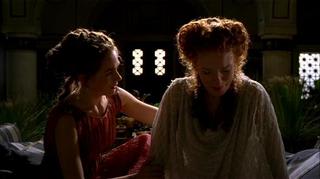
Xena Warrior Princess: Is There a Doctor in the House?


My review of this episode is slightly hampered by the fact I haven't seen 'Hooves and Harlots', in which Gabrielle is apparently 'inducted' as an Amazon, but I maintain episodic television shows ought to be comprehensible no matter where you start! I feel the same way about book series, much to several friends' frustration.

The episode takes places in a healing temple (which looks distinctly Eastern of some description to me - whatever it is, it sure as heck ain't Greek!), in the middle of a civil war, and most of it revolves around arguments between Xena, who's practicing her battlefield medicine and teaching it to a young healer called Hippocrates, and Galen, the old physician who insists only Asclepius, the (correctly identified) god of healing, can decide who lives or dies.

The war was caused, according to the other side's leader, by the Thessalians (from an actual part of Greece) trying to force the 'Mitoans' (not from an actual part of Greece) to adopt their religion. This is spectacularly unlikely in an ancient context. The only religion that demanded that everybody worship their god and no other was Christianity, and they didn't start the more violent kind of evangelism until the medieval period. The only religion persecuted to that extent by polytheistic ancient pagans was, again, Christianity (because the Christians refused to worship the major gods, and therefore might endanger others) but the pagans were quite happy for Christians to worship their god, as long as they worshipped Jupiter etc. as well. Occasionally an emperor might take against a particular cult - the cult of Isis suffered this way once or twice - but always because of a specific grudge against that specific cult, not because they were against other religions in general.

Galen and Hippocrates are both named after famous ancient physicians, though Hippocrates is the better known - he is clearly the Hippocrates, he of the oath (we see him starting to write his famous works, all attributed here to Xena, at the end), whereas Galen is more of a fictional character designed to demonstrate how much superior Xena's practical healing is to his religious ritual. The real Galen was a Greco-Roman physician who lived in the second century AD and whose writing on medicine was still being used as a practical guide throughout the medieval period and even beyond.

Healing temples are something I happen to know rather a lot about, but instead of typing out a lecture, I'll just link to my paper on the subject, which is currently available here. As far as the argument between Xena's practical healing and Galen's more overtly religious methods goes, I personally suspect that all these places practiced practical healing as well as religious rituals, but proving it either way is pretty much impossible. Civil war aside, chances are these temples were usually filled with people whose problems couldn't be cured by local healers or practical healers anyway, and pilgrimage to the temple was their last resort - I suspect there were healers there who did their best, but there was often little they could do anyway.
 
If you were going to have a baby, on the other hand, as Gabrielle's friend Ephiny is, you wouldn't want to go anywhere near a male healer of any kind, they wouldn't have a clue. You'd need a midwife, and they would definitely favour practical healing, though I'm sure they'd have some religious rituals as well.

Ephiny is apparently an Amazon, who was on her way to Athens because her recently deceased other half wanted their baby born there. At first, she doesn't specify why - better medical care? You'd want Cos or even Epidauros for that. Citizenship? You can't get that from geographical proximity, you have to have two Athenian parents. In the end, it turns out the Athenians are 'more tolerant' - presumably of mixed race marriages between centaurs and women. There's no historical evidence for that, oddly enough!

The other main storyline of the episode follows the Mitoan leader who is eventually persuaded that war is, generally speaking, not a good idea. It takes a story, a baby centaur, lots of preaching and several deaths (including, briefly, Gabrielle's) to convince him, but he gets there. I love that Gabrielle self-identifies as a bard. The nice little story she tells about finding peace in yourself is not, you'll be unsurprised to hear, an actual Greek myth, though Artemis turning people into hunted animals features in actual myths.

Not a bad episode, but a woman giving birth to a centaur? Really??!! At least when Doctor Who featured human/kitten hybrids, we didn't have to actually see the birth. And if Xena did an ancient Caesarian section that left the mother alive, she really does have magic powers. We do get another great disclaimer though: Being that war is hell, lots of people were harmed during the production of this motion picture (but since television is a dramatic medium of make believe, all casualties removed their prosthetic make-up and went home unscathed).

Wednesday, July 6, 2011

Living Dead in Dallas (by Charlaine Harris)


We return to vampires and maenads, the original version (if there’s another story featuring vampires and maenads out there, I need to see it, but somehow I doubt such a thing exists). Spoilers follow.

Unlike TV!maenad Maryann, Book!maenad actually has a Greek name, though it doesn’t seem especially related to her character. Callisto was a nymph/princess who used to hang out with Artemis, but she was raped by Zeus (or sometimes Apollo), became pregnant, and when Artemis discovered she was pregnant Bad Things happened (specifics varying according to which version you read) and she got turned into a bear. Greek mythology; not a friend to feminists.

Anyway, this Callisto doesn’t seem especially closely related to her namesake, other than having a genuinely Greek name (a few other Classical bits and pieces are scattered through the book as well – I definitely remember hubris getting a mention at some point. Godric has tattoos from the Roman period, but I don’t think he’s meant to be Roman; the name sounds like he could come perhaps from somewhere in the Empire, but wouldn’t be a Roman citizen. And while we're on the subject of Godric, his supposedly more 'modern' name, Godfrey, did not conjure up the right mental image for me).

The existence or otherwise of the god Dionysus is an interesting point in a supernatural story like this, in which all manner of mythical or folkloric creatures can be assumed to be real, but usually the line is drawn at actual gods, even – or perhaps especially – in a story with a broadly Christian base like this one (Sookie is a churchgoer and she’s the narrator, so there are basic Christian assumptions underlying the supernatural stuff). The gods can be included if they’re revealed really to be something else, like supernatural humans, aliens and so on, but gods as gods are more unusual (though they do appear – Buffy Season 5 being the best known example). The implication here seems to be that Dionysus/Bacchus was at some point real in some god-type form – maenads were ‘driven made by the god’. On the other hand, there’s a reference to the fact that maenads have ‘lost’ the god, and whether this means he used to exist in some form and doesn’t any more, or is just a reference to the lack of belief in Dionysus these days, is unclear, though the lack of current belief is brought up as a specific problem. As in the TV series, the exact process by which a human woman would become an immortal psycho is left deliberately vague, but Bacchus/Dionysus definitely seems to be involved somehow, while whatever existence he once had now seems to be lost.

As someone whose initial exposure to ancient history, pre-university, was through I, Claudius, my favourite bit of the whole explanation scene was Sookie admitting to the reader that she knew about maenads because they featured in a mystery novel she’d read, but deciding to let Eric think she ‘reads ancient Greek literature in the original language’ if he wanted to. Hehe. That would’ve been me ten years ago.

There are various minor differences between book and TV series in the plot and particularly the resolution, but the most interesting difference by far between Callisto and Maryann is that, as far as I can tell, Callisto is not actually the cause of any of the sex and murder going on until she takes her tribute at the very end. She’s attracted to drunkenness and sex and violence, but whereas Maryann brings out behavior that the people around her would usually repress, Callisto merely feeds off behavior that is already happening. Lafayette’s murder, it turns out, was a human act carried out from lust and fear, and the orgy that Sookie finds so repulsive is a simple human activity that Callisto is drawn to, but certainly hasn’t instigated. It’s hard to say which is the more cynical view of human nature – the TV version, which implies that such desires (the violent as well as the sexual) are in all of us, but we keep them buried, or the book version, that leaves the rest of the characters alone but clearly shows some of them actively engaging in such behavior without supernatural prompting. It also explains why poor Lafayette had to die – in his very little ‘screentime’ (page-time?) Lafayette came across as easily likeable, and you can believe that Sookie would go to such extreme lengths to avenge him, which she certainly would not do for Miss Jeanette.

I have to say, in places this was a strange book! Not because of the orgy per se – I am a Roman historian, after all – but because Sookie thought it was a good idea to ask someone who’s been trying to get into her pants since the moment they met to accompany her to one. As a bodyguard. While her boyfriend’s away. He actually has to tell her how crazy this is and it still doesn’t stop her. Even weirder than that, which can at least be explained away as the result of suppressed warm and fuzzy feelings she’s in denial about, is Sam’s affair with Callisto. He doesn’t seem remotely bothered that his fling is a psychotic several thousand year old Thing which Sookie describes as actively evil. Perhaps he’s in denial too.

I did like the book’s depiction of Andy Bellefleur though, one of the most complex characters in both the book and the TV series, albeit in slightly different ways. Andy is a good person trying to do the right thing who sometimes gets it horribly wrong by, for example, pointing a gun at our heroine. He’ll never be a fan favourite, but something about this character keeps Bon Temps and its inhabitants grounded while madness (literally) goes on around them.

I enjoyed this one, strangeness aside, though like anything you’ve seen in another form of media first, it probably needs a second look to be appreciated on its own merits (even if this version is the 'original'). You’ve got to have some admiration for anything that includes a full-on, named-as-such orgy outside of ancient Rome, though I have to say, that scene left me with some mental pictures that can never be erased…

Actual maenads, with Dionysus


Monday, June 27, 2011

Asterix the Gaul: Asterix and the Banquet


It's been years since I read any Asterix the Gaul, which my parents sometimes used to buy for my brother (in English) when we went to France on holiday. What I'd remembered most was the wonderfully punny names - the old man Geriatrix, Poisonus Fungus, Getafix the druid and so on (there are lots of jokes about drugs around, a clear sign of Asterix's '60s origins!*). Asterix and Obelix themselves, of course, are designed as literal 'footnotes in history', asterisk and obelisk, an idea I love, since I always enjoy stories about the minor characters and side stories of history, even entirely fictional ones like these two.

For those unfamilir with the comics, Asterix and Obelix live in a Gaulish village that has held out alone against the Romans following the conquest of Gaul by Julius Caesar. This is largely thanks to the magic potion brewed by Getafix, which allows our two heroes to beat up entire legions without breaking a sweat (though Obelix doesn't need to take any, as he fell into a cauldron-full of the stuff as a child). The village is in northern Brittany, and Obelix has a regular job as a menhir delivery man. The translations are excellent, mostly successfully translating the puns and Christmas-cracker level jokes into something appropriate (you only occasionally find something that isn't quite as effective as English).

In this story, Astrix and Obelix travel all over France collecting regional delicacies to win a bet with the new centurion who has blockaded the village. Apparently inspired by the Tour de France, the story provides a chance to see them travel all over France, and each Latin or Celtic name is accompanied by a footnote explaining which modern town or city they're in. This provides the chance for a few regional jokes - my favourite is the joke about the traffic jams on the way to Nice in the summer. Although I haven't ever been to Nice, I have been to Devon by car and lived in Bristol for a year, so I'm very familiar with the inevitable traffic jams caused by the summer getaway!

The plot provides a nice opportunity for the French authors to revel in two of the things the French are most proud of - their cuisine, and the Resistance. There is an attempt to stick vaguely to the period with the specialities by not naming champagne and calling white Bordeaux, white Burdigala, but since the whole point of the Asterix comics is to satirise modern Europe in the guise of an ancient-set story, this is largely a celebration of modern French cuisine, and thoroughly mouth-watering it is too. Other elements of the story, meanwhile, are pure Word War Two, with various helpful townspeople sabotaging Roman transport to help our heroes get away, while a couple of traitors get their comeuppance.

The Romans here tend to come across as rather inept and not very bright, though several are presented fairly sympathetically. Plus, of course, no one actually dies, as this is a children's comic - they just get knocked out and see the obligatory stars floating above their heads. It's nice to see some Latin included as well, though readers would probably prefer it to be accompanied by a translation rather than left by itself.

I love France, so I really enjoyed this story, though the Romans featured were really too stupid to provide an effective enemy for our heroes. I'll have to get hold of one of the books featuring Caesar or Cleopatra who, while losing in the end, might give the main characters more of a run for their money!

A Breton menhir, as delivered by Obelix

*Yes, I know the first comic was written in 1959. That was a joke.

Thursday, April 14, 2011

All Together Dead (by Charlaine Harris)


I've always fancied being a travel writer but never actually been able to travel enough to do it. So I'm delighted to say I've guest blogged over at Cris Crossing the Globe, on walking around Cadair Idris, in Snowdonia, Wales.

Meanwhile, back in my world of hardly ever leaving the house, I'm having a little bit of a vampire phase at the moment. You'd think, with the weather warming up and spring in the air, I'd go for something lighter (literally) but thanks to True Blood, I've now discovered the Southern Vampire Mysteries - lots of descriptions of glorious southern heat and sunshine, plus vampires! (Not at the same time, obviously. Except occasionally. Ew). Hasan Niyazi from Three Pipe Problem has also very kindly sent me a copy of Anne Rice's Pandora, which I'll read and review if I ever manage to tear myself away from the Sookie Stackhouse books...

All Together Dead is the seventh Southern Vampire Mystery - I've now read 4-7, haven't got further than that (no spoilers please!) and am making do with the TV series for the first three for the moment, even though it's radically different (if you're wondering what order the books are supposed to go in, which the publishers are bizarrely coy about, there's a handy list over at Billie Doux - scroll down, it's at the bottom). All of them share with the TV series a tendency towards lots of sex and gore, and the books make me laugh out loud more than most, sometimes at deliberate jokes, sometimes at... less deliberate ones. (There are capes in this book. And main characters suddenly turn out, unexpectedly, to be vampire clergy. It all turns out to be an important plot device, but still - hilarious in kind of the wrong way).

All Together Dead takes place at a vampire convention. By sheer coincidence, I'm leaving for the big annual British Classics conference tomorrow, but I suspect my conference will be rather different, and will lack weddings, trials, coffins or people drinking each other's blood (and will be the poorer for it I'm sure). Sookie has been paid to go and help out Sophie-Anne, the vampire queen of Louisiana (a phrase which will never, ever stop being hysterically funny to me). Sophie-Anne is on trial for regicide and of course, hijinks ensue.

The vampire hotel at which the vampire convention takes place is beautifully imagined as an ancient Egyptian-themed sort-of-pyramid-shaped building called The Pyramid of Gizeh (haha). This is a stroke of genius on Harris' part, as the image of a dark glass pyramid quite literally filled with coffins, whose inhabitants then get up and start walking around and drinking the staff after sunset, is all the right amouts of creepy, silly, funny, spooky and gothic. Because we know most of what we know about the Egyptians from their tombs, we get to know them in death more than in life, which makes them a perfect thematic thread for a vampire novel, not to mention the Mummy associations. Harris' habit of describing what everyone wears all the time tends to irritate me, but her descriptions of the stylized Egyptian-themed rooms filled with polished coffins are a perfect fit for the tone of the books.

Harris' particular vampire mythology (if you've got an hour or two to spare, there's a TV Tropes page listing all the major pop culture variations on vampires) places heavy emphasis on the age of the vampire, so Classical vampires were bound to turn up sooner or later. This book has an unusual and intriguing example. At Sophie-Anne's trial, the judge turns out to be a very old (as in, elderly, as well as thousands of years old) blind woman called the Ancient Pythoness. She is the judge, apparently, because she was 'the original oracle that Alexander consulted' and she was so revered that the 'primitive vampires' at the time (I have no idea, I haven't read the first three books!) turned her before she could up and die on them.

Just to quickly skim through the nit-picking part: Alexander (presumably the Great - pointing out there was more than one Alexander really would be a nit-pick too far) consulted lots of oracles in his time. I don't even want to go into what 'original' might mean and I don't think there's any such thing - things like oracles tend to appear at similar times in various different places. Most of the oracles in Greece had been around since centuries before Alexander, who post-dates the Classical Greek period of Plato, Socrates and the rest. He made one particularly well known visit to an oracle to ask if he would conquer the world (the answer was more or less yes) but the sources are divided over whether that was an oracle of Ammon (Egyptian god often associated with Zeus) or the Pythia at Delphi, and they lean more towards Ammon. The Delphic Oracle was the most important and most famous oracle in ancient Greece, and was often called the Pythia, because the founding myth of the shrine was that Apollo has killed a monstrous dragon/serpent, the Python, at the site. She was nothing at all like the version that appears in 300. Whether or not her prophecies were drug-enhanced we don't know, but she would prophesy and the priests would interpret it for the visitor.

I really like the way Harris has taken the bare bones of the ancient oracle with the snake-name and built a fabulously creepy and out-there character out of it. The blindness is very Classical too; individual Pythias varied according to who was in at the time, but blindness is often associated with prophecy and prophetic powers in Greek myth (Tiresias, for example). I like the way she is supposed to have been something resembling human at one point as well, who was then 'preserved' by being vamped; somehow, that fits in so nicely with the ancient oracles, who were all ultimately just human beings.

The one thing that jarred - and therefore took me out of the story - was the reference to Alexander and the 'original' oracle. Not so much because of the inaccuracy oracle-wise - after all, this is a world where the heroine is part-fairy, the heroes are mostly dead (or they're part-time tigers) and the vampire king of Mississippi just married the vampire king of Indiana - but, well because I hate the word 'original'. When a book is so concerned with relative age and has multiple characters who've had a millennial birthday, it jars to see something that implies Alexander, a relatively late figure in Greek history comparatively speaking, to be especially ancient and, well, my students will tell you I have a real thing against the word 'original'. Theres no such thing, usually. This may be a problem entirely personal to me.

Do I really need an excuse for including this picture? Thought not.

I can't decide if this is my favourite Southern Vampire Mystery yet or not, but it's certainly close (Dead to the World probably still holds that prize, I am such a sucker for snarky blonde vampires and amnesia stories). There was one slight drawback for me at the end of this one, as no one who grew up in Britain in the 1980s with Northern Irish family like I did would ever have made the quite spectacularly stupid mistake every single main character made in order for disaster to be the result, but on the whole I loved it. The real-life conference can only be a disappointment in comparison, though I fervantly hope the building is still standing at the end of it...

I'm away all this weekend and will be back with a new Spartacus: Gods of the Arena review next Tuesday.

Friday, February 25, 2011

Stargate SG-1: The Curse


Quick plug: I have a new article out at Sound on Sight, on Five Films that Blur the Line Between Fantasy and Reality (I must try to come up with a snappier title next time!).

This episode of SG-1 is one of those mid-season episodes that serve to re-direct the main Goa'uld plot a bit and set up the season finale. In this case, we are introduced to a new Goa'uld, Osiris, another Egyptian deity, in the form of Daniel's ex-girlfriend Sarah (because his wife/another Goa'uld was killed off the previous year, so of course, we need to pile some more emotional trauma/sexual tension on top of Daniel). The audience ought to realise immediately that the unfortunate Sarah will end up Goa'ulded by the end of the episode as, like so many American bad guys, she has an English accent. We also see Osiris' consort Isis, in a way - her dead worm-y body is dissected by Doc Frasier.

This is also the episode that introduced us to Colonel O'Neill's cabin by the lake with no fish in it. When Daniel calls Teal'c for some translation assistance, Teal'c delivery of the phrase 'banished to oblivion' is priceless, as are his repeated offers to return to the SGC.

Events in the episode are kicked off by the mysterious death of Daniel's old archaeology professor in an lab explosion. I can't help wondering what an archaeology professor is doing is a laboratory with explosive potential. Archaeologists do work in labs sometimes, but they don't usually have to share them with the chemistry department. (Please note: this is a joke. I am aware that chemistry labs do not spontaneously conbust on a regular basis). The episode makes several references to a 'curse' of Osiris that does not, as far as I know, have any basis in any belief, ancient or modern - I presume the writers were inspired by the supposed curse of Tutankhamun. In this case, presumably, the 'curse' is down to the fact that Osiris is a Goa'uld in hibernation.

Osiris was worshipped both in ancient Egypt and later, together with his sister-wife Isis, in Greece and Rome as the object of a mystery cult. Judging by the artefacts Daniel's old professor is working with, he's focussing on Osiris' Egyptian incarnation, which, of course, fits with Stargate's general focus on ancient Egyptian mythology. I suppose, in the Stargate universe, the quite different Greco-Roman cult of Isis and Osiris developed independently as a relic of the Egyptian cult after the Goa-uld left... but I digress.

As usual, Daniel's descriptions of Osiris' mythology and attributes (chiefly the crook and flail) are fairly accurate, up to the point where the myth needs to be changed to fit Stargate's plot, and the wall painting that Steven finds looks like it properly depicts Isis and Osiris. Daniel's description of the Osiris myth conforms fairly well to Plutarch's version, which is the most coherent version we have of Isis and Osiris' mythology (evidence for the narrative from ancient Egypt itself is very scanty; Plutarch was a Greek who lived and wrote in the second century AD). For some reason Daniel insists on referring to a 'magic box' rather than a coffin or casket, which would be more accurate. Is this a dumbing-down thing on the part of the writers? Surely their viewers know what a coffin is! Perhaps they're just using a different translation of Plutarch. The punishment/banishment bit is an alteration to make the myth fit Stargate's plotline and does not appear in ancient mythology.

Daniel describes a canopic jar that he finds as belonging to Isis (he calls it an 'Egyptian burial jar' - perhaps he's just simplifying things for Carter?). In real life, a canopic jar would 'belong' to the dead person whose organs are stored in it, but the purpose of the jar has been altered for this episode - rather than storing the organs of a human being buried in the tomb, this one stores the worm-form body of a Goa'uld symbiote. It belongs to Isis because it's Isis' symbiote that is stored in it, complete with alien technology to keep it alive (except it's broken).

One of the nice things about this episode is that is presents archaeology in a reasonably accurate way, and in a much less sensationalist way than usual. One of the handy things about archaeology for TV scriptwriters is that archaeologists often have to work against genuine deadlines, and the (1990s) Egyptian government's request for the artefacts seems a perfectly plausible one. Daniel's ex-colleague Steven's book is apparently on the bestseller list, which seems unlikely - though ancient Egypt is always popular so I suppose, if it was a general introduction rather than an academic tome, that might be possible. Daniel and Sarah's envy is certainly realistic!

Given that they obviously wanted a new female Goa'uld to play with, one can't help wondering why the writers went for the male Osiris over his female consort Isis. Presumably this was because Osiris, who was killed by Seth (a god/Goa'uld the team have already encountered), dismembered, then brought back from the dead and associated with death and resurrection seemed like a more interesting choice than Isis, who is among other things healer, mother and life-giver.

This episode is a bit functional, moving the plot to where it needs to be later in the season. On its own, it works reasonably well as a murder mystery, but the simplest kind. There are two suspects (i.e. people who may have been taken over by Osiris - Daniel's colleagues are probably not natural murderers!). One looks very obviously like the guilty party so, of course, it turns out to be other one. It is lovely to see Daniel actually being an archaeologist though, and we get a trip to Egypt thrown in too! (Well, some sand that looks like it could be Egypt. It makes a change from Canadian forests anyway). Not an all-time classic, but a fun enough way to pass forty-five minutes.

Thursday, November 25, 2010

Buffy the Vampire Slayer: Pangs


Today is Thanksgiving in the US, a festival I have celebrated several times over the last few years with American friends (we had a delicious dinner last year, my friend is an excellent cook!). I can't be with them this year, so I'm missing out on Thanksgiving, but I thought I'd at least do a celebratory post. As you can probably tell, I've been watching through a lot of old Buffy DVDs lately, so of course this, the only Thanksgiving episode of Buffy, seemed the natural choice.

'Pangs' is another classic comedy episode of Buffy, though it also features the first return of Angel since going over to his own show and a fascinating discussion about the problem of how we remember the past, something very close to my current research. Best of all, this is where Spike starts to become integrated into the main cast, albeit bound in a chair at this point (what on earth do Giles' neighbours think?!).

Early on in the episode, Anya calmly informs Buffy and Willow, who are aghast, that,

'To commemorate a past event, you kill and eat an animal. It's a ritual sacrifice, with pie.'

She's more or less right. To really be a ritual scarifice, the animal ought to be killed on an altar and its bones dedicated to the gods, and ancient rituals varied in ther reasoning behind them, but Thanksgiving roughly fits the bill. Some ancient rituals did commemorate past events, but many were explained by myth and were more related to the natural cycle of the year than commemoration; the events they commemorated, being mythological, are closer to stories people chose to pass on and celebrate than to modern commemorations of much more recent events. At first glance, this might seem to separate them from Thanksgiving, but actually, Anya is not quite accurate in her summation. Although Thanksgiving does commemorate a past event, that's not its main purpose as a festival. Thanksgiving is a harvest festival, something we still celebrate in churches and schools over here in the UK (usually at the end of September or beginning of October) and this function, of marking the point in the year where the harvest is brought in and giving thanks for having food for the winter, is probably more significant for the development of the festival than the commemorative aspect, though the latter has become more significant in recent times.

Much of the episode is taken up by an argument between Willow and Giles over whether Buffy should slay the vengeful Native American spirit who is going around killing people and chopping off their ears. Leaving aside the specific argument about the vengeful spirit (I tend to take Xander's side there, who has been given syphilis by the spirit and is not happy about it) the question of how to remember controversial past events is always a delicate one. When the past event is still having an effect on the present, the cultural memory of it is much more than memory, and any attempt to remember the past will be completely dominated by present issues - Voyager's 'Living Witness' is an excellent fictional example of this.

The last word in Willow and Giles' argument, in the end, comes from Spike, whose argument has a number of advantages over Giles' attempt to, as he bitterly points out, make many of the same points. Spike is evil, so he can say potentially offensive or controversial things without causing offence, because we expect evil characters to say offensive things. Like Giles, he's British, which gives him a certain distance from the particular issue (not a lot of distance, granted, since many pilgrims came to America to escape persecution in Britain, but he still has slightly more distance than the American characters). But most importantly, Spike uses an analogy with ancient Rome to make his point, which allows him to highlight brutal truth without sounding too heartless.

Ancient Greece and Rome (along with Persia, Babylon and other Near Eastern places) hold an unusual position in our cultural memory, because we don't connect them particularly strongly with a modern political situation. We make a mental break at the end of the Roman Empire and you don't hear too many people in North Africa complaining about these pesky camels those Italians brought over, or people from the various Roman provinces complaining about how the Italians occupied our country - in fact, we tend to be rather proud of it. The Romans conquered and subjugated half the known world, but whereas more recent examples of this behaviour are condemned, we praise the Romans for it (probably because of all the roads and irrigation and stuff).

So when Spike needs to make a fairly brutal, but true, point about how history works, the Romans are the perfect example. Their conquering is usually considered in a fairly positive light, so by pointing out that more recent situations are no different (though I suspect the Romans were quite a bit more violent than the Pilgrim Fathers) he is able to demonstrate the problem without getting too wrapped up in past wrongs at the expense of the present. Also, they way he puts it is brilliant:

'You won, all right? You came in and you killed them and you took their land. That's what conquering nations do. That's what Caesar did, and he isn't going around saying "I came, I conquered, I feel really bad about it". The history of the world isn't people making friends.'

(James Marsters' delivery of 'I feel really bad about it' is hilarious).

It's a harsh point, but also a true one, and using the Romans allows him - or rather, the show, since Spike is evil and doesn't care - to make it without directly offending anyone still feeling the cultural pain of historical wrongdoing (the Romans invaded my country, but I think I'm OK with it). Most importantly, though, it's really, really funny.

Wednesday, October 27, 2010

True Blood Season Two (Part One)


Halloween seems to be especially big this year - it hasn't always been much of a thing in England (though both Ireland and Scotland have celebrated it for years, I think it may have originated in one or the other). I've always suspected that this is because it's too close to Bonfire Night, and we have our autumnal light-bringing ritual to mark the drawing in of the nights then. Anyway, everyone seems very excited about it this year so in addition to the Halloween-themed Buffy post I have planned for Sunday, I thought I'd get in the mood a little early with some very different vampires.

True Blood is an intriguing show. I started watching it because a couple of friends alerted me to the fact there appeared to be a maenad among the main characters. The show has a largely likeable cast (Sookie, Tara and the rather yummy Sam the bartender) and a great opening credits sequence. I've never been to the American South (though I'd love to go) so I have no idea how accurately the images here portray it, but it certainly conveys a really strong sense of atmosphere, helped by the deliciously catchy and naughty-sounding song 'I Wanna Do Bad Things With You'. (I could live without the gross dead animals though).

The trouble is, the vampires on True Blood are just too nasty for it to really work for me. They're represented as an oppressed minority, chiefly drawing parallels with the gay community (the title sequence features a church with a notice reading 'God hates Fangs' and vampires supposedly 'came out of the coffin' a couple of years ago). I can see the idea behind it - there are good vampires and bad vampires, just as there are good and bad people in any group. But the 'good' vampires here are not vegetarian Cullens, ensouled Angels or well-behaved members of the League of Temperance. Of the two main vampires, who both serve as love interests for the heroine, one locked a man in a cell and tortured him for weeks, throwing the dismembered limbs of his former cellmate around at him, and the other recently turned a teenage girl into a vampire. Apparently this was because he had killed another vampire, so he had to make one to replace the dead one. Just think about the implications of that metaphor for a moment. I really don't think implying that members of minority groups really are inherently violent and sadistic (the main love interest is also shown enjoying sex while covered in the blood of a gasping victim who hasn't died yet - lovely) is doing anyone any good, nor do I feel the slightest bit of sympathy for any of the True Blood vampires, who are all downright creepy and not remotely attractive (no, not even Alexander Skarsgard) (Later edit: I would like to retract that last statement. I get it now. Boy oh boy I get it now...).

Anyway, I started watching at episode 2, season 2 to see what this possible maenad was up to. I didn't post about it immediately because True Blood is one of those very arc-driven US shows where plot developments happen veeery slooowwly over a number of episodes, so single episodes don't necessarily move things along very far. However, we're halfway through season 2 now, so I thought I'd stop and take stock.

A maenad is a female follower of the god Bacchus/Dionysus. In real life, they had a biannual festival in which they went into the mountains and had wild party, complete with drumbeats and getting themselves into a state of ecstasy but probably without vast amounts of sex, since they were all women (I'm not saying that rules out sex, but sex was not the object of the ritual - there are other types of ecstasy). In myth, they were, of course, even wilder, tearing Pentheus to pieces and so on. They crop up every now and again, most bizarrely in Prince Caspian.

Weird shaky-thing, complete with Greek-ish costume, in case we haven't got it yet.

Maryann the maenad's main trick so far is to throw a wild party, do a weird shaky-thing with her body (a quite bizarre CG effect) and make everyone have a lot of sex while their eyes go black and they go into a trance. I'm calling her a maenad because that, according to the internet, is what she will turn out to be, though so far signals have been mixed. According to Billie Doux, the first episode of season 2 (which I missed) featured this line:

Maryann: "The Greeks knew there was the flimsiest veil between us and the divine. They didn't see the gods as inaccessible, the way everyone does today."

There was also a mural of Pan, the goat-legged god of music and shepherds. Her reference to accessing the gods makes sense for someone who is, essentially, a worshipper, not a divine being herself (though she seems to have aquired some supernatural powers). But in addition to apparently worshipping both Pan and Dionysus (nothing wrong with that in a polytheistic religion) she has the ability to force shape-changers to change, which in the ancient world would be connected with witchcraft (Circe turned men into pigs, while the witch in Apuleius' Metamorphoses turns into an owl and her magic turns Lucius into a donkey). Then things get really confused; there is yet another minotaur running around (whether there's more than one or not remains to be seen) and the ritual at her latest party involves some kind of bull's head thing.

In the latest episode, Sam told Daphne (a minion of Maryann) that he didn't want to go near drums because they only lead to hippies and cults. Daphne replied 'not this time' in the sort of knowing, evil tone of a minion about to reveal her evilness to the guy she's been duping - except that is exactly, in the most literal sense, what the drums are leading them to. The cult of Bacchus/Dionysus was one of the most prominent of the ancient religions known today as mystery cults ('cult' from the Latin cultus, worship). These were groups dedicated to a particular god who carried out secret rituals known only to members, and which new members had to undergo sometimes lengthy initiation ceremonies to join. Their secretive nature leads to all sorts of speculation from modern writers on what might have gone on behind closed doors with, of course, no evidence to contradict even the wildest ideas, because it was secret. Daphne has most definitely led Sam into a cult.

(Daphne is also a Greek name, but whether or not she has anything to do with Apollo or laurel trees remains to be seen).

The trouble with the bull's head thing, though, is that it's connected to the wrong cult. Bulls were associated with another mystery cult, that of Mithras, joined chiefly by soldiers. Bulls were also essential to the taurobolium, a rite carried out by followers of the cult of Cybele. I'm not sure, however, what they would have to do with the cult of Dionysus. And the minotaur thing is getting weird now - just what is so attractive about bull-headed men?!

Maryann's ultimate goal has yet to be revealed, but so far her parties seem to bear more resemblence to the pop culture notion of a Roman orgy than a Bacchic festival (though the word orgy does come from orgia, a Greek word for ritual connected with mystery religions). Ecstasy, sometimes including sexual ecstasy, is certainly a feature of the mythology of Bacchus and may have been a big part of Bacchic ritual (hmm, that sentence came out wrong!). But on the television - unsurprisingly - sexual ecstasy seems to be the only type that Maryann the maenad is interested in. Considering the title sequence includes images of Christian religious ecstasy, it seems rather a shame to reduce Bacchic ritual to just sex and nothing more.

Further analysis will have to wait until we know more about Maryann and what she actually wants, which so far is unclear (well, she wants everyone around her to have a lot of sex, but I'm guessing there's more to it than that). Meanwhile, I will continue to watch and hope to see more of cute Sam the bartender, and less of blood, guts or really any vampire at all! (Later edit: I would also like to retract this statement. Except for the part about Sam, I still like him too).

Tuesday, October 19, 2010

Rome: Pharsalus


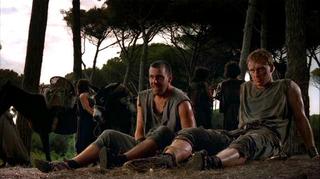
As this episode opens, everyone is recovering from earlier events and preparing for the coming battle. We see dead bodies on a beach, washed up from the shipwreck Boring Soldier and Dodgey Soldier were caught in at the end of the last episode. Boring and Dodgey themselves have, of course, survived. In ‘Caesar’s camp in Greece’, Caesar is putting up with some snark from his slave. Pompey’s lot are feeling confident (and are colour coded for your convenience – they were a bluey-greeny colour, Caesar and Antony wear red. Even Cato has got out of his robe and sandals and into a uniform). Cato is all for attacking Caesar and walking in his blood, Pompey is less convinced. The town crier informs all of Rome that Caesar is surrounded and outnumbered, which panics Atia into sending Octavia to ask Servilia for some guards to protect them when Pompey’s troops come marching back, victorious. Octavia doesn’t want to go and has ceased to care about her own potential ravishment and murder in her desperation for the whole thing to be over (and she’s hiding the fact that Servilia’s been flirting with her). Niobe’s sister comes over to make up, which is nice.

Boring and Dodgey have washed up on a sand bank in the middle of the sea. When Boring tells him not to bother fishing as they’ll die of thirst first, Dodgey suggests drinking the blood of the dead men, but Boring suggests this will be too salty. Boring seems to have decided to sit on the beach and die, while Dodgey is at least trying to do something about it.

Octavia is doing herself up for Servilia. She bursts into tears in front of Servilia, who tries to comfort her, but Octavia runs away before she can get any further. And thus begins Rome’s second most ludicrous, sex-for-the-sake-of-it, storyline (the first comes in an episode or two and also involves Octavia). Servilia was one of Caesar’s favourite mistresses and Octavia was the holier-than-thou, all too virtuous sister of Octavian. Both of them were, by all accounts, heterosexual. But, according to Rome, the two of them had a sexual relationship with each other.

In fairness to the writers, there is an argument to be made for this sort of invention. Roman writers usually recorded a man’s sexual preferences, but since they were writing for and about men, they hardly ever recorded instances of women having sexual relationships with other women. If a woman was unfaithful to her husband with a man (and was caught) that might be recorded, but since a sexual relationship with another woman cannot produce illegitimate children, it was of little interest and was rarely written about, though Sappho’s poetry was much admired. So it is entirely possible that some Roman women had sexual relationships with each other that we don’t know about and it could be a really interesting area to explore. But these particular women, who were little connected with each other in real life, seem a very odd choice and there seems to be no good reason for including this relationship other than titillation.

Caesar thinks his advantage in the battle is that they must win or die, whereas Pompey’s men have other options (running away, presumably). There is lots of ponderous washing of the face and putting on of armour on both sides, and Caesar shows how tough he is by cutting his own hand for no particular reason (presumably it’s supposed to be a religious ritual of some kind, but he’d be better off sacrificing a goat in that case, not cutting his own hand – a little bit of his blood isn’t much use to the gods).

The battle is represented by some blurry, slow-motion waving of swords, and takes about two seconds. Rome had a much, much bigger budget than I, Claudius or Spartacus: Blood and Sand but it was still only a television budget and that really shows here – I, Claudius’ verbal reports of battles were less incongruous than this. The sheer brevity of the scene, which covers one of the most important battles of the Civil War, makes it seem ridiculous and obviously done on the cheap – I would have preferred a slightly longer description by one bloodied soldier or messenger if actual fighting was too expensive.

Caesar wins and Pompey is very upset. So he sits under a tree for a bit.

Cato is heading off to Africa for money and soldiers, convinced they’re not beaten until dead. Brutus and Cicero, however, have had enough and are off to surrender to Caesar. Cicero insists that he is not afraid to die, just tired and fed up. Brutus appears to be fed up of the food. Even Cato has abandoned Pompey, insisting they should travel separately.

Boring Soldier is looking forward to seeing his mum again in the afterlife and Dodgey wonders if they have a system for finding people (he’s obviously never seen A Matter of Life and Death, where the afterlife is extremely well organised). Boring isn’t that keen to see his mum, though, as he abruptly changes his mind when he realises the potential of floating corpses as raft-building material.

Pompey is travelling incognito and arguing with his nose-less guide. Back in Rome, Octavia is masturbating and praying (not both at once) which we are presumably supposed to attribute to her feelings for Servilia. I’m not sure why she’s praying so much, lesbianism was not of sufficient interest to male Roman writers to bother prohibiting it and Sappho was positively admired. We’re several decades before Christianity and she’s not Jewish, so why is she so upset about it? She then pops over to Servilia’s to ‘do some weaving’. Actual looms have been set up but weaving is not entirely in evidence. While they’re flirting, a slave brings word of Caesar’s victory, but does not know what has happened to Brutus. Octavia goes to comfort Servilia and, of course, kissing ensues because on television it is impossible to comfort someone without kissing them.

Back to Greece again, where Cicero and Brutus surrender to Caesar, who responds by hugging them and grinning like a loon (maybe because Brutus really is his son?). Caesar was expecting Pompey, if still alive, to surrender and is baffled that they haven’t. Boring and Dodgey have, of course, run straight into Pompey, whom Dodgey recognises. Noseless tries to get Boring and Dodgey to join him in betraying Pompey and claiming a reward, so Boring kills him. Boring then tries to claim Pompey as a prisoner of the 13th Legion, despite the fact he and Dodgey are the only members of that Legion present. Pompey explains that he lost the battle because some of his men bolted and begs Boring to let him take his wife and children to Egypt for safety, to which Boring agrees because he is secretly on Pompey’s side anyway.

Octavia and Servilia have done the sex, somewhat surprisingly off screen (presumably this is bait to get people to tune in next time). Boring and Dodgey take a horse and some money and head off, Dodgey haranguing Boring all the way for letting Pompey go and denying them rich rewards from Caesar, while Boring complains that Pompey is not a slave to be sold. At the camp, Caesar tells the two of them that they are among only 14 survivors of the storm. And then Boring does the most ridiculously honourable and completely implausible thing he does throughout the series (and he does this sort of thing a lot) – he tells Caesar that they bumped into Pompey but let him go because ‘it would be wrong’ to capture him (he is at least good enough to leave Dodgey out of this insane notion). This is utterly, utterly ridiculous. Letting Pompey go was bad enough in itself, but going and telling Caesar about it is suicide. Caesar points out that he pretty much needs Pompey dead, otherwise people will still fight for him, and then lets them go with a warning that only he gets to be merciful. When they have left, he tells Antony that he thinks the two of them have powerful gods on their side and he doesn’t want to harm them for fear of offending said gods. This is equally silly. Caesar rarely referred to religion or the gods in his writing (I can tell you for a fact that he does not record a single prophetic dream in any of his works!). He did not, it would seem, consider ideas about the gods to be relevant to military strategy. So why would he be swayed by the notion that someone might be protected by the gods when they’d just let his mortal enemy go? It's lazy writing, using the fact that other Roman writers sometimes suggested that ideas about not wanting to offend the gods might motivate action to cover up for a really silly plot development. Basically, the whole scene completely disregards any kind of logic purely for the sake of keeping Boring and Dodgy alive when they shouldn’t be. Their encounter with Pompey itself is no more than an excuse to have Pompey interact with our Everyday Heroes – it would have been better and more logical to have Pompey express his despair to his wife.

Pompey’s ship arrives in Egypt and he takes a boat to go ashore, where he is promptly stabbed and then beheaded by a former legionary, in front of his wife and children, watching from the boat.

Since this episode is called ‘Pharsalus’, the lack of an actual battle or any detailed description of the battle is a bit of a disappointment, but the ending is very good. Pompey’s death is very well staged and shot, capturing both the indignity of it and the high tragedy, reflected in his wife and children witnessing it. Octavia and Servilia’s relationship makes no sense to me because I don’t see any strong narrative reason for it, and Boring is at his most ridiculously, suicidally pompous, but that ending pulls it all back up and has me eager to see the next episode, where we get to meet Cleopatra.

Sunday, September 12, 2010

Caesar IV for PC


I apologise to gamers and those who know much more than me about computer games - in parts this post will probably sound pretty ridiculous to you! I don't usually cover computer games on the blog, because I very rarely play them. For my 25th birthday I asked for a second hand Super Nintendo and apart from a Gameboy in the early 90s that's the only games console I've ever owned - I spent quite a few hours playing on my brother's Nintendo 64 and have very occasionally played on a friend's Playstation, but really, I know nothing about games and gaming and I've never even completed any version of Super Mario World.

However, years ago, when getting a new family computer, we got a copy of Caesar III free with the new PC. And I completely and utterly fell in love with it. You could choose to avoid the fighting-heavy scenarios and focus on town-building, which made it just a like Roman version of the one game I did absolutely love and spend hours playing, Sim City 2000 (and Sim Tower, but that was mostly about getting the lifts to work properly). It also had some fantastic little touches that brought it to life, including tents that citizens would pitch that gradually transformed into houses under the right conditions, and people who, when times were bad, would walk away with their head hanging low, complaining in an appoximation of a southern English accent, 'I've been thrown out of my home!'.

Because the game came free with a specific computer, I've never been able to make it work since we got rid of that PC, which died a death years ago (if anyone has any suggestions or ways to find copies of Caesar III that are compatible with new models, let me know!). But I did buy myself a copy of Caesar IV, the next version up, which is similar, though sadly the tents and the little man with no home seem to have disappeared. Gameplay is slower as well - it can be maddeningly difficult to place things where you want to place them - but presumably this is partly the fault of my graphics card. I want to talk mostly about IV, since it's been years since I played III, but a lot of the basic elements of the game apply to both.

The aim of the game is fairly simple - build successful and prosperous Roman cities - but each level has different particular requirements and provides different trade routes and raw materials (I've still never completed it, but I think you can mess around with other scenarios after you finish it and presumably you get to be Caesar eventually). You get regular requests from Rome and if you don't fulfil them or you spend too much time in debt and lose too much money, Caesar (who is, miraculously, in charge despite the fact I'm supposedly still in the era of the Republic) sends an army and kicks you out. This has happened to me a lot.

The structure of the cities is based around trade, manfacturing and the needs of the three social classes - plebeians, equites and patricians. The representation of the class system is, of course, massively over-simplified. The plebeians do mostly manual labour, which was the case at some points of Roman history but at others times some plebeians could become quite rich and influential. The equites in the game perform what we in the modern Western world might think of as middle class jobs - they are the priests, they run the bathhouses, staff the libraries and they are the actors and run the gladiator schools. Again, this is not really representative of what it meant to be an eques, a member of the equestrian order, though their running the tax offices is more accurate. The patricians don't seem to do anything other than pay tax on their villas, which is probably the closest to Roman practice of the lot, though I haven't got to the upper levels yet - maybe they get involved in politics later. Basically, the game equates the three classes with modern conceptions of what it means to be working, middle or upper class, which is fair enough for a simplified computer game - the three classes are in the right order and have the right names - but, of course, can't come close to representing the very different class system that operated in ancient Rome, and that changed frequently over the course of a millennium of history.

One Roman social class is noticeably absent from the game - there are no slaves. Even the gladiators seem to be, in game terms, equites, which is utterly ludicrous. Presumably modern gamers would not be comfortable building a slave market, trading slaves with other cities and staffing their farms, factories, mines and entertainment venues with slaves. Since the game is probably suitable for quite young children, that's probably not a bad idea - after all, no one wants their child deciding that the slave trade is really quite profitable and it would make the game rather excessively controversial. It does, however, completely destroy any chance of the game reflecting Roman society in any way, and there is an argument that not showing children how fundamentally important slaves were to the Roman economy is tantamount to lying to them to cover up the less pleasant aspects of history. The game is not an educational tool, though, and really I doubt it's intended to be any closer to reality than Sim City is, so I think overall they made the right choice - but still, considering the importance of employment and the class system in the game, leaving out the slaves does seem to be, well chickening out perhaps.

I found this image with a Google Image search and I think it's more representative of the game than the promotional images - but what's the exciting language?

When I used to play Caesar III, I remember feeling a little frustrated at the game's insistence that everything be within easy walking distance for the inhabitants (while still maintaining the desitrability of the area). This is an ancient city, I remember thinking, surely people would be used to having to walk a bit further to get to things? This seems to have been largely corrected for Caesar IV, and although it slows them down, people do seem happy to walk a bit further to get to the things they need - though they are still reluctent to walk to leisure activities, like the bathhouse, the library or the theatre. Presumably they are sending their unmentioned slaves to the markets for them. This would also explain another minor peculiarity - plebs need access to food and 'basic' goods (pottery, clothing, olive oil) but equites only need 'luxury' goods (wine, jewellery) and patricians only need 'exotic' goods (things that can only be acquired through trade like salt, perfume, spices). Either the patricians are going very hungry or their slaves are very over-worked!

The makers of the game have really taken to heart Juvenal's famous pronouncement (in a satire, one should remember) that all the people want are bread and circuses. Not only do you have to store massive amounts of food, primarily grain, to keep them from falling ill or leaving, but they are quite ridiculously obsessed with entertainment. The patricians are the worst, but the equites are pretty fussy about it as well. Now it is true that some Roman cities, like Pompeii, had several different entertainment venues, including two theatres and an amphitheatre; but when you give them an amphitheatre, a theatre and an odeum all fairly nearby and they still aren't happy, I think they may be taking things too far. In addition to the fact that permanent structures like these weren't usually built until the imperial period (the Theatre of Pompey was one of the first in Rome), 'odeums' are basically theatres, while the game commits a double crime against Juliette's Pet Peeves by not only referring to all large arenas as 'Colosseums', when the name should be reserved only for the Flavian amphitheatre in Rome itself, but spelling it 'Coliseum'. Normally, I'm fairly tolerant of international spelling differences (the game also uses 'theater', which is fine) but 'Colosseum' comes from the Latin 'colossus' - 'Coliseum' is just plain wrong!

Perhaps the most bizarre aspect of the game is the 'Religion' requirement. The fact that the citizens want religious buildings is fine, the bizarre part is that, if you don't build enough shrines and temples, not only will your citizens be unhappy, but Jupiter will strike your buildings with lightening! Five gods have been chosen to represent all the multiplicity of religions in ancient Rome - Jupiter, Ceres, Mercury, Mars and Bacchus. Although this leaves out some very important gods (no Hera, no Apollo, no Venus, though I think she appeared in Caesar III) it is a logical enough choice - Jupiter is there as Head God, Mars represents the military, Mercury trade, Ceres agriculture and Bacchus... I'm actually not sure, entertainment possibly. For me, he can stand for all the very many cults and gods worshipped outside the main pantheon in mystery religions and other smaller groups (Bacchus himself is Dionysus, a major Greek god, but he was the focus of mystery cults as well as more formal worship). The reason the chosen gods have to correspond so exactly to the main requirements of the game is that, if you build them enough shrines, they do you favours - Ceres makes the grain ripen unexpectedly, Jupiter stops crimes, and so on. It's fun but I do find it a little bit weird! I'm a religious person, but my faith is rather more complex than 'if I pray for something I'll get it' and as far as urban planning goes, while I'm all for keeping people happy by building religious structures, I'm not sure one can plan one's security and agriculture around it. Still, it does provide an incentive to build lots of shrines.

OK, I know what this language is! That is the structure the game calls an 'amphitheatre' - 'Coliseums' are the same, but bigger.

Of course, at this point it is necessary for me to step back and remind myself that this is a computer game, not a history lesson! It's a brilliant and utterly addictive game, though I am becoming incresingly frustrated at my inability to get past Caralis because I can't get the Prosperity level high enough - I think I need the game to be a little bit easier! (I won't tell you how long I spent trying to finish that level yesterday ready for this post - I've been stuck on it literally for years). For someone with little knowledge of ancient Rome playing the game (as I once was), the main impression you come away with is that the Romans liked religion, food and entertainment, engaged in lots of trade across the empire, and occasionally had to spend large sums of money buying off barbarian invaders. Which is probably not too bad an impression, and once more demonstrates that gladiatorial combat seems to have been Rome's best known and most perennially popular (in non-fatal, fictionalised form) gift to posterity.

Friday, August 27, 2010

How to Mellify a Corpse (by Vicki Leon)


This post represents one of my occasional forays into popular history, rather than popular fiction. Like the Horrible Histories series, How to Mellify a Corpse collects some of the most fascinating and unusual pieces of information we have about the ancient world and presents them in a witty and informal text, though this book is designed for adults, not children (there are fewer cartoons, but there are some humorously labelled pictures!). The book is written in American vernacular – I have the American edition so I don’t know whether this has been edited a little for other countries – which gives it the pleasantly informal feel of a lively seminar (although I would rarely commit such thoughts to writing outside of this blog, I have often described various characters in ancient history in similar colloquial and not always entirely flattering terms to those employed here).

The subtitle of How to Mellify a Corpse is ‘and other human stories of ancient science and superstition.’ The word ‘science’ could be expanded to include technology and philosophy, as the book covers all these aspects of ancient ‘scientific’ thinking, and it is in these sections – which I think form a small majority of the content of the book – that León really shines. The Introduction explains straight away that the word ‘science’ was not used in the ancient world, and the concept as we know it did not exist, but the book explores what we might term ancient scientific thinking, and does so in a thorough and thoroughly engaging manner. Since this is a popular history book, precise references are not given, but León nearly always explains broadly where the information comes from and in the case of ancient authors, it should be possible for the very interested to explore each section further for themselves (archaeology is a little more tricky, but the reader does always know whether they’re looking for archaeology or written sources, so they have a place to start).

Perhaps the best sections of all are those in which León introduces us to most of the major philosophers of the ancient world. There is a strong narrative element to these sections, as León describes each philosopher in unashamedly broad and often judgemental terms (‘geek’ is one of the milder ones!). These, while clearly personal and biased one way or the other, give the reader a clear and immediate picture of the personality of the philosopher concerned (and for once, León being the author of the ‘Uppity Women’ series, these are not all necessarily male). This technique allows the writer to create a narrative of the history of the philosopher that takes into account the various thinkers’ personal prejudices and foibles and that is comprehensible and, most importantly, interesting to a read. Each philosopher’s life history, relationships and major thoughts, theories or discoveries are described and León always makes sure to inform the reader whether we know the philosopher in question from his own works or those of others. These sections present a beautifully engaging introduction to ancient philosophy which could relatively easily be followed up on by anyone wanting to know more.

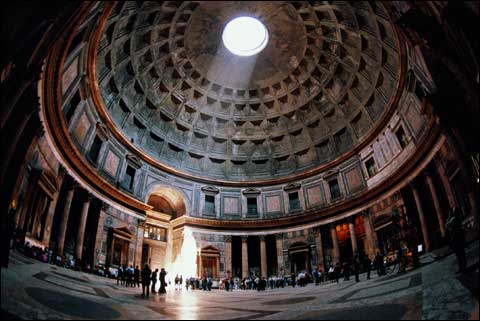
Equally impressive are the book’s descriptions of ancient technology in action. Although, thanks to the wide-ranging nature of the sources, these cannot always provide such precise information on the nature of the evidence, they present a vibrant picture of life in the ancient world, allowing the reader to learn about both the better known aspects of daily life, like make-up and gladiatorial arenas, and the less well known, such as the corpse-mellification (preserving it in honey) of the title. My personal favourite, because I once spent a summer cataloguing the cement library at RMC (Ready Mixed Concrete) Rugby, was the excellent section on Roman concrete.

The Pantheon in Rome, a masterpiece of ancient design and concrete

One other aspect of the book that I, as a Classicist, particularly appreciated was León’s careful and precise attention to language. Going well beyond the usual descriptions of how the English word ‘geography’ derives from the Greek words for ‘earth’ and ‘write’ and so on, León includes many references to the precise vocabulary of the ancient world and to the meaning of each word in context for the Greeks and Romans, as well as pointing out common English derivations. This also provides an excellent foundation for anyone who wants to study the subject further.

(Though, while I'm on the subject of language - the book translates the name 'Heracles' as meaning 'the glory of Hera' and describes this as a 'puzzling non sequitur'. For anyone who's interested, the name is more usually understood as meaning something like 'glory because of Hera', or words to that effect: Heracles gained his great fame and kleos, glory, because Hera made his life so miserable and, directly or indirectly, forced him to perform so many glorious deeds).

Just as the ‘science’ side of the book covers science, technology and philosophy, the ‘superstition’ side covers religion, superstition and myth (which I am defining broadly as stories with a religious element for the time being, for simplicity’s sake). Whereas many of the ancients would have been equally likely to lump all the ‘science’ subjects together, eliding the differences between religio, superstitio (very different concepts in antiquity, though the dividing line can be difficult for modern scholars to draw) and myth does present a slightly distorted picture of ancient ideas about the world, particularly if the reader comes away with the idea that literary myth inspired the same sort of ‘belief’ as, for example, adherence to ancient methods of divination. However, this is perhaps inevitable, since the whole concept of ancient ‘belief’, so very different to and more pluralistic than the dogmatic religions best known in the western world today, is quite spectacularly complicated and it is not the purpose of this book to get into an academic debate about the nature of ‘belief’ (Paul Veyne’s Did the Greeks Believe Their Myths? is the place to start on the complexities of ancient ‘beliefs’).

The book also follows the current popular trend of describing ancient ‘science’ as something held back by religion and superstition, and tends to describe most beliefs and ideas as subscribed to by nearly everybody. This is somewhat contrary to the position I take personally – I tend more towards the argument that the extent to which people do or do not ‘believe’ in various ideas, particularly those on the more superstitious end of the scale, has not changed as much as all that, despite the rise of the concept of atheism (which was a very minor belief in the ancient world – Lucian lumped atheists as a minority group in with Epicurians, who had pretty similar ideas, and Christians – to an ancient thinker, abandoning the traditional gods for a single deity was in the same broad bracket as atheism!). You can read my thoughts on the subject in more detail in the conclusion to my PhD thesis, which is freely available online here (do skip to the last couple of sections of the conclusion, unless you’re very interested in ancient dreams!). However, the argument León follows is an entirely valid academic argument and, indeed, one of the more popular around at the moment – the fact that I like to be awkward does not detract from the meticulous research that has gone into the book.

Mellify is indeed meticulously researched, and introduces a wealth of material from across the ancient world. The book is divided according to geographical area. Although this has the disadvantage of disrupting the chronology of the narrative (again, unfashionably, I have a fondness for chronological arrangements!) it has the great advantage of providing a real sense of place and of the subtle differences in the cultures that surrounded the ancient Mediterranean. Since it can be far too easy to divide the ancients into very basic categories (Greek, Latin-speaking, Egyptian and so on) this gives the book a welcome extra dimension and enriches the picture of the ancient world that emerges.

Pythagoras again. I like him. Even though he made my life a misery in maths class.

In this book, León has compiled an eclectic mix of the most outrageous, exciting and generally interesting stories of the ancient world. In most cases, those that seem really unlikely are flagged up (in the best tradition of Herodotus, who is covered with perfect balance under both his titles, ‘Father of History’ and ‘Father of Lies’) and in some cases, León offers tentative guesses about the truth of the matter that, while hard to impossible to back up with evidence, are nevertheless fascinating and entirely plausible – it had never occurred to me that Pythagoras might simply have been allergic to beans! The book gives plenty of background to the historical places and periods it covers, and each chapter explains who it is talking about and their background even if they have appeared before, so the themed sections can be read out of sequence it you want to. A very enjoyable read!

Tuesday, June 8, 2010

Spartacus Blood and Sand: Legends


Spartacus is still clinging to the garter-thing as he atmospherically gets dressed for a training session, in which Drill Sergeant Guy has a go at him for not thinking things through properly. Then we get a montage! A training montage! Team America really has ruined the montage sequence for ever...

The Volcanalia is announced, described by Neighbours Reject as ‘a festival to ward off wild fires’, which is accurate enough, though Volcanus was god of destructive urban fires as well (and volcanoes, thoughI guess since Vesuvius hadn’t erupted yet volcanoes might not be the first thing that came to mind). John Hannah is worrying about money again, but Xena attempts to reassure him while trying on a new and remarkably blonde wig.

A gladiator walks past, showing off his package. Neighbours Reject explains that the big gladiator who’s been annoying Spartacus, Barca, is a Carthaginian who is the last survivor of his group, brought over as slaves after the fall of Carthage. Spartacus still expects John Hannah to actually find his wife, and John Hannah is still stringing him along. Xena buys some jewellery – which apparently involves inspecting her slave-girl’s breasts – and the slave girl seems to have some connection to one of the gladiators. Meanwhile, Drill Sergeant Guy is taking metaphors about piss a bit too literally.

The slave-girl and the gladiator she likes have one of those Tense and Meaningful conversations before he goes off to have sex with Xena. Spartacus still hasn’t learned to keep his mouth shut and gets both himself and Neighbours Reject thrown into a big hole full of shit, at which point Neighbours Reject finally snaps at him to please just shut up and get on with it.

Spartacus and Neighbours Reject are down to fight each other, because this is a gladiator story so, of course, our hero has to fight his only friend, and if he succeeds he may get to fight Crixus the toughest gladiator of them all (and honestly, I am now completely confused as to who is Barca and who is Crixus and who is a Gaul. I can only positively identify Neighbours Reject and the one who’s been allowed to keep his long hair for some reason). Spartacus gets one of the retiarii knocked out, apparently as part of a cunning plan to get himself facing Crixus sooner, while he and Neighbours Reject discuss the uncomfortable fact that they may end up killing each other and the one from earlier eyes up the slave-girl.

Haldir’s wife comes by for a party, complaining that Haldir is too busy with work and being snarky about Xena’s new necklace, which is apparently out of date. JH brings the gladiators in to show everyone in hopes of selling some. People are interested in Spartacus and JH wants him fighting the big guns, but Drill Sergeant Guy whinges that he’s not ready, still too ‘animal’. The guy I thought was Barca the Carthaginian turns out to be a Gaul, and Haldir’s wife sulks that Spartacus is still alive, so Xena has Neighbours Reject perform some live porn to cheer her up, while NR vaguely hopes his wife will forgive him.

OK, the guy who likes the slave girl appears to be Crixus – Spartacus attacks him in the middle of the party and Haldir’s wife demands that they be allowed to fight, as she’s rather enjoying it. Sparatcus gets what he wanted – he will fight the undefeated Crixus in the arena the following day, and he won’t have to fight Neighbours Reject. Xena is not happy, since she wants to protect Crixus, while Crixus himself gives the slave-girl a pretty necklace.

Another gladiator tells Spartacus the story of ‘Theocoles’, the shadow of death, a giant who apparently (according to the graphic) kills people by splitting them in half. The gladiators all insist that Theocoles is not legend and only one has survived him – so either he’s Voldemort, or they’re exaggerating. I'm not aware of any real legend like this, and 'theos' is simply Greek for 'god', so I think this is an invention of the writers - if it has any basis in the ancient world it's very obscure.

Neighbours Reject

Next day, in the arena, Neighbours Reject has obviously survived his fight (he has blood on his face) and Spartacus goes forward to face Crixus. Xena has given up on fashion and gone back to red hair, but her porn show has managed to impress Haldir’s wife so she’s got what she really wanted. Rock guitar starts to play as Spartacus and Crixus enter the arena and Haldir’s wife gives away that she fancies Crixus too, at which Xena is less impressed. Spartacus doesn’t even wait for the starting signal before having a go at Crixus. Crixus so thoroughly bests Spartacus that our hero’s blood ends up artfully spattered all over the camera, but a glance at his wife’s garter-thing persuades Spartacus to surrender and ask for mercy, something that, at the beginning of the episode, he swore he’d never do and which doesn’t impress anyone in the crowd, who all wanted him to die. JH insists that Spartacus was expensive and is worth saving, but no one is really buying it, and it does seem a bit odd to be honest.

Drill Sergeant Guy points out it’s all Spartacus’ own fault for not training long enough and the episode ends, on a rather odd note. (By the way, the pic of John Hannah on the closing credits is really kinds freaky – he looks unusually evil!).

Another episode that felt like it was treading water, though at least Spartacus actually got into the arena this time. Trouble is, 1) I want Haldir to come back, I’m far more interested in him than his fashion-plate wife and 2) I’m already starting to feel like I want them to just rebel and go on the run already, since I know that’s where we’re eventually heading – at least I hope so, unless all of the actual slave revolt has been put off for a season 2 that may never happen...

Wednesday, April 28, 2010

Stargate (dir. Roland Emmerich, 1994)


I gave a short (very short - 5 minutes!) paper on Stargate a while back, as part of a panel on 'Archaeologists from real to reel', in which I basically discussed the representation of Daniel Jackson as an archaeologist. I'll copy the text of my paper into the bottom of this post - it's really very short (not all my papers are that short!) and it's sort of half formal, half informal (it was that sort of event) but hopefully it may be of interest!

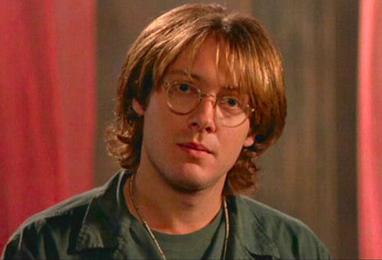
I love Stargate, it's the kind of big, cheesy fun I tend to like a lot. Also, I saw Stargate SG-1 first, so I came to the film already feeling a lot of affection for these characters - otherwise I might have been a bit more dubious about Colonel O'Neil. And James Spader is very attractive in it.

I'm never quite sure how I feel about the use of religion and mythology in Stargate in general though. On the one hand, the idea that ancient gods are really aliens is always a fun one, since it means you get to play with their mythology and even see the gods in action, offering dozens of fun episodes over the course of SG-1 and plenty of oppotunities for me to blog about it! It also fulfils that constant desire for myths to be somehow true. We do not believe in the ancient gods, but if they were, in fact, aliens, suddenly we have a way of making all their myths real, just twisted - an obscure version of euhemerism (and I'm dealing with a particular kind of fictional 'true' here - I am by no means suggesting that the gods actually were aliens and the pyramids are spaceships, those are the crazy people we walk away from slowly!). The desire to find some kind of truth behind myths is an old one and a strong one and if I could fully explain it, I'd be a happy person, but it is undeniably there.

On the other hand, throughout the history of Stargate, the team never seem to come across a religion that isn't based on the crimes of a Goauld or an, um, thing from the later seasons which I haven't seen as much of. Obviously, this is more of an issue with the television show than the original film, but the groundwork is laid in the film. It's a bit akin to Arthur C Clarke's famous dictum that 'any sufficiently advanced technology is indistinguishable from magic' in that it assumes that people will attribute anything they can't explain to magic and/or religion - it's a very Frazerian world view. And I'm honestly not sure it's true. There's a difference between believing in some form of the supernatural and attributing everything you can't explain to it, even going so far as to worship it. And there's more to religion than just 'Dear Deity, please do this for me and don't smite me and I'll kill a cow for you, thanks a lot'. Still, I suppose ancient Egypt, where Pharoahs were considered to be deities, is an appropriate culture to hijack for this sort of story, and there are plenty of historical instances to support the idea of people worshipping strangers with new technologies (I was going to say that the Romans weren't worshipped for having central heating, but Emperor-worship did develop in some places, several cultures have worshipped human rulers, and I think there might be some central American examples as well though I don't know much about that). And in the film, there's no suggestion that this is a universe-wide problem, it's just one thing that happened on one planet, which is much more plausible (with a certain amount of willing suspension of disbelief of course!).

The film also maintains much higher plausibility as far as language and culture are concerned. The Abydosians behave like ancient Egyptians because they were transported to Abydos from ancient Egypt and they speak a form of ancient Egyptian (Demotic presumably!) for the same reason. As science fiction set-ups go, this is not that unreasonable, and it does my favourite thing - actually pays attention to the language issue. By the time of the series, everyone spoke English, despite the fact that their ancient monuments were often inscribed in Latin, Greek, Egyptian and other ancient languages, which just isn't plausible at all (though I understand why they did it - it wouldn't be very practical for a weekly series to have to mess around with ancient languages every week!).

The film also features an arranged marriage that the groom doesn't realise is a marriage, and just about pulls off the resulting romantic relationship. Daniel and Sha'uri have nice chemistry and you do sympathise with his predicament, though I always find that I can't help hearing Samantha Carter's reaction from her first meeting with Daniel in SG-1 whenever I see those scenes -

O'Neill: She [Sha'uri] was a gift.
Daniel: She was, actually, from the elders of Abydos the first time we
were there.
Carter: And you accepted?

In the end they're very sweet though.

I'm sure there's more I could say about Stargate especially as it relates to Egypt (I like the alien wildlife, but actual camels are much, much cuter). I suspect a lot of it will come up over the course of the the various episodes of SG-1, though, and there's probably a limit to how long this blog post should be! So here is my very, very short paper on Stargate. This paper was given at our departmental forum, at the first session of the year, so it was a little more informal than most of my papers, as we wanted to do something fun and welcoming for new postgrads.

Stargate is a 1994 film which has since spawned the 10-year long TV series Stargate SG-1, the 5-year long TV series Stargate Atlantis and now Stargate Universe. Since I only have 5 minutes, today I will be focussing on the 1994 movie.

The film opens with the discovery of the titular Stargate at Giza in the 1920s, by a German archaeologist. Then we skip ahead to the 1990s, and the German archaeologist’s daughter recruits Egyptologist Dr Daniel Jackson, who has become an outcast in the archaeological community, to help to translate a cartouche that was found near the Gate. Daniel claims that the Great Pyramid was not built by Cheops and is at least 10,000 years old; contrary to statements made later in the series, he does not at this point claim that the pyramids were built by aliens. The Gate itself is being kept in a secret mountain base by the US air force (how and why this has happened, or how they know what it is, is never explained). Daniel solves a problem other experts have been working on for 2 years in a few hours, they get the Stargate working and a military team, led by Colonel Jack O’Neil, with Daniel in tow, travel through the Gate to an alien planet, where hi-jinks ensue.

Much of the tension in the movie comes from the conflict between Daniel, the archaeologist, and Col. O’Neil, the military man. On a broad level, Daniel, the archaeologist is made to represent science as a whole; he wants to explore the new planet and discover more about its inhabitants, and he displays a curiosity about everything. O’Neil, on the other hand, has been given orders to detonate a nuclear bomb, destroying the planet and its Stargate, in a pre-emptive strike to protect Earth (which he is willing to do because he is suicidally depressed following the accidental death of his son).

The presentation of Daniel the Egyptologist as a quintessential Hollywood scientist has two main aspects. Firstly, he is a fount of all knowledge. There is no area in which Daniel is not an expert, be it Egyptology, archaeology, anthropology, philology, cryptology, astronomy… Secondly, and perhaps more significantly, Daniel embodies the American stereotype of the science geek.

The science geek is an easily recognisable character in American TV and film. He or she wears bad glasses, often has asthma or other respiratory problems, has bad hair, wears bad clothes, and speaks in a nervous and often comic voice, sometimes with a stutter. At this point I went through some pictures of typical science geeks - Leonard form The Big Bang Theory, Frink from The Simpsons and so on.

Dr Daniel Jackson wears big glasses, has long, floppy hair (in direct contrast to the military crew cuts sported by most of the rest of the cast), wears tweed with elbow patches, stutters a little and suffers from allergies, many involving sneezing a lot. He appears foolish to the air force men he works with, and has to lie about his ability to get them home to get on the team.

This view of the archaeologist as a geek is in direct contrast to the more usual view of the archaeologist as adventurer. Although Indiana Jones looks pretty geeky while teaching, he quickly becomes much cooler and magically regains the power of perfect vision before contact lenses came into common usage, as soon as he leaves the office. Other movie archaeologists are just cool from the beginning and are characterised as treasure hunters, rather than scientists or historians. I believe that the characterisation of Daniel Jackson in Stargate is entirely governed by the decision to portray him as an archetypal scientist, rather than a treasure hunter.

It should be noted that, at the end of the movie, Daniel does turn out to be the romantic hero and gets the girl, while in SG-1, although he starts out as the floppy-haired sneezing geek, by the end of ten years he has become a lot more cool, with shorter, more military hair, better glasses, tight black T-shirts, a lot more muscles and no allergies. Clearly, no Hollywood writer can resist the allure of the adventurer archaeologist, even if they start out with a very different character.

End of the paper. I didn't use this paper as an excuse to show off lots of pretty pictures of the Daniels Jackson at all, oh no, whatever can you mean...