Showing posts with label Greek. Show all posts

Sunday, November 21, 2010

Harry Potter and the Deathly Hallows Part One (dir. David Yates, 2010)


Last Harry Potter post for a few months, I promise! The new film was brilliant, I loved it. There are spoilers for both the film and the other half of the book below, so if you haven't read the book, stop reading now!

Like most of the later stories, direct Classical references are restricted mostly to the Latin spells, and to Xenophilius Lovegood not quite living up to his name (roughly, 'brotherly lover of foreigners/strangers'. Betraying your guests to Lord Voldemort definitely constitutes a breach of xenia, guest-friendship, the often unwritten rules surrounding visits and relationships with other families/rulers/warriors etc).

What is really interesting about Deathly Hallows for me, though, is its use of folktale. 'Folktale' is a really difficult thing to pin down and define. There are whole academic journals devoted to 'folklore', but it is also possible to argue that, at least in the ancient world, 'folklore' as a separate category did not exist. Where does 'myth' stop and 'folklore' begin? Often, the answers suggested have a slight air of snobbishness about them, with 'folklore' being stories told by 'ordinary people'. More satisfactory is the idea that myth is inextricably connected to religion, while folklore is not, but in the ancient world, even this doesn't entirely hold up. Various sections from the Odyssey are often identified as folklore (most convincingly, the instruction to Odysseus to carry his oar inland until he finds a place where no one knows what it is, and settle there - there's an excellent article on this by William Hansen in Lowell Edmunds' Approaches to Greek Myth). But most of us would happily place the Odyssey under 'myth'. And although some ancient myths are closely tied to religious practice, not all of them are, so where do we draw the line? This perhaps becomes easier once we move out of the ancient world and into the Christian era in the West, since the division between official religion and other supernatural stories suddenly becomes much stronger.

The invented folktales in Deathly Hallows, I think, bear the closest resemblence to the Franco-Germanic folktales collected by the Brothers Grimm (many of their stories came from middle to upper class French ladies, so how close they are to the oral tradition among German peasants is hard to say). The three brothers, in particular, is a common theme among European fairy tales. Classical mythology also lacks such a strong Death figure - Hades is the god of the underworld, and would come closest, but Persephone is also frequently referenced in her role as Queen of the underworld while Hercules or Mercury sometimes lead people down to the underworld, so there isn't so much of a single figure to focus on. (By the way, I realise I've been using 'fairy tale' and 'folktale' interchangeably, which is also a bit naughty - see JRR Tolkien's 'On Fairy Stories', which is a brilliant deconstruction of the term 'fairy tale').

I'm never quite sure how I feel about the fact that the folktales here are actually inventions by Rowling. Of course, I realise, they have to be, because there are no real stories about an Elder Wand, Resurrection Stone or Invisibility Cloak of Death. And the existence in the Potterverse of a whole community of wizards the rest of us know nothing about means that the appearance of invented fairy tales does not stand out as much as Joss Whedon's similar use of invented fairy tales in the Buffy episode 'Hush', which is an absolutely fantastic episode but did, on first viewing, leave me thinking 'Is this a fairy tale I don't know about?!' I find it a shame, in a way, that after seeing so many 'real' mythological beasts and tales from all over Europe, we end on 'fake' ones, but they have a very real feel to them which works rather nicely. The shadow puppet representation of the story in the film is really beautiful - it has an incredibly spooky feel to it, the look is perfect for a folkloric tale and the sequence also lifts the film at a point where, judging from the noise the kids behind us in the cinema were making, children might be starting to get restless.

Hermione selects a number of really uncomfortable looking campsites in this film, and this one has to be the worst - the muddy estuary underneath the second Severn Bridge!

There is one important difference between these and genuine, orally transmitted folk tales though. 'Real' folk tales, which are traditional and have no one identified creator, do not tend to carry a moral message. This is not to say we can't draw moral messages from them, often extremely dubious ones ('Beauty and the Beast' has some particularly dodgey implications about male/female relationships). But that's not usually their primary objective, probably because the telling and re-telling of them tends to dilute any such object. There are, on the other hand, related tales which are like folk tales and are sometimes called fairy tales, but which have a specific message to impart to the reader or listener and which tend to be the inventions of specific authors - Aesop's fables, Hans Christian Andersen's fairy tales or Oscar Wilde's short tales, for example. The Tales of Beedle the Bard are of this type. Ron's reference to his mother saying 'midnight' instead of 'twilight' suggests that these stories have a strong oral tradition, but Hermione's copy has a clear author, Beedle (plus a real life author, Rowling), and the story has a clear message - you cannot cheat Death. (Of course, these are actually about 'real' Potterverse things and are presumably 'true' in the story, which makes them a bit different, but I think going into that would just confuse the issue!).

As for other stuff... well, I loved it. I think the decision to split it into two films was genuinely the right artistic decision, as this film was so much better paced, since it could take its time over everything. I think the split point was well chosen, though I would have added a final scene with Lupin, Tonks and the baby to lighten it up a bit and give the film a slightly stronger sense of closure - as some critics have pointed out, it does stop rather abruptly, but all it needed was an extra conversation with a more rounded-up feeling to it. And who would have thought, when he turned up as an unbelievingly irritating character on a par with Jar-Jar Binks in Chamber of Secrets, that Dobby would end up having a death on roughly the same trauma level as Simba's dad in The Lion King or Bambi's mother?! (What that an animatronic Harry was holding by the way? Whatever it was, it was very good). I bawled like a baby at that bit.

I was rather surprised to see Bill and Fleur's wedding, as I had assumed that this would be altered to Lupin and Tonks' wedding, since we've seen basically nothing of their romance on screen and we're supposed to care about their family in Part Two, whereas Bill and Fleur don't do much of significance in the rest of the story. Still, it was nice to see Fleur and Madame Maxime again (shame there wasn't time for Krum). I loved seeing poor Hermione leave her parents and Harry and Hermione's little dance was very sweet (though my friend pointed out that Harry dances a bit like a Dad at a wedding). It was wonderful to see John Hurt back as well - Chris Columbus should be saluted for casting fabulous actors in tiny cameos in the first film, when we had no idea where they were going to end up (I think we're all particularly looking forward to Mrs Weasley's finest hour in Part Two).

The film has a muted, depressed tone - obviously - and the numerous references to Nazi Germany were blindingly obvious, though no less effective for that (though I did think that the woman under interrogation being dressed as if she was from the 1940s was going a bit far. And why did our heroes' tent look like a bunker - couldn't Hermione have brought some cushions? And a better radio?). The locket, thankfully, did not resemble the One Ring too much, though the one good thing about that particular blatent steal is that at least, unlike certain hobbits, our heroes go for the very sensible option of sharing the wearing of it. I really never, never wanted to see that much of Harry and Hermione in the evil vision though.

It's partly because of the very well presented depressed tone that it might have been nice to see the baby at the end - ending on a tragic death makes dramatic sense, but does result in everyone leaving the cinema feeling kind of downcast, which isn't really what I look for in Harry Potter! These are minor niggles though - this is a brilliant adaptation, one of the best yet, and to be fair there is plenty of (genuinely funny) humour scattered throughout. Not quite as good as Goblet of Fire, but highly recommended.

I love Hermione's dress for the wedding, it's such a beautiful colour. And I want her lovely beaded bag, gigantic magic expansion room or not!

Monday, September 6, 2010

Only Connect


For those of you not in the know, or not from the UK, Only Connect is a brilliantly entertaining quiz show on BBC Four which I was introduced to when I moved home to live with my parents for a while. Teams of three have to guess the connections between apparently unconnected things, and it requires a basic level of general knowledge (i.e., unlike University Challenge or Mastermind, I can actually answer some of the questions - even the non-Classical ones!) and a bit of lateral thinking.

Each round in Only Connect features a selection of questions, up until now named after Greek letters - so teams had to choose a letter a random from alpha-zeta until all questions had been answered. However, the new series began tonight, and it turns out a lot of people have complained about the Greek letters. Apparently (and bear in mind I'm typing this from memory after the show so I'm not quoting exactly) the Greek letters are too elitist and pretentious, and downright silly, or words to that effect.

Of course, as host Victoria Coren read this, I was all up in arms. It's not elitist! (or pretentious, or whatever the exact word was) I was all ready to cry in hurt consternation to my parents. There's nothing wrong with Greek letters - and they're a bit more interesting than ordinary numbers or A-F! Of course, this is all tied up with attitudes to Classics and Classical education in this country, which I've posted about before, and the problem of Classics being viewed as elitist and not accessible, available or interesting to the majority of the population. As a person whose first secondary school taught no Classics at all, while it was not complusory in the second by the time I got there, and who studied Ancient History at an excellent but non-Oxbridge university, I tend to feel extremely frustrated and even, at times, a wee bit hurt by this assumption, but there we have it.

Then Victoria Coren revealed her solution (which, judging from her comments on Twitter, was actually hers) - instead of Greek letters, to acknowledge the complaints, this series will use Egyptian hieroglyphs instead!

Well, my parents and I all fell about laughing and absolutely loved it. An out-of-date, incomprehensible system has been replaced with an even more out-of-date and incomprehensible system, and those who complained about Greek letters as being too prententious now have an even deader and more obscure language to contend with. We were happy bunnies indeed.

However, I wonder if Egyptian heieroglyphs will seem more appealing and garner fewer complaints anyway. Unlike Greek and Latin, Ancient Egyptian is not associated with an elitist, old-boys'-club, upper class word not accessible to others in our (British) culture - rather, Ancient Egyptian is so obscure that very few people know it at all. Whereas Greek letters are familiar to mathematicians, scientists and people with a Classical education, Egyptian hieroglyphs are familiar only to Egyptologists - so, rather than leaving out those who did not have access to a posh education, these leave out more or less everybody. Then there's the fact that hieroglyphs are rather more fun than Greek letters. Whereas the words 'alpha', 'beta' and so on don't mean much to anyone except mathematicians, when a team asks for the 'horned viper' or 'eye of Ra' they're choosing something rather more exciting - I wonder if it's actually easier to choose from these options, since you can choose a snake because you're feeling dangerous, or two reeds because you feel in a literary mood, rather then the meaningless Greek lettes. Then there's the fact that, thanks to The Mummy, Stargate, Death on the Nile and countless others, Egyptology is simply cooler than the study of ancient Greece (which has yielded such gems as Clash of the Titans and the better but kid-dy Hercules).

The programme makers were asking for trouble when they included the phrase 'Jump the Shark' as a clue in a later round - one of the contestents, bravely but predictably, suggested that 'suddenly including Egyptian hieroglyphs' might be an example of a point where a programme jumped the shark. However, I have a suspicion that the hieroglyphs may prove genuinely popular - they are, if nothing else, unique, whereas Greek letters do occasinally appear in other highbrow-leaning programmes. Even if they do generate complaints, I hope that the programme will not have been thought to have jumped the shark, and just maybe everyone will eventually welcome the slightly simpler Greek letters back with open arms!

Friday, August 27, 2010

How to Mellify a Corpse (by Vicki Leon)


This post represents one of my occasional forays into popular history, rather than popular fiction. Like the Horrible Histories series, How to Mellify a Corpse collects some of the most fascinating and unusual pieces of information we have about the ancient world and presents them in a witty and informal text, though this book is designed for adults, not children (there are fewer cartoons, but there are some humorously labelled pictures!). The book is written in American vernacular – I have the American edition so I don’t know whether this has been edited a little for other countries – which gives it the pleasantly informal feel of a lively seminar (although I would rarely commit such thoughts to writing outside of this blog, I have often described various characters in ancient history in similar colloquial and not always entirely flattering terms to those employed here).

The subtitle of How to Mellify a Corpse is ‘and other human stories of ancient science and superstition.’ The word ‘science’ could be expanded to include technology and philosophy, as the book covers all these aspects of ancient ‘scientific’ thinking, and it is in these sections – which I think form a small majority of the content of the book – that León really shines. The Introduction explains straight away that the word ‘science’ was not used in the ancient world, and the concept as we know it did not exist, but the book explores what we might term ancient scientific thinking, and does so in a thorough and thoroughly engaging manner. Since this is a popular history book, precise references are not given, but León nearly always explains broadly where the information comes from and in the case of ancient authors, it should be possible for the very interested to explore each section further for themselves (archaeology is a little more tricky, but the reader does always know whether they’re looking for archaeology or written sources, so they have a place to start).

Perhaps the best sections of all are those in which León introduces us to most of the major philosophers of the ancient world. There is a strong narrative element to these sections, as León describes each philosopher in unashamedly broad and often judgemental terms (‘geek’ is one of the milder ones!). These, while clearly personal and biased one way or the other, give the reader a clear and immediate picture of the personality of the philosopher concerned (and for once, León being the author of the ‘Uppity Women’ series, these are not all necessarily male). This technique allows the writer to create a narrative of the history of the philosopher that takes into account the various thinkers’ personal prejudices and foibles and that is comprehensible and, most importantly, interesting to a read. Each philosopher’s life history, relationships and major thoughts, theories or discoveries are described and León always makes sure to inform the reader whether we know the philosopher in question from his own works or those of others. These sections present a beautifully engaging introduction to ancient philosophy which could relatively easily be followed up on by anyone wanting to know more.

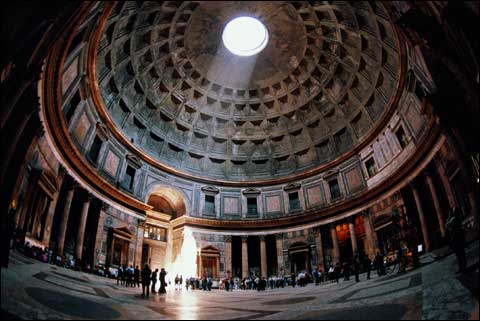
Equally impressive are the book’s descriptions of ancient technology in action. Although, thanks to the wide-ranging nature of the sources, these cannot always provide such precise information on the nature of the evidence, they present a vibrant picture of life in the ancient world, allowing the reader to learn about both the better known aspects of daily life, like make-up and gladiatorial arenas, and the less well known, such as the corpse-mellification (preserving it in honey) of the title. My personal favourite, because I once spent a summer cataloguing the cement library at RMC (Ready Mixed Concrete) Rugby, was the excellent section on Roman concrete.

The Pantheon in Rome, a masterpiece of ancient design and concrete

One other aspect of the book that I, as a Classicist, particularly appreciated was León’s careful and precise attention to language. Going well beyond the usual descriptions of how the English word ‘geography’ derives from the Greek words for ‘earth’ and ‘write’ and so on, León includes many references to the precise vocabulary of the ancient world and to the meaning of each word in context for the Greeks and Romans, as well as pointing out common English derivations. This also provides an excellent foundation for anyone who wants to study the subject further.

(Though, while I'm on the subject of language - the book translates the name 'Heracles' as meaning 'the glory of Hera' and describes this as a 'puzzling non sequitur'. For anyone who's interested, the name is more usually understood as meaning something like 'glory because of Hera', or words to that effect: Heracles gained his great fame and kleos, glory, because Hera made his life so miserable and, directly or indirectly, forced him to perform so many glorious deeds).

Just as the ‘science’ side of the book covers science, technology and philosophy, the ‘superstition’ side covers religion, superstition and myth (which I am defining broadly as stories with a religious element for the time being, for simplicity’s sake). Whereas many of the ancients would have been equally likely to lump all the ‘science’ subjects together, eliding the differences between religio, superstitio (very different concepts in antiquity, though the dividing line can be difficult for modern scholars to draw) and myth does present a slightly distorted picture of ancient ideas about the world, particularly if the reader comes away with the idea that literary myth inspired the same sort of ‘belief’ as, for example, adherence to ancient methods of divination. However, this is perhaps inevitable, since the whole concept of ancient ‘belief’, so very different to and more pluralistic than the dogmatic religions best known in the western world today, is quite spectacularly complicated and it is not the purpose of this book to get into an academic debate about the nature of ‘belief’ (Paul Veyne’s Did the Greeks Believe Their Myths? is the place to start on the complexities of ancient ‘beliefs’).

The book also follows the current popular trend of describing ancient ‘science’ as something held back by religion and superstition, and tends to describe most beliefs and ideas as subscribed to by nearly everybody. This is somewhat contrary to the position I take personally – I tend more towards the argument that the extent to which people do or do not ‘believe’ in various ideas, particularly those on the more superstitious end of the scale, has not changed as much as all that, despite the rise of the concept of atheism (which was a very minor belief in the ancient world – Lucian lumped atheists as a minority group in with Epicurians, who had pretty similar ideas, and Christians – to an ancient thinker, abandoning the traditional gods for a single deity was in the same broad bracket as atheism!). You can read my thoughts on the subject in more detail in the conclusion to my PhD thesis, which is freely available online here (do skip to the last couple of sections of the conclusion, unless you’re very interested in ancient dreams!). However, the argument León follows is an entirely valid academic argument and, indeed, one of the more popular around at the moment – the fact that I like to be awkward does not detract from the meticulous research that has gone into the book.

Mellify is indeed meticulously researched, and introduces a wealth of material from across the ancient world. The book is divided according to geographical area. Although this has the disadvantage of disrupting the chronology of the narrative (again, unfashionably, I have a fondness for chronological arrangements!) it has the great advantage of providing a real sense of place and of the subtle differences in the cultures that surrounded the ancient Mediterranean. Since it can be far too easy to divide the ancients into very basic categories (Greek, Latin-speaking, Egyptian and so on) this gives the book a welcome extra dimension and enriches the picture of the ancient world that emerges.

Pythagoras again. I like him. Even though he made my life a misery in maths class.

In this book, León has compiled an eclectic mix of the most outrageous, exciting and generally interesting stories of the ancient world. In most cases, those that seem really unlikely are flagged up (in the best tradition of Herodotus, who is covered with perfect balance under both his titles, ‘Father of History’ and ‘Father of Lies’) and in some cases, León offers tentative guesses about the truth of the matter that, while hard to impossible to back up with evidence, are nevertheless fascinating and entirely plausible – it had never occurred to me that Pythagoras might simply have been allergic to beans! The book gives plenty of background to the historical places and periods it covers, and each chapter explains who it is talking about and their background even if they have appeared before, so the themed sections can be read out of sequence it you want to. A very enjoyable read!

Tuesday, May 11, 2010

The Roman Mysteries: The Dolphins of Laurentum (TV adaptation)

Another Roman Mysteries post already! I usually try to space things out a bit (unless they're actually on TV as Doctor Who is at the moment), but I'm still getting the hang of juggling the paid work and the proper-but-unpaid work, and I had this post ready drafted, so it's going out today. Upcoming attractions, when I get the chance, will include some more Stargate, another episode of Rome (as soon as I have time), The Mummy (which needs even more time!) and possibly an episode of Charmed, which I've never watched, but which appears to have some Greek goddesses in it...

Well, there’s no difficulty in telling Gaius and Marcus Flavius Geminus (otherwise known as Hugh Beringar) apart in this episode, as Captain Marcus turns up in a terrible state, with some kind of nasty disease and infected feet. He’s been shipwrecked in a tsunami caused by the eruption of Vesuvius (and, presumably, related earthquakes). This means we get to see our old ancient medicinal friends, maggots!

Lupus actually wants to hire an assassin to kill Venalicius, which is rather shocking. I mean, I understand the sentiment, but that’s still a pretty dire thing to try to do, especially for a small child. But then, I'm always peculiarly sentimental about small children. Don't even get me started on Thomas Hardy...

Just to add to Marcus' troubles, he is also horribly in debt, and Gaius can't help because his farm has been destroyed by the volcano. I love the way Flavia quickly recruits Pliny the Younger to help her smuggle her valuables to Jonathan’s house when the debt collector comes. Pliny comes off very well here. From his letters, it’s surprisingly difficult to get a sense of his character, since they were written for publication and are rather self-consciously literary and keen to show off. It would be nice to think that he was as he’s portrayed here – a bit bookish, a bit pleased with himself, but ultimately kind and generous. I doubt the real Pliny would have harboured seroius romantic intentions - the kind that are respectable for children's television - towards a poor Jewish doctor’s daughter though.

We also discover that Gaius and Marcus don’t just happen to be identical twins, narratively speaking, they’re identical twins for a reason! Gaius must pretend to be Marcus to save them from the debt collector. For some reason when I was younger I, and I think a great many other children, loved stories about identical twins (I was obsessed with the Sweet Valley High books and Sister, Sister on the TV. Come to think of it, that coincided with my dolphin phase...). I don’t know what exactly appeals to children so much about this idea, but something does, though unusually here it is adults who play the identity-of-the-twin game.

The children go to stay with Pliny by the sea, where they swim with the titular dolphins and Lupus, who was a sponge diver in Greece, tries to find treasure in a sunken wreck. The diving sequences are beautiful, taking full advantage of filming in the gorgeous blue Mediterranean sea and introducing a new, pseudo-Roman way of counting seconds, substituting ‘legionaries’ for ‘Mississippi’. I say ‘pseudo-Roman’ because this is English rather than Latin but I’m sure a similar Latin word would work just as well and it sounds much less out of place than ‘Mississippi’. Some of the CGI and photoshopping on the dolphin sequences is a bit dodgey though.

Miriam and Pliny the Younger

The eventual revelation concerning the relationship between Lupus and Venalicius is genuinely surprising, which is nice. Venalicius as a helpful person is also rather surprising, and his slow, agonising death from the bends is really horrible. In this version, Lupus’s father’s death was an accident and Lupus became mute through psychological damage – I’m not sure what happened to Lupus’ father in the book, but since Book!Venalicius cut Lupus’ tongue out it is unexpected to find Venalicius trying to help them and to see Lupus forgive him. Although, on the other hand, the greater the crime, the more virtuous the forgiveness, and it allows the first weight to be lifted from Lupus' mind.

Best thing of all about the episode though – actual spoken Greek! I still have trouble recognising spoken Greek but I suspect this was proper ancient Greek. I don’t think I’ve ever seen subtitles in a British children’s programme before – brilliant stuff!

Wednesday, April 14, 2010

Bill and Ted's Excellent Adventure (dir. Stephen Herek, 1989)

I have seen the future, and it will look and sound like the 1980s.

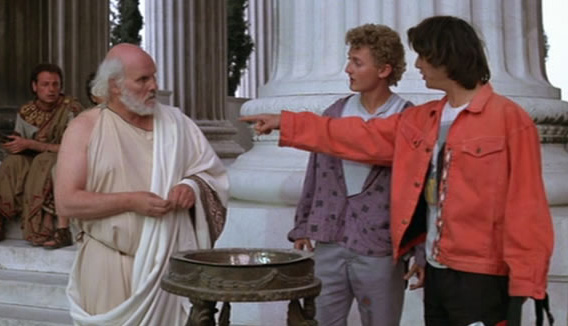
This is Bill and Ted's classic first cinema outing, in which a man from the future lends them a time machine so that they can interview historical figures for their history report, so that they won't fail senior year, Ted won't be sent to military school, and the society of the future, built on their rock music and their philosophy of 'Be excellent to each other and party on dudes!', will be secure.

Bill and Ted pick up a number of historical characters and drag them back to San Dimas, California, to do their oral history report (on what people from the past would think of San Dimas) for them. Luckily, with the possible exception of Napoleon, all the historical characters are so impressed by the time machine that they seem perfectly happy to do this. So, in preparation, for two hours Billy the Kid, Socrates (referred to by everyone as So-crates), Freud, Genghis Khan, Beethoven, Joan of Arc and Abraham Lincoln run amok in the shopping mall at San Dimas, several of them ending up getting arrested in the process.

The most awesome thing about this generally awesome movie is the languages - everyone speaks the correct language! People who would also speak English also speak English, those who would not speak English (pretty much just Socrates and Genghis Khan really, though Joan of Arc is pretty silent in general and Napoleon and Beethoven don't seem terribly strong in this regard) don't. I have to confess, unlike Latin, Ancient Greek is not a language I've heard spoken at all outside of class and I don't speak Modern Greek, so I can't actually tell whether Socrates is correctly speaking ancient Greek or speaking modern Greek - but it's some kind of Greek anyway! I love that such a fun, silly movie took the time to give everyone the right language, rather than the usual sort of excuse along the lines of 'the time machine translates for everyone/here's a machine that translates everything/here's a magic fish that translates everything etc. Even at the final report, this reality is maintained, and Socrates mimes his report on what he thinks of San Dimas while Ted 'translates', which is pretty funny.

Other awesome things about this movie include: the clever use of the time travel set-up, with a structure worthy of Steven Moffat, Bill and Ted's bizarre but somehow appealing vocabulary, the suggestion from Ted before he did his homework that Joan of Arc was 'Noah's wife' and Caesar was something to do with salad dressing, Billy the Kid picking up Bill and Ted's interesting use of language, Napoleon at 'Waterloo', Freud in general (especially his analysis of Ted's father), the scene where all the important historical figures help to do Bill's chores, the running joke about Bill's stepmother who was in school with the boys not long ago which eventually pays off as Bill tells Freud he has a 'minor Oedipal complex', Beethoven's updated music, the 80s soft rock in general (I'm a child of the 80s, I can't help it!).

I also love the phone box. I can never work out whether the writer/director knows Doctor Who and is deliberately making fun of the TARDIS, or if it's just a crazy coincidence, but the tiny phone box with all the historical figures crammed into it just doesn't stop being funny.

Socrates himself comes out of this movie very well. The more appealing parts of his philosophy are brought to the forefront and he likes Bill and Ted because they tell him that 'all we are is dust in the wind, dude'. Ancient Greece, according to Bill and Ted is 'most tranquil' and looked like a Led Zeppelin cover. Socrates, however, livens up considerably and throws himself into the adventure with gusto, helping to rescue Bill and Ted from a medieval executioner, making friends with Billy the Kid and declaring that he loves San Dimas at the end. It's great to see an ancient philosopher represented as a real, fun-loving human being rather than a dry old man who sits around doing nothing all day, and to see Socrates as a hero rather than an obscure background character. I like the way he and Billy the Kid make friends too.

It's interesting to see Greece representing the ancient world rather than Rome as well. A lot of the time, as you can tell from the relative use of my post labels, pop culture interests itself in Roman history, and Greek mythology. Greek history, with a few exceptions mostly involving Alexander, gets left out. Much as it would have been fun to see Caesar, it's actually rather nice that ancient history is represented, not by a Roman soldier, but by a Greek philosopher. As well as offering a change from the frequent appearances of centurions and reminding everyone that Greeks did do other things as well as tell good stories, this avoids an excess of military figures in the group. In fact, the selection of figures in general shows a lovely cultural spread, including plenty of artists and thinkers, not just military leaders and fighters, which offers a really nice slice of life in the past, rather than the old succession of kings, dates and battles.

One less awesome thing about this movie - Socrates must have felt right at home in Bill nad Ted's group, since there are almost no women in it. In all of history, the only woman they thought interesting was Joan of Arc? Don't get me wrong, Joan of Arc is very cool, but even she falls down a bit when, in the mall, she throws herself into a workout seesion populated entirely by women. I guess it could have been worse - she could have gone clothes shopping - but she's clearly pigeonholed into an activity mostly engaged in by women, which doesn't seem right for Joan of Arc. Meanwhile, the only other female characters are the medieval 'babes' rescued by Rufus at the end and Missy the Oedipal stepmother - nothing wrong with them, they're funny, but this means women are chiefly relegated to sex objects. It was 1989 - they couldn't have been a bit more enlightened than that and picked up Elizabeth 1st, Queen Victoria, Cleopatra, Pochohontas or Marie Antoinette (who does get a mention in another, very boring, report)?

That's a minor gripe though - this film is totally silly, but absolutely hilarious and actually a pretty good way of drumming some history into kids without them even realising that that's what you're doing. It also provided a great early role for Keanu Reeves - I don't care what anyone says about his acting, I think he's great and will not be gainsaid on this matter. They just don't make them like this any more, more's the pity...

The last line of this movie is also the best last line since 'Nobody's Perfect!' - as Bill and Ted make such awful noise on their guitars that my cat freaked out and thought we were under attack, their benefactor Rufus looks straight at the camera and reassures the audience, looking somewhat embarrassed, 'They get better!'

Wednesday, September 2, 2009

Buffy the Vampire Slayer: Restless

My thesis on dreams in ancient literature is slowly getting nearer to being finished, so in honour of this impending momentous occasion, I’m going to take a short break from blogging about Classics and blog about my two favourite appearances of dreams in TV drama – more specifically, science-fiction and fantasy. Buffy the Vampire Slayer and Star Trek: Voyager, two of my favourite shows, both did episodes devoted to dreams, so the next two blog posts will cover these: ‘Restless’ from Buffy, and ‘Waking Moments’ from Voyager. Normal Classics-centred service will resume after these two.

(Actually, there is some Classics stuff in this episode. The Voyager episode... not so much).

‘Restless’ was one of three gimmick episodes in the vastly underrated fourth season of Buffy the Vampire Slayer. I didn’t get into Buffy until season 4 was on BBC 2, so I have a fondness for it anyway, and I really like its lighter tone. I think long-running shows need a balance of dark and light and, if they’re going to tip a bit far one way or the other, I’d rather they favoured the light side, on the whole. I also think it does a pretty good job of looking at the scaryness that is going to uni for the first time, and I was sad that the university was so completely dropped from the later seasons (I think its good to have a mix of characters, so Buffy dropping out to join Xander and Anya in the real world was OK, but Willow and Tara seemed to almost give up on it as well).

When SFX ranked every episode of Buffy from best to worst, both the best and the worst were in season 4 – ‘Hush’ (best) and ‘Beer Bad’ (worst). I disagree with them on both counts (for best I’d have gone for ‘Becoming Part 2, with ‘The Gift’ in second place, and for worst, a tie between ‘Hell’s Bells’ and ‘Seeing Red’, both of which I refuse to watch) but it shows the mixed reactions season 4 tends to provoke. Unusually, it’s the gimmicky episodes that tend to draw the highest praise – ‘Hush’, with much reduced dialogue, ‘Superstar’ is an alternate universe episode which is quite well thought of, and ‘Restless’, an episode almost entirely made up of dream sequences with which Whedon chose to round out the season, in place of the usual massive climactic fight (shifted here to the penultimate episode). And it’s brilliant, because it’s unusual, intriguing and, most importantly, very funny as well.

‘Restless’ opens with our heroes coming back to Buffy’s mother’s house for some R&R following their latest victory over evil (I always wondered just what they do after these things). Xander’s idea of a relaxing movie is Apocalypse Now, and they all fall asleep in front of it.

The first dream we see is Willow’s. And – yay! – it opens with an actual Classics reference! Willow and Tara are in Tara’s room, and Willow is painting Tara’s naked back with Greek poetry. The poetry she is writing is Sappho’s 'Hymn to Aphrodite' (Fragment 1 of Sappho’s works – Willow is soon going to run out of space if she wants to copy the whole works). Sappho is one of the absolutely miniscule number of pre-Christian female writers whose work has survived (in fragments; the other reasonably well known woman, also a poet, is Sulpicia) and is the most famous, known for her love poetry addressed to women (hence ‘Sapphic’, and ‘lesbian’ is derived from the island of Lesbos, where she lived). Aphrodite is the goddess of love, so this is a particularly appropriate poem for Willow and Tara, beautifully rendered in capital letters, the way ancient Greek is preserved on papyrus fragments (before it is edited into something much easier to read!). Willow explains how safe she feels with Tara, but she is soon on the move, taking part in a bizarre production of Death of a Salesmen. Whedon has gone on record as saying that everything in ‘Restless’ is symbolic of something, except for the fabulous Cheese Man (‘I wear the cheese. It does not wear me’). On the DVD commentary, he explains the significance of the red theatre curtains, which are very Freudian. To be honest, I hadn’t noticed that before, and now that I know, it just looks crude and a bit icky – less subtle than Austin Powers eating a sausage. I prefer the Sappho.

You can actually read the Greek - it's very cool

If anyone can tell me what Harmony’s milkmaid outfit symbolises, I’d be very grateful!

Everyone keeps telling Willow to take her costume off, and she is confused, until Buffy rips off her season 4 hippy chick bright clothes and reveals her season 1 ‘softer side of Sears’ outfit (what is Sears? What is it’s softer side? Why do American’s find this so funny??!!) complete with season 1 longer, darker hair (which Anya refers to as 'a Greek tragedy'), in a classroom from the dearly departed Sunnydale High School. The symbolism here is pretty darned obvious (Willow is afraid everyone, especially Tara, will see through her cool new costume to the geek within). It does contain Xander’s classic allusion to the magic=sex metaphor that’s been running through the whole season though – ‘Sometimes I think about two woman doing a spell, and then I go do a spell by myself’.

Xander’s own dream has more of this delightful male obsession, as the camera swoops away from Willow and Tara’s first implied kiss to focus on Xander’s stunned face. I’m glad their first onscreen kiss wasn’t here though – much as I dislike ‘The Body’ (too depressing), their kiss there is much more touching and natural.

Xander’s dream follows Willow’s as Willow is attacked by a mysterious, savage figure. Sex is pretty prominent feature in Xander’s dream (surprise surprise) as it opens with Joyce trying to seduce him before moving to a playground where Giles and Spike are playing on the swings and Buffy is in the sandpit. Giles says Spike, rather amusingly dressed in tweed, is like a son to him and that he is training him to be a Watcher. Xander says he was into that for a while, but has moved on to other things, and he goes to join Anya in the ice cream van he has been working in – which is where Willow and Tara show up. The best bits of Xander’s dream are yet to come though, as first he finds Giles and Anya, on the UC Sunnydale campus, speaking French which he can’t understand (but which gives me an opportunity to practise, excellent) and then wanders into his own personal Apocalypse Now, with Snyder as Colonel Kurtz (which all made a lot more sense once I had seen Apocalypse Now). Xander’s dream is mostly about questioning where he’s going, since he (along with Anya) is not in college, as the girls are, and ending up back in the basement, where he is attacked by the savage figure.

Whedon explains in the commentary that the dreams are supposed to get creepier as they get along. I’m not sure if this is what he was referring to, but the beginning of Giles’ dream, with Buffy, and a watch, and Giles saying something very odd about women and men, is definitely creepy. Luckily Spike turns up pretty quickly, doing some hilarious poses for a group of photographers and admirers. Then it get even better – the undoubted highlight of the episode (apart from the Cheese Man) is ‘The Exposition Song’, in which Giles explains that their spell in the previous episode has angered a primal force, and adds a final line asking Xander to please not bleed on his couch, as he’s just had it steam-cleaned. As the savage figure scalps him (in a shot that looks just like Sylar’s MO from the much later Heroes), he realises who it is – the First Slayer, who ‘never had a Watcher’.

The First Slayer, complete with spooky skull-effect make-up

Finally, we get to Buffy’s dream, much of which foreshadows the arrival of Dawn at the beginning of the next season (not that we all knew that at the time). As Buffy wanders though the dream (they all wander from set to set, taking advantage of the layout of the main Buffy sets at the studio), she sees her mother living in the walls (which is definitely creepy) and Riley and Adam planning world domination via the medium of coffee makers that think (which is hilarious). Eventually Buffy ends up in the desert, where she fights the First Slayer, first with weird prose poetry (‘I walk. I talk. I shop. I sneeze. I'm gonna be a fireman when the floods roll back. There's trees in the desert since you moved out, and I don't sleep on a bed of bones’) and then with, you know, fists. Eventually, Buffy just gets fed up and decides to wake up, and somehow, everyone is safe.

(Pedantic whinge of the day: the spell in question names the four of them as four parts: Spiritus=Spirit, Animus=Heart, Sophus=Mind, Manus=Hand. Oh. Dear. For starters, ‘sophus’ is Latinised Greek, while the rest are Latin, and Buffy apparently incants a spell in Sumerian. ‘Sophos’ is Greek for wisdom, not mind. ‘Animus’ is a Latin word referring to the logical, rational part of the soul (as opposed to ‘anima’, the emotional part of the soul) and it can also mean ‘heart’. ‘Spiritus’ is closer, meaning breath of life or spirit, and ‘manus’ as hand is fine.)

I love ‘Restless’ I think its weird and wonderful. It was also a lot of fun, the first time round, watching it again after seeing season 5 and seeing what elements foreshadowed elements of that season.

The dreams in ‘Restless’ are all, of course, symbolic – no message dreams here. Although Whedon goes to a lot of effort to make them really bizarre, like real dreams, and includes the Cheese Man to ensure there is at least one random element, the level of symbolism in these dreams marks them out as being purely literary. They’re like puzzles for the viewer to figure out (some of which, I confess, I have yet to figure out myself – others are more obvious). ‘Restless’ is a very self-conscious piece of writing. Even leaving aside the fact that these are all dreams, and the science-fiction aspect of the concept, these are still not the sort of dreams a person might really have, even if they look more like them than a lot of fictional dreams do. They are also, since the show is technically in the horror genre, relatively creepy. This all contrasts strongly with the use of dreams in the more ‘science’-oriented Voyager – of which, more later...

Wednesday, June 10, 2009

Buffy the Vampire Slayer: Giles the classicist?


An explanation for this post: I've been presenting at a multi-disciplinary poster conference all day. My thesis is on whether Romans believed that dreams might foretell the future or provide a way to communicate with gods or the dead. Several times today, people asked me whether I believe that dreams can tell the future. Slightly flustered, I tried to answer, while also trying to explain that that isn't what my research is about - I'm not looking at whether dreams might be divine or not, but whether Roman writers thought they might be divine or not.

Anyway, after an (exhausting!) day of presenting, I thought I'd write a blog about a representation of a Classicist in popular culture. Except I can't think of any! There are plenty of archaeologists, a few scattered Classics teachers, but no professional researchers who are Classicists or ancient historians (or historians either). Its no wonder no one knows what I do for a living.

So the closest I could come was Giles from Buffy the Vampire Slayer. Giles works in heritage management (he used to work in 'a British museum, or the British Museum, I'm not sure' - Willow, 'Welcome to the Hellmouth') but his knowledge of ancient languages suggests he must have a classics background, so he's as close as I could get.

When Giles first appears, he seems to be the worst sort of British stereotype - always in tweed, uncoordinated, useless at fighting etc. All that changed in 'The Dark Age', when his dodgey past as a dabbler in dark magics is revealed and he suddenly gains a whole bunch of fighting skills he never had before. Giles is always at his coolest when he's being his nastier alter ago, Ripper - as when he reverted to teenagehood (and his own accent instead of the fake posh one) in 'Band Candy' and when he coldly murders Ben in 'The Gift'. What it says about me, that these are the bits I like, is probably best left unexplored!

As a lone Brit in America (well, except for Spike) Giles gets some great one liners. Two of my favourites are:

'I just think it's rather odd that a nation that prides itself on its virility should feel compelled to strap on forty pounds of protective gear just in order to play rugby' ('Some Assembly Required')
'"Do you like my mask? Isn't it pretty? It raises the dead!" Americans!' ('Dead Man's Party')

Unfortunately for me, if Giles was studying dreams in ancient Rome, he really would be looking to find out whether dreams actually do predict the future. Ancient texts in Buffy (as in most sci-fi and fantasy shows) are used to find out how the magical thingummy of the week works. The ancient text is always absolutely accurate and our heroes are always able to translate it precisely (see earlier post-come-rant on Night at the Museum 2). In my (real) world, no ancient text can be precisely translated, they are very rarely accurate and regularly tell outright lies, and I have yet to discover an ancient artefact or spell with actual magical powers. But I guess that just isn't very interesting!


'Xander, don't speak Latin in front of the books!'
Giles, 'Superstar'

Sunday, June 7, 2009

Yes Minister: The Bed of Nails


Since the news is full of nothing but MPs at the moment, I thought I'd blog about Yes, Minister, a sitcom which often seems to be talking about the exact same things that are in the news, despite the fact it was made nearly 30 years ago.

(I wanted to look at some of the Classics-inspired Original Series Star Trek episodes, but apparently only Americans are allowed to watch them online. I don't have them on video, and being a cheapskate, I only have 5 TV channels, and they're not on. So those will follow as soon as I manage to beg, borrow or steal the episodes!)

Jim Hacker has been offered a job working on Transport issues and Sir Humphrey is explaining to him why its a completely terrible idea (thanks to Wikiquote):
Hacker: Sir Mark thinks there might be votes in it, and I do not intend to look a gift horse in the mouth.
Sir Humphrey: I put it to you, Minister, that you are looking a Trojan horse in the mouth.
Hacker: You mean if we look closely at this gift horse, we'll find it's full of Trojans?
Bernard: Um, if you had looked the Trojan Horse in the mouth, Minister, you would have found Greeks inside. Well, the point is that it was the Greeks who gave the Trojan horse to the Trojans, so technically it wasn't a Trojan horse at all; it was a Greek horse. Hence the tag "timeo Danaos et dona ferentes", which, you will recall, is usually and somewhat inaccurately translated as "beware of Greeks bearing gifts", or doubtless you would have recalled, had you not attended the LSE.
Hacker: Yes, well I'm sure Greek tags are all very well in their way, but can we stick to the point?
Bernard: Sorry, sorry, Greek tags?
Hacker: "Beware of Greeks bearing gifts." I suppose the EEC equivalent would be "Beware of Greeks bearing an olive oil surplus".
Sir Humphrey: Excellent, Minister.
Bernard: No, well, the point is, Minister, that just as the Trojan horse was in fact Greek, what you describe as a Greek tag is in fact Latin. It's obvious really: the Greeks would never suggest bewaring of themselves, if one can use such a participle (bewaring that is), and it's clearly Latin, not because timeo ends in "-o", because the Greek first person also ends in "-o" – although actually there is a Greek word timao, meaning 'I honour' – but the "-os" ending is a nominative singular termination of a second declension in Greek, and an accusative plural in Latin, of course, though actually Danaos is not only the Greek for 'Greek'; it's also the Latin for 'Greek'. It's very interesting, really.
An extended clip is on YouTube, here, and is worth watching for the completely dumbfounded look on Hacker's face, and even Sir Humphrey starts edging away from Bernard as he really starts to warm to his theme.

Picking apart everyone's metaphors is one of Bernard's defining character traits (along with looking wide-eyed and saying 'Gosh!') so this is an exaggerated version of his character's usual behaviour - never use any kind of similie or metaphor when Bernard is around. Like Lister (see the previous post on Red Dwarf), Bernard has been thinking about the whole issue of whose horse it is and what we should really take away from this story, but with a somewhat fuller knowledge of Greek and Latin to back it up (so far as I can tell, everything Bernard says is correct). Beranrd's smile when he says its all very interesting is brilliant - he obviously thinks it is, while Hacker is completely lost and Humphrey just wants to get back to the point.

The joke about how Hacker would have recalled this if he hadn't gone to the LSE is, of course, indicative of the cultural hole many of us are trying to drag Classics out of. In Bernard's world, you can go to private school/some grammar schools (though not mine!), learn Latin and Greek, go to Oxbridge etc - as he and Humphrey have done - or you can go to a state school, not learn any Latin or Greek, and go somewhere else. (I don't remember them ever mentioning where Hacker went to school, but he is often mocked for having gone to the LSE rather than Oxbridge). Classics becomes something valued only by the upper and some upper middle classes and everyone else despises it, and the study of Classics slowly dies.

What many of us want to see is Latin and Greek reintroduced into *all* schools and everyone being able to study Classics if they're interested. This is partly what initiatives like Minimus are about. Eventually, the hope is, jokes like Bernard's would become obsolete and no one would get it any more.

OK, I promise I will try really hard not to start going off on one about the British educational system in my next post!