Showing posts with label British sitcoms. Show all posts

Wednesday, May 11, 2011

Classical Places in Popular Culture: Britain


The news had an item today about how Lonely Planet apparently gave Britain in general a bit of a pasting in its most recent Guide. The good news is, two places close to my heart seem to have come out of it rather well - Birmingham, where I've lived for more years in total than anywhere else in the country, and Bath (left), home of Britain's best preserved Roman remains.

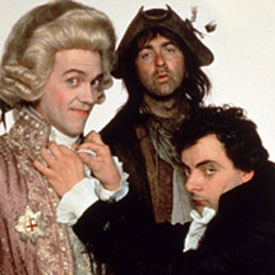
Britain was one of the furthest flung posts of the Roman Empire, and our Roman remains are, shall we say, not always that impressive. (I'm talking about England and Wales here, of course, since the Romans didn't get to Ireland - Northern or otherwise - or Scotland). There's a reason that Blackadder's Roman incarnation wondered why they were trying to keep the Picts out of the Empire by building a three-foot high wall. I'm not sure exactly what the problem was - presumably a combination of climate and looting by Anglo-Saxons and Vikings, who took the Roman bricks and stone to make their own buildings - but very few Roman ruins in this country come up any higher than ankle level.

Roman villa near Gloucester, with CurrentHousemate walking away from the camera!


Saxon church in Escomb, near Durham, built partly with Roman bricks and stone, identifiable by the diamond-pattern markings on them (viewed on an excrusion during this year's Classical Association conference).

In some places, there are reasonably impressive remains underground, which are dug up and then covered up with a somewhat dingy-looking corrugated iron hut thing.
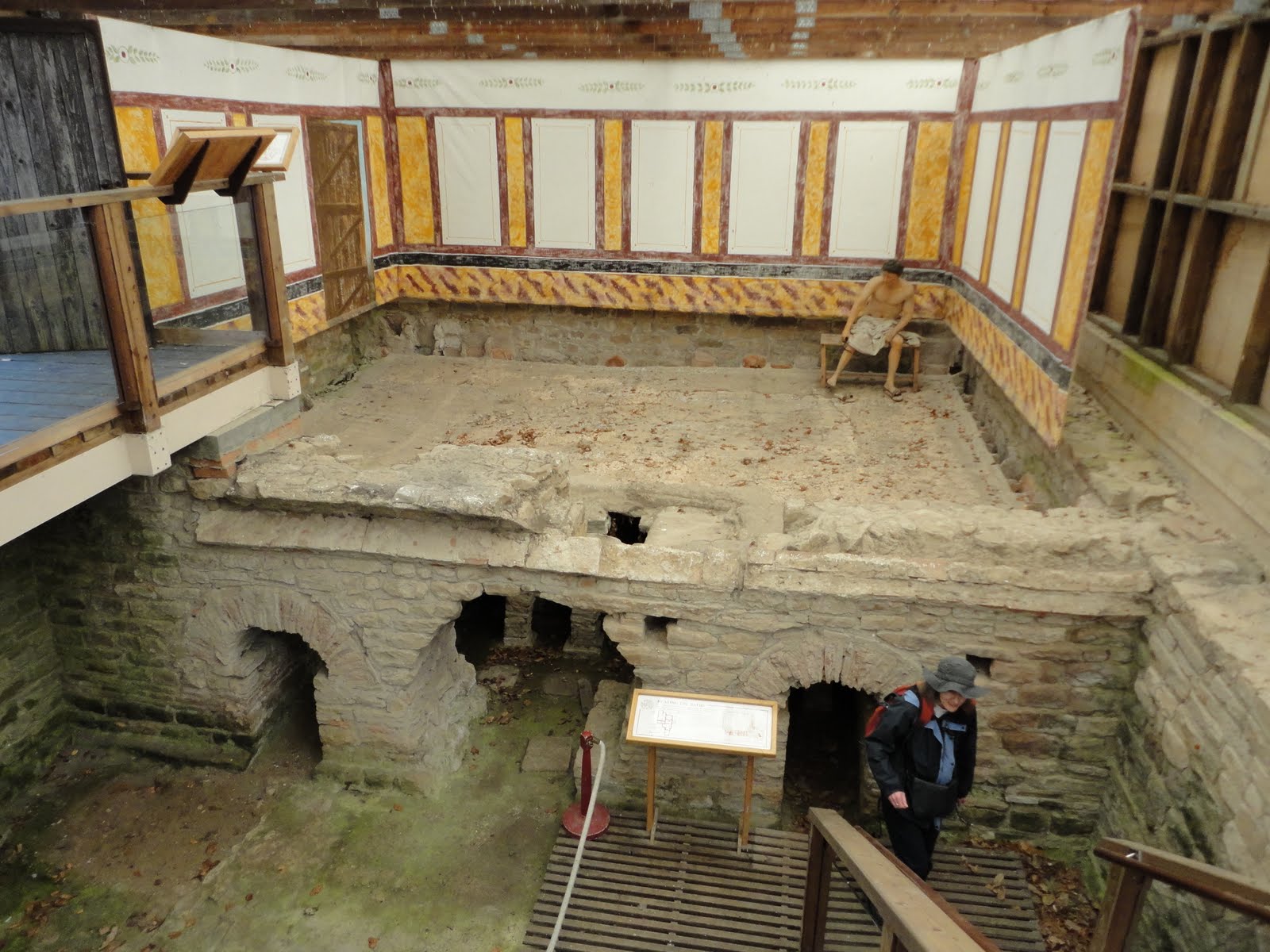
Interior of the best-preserved section of a Roman fort near Durham, also part of the CA conference excursion, with Claudius the plastic Roman in the top right hand corner


The exterior of this section of the fort, under this time wooden hut-thing, surrounded by less well-preserved sections

This is quite good though - follow a sign for a 'Roman mine' in North Wales and you'll never find it, though you'll probably get a very nice walk in the process and will almost certainly see some sheep.


We do have one spectacularly well-preserved set of Roman remains - the baths at Bath (so impressive we named the town after them). These are much better preserved, and although this preservation is due largely due to lots of later additions (especially Georgian, I believe) it makes the Baths that much more impressive to look at and they are the highlight of our Roman archaeological sites (along with Caerleon, which I haven't seen because I couldn't afford to go to the CA conference that year).


You're not allowed to dip your fingers in the water at the baths at Bath, so naturally, OldHousemate(theRomeone) and I did no such thing. Ahem.

With these being far and away our most visually impressive Roman remains, it's not surprising that if Roman Britain is required, programme-makers will try to get them in there - though few go to the lengths of Bonekickers, which kept Boudicca alive far longer than history did and in a different part of the country, just so that they could set their episode about Boudicca at the Baths, conveniently located near where they were filming at BBC Bristol.


I couldn't find a picture of them in the Baths specifically, because all the photos relating to this particular episode were from... my own blog. No one else is interested in Bonekickers. I don't blame them.

Most pop culture representations of Britain, however, don't bother with real Roman ruins, they just build sets and set stories in Londinium (London) or Camulodunum (Colchester), the major urban centres of Roman Britain. (Colchester has an excellent museum with Roman section, which I haven't been to since I was 10 years old, but it was very good). Just lately, they all seem obsessed with the probably-fictitious disappearance of the Ninth Legion north of Hadrian's Wall, in dark, wet, atmospheric Scotland (see Centurion, The Last Legion, The Eagle etc.).

This was the only picture of Scotland I could find on my computer (it's in Glasgow and when I was little I thought this actually was Sydney Opera House). Just pretend it's a dark, damp, atmospheric forest.

As you can tell from the pictures, the British climate is not quite like the Roman/Italian one and this is usually a major theme in depictions of Roman Britain. Every Roman who is ever sent to Britain, whether it's Kenneth Williams' Caesar, Lindsey Davis' Falco, a character from Chelmsford 123, or even Blackadder, will complain about how cold and wet it is. To be fair, they have a point (hence the mass exodus from Britain to the Mediterranean every summer) though for the record, I do have a friend from Texas who actually likes the climate here. It's not that terrible... really...


My birthday present from CurrentHousemate this year - note pouring rain in the background

As this picture reminds us, the most interesting use of the British landscape in a Roman-set story recently was last year's two-part Doctor Who finale, 'The Pandorica Opens'/'The Big Bang'. Rather than go hunting for some decent Roman remains and trying to build an episode around them, Steven Moffat took the whole thing even further - he simply went for the most impressive historical monument we have in this country and built an episode around that, on the quite sensible grounds that it was already there during the Roman period, so there was no reason not to go there with Romans.


Romans at Stonehenge!


Me at Stonehenge!

I love this double layering of history, like the ruined Roman villa in Britain where the lovers meet in the 2006 film version of Tristan and Isolde. And it's certainly a nice way to mix two of
the major elements of pre-1066 British history together.

All in all, Britain doesn't do that badly as far as pop culture Romans go, though in defense of my country, I would like to point out that the sun does shine here sometimes. Just not very often.

See? Sunshine!

Sunday, April 24, 2011

Up Pompeii! (dir. Bob Kellett, 1971)


Up Pompeii! was a television series which ran for a couple of years on the BBC in 1969-1970, with this film following in 1971. It was inspired by Frankie Howerd’s performance onstage as Pseudolus in A Funny Thing Happened on the Way to the Forum. This musical (there’s a film too) is very good and based loosely on some of Plautus’ actual surviving comedies from the Roman republic – I saw it years ago and don’t remember it very well, but it’s a good show. Up Pompeii!, on the other hand, is composed entirely of sub-Carry On humour (from Talbot Rothwell Carry On producer), mostly involving terrible puns and sex-mad, gorgeous women.

To be fair, this is not really that desperately far from Plautus. Plautus’ comedies are often a bit like Jeeves and Wooster in ancient Rome with added naughty jokes, except the young men are usually getting their slaves to help them get married to the right girl, rather than avoid marriage all together. Up Pompeii! does revolve around Lurcio’s attempts to help his effeminate young master get the girl and prevent a plot to assassinate Nero, but the emphasis is so much more heavily on sex jokes and so much lighter on Lurcio’s cleverness that it doesn’t feel entirely Plautine.

The plot, such as it is, involves a plot to assassinate Nero and the eruption of Pompeii, which tells you a lot – I don’t there’s much point discussing accuracy and inaccuracy here (Vesuvius erupted during the reign of Titus, over a decade after the death of Nero).

The way broad comedy like this tends to work is to think of all the main things people might know about ancient Rome – indeed, about the ancient world as a whole – and bung them all in, in the hope of raising a laugh. Nero is the best known of the mad emperors, so he usually makes an appearance (see also Doctor Who: The Romans) and of course the eruption of Vesuvius is one of the best known events from the whole Roman period, so the series was set in Pompeii and the film covers the eruption (see also Doctor Who: The Fires of Pompeii – not a comedy, but following the same principle of finding the most recognisable bits of ancient history to play with). Oddly enough, Nero is much more sane (and older) than usual, perhaps because the plot requires that we sympathise with those trying to prevent his assassination.

In the spirit of throwing in anything people might have heard of from the ancient world as a whole, the film also features a soothsayer called Cassandra who, of course, prophesies the destruction of Pompeii and, of course, no one believes her. Since Cassandras who prophesy truth no one believes pop up everywhere from an alien abductee in The X-Files, to a computer in Red Dwarf, to a girl with a heart defect in Buffy the Vampire Slayer, the fact that Cassandra is both mythical and Trojan probably shouldn’t bother us here.

This film springs from a particularly smutty period in British comedy (only three years later the Confessions... series of sex comedies began) so it is hardly surprising to see the traditional Roman orgy presented here in all its glory (statue peeing wine and gratuitous breasts included). The opening scene gives us Lurcio shopping for prostitutes to hire for the evening’s orgy and his master’s daughter is called Erotica, and the young female slave Scrubba. Not all the humour is smutty though, some of it’s just Christmas-Cracker level punning and lines like ‘Friends, Romans, countrymen, lend me your feet!’ (to stamp out lice).

The film does include some nice touches. I rather like the narration by a giant Lurcio, standing over a model of Pompeii complete with smoking volcano, and the joke about how they thought of having an intermission, but the film isn’t really long enough to bother (ancient-set epics having something of a tendency towards being very, very long and needing to provide everyone with a five-minute toilet break in the middle). I quite like Lurcio’s prison tunic with arrows motif as well. While in prison, Lurcio meets some condemned Christians, depicted as hippies, which is both amusing and somehow seems appropriate. And, of course, Lurcio and the Christians use a model horse made of a wine casket in their prison escape attempt (unfortunately they make the same mistake as Sir Bedevere and the knights, and forget to get in it).

Best of all is Nero's final line. As he and his female companion watch Pompeii collapse, it is implied he caused it, and he says 'wait till you see what I've planned for Rome.' Total nonsense (unless Nero has an alien device for blowing up volcanoes we don't know about) but somehow it works, and it realigns Nero with more usual representations of him.

On the other hand, the sex and gender humour is all hopelessly outdated, and Lurcio probably wouldn’t cover himself in soot and pretend to be a Nubian if the film were re-made today.

The final sequence of the film depicts the eruption of Pompeii (inaccurately, geologically speaking), an interesting choice for a comedy. Ludicrous Sextus (Lurcio’s master) and his family are caught in compromising positions, while Lurcio himself takes on a noble pose as the town collapses around him. We then see Howerd as a modern tour guide showing visitors Erotica in the middle of sex, Ludicrous in conversation and so on. We hear echoing voices of the Roman characters as their actors play their modern counterparts, which is almost touching and even a little sad, while funny too. I’m not really sure how completely successful this is – the death of hundreds of people is hardly a good subject for laughs – but it is certainly memorable. Perhaps the living modern characters lift the tone enough to make up for the large scale death and destruction.

Overall, though, this is the usual somewhat random hotch-potch of ancient Stuff with some interesting ideas. It was funnier than I was expecting (I laughed at least five times, which means it passes Mark Kermode's test for a reasonably successful comedy) but I suspect, really, it's just not funny enough to be good. Watch with alcohol and don't expect too much.

Thursday, March 3, 2011

Chelmsford 123: Heads You Lose


The second series of Chelmsford 123 brought a few changes - a new, more arty opening sequence, no Gargamadua (thank goodness) and a new blonde hairdo for Aulus. This opening episode is largely notable for featuring Chris Langham, the actor formally known for The Thick of It before his imprisonment in 2007, and Geoff McGivern, the original voice of Ford Prefect, in his new recurring role of Wolfbane.

As the episode opens, the sheep-shagging, bearded emperor is confirmed as the chronologically correct (though no doubt spinning in his mausoleum, as he never touched a sheep in his life) Hadrian, and he has ordered Aulus to organise the building of his famous wall, which Aulus feels is a waste of time because the Caledonians are famous for their ladders.

The most successful parts of this episode are those that combine post-modern playing about with actual knowledge of the Greco-Roman world. Aulus, for example, is struggling with authority issues and calls in a psychologist who, as a Freudian, is a good 1800 years ahead of his time, but, as a Roman period physician, is appropriately dressed as a Greek (most physicians were Greek or trained by Greeks). After Aulus has condemned Badvok to death for repeatedly breaking into his office, Wolfbane tries to persuade Aulus to let Badvok off by pretending to appear to Aulus in a dream as the Ghost of Next Week. This is quite a nice combination of Dickens' beloved A Christmas Carol and the genuinely Greco-Roman recurring trope of people being persuaded to do things by ghosts or gods in dreams.

One other example is, however, perhaps a little forced. Wolfbane, who is Welsh-sounding and appears to be a druid, tells Badvok at length the details of Roman mythology relating to the afterlife, which seems very odd - but this is largely so they can make a then-relevant joke about how the powers that be have been talking about building a tunnel under the Styx for years (the Channel Tunnel was still in the planning phases when this episode was made).

Overall, this is a pretty forgettable episode, and a somewhat disappointing start to Series 2. The episode ends with Badvok's execution and a voiceover joke about how the part will be played by Bonnie Langford from now on, but this is revealed to be a dream of Grasientus' at the beginning of the following episode. Exactly how much of this episode was supposed to be Grasientus' dream is unclear, but Badvok is alive, well and free when we next see him, so presumably quite a lot of it. One can only conclude that McGrath and Mulville had watched a bit too much Dallas before writing this one.

Wednesday, December 22, 2010

The Vicar of Dibley: Winter

The Vicar of Dibley was a BBC sitcom that ran intermittently between 1994 and 2007, following the introduction of a female vicar to a very traditional village in England (a new and controversial move in 1994 when it began). It was written by Richard Curtis, co-writer of Blackadder, and starred Dawn French as the vicar Geraldine, and had a beautiful theme song (The Lord is my Shepherd, set to music by Howard Goodall).

British TV series often have strange schedules and there is something of a tradition of doing really exciting plot developments during a one-off Christmas special, but The Vicar of Dibley got even stranger than most and this episode was one of four stand-alone seasonal specials. Although it's called 'Winter', it's actually the Christmas special and centres around Geraldine's attempt to do something really special with the annual Nativity play for the millennium.

The Nativity Play is a British school and church tradition, in which all the kids put tea towels on their heads and pretend to be living in Roman Bethlehem, and re-enact the Christmas story. Mary and Joseph are the leads (all the little girls want to be Mary), other speaking parts go to the first and second innkeepers (who have one line, 'No room!'), the innkeeper who provides the stable, three shepherds, three 'kings' or wise men and Gabriel. (The Magi are most often portrayed as kings, despite the historical inaccuracy, partly so they can sing 'We Three Kings' and partly so they can wear paper crowns). The other kids all have to make sure they have white sheets and stand at the back playing angels and singing 'Away in a Manger'. It's a brilliant tradition, which is great fun and which has occasionally been lampooned elsewhere, most notably in the play 'The Flint Street Nativity' and in Curtis' own Love Actually (where the nativity play, for some reason, includes at least two lobsters). I always got stuck as the incredibly boring Narrator in school, but I did once get to play Mary in a church procession.

The Love Actually Nativity was a bit *different*. An octopus was also involved.

In this episode, Geraldine's incredibly dim verger Alice actually comes up with a genuinely brilliant idea, which is to stage the Nativity play in an actual stable on a local farm. Complications ensue when the heavily pregnant Alice insists on being cast as Mary and goes into labour during the show. Hilarity and sweetness ensues.

Since the point of the outdoor Nativity is to be more realistic than usual, historical accuracy (or lack thereof) becomes something of an issue during the preparations. No one suggests the Kings should actually be Persian priests, because no Nativity is likely to bother doing that - we're all far too attached to the paper crowns etc. In fact, at one point Jim and Frank discuss whether they're wise men, who should help with the birth, or Kings, 'inbred cretins' who can't help with anything, according to Jim. But Geraldine does try to use historical accuracy to stop Alice from playing Mary, by insisting that Mary could only speak Hebrew (which isn't actually true, she would also have spoken Aramaic and possibly some Greek). Brilliantly, Alice responds in fluent Hebrew! This is a lovely moment, not to mention quite possibly the most intelligent thing Alice has ever done.

Geraldine's rehearsals follow the Mike Leigh method of improvising around the subject, which also leads to some interesting work. Alice suggests that 'loaves and fishes' is a family recipie, which is very funny, while she and the vicar both get a bit carried away improvising an argument between Mary and Joseph and the shepherds' improvisation seems to imply that everyone in ancient Bethlehem had access to BBC television.

The greatest amount of historical meddling, however, is down to David Horton, local politician, who wanted to be cast as God but has instead been cast as Herod (another speaking part often included as part of the Kings' story, though the massacre of the infants is not, in fact, commonly part of a Nativity play). David is not at all pleased with this and starts trying to suggest reinterpretations of Herod's character, insisting that history has misunderstood the man. His first suggestion to explain away the massacre of the infants is that some soldiers misheard what Herod said and misunderstood, which is a bit like Henry II's explanation for the murder of Thomas Beckett. (The soldiers in question appear to be dressed as Romans, even though Herod was a Jewish king and probably had his own guards - Romans are too much part of the cultural imagination of the ancient world to leave them out all together). During the play itself, he starts giving out sweets to all the children in the audience, trying to get them to like him (all this despite the fact his costume resembles that of Ming the Merciless). Best of all, he asks the soldiers to 'kill them gently!' The whole thing is entirely doomed - quite apart from his Biblical nastiness, the historical Herod the Great was a nasty piece of work with a tendency to have his own children put to death.

This is a lovely episode (albeit with one of those very clean sitcom childbirth scenes with hardly any screaming). The Vicar of Dibley is one of those nice, homey shows that always feels slightly Christmassy anyway and anything with Nativity plays in it always brings me right back to childhood Christmasses and the desperate search for some kind of blue headscarf to wear as Mary. I also genuinely like the idea of a farmyard Nativity, though historical realism can be taken too far - luckily Geraldine is at hand to reassure Alice that she hasn't, in fact, given birth to the Messiah.

Thursday, April 1, 2010

Blackadder the Third

There aren't many Classical references in Blackadder outside of the Romans' appearance in Blackadder Back and Forth, but Classics does crop up once or twice in the third series, most interestingly in the episode 'Sense and Senility'.

This episode revolves around the Prince's desire to get some elocution lessons from two rather annoying actors, whom Blackadder merrily tortures by saying 'Macbeth' as frequently as possible. Eventually, he is able to dispose of the actors entirely because Baldrick mistakes a play they are rehearsing ('The Murder of Prince Romero and his Enormously Bosomed Wife', if I recall correctly) for a genuine plot to kill the Prince. The Prince has no trouble believing this because he doesn't fully understand the concept of acting - and this is where Classics comes in. The Prince is convinced that, during the production of Julius Caesar he saw not long ago, Brutus actually killed Caesar, even though, as Blackadder points out, Caesar got up for the curtain call afterwards. Julius Caesar seems to have made an impression on the Prince - when he asks for lessons, he decides he must dress up in a toga, because that is what actors wear (and a silly moustache).

The reason for the toga is, of course, the Shakespeare play he has recently seen, but it is interesting that this, and Julius Caesar, are chosen to represent theatre in general. The toga itself is useful because it is so very different from Georgian period costume. Medieval or Elizabethan costume would be different as well, but to the modern eye, the difference between a medieval tunic, an Elizabethan doublet and hose and, er, whatever it is the Prince wears, although clear, is not so great. A toga, however, is clearly a very different and completely ridiculous thing for a Georgian to wear - the visual impact is greater, and therefore the joke works better.

Another factor is that the Prince needs to give a speech, which is partly why this is a useful play to use. Shakespeare's 'Friends, Romans, Countrymen' is, of course, very well known, but importantly, it is also written and performed as a speech, delivered to a crowd. The other famous speeches the actors mention ('to be or not to be' from Hamlet, for example) tend to be, in fact, monologues, delivered by a character to the audience in an ostensibly private setting . The speeches in Julius Caesar, however, are really speeches; the importance of public speaking in Classical literature is carried through into Shakespeare's play, and it is that which makes this play useful for Blackadder.

The other references to Classics are briefer. Pitt the Younger, as Prime Minister, calls on a Member of Parliament to test him on his Latin vocab in 'Dish and Dishonesty'. In addition to being historically accurate, since all schools for someone of Pitt's rank taught Latin at that time, this enhances the episode's depiction of Pitt's school as embodying all the worst and most cliched aspects of British public boys' schools - other jokes include references to a hot crumpet burning his cheeks with shame, and he doesn't mean the cheeks on his face. Finally, in 'Nob and Nobility', Blackadder refers to Baldrick's trousers as Pandora's Box - because if they are opened (or removed) all the evils in the world will come out. He doesn't make reference to the idea that only Hope was left in the box - where this detail would logically lead is probably best left to everyone's imagination!

(Blackadder the Third is, by the way, the series that plays with history the most - the first series claims to be an alternate history, and can do what it likes, the second messes around a bit but stays broadly within the reign of Elizabeth I and the fourth is really pretty accurate. In the third, on the other hand, we have the French Revolution (1790s), the Regency (1811-1820), Pitt the Younger (1783), Samuel Johnson's dictionary (1755) and the Prince's marriage (1795) all happening at once!).

Sunday, January 17, 2010

The Black Adder


Watched a couple of old episodes of this, the first series of Blackadder, at lunchtime today and spotted a couple of Classical/Ancient History references.

The first series of Blackadder, called The Black Adder rather than the one word surname 'Blackadder', gets a lot of stick for not being as good as the others. To some extent, this is true - Edmund himself is extremely annoying in this version and some of the humour is rather forced. Most of the problem, though, has more to do with the fact that the subsequent three series were all so amazingly good, culminating in, as I've said before, one of two contenders for Best Episode of a TV Comedy Ever Made, TM. But none of these half hours of greatness would exist without the original, which for all its flaws is still a perfectly good, at times hilariously funny and rather nicely filmed sitcom.

The first series also benefits from having the National Treasure, the fabulous BRIAN BLESSED in the regular cast as the fictitious King Richard IV (supposedly Richard of York, the younger of the two Princes in the Tower, not murdered by Richard III but alive and well and shouting a lot). BLESSED is as birlliant as ever, and since I saw this series after I saw I, Claudius, I am left with a vague impression that medieval England is actually being ruled by the Emperor Augustus the entire time.

The two episodes we watched today were 'Born to be King', in which Edmund (younger son of King BRIAN BLESSED) tries to have his elder brother Harry exposed as illegitimate, but ends up nearly exposing himself as same instead, and 'The Archbishop', in which Edmund is forced to become Archbishop of Canterbury and make rich, dying men leave their lands to the Crown instead of the Church. 'The Archbishop' is, I think one of the best episodes of this series (the other great one is 'The Queen of Spain's Beard', which stars Miriam Margolyes as a nymphomaniac Spanish princess and Jim Broadbent as her amusingly-voiced interpreter). It features false relics (Baldrick produces items made by Jesus as a carpenter which include crucifixes), curses ('may your head fall off at an inconvenient moment') lots of descriptions of Hell from over-enthusiastic churchmen ('Alas, spare my posterior!') and some very naughty nuns ('you wont be wanting to unicorn tonight, then?'). There are also a couple of jokes about increasing numbers of Popes that would be accurate, if they weren't a few decades out.

Anyway, the ancient references are pretty small and unimportant, but there you go. In 'Born to be King', Edmund plans to murder a Scottish rival by having him play the part of the murder victim in a play set in Ancient Egypt, incorrectly referred to as a mystery play. A mystery play is a play which tells a religious story, usually a Christian story from the Bible, but this doesn't sound like anything Biblical, and it certainly isn't by the time they've inserted the role of the Scotsman. It's vaguely amusing seeing the medieval Scotsman with Egyptian headress, but not really that significant to the episode. In 'The Archbishop', celebrating what he incorrectly believes to be Harry's impending doom, Edmund dresses in an elaborate costume which includes a 'Trojan' helment. The helmet in question doesn't really look very Trojan - it's sort of pointy, but that's about it - and the centrepiece of the costume is actually the Russian codpiece, which is quite something. It's interesting that 'Trojan' was chosen though - presumably it sounded suitably exotic.

There is one other vageuly Classical reference. As Archbishop Edmund tries to persuade a dying man to leave his lands to the Crown, he says the man can't have done anything that bad. Unfortunately, the dying noble in question turns out to have a really, really bad Oedipus complex - having already confessed to killing his father and committing adultery more than a thousand times, he adds that said adultery was comitted with his mother. It is this revelation that causes Edmund to change tack and, rather than persuading the man that he will get into Heaven anyway, convinces him instead that Hell is much more fun and he will be better off there. Contrary to Freud's idea, that Sophocles' play is so moving because everyone shares the Oedipus complex, I would say this is an excellent example of why the opposite is true - Sophocles' play can move many different people from different cultures because they are all equally horrified by it, and Oedipus' deeds are still considered in most societies to be the ultimate example of acts that are completely beyond the pale.

Thursday, January 14, 2010

The Brittas Empire: Not a Good Day


The Brittas Empire was a slightly surreal - at times very surreal - British sitcom that I absolutely loved in the 90s. It focussed on the well-meaning but inept manager of a local leisure centre, Gordon Brittas (Chris Barrie from Red Dwarf), who had a dream to unite the world through sport but whose dream was continually interrupted by his own tendency to drive everyone around him completely insane with anger.

'Not a Good Day' was the first episode of the fourth series, and storylines included Sebastian Coe MP being chained to a stair rail, Carol's toddler Ben running amok in the ventilation system and having to be coaxed back like a wild animal and one woman and her daughter actually having a really nice day at the leisure centre - possibly a first. The storyline I want to talk about though, involved the centre coming under attack from the Tenth Legion, some Carthaginians and an elephant...

The Classical War Society, a battle reenactment group, are apparently re-enacting the Second Punic War in the grounds of the leisure centre. While they are outside, Brittas places the 8-yr-old son of a centurion under citizens' arrest for refusing to pay the 20p entrance fee for the swimming pool. When Brittas refuses to release the boy, the centurion calls all his friends and the entire society attack the leisure centre with arrows, missiles flung from catapults (or possibly trebuchets, but I think they're catapults), siege ladders and a battering ram. Various staff members mention that these are apparently mostly the 10th Legion, with some Parthian mercenaries, and the Carthaginians they're fighting, with an elephant. I'm not that hot on military history so I don't know if those names match, but I'm sure someone will tell me. I am reasonably sure that the Praetorian Guard, no matter how highly trained, probably shouldn't be at the back, since they were imperial guards, from long after the Punic Wars.

The really funny thing about all this, of course, is that Brittas and his staff get to say lines like 'There's a centurion to see you' and 'We're being attacked by Romans!'. The police refuse to come to the centre 'again this week', and the Romans eventually break in by catapulting the engine of a Morris Marina through the window and breaking down the doors with a battering ram with a lion's head on the front.

The best bits of this episode are where we see the crazy goings-on - the enraged centurion with his old-fashioned big glasses, the group of Romans with their catapult, Linda defending the centre with a bow and arrow, presumably used for archery within the centre. What's a shame is that, as ever on a BBC budget, we don't actually see most of the action once the group outside gets really big - it all has to be described as if in a radio play. On the other hand, this means they can get away with lines like 'they have an elephant!' without the utter ludicrousness of an elephant in a British leisure centre sending the whole thing into complete insanity.

An elephant. Not actually seen in The Brittas Empire.

I enjoyed this episode very much. The idea of Roman legionnaires attacking using an internal combustion engine is somehow especially amusing, and the way everyone talks about the battle reenactors as if they were actually Romans keeps the humour level high. I won't join in with some of the jokes made at the expense of battle reenactors, since people who go to Star Trek conventions shouldn't throw stones, but the whole idea is really very funny - and the scene at the end where the woman who has had a great day, apparently completely oblivious to the chaos around her, thanks Brittas and tells him how he must be used to getting praise and presents from customers, is the cherry on top of the cake.

Tuesday, December 1, 2009

Yes, Prime Minister: The National Education Service

Another bit of dialogue from Yes, Prime Minister (basically, the last two series of Yes, Minister, in which Jim has been promoted!) which I talked about briefly during my paper the other week:

Hacker: That's not the point. Look at Latin. Hardly anybody knows that now.
Humphrey: Tempora mutantur, nos et mutamur in illis.
Hacker: What?
Humphrey: Times change and we change with the times.
Hacker: Precisely.
Humphrey: Si tacuisses, philosophus manisses.
Hacker: What does that mean?
Humphrey: If you'd kept your mouth shut, we might have thought you were clever.
Hacker: I beg your pardon?
Humphrey: Not you, Prime Minister. That's the translation.
Bernard: No one would have thought Sir Humphrey was saying that about you.
Humphrey: Go away, Bernard, please.
Hacker: I can't believe it. You had a strict academic upbringing. Are you denying the value of it?
Humphrey: What's the use of it? I can't even call upon it in conversation with the Prime Minister of Great Britain!

Hacker has been arguing that the edcuation system needs reform, but Humphrey disagrees, so ends up slighting his own classical education while at the same time reinforcing his conviction that he much cleverer (and much better educated) than Hacker. He does it agian a little later, when Hacker says 'QED' and he can't resist adding 'quod erat demonstrandum'. I've talked about classics and the British education system before: like Jim Hacker, I would love to see more Latin taught in schools and prevent it from being something valued only by the rich and privileged.

The brilliance, and at the same time, the most depressing thing about Yes, (Prime) Minister is that you can choose any epsiode at random and the chances are, it will be discussing something that is still an issue today. We have moved on very little from the early 1980s (except in certian areas - it's actually quite encouraging to remember that apartheid has ended and Northern Ireland is in a much better state than it was when I was a child). For the most part, though, we are still having exactly the same arguments as we were back then, and this is one of them. I think we've made some progress though, and hopefully the best is yet to come!

As a random aside, while looking for this quote, I also found this on Wikipedia:

Quidquid Latine dictum sit altum videtur - "whatever has been said in Latin seems deep". Or "anything said in Latin sounds profound". A recent ironic Latin phrase to poke fun at people who seem to use Latin phrases and quotations only to make themselves sound more important or "educated". Similar to the less common omnia dicta fortiora si dicta Latina.

This made me laugh. Very true, and something I'm looking into at the moment - the bizarre notion that things sound more important in Latin. Part of the subject of a paper I hope to write soon...

Monday, September 21, 2009

Red Dwarf: Psirens

I had hoped to do a proper re-cap of the next episode of I, Claudius yesterday (it's a particularly good one!) but the thesis is still not as far ahead as it needs to be, so I had to put it off. So, to cheer myself up, here are some reflections on a sixth series episode of Red Dwarf.

'Psirens' is the first episode of series 6 and features one of Red Dwarf's periodic reconceptualisations of the show - at the beginning of 'Psirens', we find out that Red Dwarf itself has been stolen (or possibly Lister just can't remember where he parked it) and the crew have therefore lost Holly, and are on a mission to recover both it and her(/him). They are following the ship's vapour trail, which requires them to fly through an asteroid belt.

In the belt, they find evidence of crashed ships and a message scrawled with the victim's own intestines ('someone who badly needed a pen') - PSIRENS. The following conversation ensues:

LISTER: This entire belt is swarming with some kind of genetically engineered life form who can alter your perception, telepathically. They're called Psirens. Like with Ulysses in that ancient Turkish legend.

KRYTEN: I believe the legend was Greek, sir.

LISTER: Whatever. Some country big on curly shoes and hummus. The point is, they use this power of illusion to lure you on to the asteroids, strip the ship of anything they can use and suck out your brains.

RIMMER: They shouldn't bother us, then. There's barely a snack on board.

KRYTEN: We can't turn back. We'll lose Red Dwarf.

LISTER: Look, we'll be through the belt in three, maybe four hours. We've just got to be on our toes. They'll try and tempt us, scare us, break our morale - anything to force us down on to the rocks. Just be alert.

The script I pulled from the internet said 'hummus' but I always thought I heard Lister say 'eunuchs'...

Odysseus (Ulysses in Latin) listening to the Sirens while tied to the mast of his ship: the other crew have stopped up their ears (mosaic from Bardo Museum, Tunis)

Obviously this is based on the Sirens, one of the best known Greek myths. In mythology, it was the Sirens' song that lured sailors onto the rocks (their appearance is less important, though they are often depicted with wings). These Psirens (the silent 'P' tells you it's Greek, like 'psychology'!) are a little more sophisticated - they can appear in many different forms in order to get you to come near enough for them to suck out your brains. So, for the Cat, they appear as a group of women who have lost their men and need seed-spreaders (a set-up which also has a basis in Greek mythology), for Lister, they appear as Kochanski, who has used his DNA to have twins called Jim and Bexley (after Jim Bexley-Speed; I have to confess, I would never have recognised Clare Grogan as Kochanski if Lister hadn't said so, she looks so different here!), and for Kryten, one appears as his creator, whose every order he must obey.

Although the Psirens appear in various forms (usually beautiful women) their true form is as large, insectoid, beeping monsters, resulting in a delightful scene where Lister, feeling desperate after being deprived of sex for more than three million years, snogs one. (Apparently Craig Charles had complained that it wasn't fair that Rimmer got all the action in series 5, since his character was dead, and this was the writers' response).

Somewhat grainy image of a Psiren from the crashed ship's black box recording

Lister and the Cat (the only crewmembers who have edible brains) are eventually saved by Kryten - the Psiren thought she had got rid of him by having him crush himself in the waste disposal unit, but all it does is make him cube shaped.
Red Dwarf used aliens which could appear as anything as plots several times over the course of the series (most successfully in 'Polymorph', but 'Polymorph II: Emohawk' was pretty funny too). In this case, the focus on the sexual lure of the Psirens gives the episode a slightly different focus and keeps it fresh (plus the fact that there are several of them). The Psirens don't work only through sex - in one very funny scene, one of them poses as Lister and reveals itself by actually playing the guitar well - but it seems to be their favourite method of attack. The Sirens of classical mythology aren't particularly sexy (unless wings turn you on) but they have become associated with sexyness over the years, as their irresistable call has been interpreted as a sexual lure. If I had more time, I'd look into exactly how that happened - I suspect it involves Romantic poets. Anyway, this is pretty good episode - perhaps it suffers in comparison to the same series' 'Gunmen of the Apocalypse', but it's funny and it introduces us to the show's new format, with added danger and tension as a result of the need to chase Red Dwarf, very effectively.

Tuesday, July 21, 2009

Blackadder: Back and Forth

This clip is from the Millennium special episode of Blackadder, Blackadder Back and Forth, which was made by Sky and the BBC and shown at the Millennium Dome, and later on Sky.

Back and Forth was able to revisit some old favourites (Queen Elizabeth I) and go to some periods the original four series (and two specials) missed out, as Blackadder and Baldrick try to learn to steer a time machine built by Baldrick according to a design by Leonardo da Vinci (nice touch - if anyone could ever be capable of inventing a time machine, it would be Leo!).

Blackadder and Baldrick discover their distant ancestors guarding Hadrian's Wall from the Scots (which is inaccurate by the way - the Scots came over from Ireland later, Hadrian's Wall actually kept out the Picts. So any and all jokes about Scottish people - red-haired etc - are all out too).

My favourite joke No 1 - Blackadder wonders why they are trying to keep the [Picts] out by building a three foot high wall. Roman remains are not well preserved in Britain - villas are usually reduced to a few buried walls and mosaics. I haven't been to Hadrian's Wall, but I believe (from photos) that it has survived in a somewhat reduced state. I suspect the original wall was a little higher.


A typical Roman ruin in Britain - this is a villa near Gloucester, which we stopped off at after going to the annual cheese-rolling one year.

My favourite joke No 2 - Hugh Laurie appears in a very, very short skirt, then Stephen Fry appears in his pants. Basically, each man's tunic is shorter than the last. Luckily, Baldrick appears to be wearing the longest tunic.

Stephen Fry praises the others for practising their 'English' - like Chelmsford 123 (an old C4 sticom, posts on that to follow at a later date), the conceit is that 'English' is the local langauge of the Romano-British (actually 'British' would have been a Celtic langauge - see Dr Who post).

Fry's character is a distant ancestor of his General Melchett, from Blackadder Goes Forth (and , presumably, of Melchett from Blackadder II, though he is more similar to the General). He switches to speaking in Latin (yay!), pronounced in the modern way (vs as ws, hard cs) and explains that Rome is under attack and all the Emperor has done is poison his mother (based on Nero, who tried to drown his mother and then had her stabbed to death) and marry his horse (loosely from Caligula, who thought about making his horse a senator, but twisted over time - I'm planning to write a paper on that subject for the CA conference next year). He finishes with my favourite joke No 3 - converting WW1 General Melchett's favourite expression, 'Baaaa!' to 'Baaaaa-us!'

Then they're attacked by 'Scots', who are referred to as Rod Stewart's ancestors and look like extras from Braveheart. Sigh.

It's a shame Blackadder didn't do more in the Roman period - I think the political world of ancient Rome would be perfectly suited to his scheming and conniving. It would have ruined the forward momentum of the series though, and series 2, 3 and 4 are so good I wouldn't want them changed (and even series 1 has it's moments - Jim Broadbent's Spanish translator is genuis and the Archbishop of Canterbury episode is great). At least we have this clip, and anything that provides a slightly more entertaining way to revise Latin has got to be a good thing!


Hugh Laurie and Rowan Atkinson, short skirts hidden by three foot high wall

Monday, June 22, 2009

Red Dwarf: Meltdown

'Meltdown' is a pastiche of Westworld (which I haven't seen), in which our heroes are trapped on a planet entirely populated by wax-droids - robotic waxworks of various famous historical and literary figures. The wax-droids have run amok in the millenia since humanity became extinct and are reaching the climax of an epic battle between Good and Evil (as the entertainment complex was originally divided into areas for Heroes and Villains). The Heroes are losing, since the Villains have all the more accomplished military strategists.


One the side of Good, along with Stan Laurel, Elvis Presley, Marilyn Monroe and Albert Einstein, is Pythagoras, who is convinced that there must be a solution, probably involving triangles. Pythagoras' obsession with triangles, and Einstein's frustration with it, are hilarious, and accurately rest upon the fact that the only thing most of us remember about Pythagoras is that he came up with a theory about triangles (maths not being my strong point, I can't even remember what it is...).


Fun facts about Pythagoras that don't involve triangles: He was a late 6th century BC philosopher who really did think that mathematics was the key to life, the universe and everything (urgh!). Josephus claims that Pythagoras used to communicate, both at night and during the day, with the soul of a dead friend, who gave him instructions. He refused to eat beans, and some say that he thought that the souls of the dead were in beans (unlikely - but he does seem to have supported the idea of reincarnation, which is probably the source of this rumour). It is more likely that he refused them because beans cause indigestion, and indigestion disturbs the sleep and prevents truthful dreams while creating false ones.

On the side of Evil is the Emperor Caligula, everyone's second favourite mad emperor (after Nero). There'll be a lot more on him in future posts on I, Claudius. Caligula's funniest trait in the episode is his habit of slapping Lister every time the Cat annoys him. He seems to have acquired a silent Rasputin as a sidekick, and he has some great ideas for punishments:


Two men enter the cell.

CALIGULA: On your feet, pigs!
CAT: Hey, buddy, we just {something}.
CALIGULA: Silence, scum! (Wack -- he hits LISTER in the face.) Do you not sink to your knees and bow in the presence of the emperor, Caligula?
CAT: Who is this guy?
LISTER: I think he was a famous Roman Emperor. He slept with his mother, both his sisters, and ended up eating his son.
CAT: Hey, a little advice, bud: we all feel peckish after making love but most of us settle for pizza.
CALIGULA: You are an impudent fool! (Wack -- he slaps LISTER again.)
LISTER: Dunno who the other one is.
LINCOLN: That's Rasputin, the most hated, loathed and despised man of his era.
CALIGULA: This machine -- how does it work?
LISTER: Don't know. If I did, I wouldn't be here.
CALIGULA: Very well, if that's the way you want to play it. Rasputin, bring in the bucket of soapy frogs and remove his trousers!
LISTER: Hang on, it's got something to do with travelling across sub space.
CALIGULA: Demonstrate.
LISTER: Well, like I said, I don't really know.
CALIGULA: Very well. Rasputin, bring hither the skin-diving suit with the bottom cut out and unleash the rampant wildebeest.
LISTER: Hang on, I'll try my best! I'll try my best! Just give it here.
CALIGULA: Aah, you think I'm insane?
CAT: Shall we take a quick vote?
CALIGULA: Silence, scum! (Wack -- he slaps LISTER, not CAT.)
LISTER: (To CAT) Shut up!
CALIGULA: We will all hold on to it.Everyone holds on to the paddle.

LISTER, CAT and LINCOLN look at eachother -- when LISTER speaks the three of them let go.

LISTER: Now!

Buzzzt -- only CALIGULA vanishes.

LISTER: Come on, let's get out of here.

They leave the cell. Just after they go, the door to the metal cabinetopens and CALIGULA and Rasputin exit.

CALIGULA: Rasputin, I'm very cross indeed! Guards!


Lister and the Cat in their cell

As far as we know, Caligula did not sleep with his mother, who was a very well respected Roman matron. He may have slept with his sisters - in fact, he probably did sleep with his sisters (all three of them). He did not eat his son - Lister (who is remarkably well educated for someone who's 'never read... a book', 'Future Echoes') has been watching the BBC I, Claudius, which is where this little gem appears, so it'll be covered when I get that far with the I, Claudius re-caps/reviews.


I really like 'Meltdown', if only for the fun of watching a wide variety of historical and literary characters interact, and for Lister's expression after he witnesses the death by firing squad of Winnie the Pooh ('That is something no-one should ever have to see!'). The rest of the episode concerns Rimmer's entry into the war and subsequent destruction of all the remaining wax-droids, and the theme song is sung by Elvis Presley (well, an Elvis Presley impersonator). It's also an anti-war statement, as Rimmer takes a ridiculous amount of satisfaction in the deaths of every single droid (he feels he still won). Lister takes revenge by swallowing his light bee.

Sunday, June 7, 2009

Yes Minister: The Bed of Nails


Since the news is full of nothing but MPs at the moment, I thought I'd blog about Yes, Minister, a sitcom which often seems to be talking about the exact same things that are in the news, despite the fact it was made nearly 30 years ago.

(I wanted to look at some of the Classics-inspired Original Series Star Trek episodes, but apparently only Americans are allowed to watch them online. I don't have them on video, and being a cheapskate, I only have 5 TV channels, and they're not on. So those will follow as soon as I manage to beg, borrow or steal the episodes!)

Jim Hacker has been offered a job working on Transport issues and Sir Humphrey is explaining to him why its a completely terrible idea (thanks to Wikiquote):
Hacker: Sir Mark thinks there might be votes in it, and I do not intend to look a gift horse in the mouth.
Sir Humphrey: I put it to you, Minister, that you are looking a Trojan horse in the mouth.
Hacker: You mean if we look closely at this gift horse, we'll find it's full of Trojans?
Bernard: Um, if you had looked the Trojan Horse in the mouth, Minister, you would have found Greeks inside. Well, the point is that it was the Greeks who gave the Trojan horse to the Trojans, so technically it wasn't a Trojan horse at all; it was a Greek horse. Hence the tag "timeo Danaos et dona ferentes", which, you will recall, is usually and somewhat inaccurately translated as "beware of Greeks bearing gifts", or doubtless you would have recalled, had you not attended the LSE.
Hacker: Yes, well I'm sure Greek tags are all very well in their way, but can we stick to the point?
Bernard: Sorry, sorry, Greek tags?
Hacker: "Beware of Greeks bearing gifts." I suppose the EEC equivalent would be "Beware of Greeks bearing an olive oil surplus".
Sir Humphrey: Excellent, Minister.
Bernard: No, well, the point is, Minister, that just as the Trojan horse was in fact Greek, what you describe as a Greek tag is in fact Latin. It's obvious really: the Greeks would never suggest bewaring of themselves, if one can use such a participle (bewaring that is), and it's clearly Latin, not because timeo ends in "-o", because the Greek first person also ends in "-o" – although actually there is a Greek word timao, meaning 'I honour' – but the "-os" ending is a nominative singular termination of a second declension in Greek, and an accusative plural in Latin, of course, though actually Danaos is not only the Greek for 'Greek'; it's also the Latin for 'Greek'. It's very interesting, really.
An extended clip is on YouTube, here, and is worth watching for the completely dumbfounded look on Hacker's face, and even Sir Humphrey starts edging away from Bernard as he really starts to warm to his theme.

Picking apart everyone's metaphors is one of Bernard's defining character traits (along with looking wide-eyed and saying 'Gosh!') so this is an exaggerated version of his character's usual behaviour - never use any kind of similie or metaphor when Bernard is around. Like Lister (see the previous post on Red Dwarf), Bernard has been thinking about the whole issue of whose horse it is and what we should really take away from this story, but with a somewhat fuller knowledge of Greek and Latin to back it up (so far as I can tell, everything Bernard says is correct). Beranrd's smile when he says its all very interesting is brilliant - he obviously thinks it is, while Hacker is completely lost and Humphrey just wants to get back to the point.

The joke about how Hacker would have recalled this if he hadn't gone to the LSE is, of course, indicative of the cultural hole many of us are trying to drag Classics out of. In Bernard's world, you can go to private school/some grammar schools (though not mine!), learn Latin and Greek, go to Oxbridge etc - as he and Humphrey have done - or you can go to a state school, not learn any Latin or Greek, and go somewhere else. (I don't remember them ever mentioning where Hacker went to school, but he is often mocked for having gone to the LSE rather than Oxbridge). Classics becomes something valued only by the upper and some upper middle classes and everyone else despises it, and the study of Classics slowly dies.

What many of us want to see is Latin and Greek reintroduced into *all* schools and everyone being able to study Classics if they're interested. This is partly what initiatives like Minimus are about. Eventually, the hope is, jokes like Bernard's would become obsolete and no one would get it any more.

OK, I promise I will try really hard not to start going off on one about the British educational system in my next post!