Showing posts with label Biblical stories. Show all posts

Wednesday, March 16, 2011

Classical Places in Popular Culture: Tunisia


I have a new article up at Sound on Sight, in defense of odd-numbered Star Trek movies.

Bit of an experimental post, this. I thought it might be interesting to look at some places from the Classical world (which I'm loosely defining as anywhere conquered or invaded by Greeks or Romans!) and how they're portrayed in modern popular culture - whether they appear much in their Classical context, whether they're more closely associated with other periods or events, their most famous pop culture appearance and whether or not it's Classical, and so on. The selection of places is entirely determined by where I happen to have visited in the years since I was first given a digital camera.

Whadd'ya mean, blatent excuse to show off my holiday photos?!

I visited Tunisia in April 2008 and all my photos date from that visit (the film stills are, of course, not mine).

Modern Tunis is built on the site of the ancient city of Carthage, one of Rome's most infamous enemies, home of Hannibal (who fought Rome in the Second Punic War and tried, famously but with only a very little success, to bring elephants across the Alps). Carthage was utterly destroyed at the end of the Third Punic War in 146 BC (I was very sad to discover that the story of how the Romans sowed the ground with salt to prevent re-growth is now considered to be untrue. It was a good story).

Carthage was rebuilt under Augustus, supposedly something planned by Julius Caesar but not yet carried out when he was killed. It became a thriving city in the province of Africa Proconsularis and was the eventual home of one of my favourite Latin authors, Apuleius.

The museum in modern Tunis is excellent and contains many interesting archaeological remains, both Roman


A charming piece labelled 'Drunken Hercules'

and some Punic items.


The remains of Roman Carthage are somewhat spread out, and unfortunately the coach tour OldHousemate (thecamelridingone, of course) and I visited it with only had time to take us to the most visually spectacular part, the site of the Antonine Baths. (By the way, before anyone judges us for going with a big coach-group of tourists, please bear in mind that this really is the easiest and safest way for two young women to explore the sites of Tunisia!).

That's me, dwarfed by the pillar!

The history of Tunisia since the fall of the Western Roman Empire is long and complex and I don't pretend to be an expert in it - suffice to say, modern Tunisia is inhabited by both Arabs, from later invasions, and Berbers, who are believed to have been there since pre-Roman times.

Tunisia/Carthage's most notable appearance in ancient popular culture was, of course, its role in Virgil's Aeneid. Book 4 of the Aeneid, which tells of the death of Dido, the queen of Carthage who had fallen in love with Aeneas, is one of the most dramatic and enjoyable books in the poem (Books 7-12 get really dull, I find). Meanwhile, Hannibal's exploits ensured that he remained famous from the Roman Republic all the way through to the present, where he makes a sort-of appearance in Gladiator - it is Hannibal's army that is supposed to represented by Maximus and his colleagues, while the female chariot-driving gladiators (inaccurately!) represent the Roman forces led by Scipio Africanus.


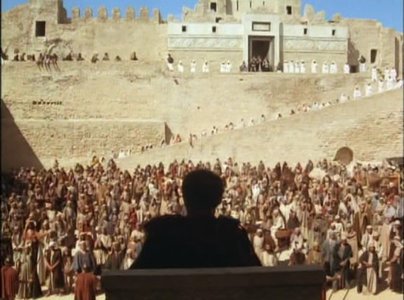
However, Tunisia/Carthage is only very rarely allowed to represent itself in popular visions of the ancient world. Rather, because until recently Tunisia, along with Morocco, was one of the most stable and friendly-to-the-West countries in the whole of North Africa and the Middle East, both countries have frequently been called upon to represent ancient Palestine in films about the life of Jesus. This ninth-century Islamic fortress in Monastir has been used to represent various parts of Jerusalem in Jesus of Nazareth...


...and it has also been used for the odd less reverant Biblically-themed production.


The desert sands of Tunisia have also been useful for representing first century Palestine


and the cave-homes the southern Berbers still live in are so unusual they've been used to represent a planet far, far away.


One of the biggest oases in Tunisia, in the Atlas mountains, was used to represent an Egyptian cave in The English Patient.


As you can see, Tunisia rarely represents itself on film, at any period, and its Classical period is little seen beyond recreations in the arena. The exception, however, is popular travel documentaries. Michael Palin and motorcycling pair Ewan MacGregor and Charley Boorman all visited the amphitheatre at El Jem, one of the largest and best-preserved Roman amphitheatres in the Classical world.

The old, juxtaposed against the slightly-less-old and the newer-still

Camel! This was the first camel we saw up close in Tunisia, as we made our way south

Both Palin and MacGregor & Boorman observe how creepy and unsettling the atmosphere still is in the tunnels underneath the amphitheatre, where criminals and animals were kept - but of course, they all visited at a very quiet time, apparently in complete isolation! There's not a soul in sight in either programme (Palin's Sahara and MacGregor and Boorman's Long Way Down). The experience is a bit different for the rest of us - OldHousemate(thecamelridingone) and I visited as part of a large coach party full of German, Dutch and British tourists and we weren't the only party there at the time - so, rather than experiencing a creepy atmosphere, we were surrounded by excited children, giving the whole place the feel of a playground rather than an horrific place of death.


Palin also visited Dougga, a well-preserved archaeological site in the north of Tunisia, where he looked at the toilets (the Roman ones, that is). We didn't go to Dougga because that coach trip was full, but it's a good thing we didn't, as it clashed with the much more exciting trip to El Jem, the Berber caves, the camel-riding site in the desert, the salt lake and the mountain oasis. We can go to Dougga next time.

The salt lake, empty of water for most of the year

Tunisia certainly doesn't lack interest from filmmakers and television producers (recent events notwithstanding) but I think it's a shame that its own Classical past isn't explored more often in modern popular culture. Perhaps it has been and I'm just not familiar with the works - there must be a film about Hannibal out there somewhere, surely?! Anyway, I hope to see works that exploit Tunisia for its own (preferably Classical, since that's my area of interest!) past in the future, as well as using to represent just about anywhere else.

Tuesday, January 25, 2011

Classical Films at the Oscars


As I'm sure you've heard, the Oscar nominations came out today - not too many surprises, though unfortunately those there were were negative (no director's nod for Christopher Nolan?! And I'd have liked to see Andrew Garfield in the Supporting Actor category). On the other hand, I'm very happy to see one science-fiction film and one horror film among the top five of this year's awards season, since the awards have being leaning away from anything other than worthy issues-movies or dramas that looked far too miserable and I didn't go to see ever since Return of the King. The Best Picture nominations include four films I saw (Black Swan, Inception, The King's Speech and The Social Network) all of which I really enjoyed and one of which (Inception) included some Classical references, which I blogged about.

However, in a year noticeably full of Classical movies, none of them have received any Oscar nominations at all. This is not overly surprising. Two Classical movies have done extremely well at the Oscars; Ben-Hur still jointly holds the record for the most Oscars won by a single film, 11, held with Titanic and The Return of the King (my favourite movies - the Academy doesn't always get it wrong!) while Gladiator won five Oscars including Best Actor and Best Picture. Since Gladiator, however, none have got very far in the awards shows, for various reasons. The Passion of the Christ was too controversial and too much of a personal religious meditation as well as a movie, though it did get three Oscar nominations in the less high profile categories (I hate the idea of bigger and smaller awards, as everyone worked as hard as everyone else, but some are undeniably higher profile than others). Alexander was too long and rambling and featured Colin Farrell in a very silly wig. Troy simply wasn't that high quality, though I really liked it (I thought it was a pretty good stab at a difficult adaptation, and thoroughly enjoyable to boot) and 300 is classic, silly fun but definitely too lowbrow for the awards.

And so to this year's bumper crop of Classical movies, Agora, Centurion, Percy Jackson and the Lightning Thief and Clash of the Titans. I haven't seen either Agora or Centurion, as both came out while I was in the Land of No Cinema and they didn't have as much staying power as the other two (both of which I saw in empty cinemas towards the end of their runs). I've heard that Agora is excellent (see for example Cris's review over at Here, There and Everywhere) and the emotive subject matter would make it pretty suitable for a bit of recognition - indeed, it won seven Goya awards in Spain. In Agora's case, I think the film just didn't get the publicity it would have needed in the States (or here - if it had come to more cinemas or stayed on release longer I might have been able to see it). As a Spanish film, but in the English language (so, not eligible for Best Foreign Language Film) it was just too small. As for Centurion, I haven't come across many reviws of it - I don't know whether that means anything as far as the quality of the film goes, but even if it was brilliant, it would probably be too small and not well known enough to get anywhere anyway.

And so to the two mythological movies, Percy Jackson and Clash of the Titans. They are, of course, immediately at a disadvantage because of their subject matter, as genre films are generally less frequently rewarded, so the only mythology-based stories with a really good shot at awards would be a really tight adaptation of the Iliad that only told the story of Achilles and Hector, with no gods (and no horse, which isn't in the Iliad anyway) or an update of the Oedipus story with no prophecy, or something along those lines. However, it's not impossible to get near the awards with a more fantastical story - The Return of the King may be the only one to make it all the way to Best Picture, but Harry Potter and the Deathly Hallows Part 1 has two nominations in the less high profile categories this year, not to mention Inception (science fiction, equally difficult to get awards for) and Black Swan (psychological horror bordering on fantasy).

So, Titans and Percy had the money, the exposure and plenty of special effects to show off with, and nothing should have stopped them having a shot at a technical award - except the one remaining problem. They just weren't that good! They were both decent enough, but neither set the screen on fire. Even the special effects weren't that desperately special, as we've all got used to spectacular computer graphics by now, and Titans seemed to think you could emulate Hades by just wandering around Blanau Ffestiniog. Both tended towards two-dimensional characterisation and spectacle over story, so neither were really engaging. And no Titans clashed, which was blatent false advertising.

These seem to be the problems that plague Classically-themed films. They're either too small to get noticed, or they get so lost in the splendour of the ancient world, whether Roman history or Greek mythology or, more rarely, Greek history, that they forget to be high quality films. Carried away with battles, grand sweeping shots of Rome or wild landscapes, mythological beasties, gods and goddesses, the writers and directors don't pay quite enough attention to character, dialogue and plot development. And, in some cases, they don't have to, since we'll all flock to see a Gorgon in 3D anyway! Let's hope that the upcoming Eagle adaptation, helped by having a beloved source novel to work from, takes its cue from the more carefully put-together Gladiator or Ben-Hur instead. That way, whether it wins awards or not, it will be a more satisfying cinema experience for all of us.

Tuesday, January 11, 2011

The Matrix (dir. Larry and Andy Wachowski, 1999)


I have often felt mildly disappointed that, since I was doing my GCSEs at the time, I missed out on the chance to see The Matrix for the first time in a cinema. It might not look so impressive now, but back in 1999, I can still remember how blown away I was by Neo bending backwards to avoid bullets in slow motion (followed by Trinity's equally satisfactory concluding note, 'Dodge this!'). The Matrix was a game-changer in the field of special effects, but more importantly, it also had a strong, compelling story filled with equally strong characters, both male and female, which made it a stand-out film in a really good year (which also included The Sixth Sense, The Mummy, Being John Malkovich and one of my favourite films of all time, Galaxy Quest. We won't hold The Phantom Menace against it). I am, therefore, restricting myself to discussing only The Matrix itself in this post - the two sequels, while maybe not quite as bad as you remember, definitely lacked something, possibly coherence.

The Matrix blends a lot of different elements into its mix, including at least two different mythologies - I say 'at least two' because I know there's a strong Asian influence on the film, but I know next to nothing about Far Eastern (as opposed to Near Eastern) mythology. The two biggest Western influences, though, are clearly Greco-Roman and Judaeo-Christian mythology. Judaeo-Christian mythology might be said to be the biggest influence of all, since it provides the story (guy dies, comes back from the dead, saves the world) as well as various other smaller references (Trinity, Zion, the ship named Nebuchadnezzar after the biblical dreamer, the thematic exploration of faith and doubt). Greco-Roman myth, however, has an important role to play as well.

Keanu Reeves - another one of those things (or in this case, people) I will not hear a word against. I actually think he's pretty good in Much Ado About Nothing.

Like most of the names in the film, Morpheus is significant - a Roman god of dreams. Ovid (in the Metamorphoses) describes Morpheus as one of three sons of Sleep, who is particularly skilled in imitating human shapes. This specific definition is, as far as we can tell, an addition of Ovid's, but it certainly works as an allusion in the film, which is full of intelligent computer programs that look like people. The human Morpheus as god of dreams is a little off - surely Morpheus is the character who wakes people up?! - but the dream analogy is interesting. Like Inception, Through the Looking Glass and What Alice Found There and countless episodes of science fiction shows (Red Dwarf's 'Back to Reality', Voyager's 'Waking Moments', The X Files' 'Field Trip' and Buffy's 'Normal Again', to name just a few) the film problematises reality and questions how we know what's real and what isn't. Intriguingly, as far as I can tell, this appears to be a modern problem. Apart from Ovid (who questions whether Love really appeared to him in a dream in a letter from exile, and who just has to be different) and contrary to some nineteenth century academics who thought the ancients couldn't tell the difference between dreaming and reality, ancient writers are generally pretty clear whether someone's dreaming or not. They compare things that happen to dreams and they describe things that happen in dreams, but they don't include the sort of trope we see here, where people aren't sure whether they're dreaming or not and can't tell the difference between dreams and reality. I wonder if this new sub-genre has something to do with developing technologies, from the photograph to virtual reality...

The most significant Greco-Roman element in The Matrix, though, is of course the Oracle. From a Latin word, this means a shrine where a god answers questions, usually about the future, often through a human intermediary. The Oracle quotes the famous phrase that Pausanias said was inscribed in the temple at the Delphic Oracle, 'Know Yourself', which she also has painted above her door. The phrase, in this context, refers to the need to be sure what you're asking and what the answer really means, so you don't get caught out like Croesus of Lydia (the one who was told he would destroy a great empire, but the Oracle failed to specify that it would be his own). It is perfect for the film, since Neo (and Trinity as well) can only fulfil the prophecy by knowing himself and it is his and Trinity's understanding of themselves that is the only thing that can reveal that he really is the One.

The inscription at Delphi, however, was, of course, in Greek (γνῶθι σεαυτόν) whereas the Oracle's painting here is in Latin (nosce te ipsum, given here in a shorter form, temet nosce). As ever, I am left wondering whether there is any great significance to the Latin - did some medieval poet mention it in Latin? Is from Dante's Italian somewhere? - or whether, more likely, this is the usual acute research failure that assumes that everything ancient is Latin. This is a rather depressing situation and must be enormously frustrating to modern Greeks, given that there is actually a fair bit more surviving literature from the ancient world in Greek than in Latin. This particular case is made even worse by the fact that at least one of the Latin authors who mentions it (Juvenal) uses the Greek when he does so. I can only assume that, because Latin is perceived to be easier and therefore taught more often (actually I find Greek easier myself) and because Latin is still used in the Catholic Church and in choral music and is therefore very much still around, Latin is the default ancient language that most people are familiar with, so Latin is what they use. The writers of The Matrix must have known this inscription was originally in Greek, since they'd done enough research to know it existed, so perhaps they thought Latin would be more easily recognisible, and didn't want to further the confuse their audience in an already potentially confusing film by throwing an unfamiliar alphabet at them.

Language quibbles aside, though, the use of the Oracle in The Matrix is really rather good and much closer to ancient oracles than most modern versions. Modern oracles in science fiction and fantasy tend to tell the protagonists what is going to happen, either directly or indirectly - and then it does. In The Matrix, however, what happens, happens at least partly because the Oracle told them what she told them - lampshaded early on when she points out to Neo that what will really bother him is whether he would have broken her vase if she hadn't told him not to worry about it. This is the sort of oracle we read about in Herodotus and in Greek tragedy, the sort that complicates the issue because a lot of the time, the situation would never have come about without the oracle in the first place (as with the unfortunate Croesus, and in the story of Oedipus, who would never have killed his father or married his mother if they hadn't exposed him in an attempt to avert the oracle). The way the Oracle's advice causes a chain of events that leads to the implied result is very Classical, and makes this particular oracle a lot more interesting than your average sci-fi soothsayer.

There's probably a lot more I could say about The Matrix, Classical or otherwise, not to mention the other two films, but that will have to wait. What I think this really reiterates, though, is that, just as Inception proved again this year, it is far from impossible to create a big budget sci-fi epic that is built around ideas, not explosions. Well, ideas as well as explosions. And guns. Lots of guns. The Matrix succeeded, not because of bullet time (impressive though that was) or even because of the guns but because of the story, told with plenty of humour, the characters and the ideas that really got us engaged and interested. Hopefully there will be many more equally thoughtful blockbusters in the future!

Sunday, January 9, 2011

The Roman Mysteries: The Prophet from Ephesus


This will be another pretty short review, to avoid spoiling the last book, The Man from Pomegranate Street, as some of the story here sets up the conclusion to that book. There are minor spoilers for The Prophet from Ephesus here, though.

These books are set during the first century AD, when Christianity was a very new religion, and this volume is about the rise of Christianity, taking place in modern Turkey, where our heroes are able to meet Jesus' disciple John while investigating more kidnappings of young children. Earlier books in the series had referred to Christianity as well, of course, but this is the only one to focus on it almost exclusively. Over the course of the story, Jonathan rediscovers his faith and Nubia and Lupus, along with several old acquaintances, convert as well. Several different aspects of early Christianity (of which we know very little for sure) are depicted; the more contemplative side is represented by John, but we also see the hysteria and intensity of the crowd in some early scenes. Most heartbreakingly, we see Lupus caught up in claims of miraculous healings, which can only end in disappointment for him.

The book does not, however, fall into the CS Lewis trap of presenting only one point of view. Flavia does not convert, and her isolation when her friends get swept up in a baffling new cult that she cannot understand is just as heartbreaking. Looking for her father and frustrated in her renewed desire to get married, her loneliness enhances how alien and frightening this strange religion is to her. This provides a vital balance to the enthusiasm of the others.

Perhaps appropriately, there are not many answers at the end of this book. The mystery is only half-solved, Flavia and Nubia's burgeoning relationships are dangling in the air, and the power of the new religion to effect real change in people is suggested but as yet unproven. This seems particularly appropriate for the penultimate volume in the series, as the children grow further towards the adult world in all its murky greys. Overall, the story is a touching exploration of how some people may have encountered Christianity back when it was a relatively obscure cult surrounded by strange claims and in a constant state of flux as it developed, leaving no one quite sure where they are going but perhaps a little more confident of getting there.

Wednesday, December 22, 2010

The Vicar of Dibley: Winter

The Vicar of Dibley was a BBC sitcom that ran intermittently between 1994 and 2007, following the introduction of a female vicar to a very traditional village in England (a new and controversial move in 1994 when it began). It was written by Richard Curtis, co-writer of Blackadder, and starred Dawn French as the vicar Geraldine, and had a beautiful theme song (The Lord is my Shepherd, set to music by Howard Goodall).

British TV series often have strange schedules and there is something of a tradition of doing really exciting plot developments during a one-off Christmas special, but The Vicar of Dibley got even stranger than most and this episode was one of four stand-alone seasonal specials. Although it's called 'Winter', it's actually the Christmas special and centres around Geraldine's attempt to do something really special with the annual Nativity play for the millennium.

The Nativity Play is a British school and church tradition, in which all the kids put tea towels on their heads and pretend to be living in Roman Bethlehem, and re-enact the Christmas story. Mary and Joseph are the leads (all the little girls want to be Mary), other speaking parts go to the first and second innkeepers (who have one line, 'No room!'), the innkeeper who provides the stable, three shepherds, three 'kings' or wise men and Gabriel. (The Magi are most often portrayed as kings, despite the historical inaccuracy, partly so they can sing 'We Three Kings' and partly so they can wear paper crowns). The other kids all have to make sure they have white sheets and stand at the back playing angels and singing 'Away in a Manger'. It's a brilliant tradition, which is great fun and which has occasionally been lampooned elsewhere, most notably in the play 'The Flint Street Nativity' and in Curtis' own Love Actually (where the nativity play, for some reason, includes at least two lobsters). I always got stuck as the incredibly boring Narrator in school, but I did once get to play Mary in a church procession.

The Love Actually Nativity was a bit *different*. An octopus was also involved.

In this episode, Geraldine's incredibly dim verger Alice actually comes up with a genuinely brilliant idea, which is to stage the Nativity play in an actual stable on a local farm. Complications ensue when the heavily pregnant Alice insists on being cast as Mary and goes into labour during the show. Hilarity and sweetness ensues.

Since the point of the outdoor Nativity is to be more realistic than usual, historical accuracy (or lack thereof) becomes something of an issue during the preparations. No one suggests the Kings should actually be Persian priests, because no Nativity is likely to bother doing that - we're all far too attached to the paper crowns etc. In fact, at one point Jim and Frank discuss whether they're wise men, who should help with the birth, or Kings, 'inbred cretins' who can't help with anything, according to Jim. But Geraldine does try to use historical accuracy to stop Alice from playing Mary, by insisting that Mary could only speak Hebrew (which isn't actually true, she would also have spoken Aramaic and possibly some Greek). Brilliantly, Alice responds in fluent Hebrew! This is a lovely moment, not to mention quite possibly the most intelligent thing Alice has ever done.

Geraldine's rehearsals follow the Mike Leigh method of improvising around the subject, which also leads to some interesting work. Alice suggests that 'loaves and fishes' is a family recipie, which is very funny, while she and the vicar both get a bit carried away improvising an argument between Mary and Joseph and the shepherds' improvisation seems to imply that everyone in ancient Bethlehem had access to BBC television.

The greatest amount of historical meddling, however, is down to David Horton, local politician, who wanted to be cast as God but has instead been cast as Herod (another speaking part often included as part of the Kings' story, though the massacre of the infants is not, in fact, commonly part of a Nativity play). David is not at all pleased with this and starts trying to suggest reinterpretations of Herod's character, insisting that history has misunderstood the man. His first suggestion to explain away the massacre of the infants is that some soldiers misheard what Herod said and misunderstood, which is a bit like Henry II's explanation for the murder of Thomas Beckett. (The soldiers in question appear to be dressed as Romans, even though Herod was a Jewish king and probably had his own guards - Romans are too much part of the cultural imagination of the ancient world to leave them out all together). During the play itself, he starts giving out sweets to all the children in the audience, trying to get them to like him (all this despite the fact his costume resembles that of Ming the Merciless). Best of all, he asks the soldiers to 'kill them gently!' The whole thing is entirely doomed - quite apart from his Biblical nastiness, the historical Herod the Great was a nasty piece of work with a tendency to have his own children put to death.

This is a lovely episode (albeit with one of those very clean sitcom childbirth scenes with hardly any screaming). The Vicar of Dibley is one of those nice, homey shows that always feels slightly Christmassy anyway and anything with Nativity plays in it always brings me right back to childhood Christmasses and the desperate search for some kind of blue headscarf to wear as Mary. I also genuinely like the idea of a farmyard Nativity, though historical realism can be taken too far - luckily Geraldine is at hand to reassure Alice that she hasn't, in fact, given birth to the Messiah.

Monday, June 7, 2010

Pinocchio (Disney, 1940), for World Oceans Day


Cris over at Here, There and Everywhere is hosting a Blog-a-Thon about oceans and oceanic wildlife as part of World Oceans Day, which is June 8th, and asked me if I’d liked to take part, so here I am! (Spartacus review to follow early Wednesday).

There’s loads I could say about ancient ideas about the sea, the ocean and marine wildlife and the idea of ‘ocean’ rather than sea is especially interesting. In myth, Oceanus was a Titan, son of Sky and Earth, while geographically speaking the ocean was the water that surrounded the whole Earth – for, in ancient conceptions of the world, the Mediterranean sea sits in the middle, the three continents (Europe, Asia and Africa) sit around it and Ocean/us flows around them all.

The Babylonian map of the world, the oldest we know of, showing the ocean that surrounds the world - the world being, here, Mesopotamia. Later, Greeks and Romans would include the three continents of Europe, Asia and Africa, but they still surrounded all three with Oceanus

The problem for this blog, though, was that I needed to find a representation of a Classical idea about the ocean in modern popular culture. I had a few ideas, most of which I don’t have time to do in a day, but then I remembered that the theme for this year’s World Oceans Day is oceanic life, and people are being asked to choose their favourite ocean creature to write about. Well, my favourite oceanic life form has always been the whale, thanks to a primary school project (specifically the Blue Whale, but any whale will do!) and that’s what led me to Pinocchio.

The 1940 Disney film of Pinocchio is based, reasonably faithfully, on a 19th century moralising story by Carlo Collodi. Two of the incidents in the film draw particularly on ancient references: the whale, which I’ll come to in a moment, and the transformation of the boys on Pleasure Island into donkeys. Although the film explains this as the result of the boys acting ‘like jackasses’, the concept is much older.

The two best known transformations of man into donkey in literature are that of Bottom in A Midsummer Night’s Dream, and that of the protagonist Lucius in the Latin second century AD novel Metamorphoses, also known as The Golden Ass. Bottom is the victim of the fairies’ quarrel, but Lucius, like the protagonist of the earlier, Greek, story ‘Lucius, or the Ass’ which The Golden Ass is loosely based on, is turned into a donkey as the result of his own foolish curiosity. He watches a witch turn herself into a bird by magic and wants to try the same thing, so that he can fly, but is accidentally turned into a donkey instead. The only cure is to eat roses, but finding some roses to eat proves more difficult than he’d anticipated and, in The Golden Ass, he misses his chance and has to wait a whole year until roses bloom again before he can be returned to human form. Like Lucius, Pinocchio is almost transformed into a donkey (in the book he is actually transformed) because of his own foolishness, though in Pinocchio’s case curiosity is combined with indulgence. Lucius is eventually saved by the goddess Isis, who points him in the direction of some roses, just as Pinocchio is saved by the Blue Fairy.

The reason this post is appearing for World Oceans Day, though, is the whale. The most obvious forerunner to this is, of course, the Biblical story of Jonah and the Whale. Both Jonah and Pinocchio find redemption in the belly of the whale. Jonah is swallowed up while trying to escape his duty and eventually agrees to obey God is order to escape the whale, repenting and being forgiven. Pinocchio, on the other hand, goes to find the whale in order to save Gepetto, and proves that he is brave and true in the process, and when he sacrifices his life for Gepetto he is redeemed and turned into a real boy by the Blue Fairy. Pinocchio is, then, rather more proactive than Jonah in his story and self-sacrifice is added to obedience as a required quality, but it is a similarly redemptive, new-birth type experience from the belly of the monster.

The part where Gepetto lives inside the whale on his ship also reminds me of another ancient Greek work of fiction, the 'True Story' by Lucian. The title is ironic – this is a fantasy adventure involving trips to the moon, and to the land of the dead, and to the island of dreams. Among the hero’s other adventures, he spends over a year living inside the belly of a whale that has swallowed his ship. As in Pinocchio, the story imagines that whole ships can float around inside the whale’s stomach and eat the smaller fish the whale swallows (how the whale doesn’t starve to death I’m not sure) and in the 'True Story' there’s even a battle between different ships that have been swallowed and the whale’s stomach contains forests and islands. The story may have been a direct influence on Pinocchio, as Lucian’s hero also escapes by lighting a fire, though in this case the fire is not designed to make the whale sneeze – rather, the creature is slowly burned to death from the inside. Eeeew.

Despite the obvious essential problem that we now know that anyone who had been swallowed by a large mammal would be killed by its stomach acid, and despite the knowledge that many large whales only eat plankton, and killer whales would probably bite rather than just swallow, the motif of people being swallowed by whales is still around. The stomach acid problem can be side-stepped most easily by not allowing our heroes to get further than the mouth, like Marlon and Dory in Finding Nemo and, most recently, the Doctor and Amy in ‘The Beast Below’.

‘The Beast Below’ is indicative of another oceanic trend – now that we know more about the oceans, space is the new area of choice for marine-flavoured fantastical adventures. Other planets may be the new frontier, but space itself is often depicted like a giant ocean, and in Star Trek, Starfleet is clearly based on naval motifs (even bell-bottomed trousers in some of the films!) and many of the battles work like submarine battles. The whale-swallowing-people idea, meanwhile, is taken to its furthest extreme by that most extreme of sci-fi shows, Farscape. The whole series is set inside a giant space-whale (the species is usually referred to as Leviathons). When my friends first told me this and insisted that I watch the show I thought it sounded completely ridiculous, and it took a while to get used to, as there’s a lot of suspension of disbelief involved (what do they breathe? Where is the stomach acid? Just.... how? And who thought of flying around space inside another animal in the first place?). I got over it eventually, as Farscape is a great show which, deep down, is based on real, human emotions – but you do have to look very determinedly past the giant space whale, the fart gags, the puppets and the make-up to see it.

Of all the people-swallowed-by-whale stories, Pinocchio is one of the best – more emotionally satisfying than Jonah, slightly more logical than Lucian, more exciting than the whale section of Finding Nemo, definitely more logical than Farscape. It fits this allegorical, moralising fable that it ends with a Biblical allusion, and an allusion to one of the most obviously mythical, allegorical parts of the Bible at that, but Pinocchio takes the story of Jonah and makes it something more affirmative, and less oppressive, than the Biblical story. The only unfortunate thing about it is that the whale, Monstro, must be a monster, aggressive and unpleasant, when in fact many whales are relatively gentle creatures – ‘The Beast Below’ has the edge there, depicting the ‘Star Whale’ as a gentle, kindly being. That’s a minor niggle though – after all, the giant animal that swallows our heroes is rarely the good guy!

Friday, April 30, 2010

Xena Warrior Princess: Cradle of Hope

Whew, I've posted a lot this month! There are a few reasons for it. I've been trying out different posting patterns to see what works - not anything I'd stick to rigidly, but a vague plan. This month, I was playing with posting Mondays, Wednesday and Fridays, but I think that's going to be a bit too much in the end, partly because every now and again, something interesting - Doctor Who, at the moment - comes on on Saturday and I want to blog it while it's fresh. So next month I think I'll try posting Tuesdays, Thursdays and other days when something interesting comes up - we'll see how it goes. This month has also been my first full month of unemployment. I've got loads of non-paid work I need to be getting on with and a massive pile of job applications to do, but not so many tight deadlines, hence the increased blogging. Finally, I am horribly superstitious and don't like having 13 posts in a month! Crazy, isn't it?! I think in future I should stick to my more usual 9-12. I have got a bit of paid work now, so I won't have so much time anyway.

In this episode, Xena and Gabrielle rescue Pandora’s granddaughter, also Pandora, from an angry mob while simultaneously rescuing a baby who, it is prophesied, will one day be a king. Unfortunately they end up being attacked on all side with only a few hours left to save the word from losing Hope forever (or not, as it turns out).

This is also the episode that features Xena posing as a veiled dancer, looking like a harem girl, which may be more memorable to some. The bit where they start throwing a baby around like a football, might, on the other hand, be the most memorable bit.

There are more dreams at the beginning of this episode, and a female soothsayer who seems to be mixing up half a dozen methods of divination at once – prayer to a god (Zeus), stones, dreams and some kind of vision (stones really could not give that much information). She prophesies that an infant orphan will one day rule instead of the king and the child is put in a Moses basket (very appropriate) and sent down river, only to be discovered by Xena and Gabrielle.

The idea of the prophecy that a baby will rule, followed by an attempt to kill or capture the baby, is very Classical, and Near Eastern, and Biblical. There are lots of stories of that nature, the most historical ones being those connected with the Persian monarchy that appear in Herodotus (Astyages dreamed that his infant grandson Cyrus would overthrow him and tried to have him killed, but as usual the general who was supposed to kill the child didn't want to, in this case because it meant killing a royal. Cyrus eventually overthrew Astyages). Gregor proves to be wiser than any of them by simply adopting the child as his heir, thus saving the kid the bother of usurping him at a later date.

The version of the Pandora story used here features a wooden box, rather than a jar, and includes the detail that Hope was trapped inside the box. However, here, the fact that Hope was trapped apparently means that we all still have hope, as opposed to all other desires, which are fleeting, rather than that everything is hopeless. My copy of Hesiod, in which this detail first appears, has an explanatory note saying that Hope remaining in the jar means men still have Hope, and Hesiod is just being inconsistent in his symbolic use of the jar, which would fit the interpretation here (though I have to confess, the tone of Works and Days being what it is, I wouldn't be surprised if Hesiod had had the more negative interpretation in mind). I have to admit as well that I was rather relieved when the box turned out to be empty. I know the whole point of Xena is to dramatise mythological stories, but this particular story really works better on a metaphorical level than a literal one.

Unfortunately, presumably in order to fill time, the episode gets more and more ridiculous as time goes one, with some bizarre and inexplicable use of slow motion (the director must have been getting bored) and Xena and Gabrielle literally throwing a baby around as if they were Jareth the Goblin King in Labyrinth.

Jareth, in the middle of throwing the baby around.

One final, random observation – the currency is apparently dinars. Interesting choice. I would have expected drachmas, sestercii or denarii, but I guess dinars is as good as anything else!

Sunday, March 28, 2010

The Passion of the Christ (dir. Mel Gibson, 2004)

Since it's Roman Catholic Palm/Passion Sunday, and the start of Holy Week, this seemed like a good time to look at Mel Gibson's The Passion of the Christ, which is that rare thing - a production that includes spoken (subtitled) Latin that is not part of a church service, nor does it appear in a comic context (see Chelmsford 123 and Blackadder Back and Forth).

Before we get on to the Latin, though, there are several other points of interest in this film. The second biggest controversy at the time it was released revolved around the film's use of extreme violence, and it remains the most successful R-rated film to be released in the United States. I didn't see the film in the cinema and put off seeing it at home for ages because I'd heard such horror stories about it. When, eventually, I did see it, I didn't think it was that bad after all, but perhaps if I'd been stuck in a cinema, watching it on the big screen, I would have felt differently.

What marks Gibson's film out from Jewison's or Zeffirelli's is that Gibson's version of the story is very much a personal act of faith. This is not to say that faith was not a factor in the other two - I would not dream of presuming to make statements about the extent or nature of Jewison or Zeffirelli's religious faith - but whereas their films presented an attempt at an historically accurate re-telling of the Gospels in Zeffirelli's case, and an exploration of the human Jesus told chiefly from Judas' point of view in Jewison's, Gibson's film is basically an extension of the Catholic tradition of meditating on the Stations of the Cross during Lent. This tradition emphasises the significance of the physical suffering of Jesus and encourages meditation on, well, how horrible the whole thing is. This is part of the reason for Gibson's unusual level of attention to physical suffering in the film.

There are other reasons as well. Isaiah 52:14, often interpreted as a prophecy concerning the suffering of Jesus, says that His appearance was 'disfigured beyond that of any man', which can be interpreted as a reference to the result of extreme violence. Perhaps more importantly, the extent of the violence seen in the film justifies some of the other events of the film. The first beating, for example, which as far as I can tell does not have its origin in the Gospels, provides Judas with sufficient comprehension of what he has done that it drives him to suicide (along with some bizarre devil-children - more on them below).

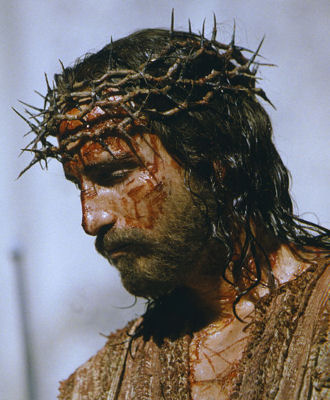
There are other points which do originate in the Gospels or in church tradition that make more sense in the context of the film's extreme violence. Whereas other films about Jesus shy away from depicting miracles, or depict only those which are smaller and less showy (Zeffirelli, for example, depicts healings but not Jesus walking on water, though he does include the feeding of the five thousand) Gibson, more interested in the spiritual story than in a more secular interpretation, includes just about all elements of the Passion story, from Pilate's wife's dream to the removal and replacement of the ear of a soldier called Malchas, which is very rarely dramatised. So Gibson also includes Veronica offering Jesus a cloth which is left with the imprint of His face - which suddenly makes a lot more sense when His face is shown covered in copious amounts of blood.

Most importantly, according to the Gospels, Jesus died after only 3 hours - crucifixion normally takes days. The traditional explanation for this, which seems logical enough (well, the physical explanation, divine intervention being understood as the real reason), is that Jesus had been so badly beaten and tortured before He was crucified that He was dying already, and this is stated specifically in the traditional prayers that are said at the Stations of the Cross. So the violence inflicted on Jesus has to be fairly extreme, to demonstrate that His body is already dying before it is nailed up.

Having said that, some of it is a bit excessively extreme. Why on earth the unrepentant robber has to have his eyes plucked out by ravens or crows I do not know - this is pure invention on Gibson's part and totally unnecessary, as is Judas resorting to taking rope from a dead donkey (or was it a goat? No, I think it was a donkey) to hang himself with (as if hanging himself wasn't bad enough already). And I'm not sure Jesus needed to be beaten up quite so often, considering the flogging could easily have killed him by itself. Talking of the flogging - that wasn't nearly as bad as I'd expected - there were a couple of nasty shots of flesh being torn away, but for the most part we saw only the soldiers and Jesus' hands or his face, like most filmed flogging scenes, and for much of it we followed Mary away from the scene all together.

Anyway, the more important point as far as Classics is concerned (don't worry, I haven't forgotten I'm supposed to primarily talking about Classics!) is: is all this violence historically accurate? I think, for the most part (horrible bird-related eye-gouging excepted) it is presented in a reasonably accurate way. It is made clear that not all criminals are treated with this degree of cruelty, as several soldiers demand that the flogging/beating be halted at various points, and the other two criminals look absolutely fine (apart from being crucified, that is). This fits nicely with the idea that Jesus was more badly beaten than usual, and that's why He died more quickly than usual. On the other hand, it's equally clear that no one is especially surprised by the treatment doled out to Jesus, and that the soldiers will not get into trouble for it - this is, after all, the civilisation that gave us the gladiatorial arena. Pilate's expression when he sees Jesus post-flogging, crown of thorns and all, sums it up perfectly - he raises his eyebrow in mild surprise at the extent of Jesus' injuries and he treats Him with sympathy and concern, but he is not especially shocked or outraged - this is more exaggerated than usual, but nothing out of the realm of his experience. This seems about right for ancient Rome (or rather Judaea).

Of course, the most significant use of Classics in this film relates to language, and this is something I'll talk about more in an article I'm writing at the moment (which will be published online). I'll go over the main points here as well though. Firstly, and most obviously - for much of the film, Pilate, Jesus and the various other characters are speaking the wrong language. Gibson shot the film in three languages - Latin, Aramaic and Hebrew. Aramaic was the language of the Jews in Palestine at that time, Latin the language of the Romans, and Hebrew I think was chiefly a religious language but I'm not sure. I can't tell the difference between Aramaic and Hebrew, I'm afraid, so I don't know when they switch between those two but, of course, I can tell when they switch into Latin.

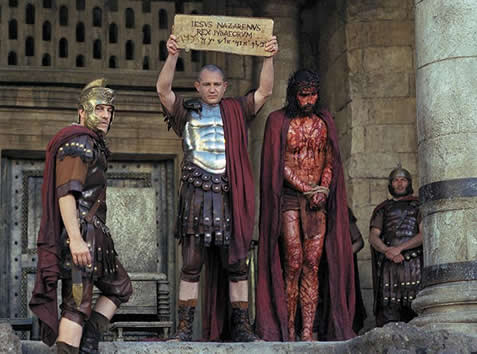
Trouble is, the lingua franca of the East of the Empire at that time wasn't Latin, it was Greek. Scenes between two soldiers who both come from the Latin West might reasonably show them speaking Latin, and Pilate and his wife might communicate with each other in Latin, but any scenes in which Pilate communicates with the Jews - or even with large groups of soldiers, if they come from various parts of the Empire - should have been performed in Greek. Not only that, but the Gospel of John actually states that the sign placed above Jesus on the cross - reading 'Jesus of Nazareth, King of the Jews' - was written in Latin, Greek and Hebrew. Gibson shows only Latin and Hebrew. Gibson claimed that the reason for using the ancient langauges was historical accuracy, but it wouldn't take much research to establish that Greek would be the common language for communication between different groups - any ancient historian could have told him that (and he's hardly known for his attention to historical accuracy anyway). So why the inaccuracy?

I have a few ideas, which I'll talk about more in my article. Basically, I think Gibson is a little too attached to his Catholic upbringing. He wants Pilate to say 'Ecce homo!', not 'Idou ho anthropos!', and he wants to hear Latin, the language of the Catholic Church, not Greek (the language of the Greek Orthodox Church, presumably). Perhaps this is also why he has the two other criminals carry only the cross-bar of their crosses, as depicted in Jesus of Nazareth and as some historians argue was the case in reality, while Jesus Himself has to carry the whole enormous cross, as depicted on many, many illustrations of the Stations of the Cross (which are on the walls of every Catholic church). (Of course, this also makes it easier for Simon of Cyrene to help carry the cross, so that might explain that one).

Gibson also plays with the language a bit to emphasise Jesus' divine nature - whereas Pilate communicates with all other Jewish characters in Aramaic (I'm very skeptical that a Roman governor would have bothered to learn Aramaic) when Pilate starts to question Jesus in Aramaic, Jesus replies in Latin. Presumably this is meant to acheive the same goal as the earlier, rather ridiculous flashback sequence where, as Mark Kermode puts it, Jesus invents the kitchen table - it demonstrates that Jesus has access to knowledge others around him do not have, because he is divinely omniscient. All this is at the expense of everyone else around him, who are confined to Aramaic and Hebrew.

The other oddity, language-wise, occurs in the flogging scene, in which the Latin subtitles suddenly disappear. The Aramaic/Hebrew (sorry, no idea which it is!) is still subtitled but the taunting Latin of the soldiers, and the counting of the strokes of the whip, is in unsubtitled Latin. Gibson famously wanted the whole film to be shown without subtitles - perhaps to produce a more immersive experience? - and was persuaded otherwise, but this bit was left. Why?

Perhaps the idea is to increase our incomprehension and confusion, as we watch the flogging from Mary's point of view. The use of Latin here is not so odd - perhaps the soldiers all come from the West - and Mary would be unlikely to speak Latin fluently, so perhaps this is supposed to put us in her shoes. The soldiers aren't saying anything terribly strange or exciting - I'm not used to translating spoken Latin (even in church they give you the words) but I caught phrases like 'enough!' and the counting, which are obvious enough from context, taunting phrases like 'facta non verba' (deeds not words) and, at one point as Jesus tries to get up from the floor, 'credere non possum', I don't believe it. I can only assume that Gibson wants to make the soldiers seem more alien and Jesus more human and closer to us by allowing us (his non-Latin speaking audience that is, which may be the majority) to understand Jesus but not the soldiers.

Oh, and the pronunciation of the Latin, often by Italian actors, tends to towards the Italinate - which gives us a slightly bizarre situation in which the Jewish Aramaic pronunication of 'Caesar' (like the German 'Kaisar') is closer to the way Caesar probably said that the the Latin Romans' (which is more like 'Che-sar').

I actually like The Passion of the Christ a lot, it's very moving and the shot of Mary sitting in the traditional pieta position and staring straight at the camera is quite unnerving (in a good way). I think it loses the plot, though, whenever it strays too far from either the Gospels themselves, or sensible extrapolation and enhancement of the Gospels. By 'sensible', I mean scenes like that of Mary seeing Jesus fall under the cross, and remembering seeing him fall as a child, and rushing to help him - although Mary's flashback and memory are invented, these seem like reasonable enhancements of the story. The slightly extended role for Pilate's wife, deeply affected by her dream, is quite nice too.

On the other hand, the 'kitchen table' scene is pretty bad, and the strange, androgynous devil figure who stalks Jesus throughout the film and the creepy devil-children who hound Judas to his death (and who look like something out of Don't Look Now) are just strange and out of place. Perhaps Gibson wanted to emphasise the Catholic doctrine that Judas' worst sin was despair, thinking he could not be forgiven, by having the devil drive him to suicide, but it just doesn't work, and Judas has quite enough reason for despair already. The Gospels do describe Jesus being tempted by the devil, but way back at the begining of His ministery, not at the end. The scene in the Garden of Gethsemane would be much more powerful if it was solely about a man struggling with his conscience and determination, no devil figure required.

Other than that though, it is a beautifully made film (well, you know - the less gory bits are) and the music is great. The depiction of the Roman empire manages to emphasise the violence that TV and filmmakers are so fond of emphasising in Roman stories, but whereas most glamourise this violence, or use it like historical window-dressing, all over the place and sometimes without much rhyme or reason to it (Rome, I'm looking at you!) this film depicts that violence in a brutal and unforgiving fashion, without throwing it in to scenes where it isn't necessary.

One final niggle though - as I reached the end of the film, I remembered something else that stands out about it - this is the film that gives us Naked!Jesus! I'm sure Gibson was going for spirituality and new life, and the shot of the burial shroud deflating as the body disappears from it is beautifully done. I take the point that if the shroud is empty, Jesus probably doesn't have much else to wear, and it's very Gandalf-on-the-mountain-post-Balrog, etc etc etc. But Jim Caviezel is a very good-looking man, and even bearing all that in mind - it's Naked!Jesus! And he's really close to the camera - OK, you don't see anything, but you're pretty close to some upper thigh there. This does not make me reflect on the miracle of the Resurrection and is liable to result in a train of thought that would get one excommunicated. Surely they left Him a loincloth in the tomb? Or if not, God could just - I don't know - provide magic clothes?! Or He could wrap the burial shroud around Him, before wandering off? Naked!Jesus is just not the way to end such a deeply serious and genuinely moving film...

Edited to add: Having done a bit more research on this film for my article, consensus seems to be that the whips used on Jesus here are accurately portrayed, and soldiers quite often deliberately whipped victims to the point of death because they had to guard the cross until the victim died - the worse the scourging, the less time they had to spend hanging around by the cross. So the violence is pretty accurate. Also, victims would be naked during the scourging, so I should be grateful there wasn't even more nudity in the film.

Monday, March 8, 2010

Jesus of Nazareth (dir. Franco Zeffirelli, 1977)


Still recovering from the Oscars... goodness, they were predictable this year! (I had a feeling Hurt Locker might win out - the Academy has been desperate not to give Oscars to anything people actually want to see since Return of the King's victory a few years ago. Very pleased for Kathryn Bigelow though, and though I haven't seen it, I hear that The Hurt Locker is a very worthy winner).

Jesus of Nazareth is a six-hour mini-series covering the life of Jesus from the Anunciation tot he Resurrection. I believe there is also a shorter, 'theatrical' length version (unless I'm mixing it up with Das Boot!). Although it is not always the most popular Jesus film these days, it's my favourite - Robert Powell's central performance is just the right mix of human and slightly other-worldly, the all-star cast are uniformly excellent and the blending of the four Gospels seems well done to me (though I confess I'm not an expert in this area). The portrayal of Judas as a conflicted political activist is done better in Jesus Christ Superstar, and Ian Holm's character Zerah seems rather unnecessary, but otherwise it's very, very good.

Zeffirelli's approach to historical drama tends to be to aim as far as possible for historical authenticity in sets, costumes, background action etc, or at least, to stay as close to what is currently believed to be historical authenticity by historians at the time. So, his Romeo and Juliet is a vision of what we think of as medieval Italy, complete with castles and Juliet caps, while his Hamlet appears to be set in a medieval Danish castle, his Gertrude wearing Germanic-looking long blonde plaits. His earlier religious film, Brother Sun, Sister Moon (about the life of St Francis of Assisi), had used some contemporary music over the 'period' images, but Jesus of Nazareth does not, relying instead of the beautiful score written for it by Maurice Jarre.

Zeffirelli's authenticity is an artistic authenticity though, and many of his scenes are modelled after Renaissance paintings. Although Brother Sun, Sister Moon had included some scenes of injury and illness intended to put across the difficult aspects of life in the medieval period, there are fewer scenes of this nature in Jesus of Nazareth, other than those required by the Gospels involving epilepsy, crucifixion and so on. Zeffirelli's ancient world is striving for authenticity, but is also prettied up a bit.

All this means that his approach to the Romans is also aimed at historical authenticity. Everyone speaks English, but this isn't a problem - we can just assume that they're speaking Greek most of the time, and some Latin when speaking to each other. Costumes, sets and so on aim at authenticity and, as far as I can tell, they achieve it, though the series makes use of the same ninth century Islamic fortress as Life of Brian two years later, so some of the architecture is not quite as authentic as it looks.

Since Jesus of Nazareth is not a Passion play, the Romans take up a proportionally smaller chunk of screentime than they do in Jesus Christ Superstar. Although the series avoids most of the more spectacular miracles (walking on water, turning water into wine) it does include some healings and the raising of Lazarus, and it depicts the virgin birth as just that, with no Roman interference. We see a few Roman soldiers generally treating people not very well, we see the Roman centurion whose slave was cured (who later, in a nice bit of storytelling, turns out to be the centurion who exclaims 'truly this man was the Son of God!' at the crucifixion) and we see Zealot resistence to Rome, but Rome and Romans do not really come to the fore until the series reaches its climax - Roman decrees like the census are seen through the intermediaries of the Jewish kings, Herod the Great and, later, Herod Antipas (Peter Ustinov and Christopher Plummer, both brilliant).

The chief representative of the Roman Empire, though, is Rod Steiger's Pontius Pilate. This is the Pilate you might imagine when hearing the Passion story in Sunday school - a mixture of brusque Roman disinterestedness in Jewish problems and fascination with Jesus himself when they meet. Pilate's questioning of Jesus demonstrates a nice tension between Pilate's desire to ignore unimportant Jewish religious problems and a genuine interest in Jesus, as he asks in perplexion 'what is the truth?'. His delivery of 'Behold the man' is equally beautifully balanced between regret and an almost careless dismissal. Slightly stronger perhaps than the Pilate of Jesus Christ Superstar, his ultimate lack of strong interest, in addition to his desire to avoid riots, seems to be his ultimate motivation for crucifying Jesus even though, as in most adaptations that stick fairly close to the Gospels, he believes him to be innocent of any crime. As a depiction of a Roman governor, this works rather nicely - Pilate is just trying to get through his time here without any disasters occuring in a volatile region, which seems like a fair interpretation.

For the crucifixion scene, Zeffirelli depicts Jesus carrying only the cross-bar of his cross up the hill, rather than the whole cross, which I believe was a popular theory at the time, though I don't know much more about this issue. I do know that the depiction of all victims being both nailed to their crosses and tied with ropes is accurate - the ropes would probably be necessary to stop the nails going right through the victims' hands, but Lucan's Civil War, in its description of a witch who lives in graveyards and feeds off corpses, confirms that nails were also used in crucifixions.

The ribat in Monastir, where much of the series was filmed

Zeffirelli's strive for authenticity is very different from that of Rome or other more recent examples. Quite apart from the obvious lack of sex and nudity, Zeffirelli is not out to depict the dirtiness, unpleasantness or even the violence of the ancient world. Rather, he wants to provide an 'authentic' background for the story he's telling which serves that story - it is violent or unpleasant where necessary, but for the most part, he wishes simply to show people getting on with their lives within their historical context. This is, of course, partly determined by his subject matter, since adding sex and violence to the story of the Gospels would make a rather different series and not give it the reverent air it has. But it is also, fundamentally, a different, perhaps an older, approach to the depiction of the ancient world, in which the director is more interested in showing the similairties between us and the ancients than the (sexy, violent) imagined differences.

Thursday, January 21, 2010

I, Claudius: A God in Colchester


First, Chris has posted an excellent review of a new film, Agora, which I haven't seen, over at Here, There and Everywhere. It's about the murder of a female, pagan philosopher in Late Antiquity and well worth a look.

The title of this episode reflects Augustus' wry, sad acknowledgement that he is a god in Palmyra from much earlier in the series, as he demanded to know from Livia, in utter frustration, how he's supposed to cure gout. The main content of this episode, however, is very different - we're deep into the classic Roman orgy of melodrama here, almost enough to rival the Caligula episodes - and it is most certainly not suitable for children.

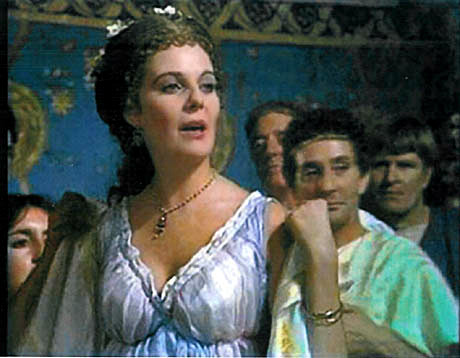
We open with Messalina naked in bed with one of her many lovers, who is an actor. They discuss her boredom and many lovers, and she makes it clear that if he really pisses her off, the consequences will be dire. There's some full frontal boob on display again, very un-BBC. Mnestor, the actor, dares Messalina to hold a competition with a well known Sicilian prostitute to see which of them can have sex with the most men in one night.

Claudius himself is away conquering Britain, but writes to tell Pallas and Narcissus that he is returning soon. They debate if and how to tell him exactly what his wife is up to when he returns.

Messalina and Mnestor hold their competition with Cilla the prostitute, who demands some payment on the grounds that her job is Messalina's hobby, and she doesn't expect to be paid for her hobby, which is gardening (this always amuses me somehow). Although Caligula's orgy was more in the tradition of popular culture's idea of a Roman party, this scene, while quieter and less manic, is also a bit seedier and somehow seems almost equally depraved, though it is thankfully lacking in rape, unlike Caligula's.

Messalina's competition. In the early stages.

Pallas refuses to help a guard who has foolishly let one of Messalina's friends know that he plans to tell on her to the Emperor, and who is pretty well doomed. Then we return to the competition, where Cilla has given up on the grounds that Messalina is 'inhuman' and must be built like concrete.

Claudius returns victorious from Britain, but Old!, or rather EvenOlder!Claudius writes that the victory was soured by what had happened with Herod Agrippa. Herod, Claudius' oldest friend and the one who warned him not to trust anybody, is plotting a rebellion against Rome. Apparently Herod has fallen victim to delusions of Messiah-hood, something which seems to have been a common ailment at the time (Caligula suffered it too). Claudius discusses what Thrasyllus told him about the Messiah - and in the world of I, Claudius, everything Thrasyllus says comes to pass, and apparently that means the Messiah died in the same year as Livia (that would be AD 29, which more or less fits a Christian chronology, since the exact date of Jesus' birth is uncertain).

Messalina appears and very hypocritically insists that Calpurnia, Claudius' courtesan of many years, must not take her plae in his bed at the palace. She also asks him to tell Mnestor to do anything she asks, which Claudius does, which leads to Mnestor introducing her to her next lover. Messalina tells the new boy that Claudius is even more corrupt than Tiberius and snares him.

One of Claudius' minions has done some homework on the Messiah and gives us the basic details - must be born in Bethlehem etc - and that the last candidate died about 15 years ago - Joshua bar Joseph from Galilee (Jesus). The minion says there was some scandal concerning his birth; a Greek was supposed to have seduced his mother. Herod has recently executed one his followers, James, and is after another, Simon (Peter). Claudius' minions can't understand his fascination with 'strange religions', but Claudius explains that Herod was also born in Bethlehem and now really believes that he is the Messiah himself.

Messalina's mother is getting worried by Messalina's habit of giving her new lover presents from the palace and openly having an affair with him, while he is divorcing his wife to be with her. Messalina's mother quite rightly thinks that all of this will not end well.

Claudius is informed of the death of Herod Agrippa, something his minion is inappropriately cheerful about. Poor Claudius is destroyed - his last friend from his youth is gone - indeed, the last character whose involvement in his life goes back as far as the reign of Tiberius. Claudius now feels truly alone. Herod was prancing about proclaiming his godhead and forgetting that his religion is monotheistic, when he was struck down with pain and died a little later of worms. He reads a last letter from Herod, who asks for forgiveness. Claudius wonders who the Messiah actually is. Although Claudius' interest in Herod certainly make sense, he is rather a lot more interested in the Messiah than a Roman Emperor was really likely to be, I think - a clever way of incorporating elements of Christian history into the series, which ends before the first great persecution of Christians under Nero.

Claudius is left with only Messalina, who has now got use of his seal, and remarks that it was at this point that he began his history. But now he begins to explain how he eventually discovered Messalina.

Messalina is getting a bit bored with Gaius, her new lover, and he wants her to divorce Claudius and marry him, before Claudius finds out about them anyway. They plan not only to marry, but to stage a coup d'etat while Claudius is in Ostia examining the new harbour works. We see them get married, bigamously, since Messalina has not properly divorced Claudius - he would have to know about it for it to count (she sent a freedman to his house to divorce him, but he really is supposed to receive the message before you marry someone else). Narcissus is utterly horrified and he and Pallas know that they are going to be in serious trouble when Messalina and Gaius take over, but still neither of them want to tell him, since he won't believe a word said against her. They realise that she must never be allowed to see him again, so she can't work her wiles on him, and that poor Calpurnia should be stuck with the job of telling him.

Calpurnia gives Claudius the bad news

Calpurnia calls Claudius to her house to see her, warning him of great danger, and slowly spits it all out, convinced that he will order her execution, or at least torture, for doing so. Claudius still hasn't learned to stop putting things in threes - this time he's trusted three women, his mother, Messalina and Calpurnia herself. At least his late mother and Calpurnia remain trustworthy. Pallas and Narcissus come in and tell him the rest, including the competition with the prostitute, and the fact that he is now divorced.

The wedding feast has become a proper orgy - no rape, just a lot of willing and very drunk people jumping around on top of each other. A completely hysterical woman interrupts by running and screaming that the guards are coming to arrest everybody, and all descends into chaos.

Messalina demands to see 'her husband' but Narcissus and Pallas prevent her from seeing him. There's a lot more screaming and young Britannicus and Octavia have to watch and listen while Narcissus doubts their legitimacy. This is another episode not to watch late at night in a house with thin walls.

Most of the guard were loyal, so Claudius is safe, but he is getting very drunk and feeling sorry for Messalina and how unhappy she must have been. Pallas and Narcissus shove the orders for her execution, and some of the others', while he's drunk and not paying attention. They go to Messalina and offer to let her take her own life first, which would save them having to explain about the warrent to Claudius in the morning, but Messalina can't do it. Having already sent her children to try to get Claudius to forgive her and yelled at her mother for not helping, the guard is forced to chop her head off while she screams.

Claudius, having sobered up, wants to see his wife and has to be told that he ordered her execution the night before. A temple that was to be dedicated to Augustus in Colchester is to be dedicated to Claudius instead. Claudius feels even more helpless than Augustus did when the temple in Palmyra was built. He weeps to himself, his face contorted in an agonised silent scream.

There are a lot of episodes of I, Claudius that deal with very unpleasant subjects, especially those featuring Caligula, but somehow this one is especially nasty - with the death of Herod occuring in the middle, everything really does seem to be going to Hades in a handbasket. Messalina seems to have no redeeming qualities whatsoever, Claudius is a broken man and we've seen more or less the last of EvenOlder!Claudius, for the next episode will have a distinctly post-mortem aspect to it. Claudius is behaving less and less like the clever, quiet survivalist of the earlier episodes and more and more like the drunkard and pawn of his wives and freedmen portrayed by Tacitus and Suetonius. This fits the sources rather nicely, but is a bit depressing. The narrative is taking us on the slow slide to inevitable awfulness that is Nero, whom we haven't yet seen, but who is the future, and who will be introduced in the next and last episode...