Showing posts with label Doctor Who. Show all posts

Monday, June 6, 2011

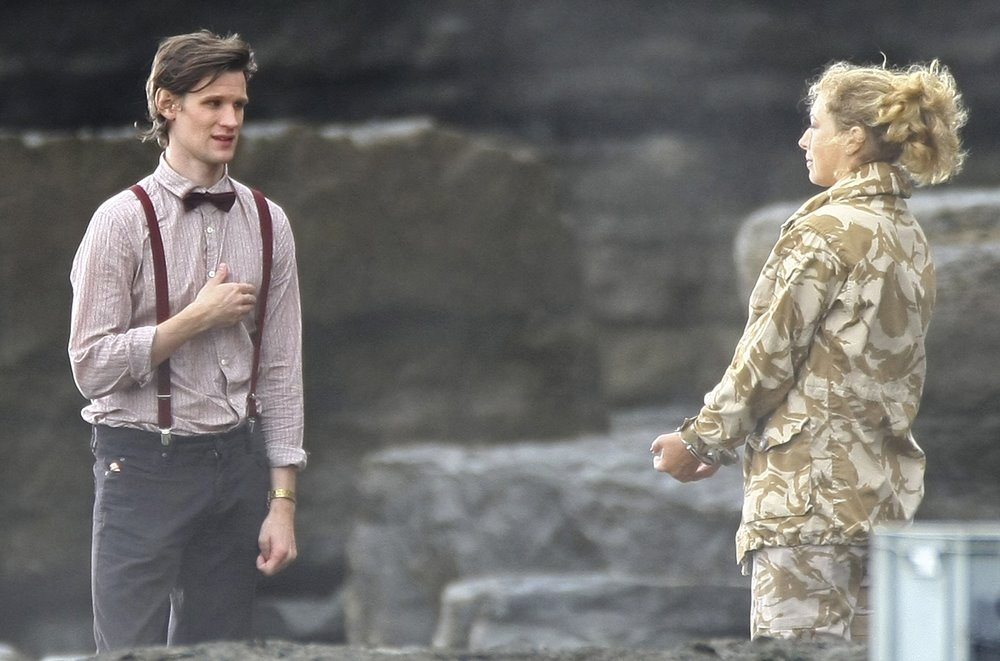
Doctor Who: A Good Man Goes to War


Dirty great spoilers for the most massively over-hyped episode of Doctor Who thus far follow, so look away now if you don't want to be spoiled.

'Over-hyped' does not necessarily mean 'bad' - I very much enjoyed this episode, though some of the dialogue was perhaps a wee tad on the melodramatic side. The repetition of how the Doctor would face his darkest hour really didn't ring true for me. He accidentally got some people killed (which is bad, admittedly) and got tricked. Oh dear. This is the same man who committed acts of genocide against both his own race and their enemies, yes? I don't think this was actually his darkest hour, somehow.

It probably was Rory's though. I wasn't sure about the reappearance of the centurion costume at first. It was last seen in the context of Amy and Rory's honeymoon sex games in the Christmas special and did look rather silly, especially since the futuristic soldiers were wearing current-style uniforms. As the episode went on, though, I realised just how effective the costume actually was. The Nurse Sontaran, who came from a society entirely obsessed with warfare (like the Spartans, I suppose, but wearing more clothes thank goodness), was a clear mirror for Nurse Rory Williams, who, for this episode at least, has metamorphosed entirely into a solider and to whom the title refers, just as much as it refers to the Doctor (Amy's opening lines, which play with audience expectations and must have led a fair few fans to think for a second or two that the Doctor really was the father of Amy's baby, are an inidication of how much the characters are intended to be viewed in a similar way throughout this episode).

Uniform, as far as I can tell (never having been in any armed forces myself), is a very important thing to members of the armed forces. It changes according to promotion or demotion, it marks you out from the enemy and it is a badge of honour that declares that you have served your country and risked your life for it. To wear a uniform you're not entitled to would be utterly wrong. But once you've served and worn a uniform, even if you leave, you always have something of a right to it - for example when characters in Dad's Army wear their old First World War uniforms if they haven't got Home Guard ones. Rory is dressed as a Roman because he served in the Roman army as a centurion. I'm still a little unclear on exactly what was going on with the plastic Romans in 'The Pandorica Opens' and 'The Big Bang' and I'm not entirely sure what their relationship to the actual Roman army was, but I think it's safe to say that somewhere over the course of two thousand years, Rory probably did some active service as a Roman soldier. The uniform in this episode doesn't represent Romans, it represents Rory the soldier, a Rory who fights and hunts down his enemies, rather than healing, as he did in a former life.


Ralph Fiennes at the Hay-on-Wye literary festival, last Saturday. It's relevant, I promise - read on!

This is especially satisfying for me as a Classicist because it's a reminder of the similarities between ourselves and the past. I'm sure I've talked before about how people from the past can be represented as either very like ourselves, or entirely different from ourselves, depending on the writer's intentions (and in fact I'm giving a paper on the subject in July). Often the Romans are the Other, the not-us, but this episode, by mixing up Silurians, Sontarans, Cybermen and Romans together with Moffat's weird militaristic future church (the Roman Catholic Church perhaps?)  deliberately draws parallels between military forces from different times and places, between lots of good men and women going to war. By a weird coincidence, I was at the Hay festival this weekend and went to a talk by Ralph Fiennes about his new film version of Shakespeare's Coriolanus (sadly not out until next year) which does exactly the same thing, moving a Roman story about war and warriors, dramatised by Shakespeare, into a modern setting, because as Finnes sees it, the characters and themes and emotions of the story and timeless and universal. (The film looks brilliant, by the way). Because Romans are often viewed as so different, with all the orgies and so on, drawing the audience's attention to the similarities between us and them can be particularly effective.

River was a bit too preoccupied to do anything archaeological in this episode, though I will say, give a child a 900-year-old cot, what do you expect them to grow up into? Half the internet guessed the big revelation - and pointed it out to the other half - weeks ago, so no surprises there and although it's logical and kind of fun, there is a slightly uncomfortable Twilight-y edge to the Doctor banging Amy's daughter - he didn't imprint on her, did he?! Also, why didn't she just regenerate in 'Forest of the Dead'? Maybe she'd run out of regenerations. This does solve one niggly problem though, that of Alex Kingston growing older while her character grows younger. We can go as young or as old as we want and we don't even need an actress that looks like her! Sorted.

As I said, I enjoyed this episode a lot, though I look forward eagerly to the day I don't spend half an episode of Doctor Who wondering what the frell is going on. I also hope we get to see more of Hugh Bonneville, Space Pirate! in the really stupidly titled next episode, as he was totally wasted here. Matt Smith was brilliant though - I have finally been converted. And maybe, just maybe, we'll actually get to find out some more about the Doctor's own family and possibly even where Susan came from in the next bit of the series, now that Amy, who is not a person to let a thing go once it's been brought to her attention, has started asking questions...

Edited to add: I complete forgot to praise the use of language in this episode! English, as a language, has an unusually enormous vocabulary and there are loads of words that you just can't quite translate from one language to another. It was wonderful to see this not only acknowledged but used as a plot point!

Edited to further add: I should probably also draw attention to the fact that Amy's father was called Augustus and River was 'in the care of' Father Octavian. Octavian and Augustus were, of course, the same person. Is this just a really obscure, nerdy in-joke, or is there a deeper meaning to it?

Wednesday, May 11, 2011

Classical Places in Popular Culture: Britain


The news had an item today about how Lonely Planet apparently gave Britain in general a bit of a pasting in its most recent Guide. The good news is, two places close to my heart seem to have come out of it rather well - Birmingham, where I've lived for more years in total than anywhere else in the country, and Bath (left), home of Britain's best preserved Roman remains.

Britain was one of the furthest flung posts of the Roman Empire, and our Roman remains are, shall we say, not always that impressive. (I'm talking about England and Wales here, of course, since the Romans didn't get to Ireland - Northern or otherwise - or Scotland). There's a reason that Blackadder's Roman incarnation wondered why they were trying to keep the Picts out of the Empire by building a three-foot high wall. I'm not sure exactly what the problem was - presumably a combination of climate and looting by Anglo-Saxons and Vikings, who took the Roman bricks and stone to make their own buildings - but very few Roman ruins in this country come up any higher than ankle level.

Roman villa near Gloucester, with CurrentHousemate walking away from the camera!


Saxon church in Escomb, near Durham, built partly with Roman bricks and stone, identifiable by the diamond-pattern markings on them (viewed on an excrusion during this year's Classical Association conference).

In some places, there are reasonably impressive remains underground, which are dug up and then covered up with a somewhat dingy-looking corrugated iron hut thing.

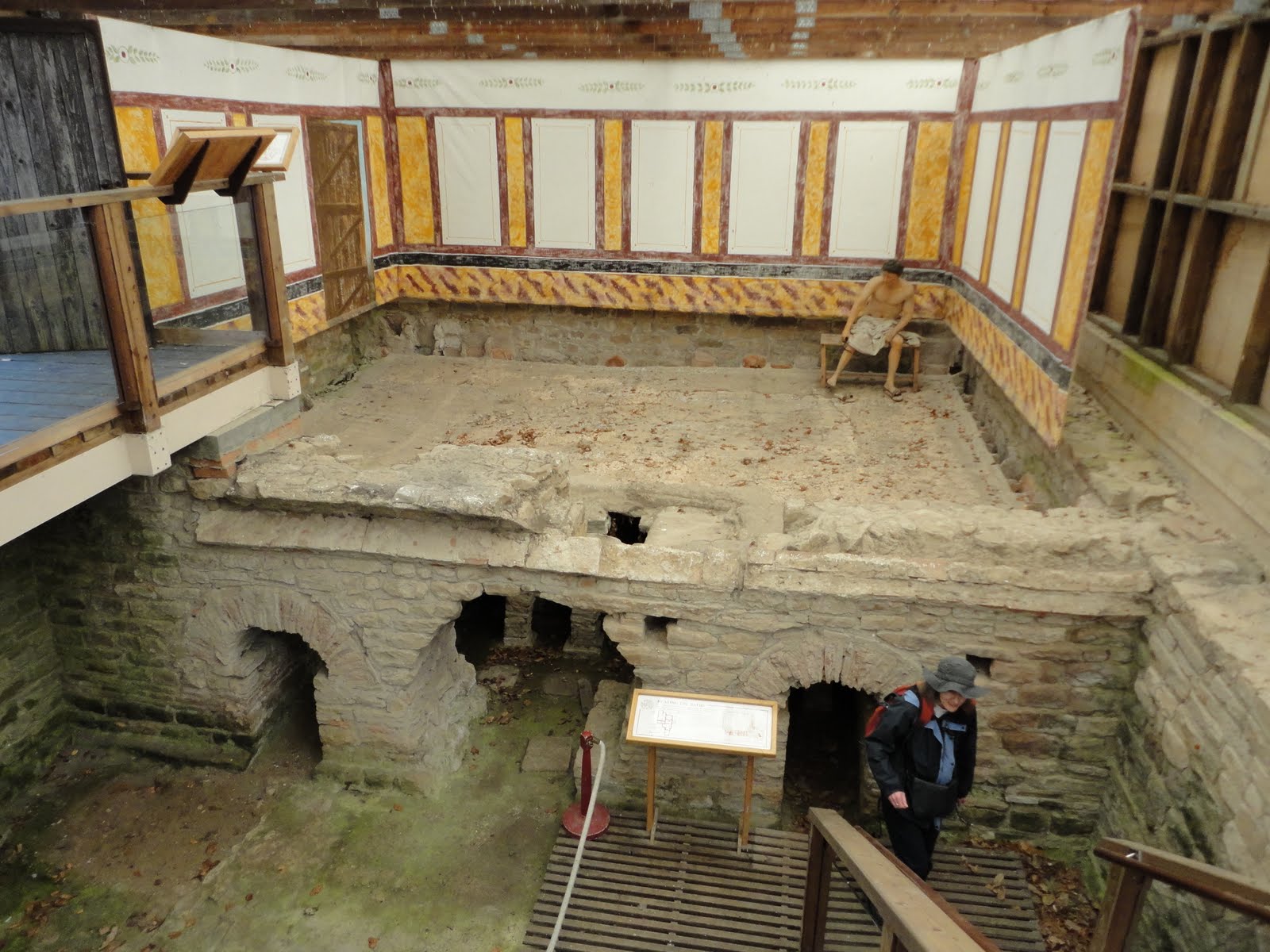
Interior of the best-preserved section of a Roman fort near Durham, also part of the CA conference excursion, with Claudius the plastic Roman in the top right hand corner


The exterior of this section of the fort, under this time wooden hut-thing, surrounded by less well-preserved sections

This is quite good though - follow a sign for a 'Roman mine' in North Wales and you'll never find it, though you'll probably get a very nice walk in the process and will almost certainly see some sheep.


We do have one spectacularly well-preserved set of Roman remains - the baths at Bath (so impressive we named the town after them). These are much better preserved, and although this preservation is due largely due to lots of later additions (especially Georgian, I believe) it makes the Baths that much more impressive to look at and they are the highlight of our Roman archaeological sites (along with Caerleon, which I haven't seen because I couldn't afford to go to the CA conference that year).


You're not allowed to dip your fingers in the water at the baths at Bath, so naturally, OldHousemate(theRomeone) and I did no such thing. Ahem.

With these being far and away our most visually impressive Roman remains, it's not surprising that if Roman Britain is required, programme-makers will try to get them in there - though few go to the lengths of Bonekickers, which kept Boudicca alive far longer than history did and in a different part of the country, just so that they could set their episode about Boudicca at the Baths, conveniently located near where they were filming at BBC Bristol.


I couldn't find a picture of them in the Baths specifically, because all the photos relating to this particular episode were from... my own blog. No one else is interested in Bonekickers. I don't blame them.

Most pop culture representations of Britain, however, don't bother with real Roman ruins, they just build sets and set stories in Londinium (London) or Camulodunum (Colchester), the major urban centres of Roman Britain. (Colchester has an excellent museum with Roman section, which I haven't been to since I was 10 years old, but it was very good). Just lately, they all seem obsessed with the probably-fictitious disappearance of the Ninth Legion north of Hadrian's Wall, in dark, wet, atmospheric Scotland (see Centurion, The Last Legion, The Eagle etc.).

This was the only picture of Scotland I could find on my computer (it's in Glasgow and when I was little I thought this actually was Sydney Opera House). Just pretend it's a dark, damp, atmospheric forest.

As you can tell from the pictures, the British climate is not quite like the Roman/Italian one and this is usually a major theme in depictions of Roman Britain. Every Roman who is ever sent to Britain, whether it's Kenneth Williams' Caesar, Lindsey Davis' Falco, a character from Chelmsford 123, or even Blackadder, will complain about how cold and wet it is. To be fair, they have a point (hence the mass exodus from Britain to the Mediterranean every summer) though for the record, I do have a friend from Texas who actually likes the climate here. It's not that terrible... really...


My birthday present from CurrentHousemate this year - note pouring rain in the background

As this picture reminds us, the most interesting use of the British landscape in a Roman-set story recently was last year's two-part Doctor Who finale, 'The Pandorica Opens'/'The Big Bang'. Rather than go hunting for some decent Roman remains and trying to build an episode around them, Steven Moffat took the whole thing even further - he simply went for the most impressive historical monument we have in this country and built an episode around that, on the quite sensible grounds that it was already there during the Roman period, so there was no reason not to go there with Romans.


Romans at Stonehenge!


Me at Stonehenge!

I love this double layering of history, like the ruined Roman villa in Britain where the lovers meet in the 2006 film version of Tristan and Isolde. And it's certainly a nice way to mix two of
the major elements of pre-1066 British history together.

All in all, Britain doesn't do that badly as far as pop culture Romans go, though in defense of my country, I would like to point out that the sun does shine here sometimes. Just not very often.

See? Sunshine!

Sunday, May 8, 2011

Doctor Who: The Curse of the Black Spot


There's Classics and Archaeology all over this series of Doctor Who - I don't think I've ever seen so many bloggable episodes in one series! (Bearing in mind River is certain to return by the autumn if not before, and we might be seeing Rory the Roman again as well).

This episode had a lot of very promising ingredients for a Doctor Who story - Pirates! Treasure! A Curse! Hugh Bonneville! Rory! Matt Smith continues to grow on me and much of the episode featured a nice, traditional adventure story with a bit of danger, and the TARDIS going missing, which always ratchets up the tension nicely. A few flaws at the end - Rory dying holds no dramatic power whatsoever any more because he's done it more often than Harry Kim and we didn't need the reminders of the Doctor's apparent (and equally drama-free) impending doom and Amy's maybe-pregnancy, because this was a stand-alone story and should, therefore, have stood alone. On the other hand, I'm sure we'll see Captain Avery and his crew again in the future, and I look forward to that, pirates are always good fun. And the Doctor's characteristic dislike of firearms is back to normal after last week's unusual fondess for bottom-kicking, so all's well with the world again.Link
I blogged about Sirens in general a good while back, when reviewing the Red Dwarf episode 'Psirens'. To sum up; ancient depictions of Sirens often included wings, which never get into modern depictions, and I don't think they became sexy until after their most famous appearance in Homer, though this was a point of some debate. The main difference between this Siren and your classic Sirens was that she functions best in becalmed water, rather than dashing people to their deaths against the rocks, for which I presume rough seas would be more effective; plus, of course, she's entirely well intentioned and not a psychopathic killer at all. This episode does rather make you wonder what other forms Voyager's holographic Doctor could have taken (wonderful as Robert Picardo is in the role). The Doctor kept calling her a mermaid, which was mildly irritating - although Sirens are sometimes depicted as mermaids in later (non-Classical) works, this one definitely had legs.

I rather like the reinvention of the Siren as an essentially benevolent (sort of) force, though the inversion is less dramatic for being a bit too reminiscent of other relatively recent Who episodes (Moffat's own 'The Empty Child/The Doctor Dances', chiefly, and people going poof! but turning out to have been transported, not killed, appeared in 'Bad Wolf'). Her music was nicely ethereal and is one of those things that's really hard to do, like casting Helen of Troy - how do you decide what the most beautiful song in the world sounds like? (I like Ariel's little ditty from The Little Mermaid, myself). The idea that she appeared beautiful and sounded beautiful if you'd been injured, almost like a drug, solved this problem rather nicely, as we could imagine she looked and sounded even more beautiful to those under her influence.

I was less keen on the Doctor's reference to 'folklore' that says the Sirens go after treasure ships. Perhaps there's some post-Classical folklore that has them do so, but Greek Sirens just like to crash ships for the lolz, usually - which in some ways can be more frightening and more interesting, though of course it wouldn't fit this story. Talking of interesting, why did Avery become a pirate? We never did find out. Perhaps he's going to show up again later and explain then, though I would have preferred an explanation here - again, this is supposed to be a stand-alone episode. Russell T Davis had a knack for making episodes feel complete and surprising you by picking up on them again later (the watch from 'Human Nature/The Family of Blood' that reappeared in 'Utopia', for example) but there are so many hanging threads this series nothing really feels complete.

Some major plotholes here (why aren't the Doctor, Amy and Avery put straight in the sickbay? why does CPR have a 100% success rate on TV, when it has a 20% success rate in real life?!) but this was a fun run-around with lovely production values and I'll be quite happy to see Avery and his crew again, as we undoubtedly will. If they bring more Classical creatures with them, so much the better!

Sunday, May 1, 2011

Doctor Who: The Impossible Astronaut/Day of the Moon


Somewhat appropriately given today's blog, 365 Tomorrows published my flash fiction piece 'The Value of Archaeology' as their story for April 30th, 2011, my first piece of published fiction since poetry competitions in school - I'm very excited!

And of course the other reason for excitement is that Doctor Who is back (temporarily)! And the good news is, Matt Smith is finally beginning to grow on me as the Doctor. Perhaps this is because I enjoyed his performance as Christopher Isherwood in Christopher and his Kind so much, perhaps it's because he's getting some more subtle stuff to work with, perhaps it's just that I've finally got used to the weird bow tie and tweed look. Anyway, I'm warming to him. I hope next week gives us a somewhat more straightforward story though. There are some times when I love a bit of mystery and I want to watch something that makes my brain work. Sitting down on a Saturday evening to watch Doctor Who is, I'm afraid, not one of those times. I never thought I'd say this, but more Daleks, less mystery please!

This opening two-parter featured River Song, one of my all-time favourite Doctor Who characters (I like to see some mystery) and an archaeologist, hence the blog. For the most part, River was in strict Indiana Jones mode here, firing lasers, flirting and breaking out of prison all over the shop. She really is being kept in the worst prison in the galaxy, though the 'she's packing again' comment was funny. Her declaration to Rory that she's a doctor of archaeology was played purely for laughs and does at least demonstrate some awareness that most of my colleages in archaeology, as far as I know, do not spend their time running around the White House shooting bad guys. Maybe they do and they just don't invite the Classicists?

There was one brief, more substantial reference to River's actual job, which I absolutely loved. Describing President Nixon (as I'm sure many parents had to do to confused children later, which is great, as the show is living up to the original intention to include some educational elements), the Doctor's summary of the man pretty much matches that of my parents in terms of negativity. 'Hippie', River calls him, and points out that Nixon did some good too (I am reminded of the old Vulcan proverb, 'only Nixon could go to China'). 'Archaeologist!' snarks the Doctor. Because River views history largely dispassionately, as a general subject of study, she sees both the good and the bad even in some of history's villains (not all of them - there are still a few who don't seem to have any redeeming qualities. But not as many as you might think). The Doctor, however, like my parents, has probably lived through the period (didn't he and Martha spend several months in 1960s Britain - come to that, wasn't Jon Pertwee's Doctor stuck on Earth during the 1970s? or was it the 1980s?) and views events emotionally, still feeling the justified anger felt at Nixon at the time.

'I wear a Stetson now. Stetsons are cool.' But the joke doesn't work, because Stetsons really are cool!

The other minor point I adored was the use of Nixon's tapes as a plot device. This is exactly what Doctor Who's historical stories should be doing - picking up on elements of history and spinning a story around them that uses the history and introduces children to something real amongst all the fantasy. For me as an historian, the most satisfying historical stories are always those that play with real elements of history (with the exception of 'Agatha Christie disappeared because she was attacked by a giant wasp'. Urgh).

Both Rory and the Doctor also referred to the fact that they've both lived through the fall of the Roman Empire. It's nice to see Rory's time as a plastic soldier will not be forgotten and it may be the basis of some interesting character development. I also find it quite interesting that Rory is now twice as old as the Doctor. (Rory, the Doctor and Jack Harkness should really start some kind of 'I survived the Roman Empire' support group, though Jack's stories of coming to and dying again repeatedly in a coffin might bring down the general tone of meetings). Rome, the Empire and its fall are the subject of all sorts of sayings and metaphors dropped into English conversation ('all road lead to Rome', its position as the archetypal Empire and so on) but these gain much more depth when two of our three main characters actually remember these events. I think we can expect more of this later in the series.

Overall, a good opener and I'm intrigued and interested in some of the hints dropped (who is the little girl? Does she have anything to do with Amy's maybe-pregnancy?). I still love River and she's gained a tragic air now - so far (and assuming a later Doctor does manage to visit her out of order to give her the future screwdriver) her appearances are matching up nicely and I foresee backwards marathons once this series has finished, so we can watch events unfold from her point of view. I really like the direction the characters and the emotional development of the series is going - I just hope we get a few stories that don't require intense concentration on the part of the viewer at some point this series, my brain is tired!

There was some gorgeous location shooting in Monument Valley for this episode, but if I was Amy or Rory and my friend who owned a machine that could travel all over time and space made me fly by plane to America, I'd be pretty miffed. Possibly even vexed.

Thursday, January 6, 2011

The X Files: Tithonus


My best friend and I were completely obsessed with The X Files as teenagers - I can still remember the excitement of going round to her house (she had Sky) to watch 'Ascension' (the Scully abduction episode) and all the pictures of David Duchovny lovingly cut out of the Radio Times and stuck onto my tin pencil case. I stopped watching The X Files back in season 4, but my wonderful brother bought me the whole lot for Christmas last year and I've been watching my way through them (I'm currently up to the early part of Season 8, which I'd been putting off due to its reputation. So far, there've been two really good episodes, which is two more than I was expecting).

'Tithonus' is a sixth season episode in which Scully is put with a new partner and sent to investigate a crime scene photographer who is suspicially quick to the scenes of murders. Spoilers follow for the episode and for the story arc of the show as a whole, up to season 8.

It turns out that the photographer literally cheated Death - as in, made Death miss him and take someone else instead - and has since become immortal. Within the episode itself, direct references are chiefly to the idea of Death as a personified figure who comes for dying souls, which is a pretty common idea, but not especially common in Classical literature (souls tend to fly down to Hades, or whizz off to the Styx to be transported by Charon and so on. Thanatos, Death, appears every now and again but not often). However, the title of the episode is a direct Classical reference to the mythical figure of Tithonus, and it's Tithonus' story that is really important to understanding what the episode is about, which is not cheating Death, but enduring life.

Tithonus was a Trojan prince who was taken off by Eos/Aurora, goddess of Dawn. She asked Zeus to grant him immortality but forgot to specify eternal youth as well, so Tithonus lived on but continued to age. Eventually he ended up wrinkled and shrivelled, shrinking until he fitted into a basket. For a more literal representation of this myth, we need to turn to Doctor Who and the episode 'Last of the Time Lords', in which the Master makes the Doctor's body reflect his actual age of 900 years or more (and very silly it looks too). The X Files does not actually go all the way with this myth on this one; Fellig, the photographer, has aged but stopped somewhere around 65, rather than continuing to age throughout the nineteenth and twentieth centuries. He is, however, apparently immortal and in addition, he has acquired the ability to see when someone is about to die, which is how he's always first on the crime scene.

The Doctor, showing his age.

What really makes this episode interesting to me, and why I think the title's emphasis on immortality rather than death is important, is how the episode ends. Fellig escaped Death in the first place by distracting Death's attention on to someone else, and has been chasing deaths ever since because he believes that if he looks Death in the face, he'll be able to die. He's desperate for this to happen because no immortal character in fiction ever actually wants to be immortal, for one reason or another. Being very very long-lived is OK, and evil characters often want to be immortal, but anyone who actually acheives it will end up miserable because everyone they loved has died and, in extreme cases, because living to the end of time and the universe is quite boring, as Red Dwarf's Inquisitor and Star Trek: Voyager's Q2 can testify. Lord Voldemort may be the exception that proves the rule, but he died before he got really bored of everything.

At the end of the episode, Fellig sees that Scully is about to die. Scully being the hero, of course, he finally manages to look Death in the face and dies instead. What's really interesting about it is - does this mean that Scully is now immortal (though not ageless)? It would be easy to dismiss it as a TV plot-hole, except that it does rather beautifully fulfil a throwaway line from season 3's 'Clyde Bruckman's Final Repose'. Clyde Bruckman could see how people were going to die (as opposed to Fellig, who just sees that it's about to happen). He implied that Mulder would die of auto-erotic asphyxiation, which may or may not be a joke, and when Scully asked how she would die, he said 'You don't.' (In practical terms, of course, his statements about their deaths had to be open to interpretation because the writers had no way of knowing whether or not they might eventually want to kill either character off, or how). Since Bruckman had formed a strong crush on Scully at the time, we all assumed he was either trying spare her feelings or didn't want to think about it, but it was a nice, spooky little idea thrown out there. 'Tithonus' plays into this idea perfectly - if Fellig distracted Death from Scully and died instead of her, Scully is now immortal, though she will still age, proving Bruckman right.

Of course, this idea is never referenced again and Scully certainly doesn't seem to think she's immortal. But it does make rather more sense of all those narrow escapes and improbable survivals that are part of the package for all science fiction TV heroes! Any time, for the rest of the series, Scully manages to survive something that really ought to be fatal, we can just tell ourselves 'oh, well she would, wouldn't she, she's immortal'! This might have the less beneficial effect of removing all sense of dramatic tension any time Scully's in danger - but luckily she spends all of season 8 pregnant, and the baby isn't immortal, so that puts a hefty sense of danger right back in.

All in all, this is two throwaway references in a nine-year long show that we probably aren't meant to read too much into. But I can't help thinking that by calling the episode 'Tithonus' and drawing attention to the 'immortality' aspect of the storyline, knowing how much fans have enjoyed discussing Clyde Bruckman's enigmatic statement, the writers were having a little fun and providing a possible solution to that particular conundrum. If it comes with an excuse for their heroine's frequent improbable survival, all the better!


Some pictures of John Simm and David Duchovny. Just because.

Sunday, June 27, 2010

Doctor Who: The Big Bang


Spoilers follow, and in fact, I haven't recapped the plot (mostly because, to be honest, I'm not actually sure that I followed it) so none of this will make any sense if you haven't seen the episode.

OK, first things first - my excuse for blogging this, aside from the odd Roman, is that River Song is an archaeologist, so let's look at that. I love her slightly Indiana Jones-y outfit - in fact, she was very much a female Indiana Jones throughout this episode. Since we haven't yet met a version of River who doesn't know the Doctor, this is less out of place than usual, as an archaeologist who may or may not be married to the Doctor is much more likely to be handy with a weapon and up for some action adventure than your average university lecturer. I especially loved her totally brutal, cold-hearted annihilation of the Dalek who killed her lover - perhaps she is Steven Moffat's version of Captain Jack, who can be the tough guy with a gun that the Doctor can't be.

I loved the Pandorica and the battered Dalek ending up in the museum, though I thought calling it 'The National Museum' was pure laziness - why not just mock up a couple of rooms from the British Museum and add some stock exterior shots? I loved the timeline of all the things that had happened to the Pandorica through the centuries as well - that felt like a very 'real' touch - and every time anyone mentioned the story of poor Plastic!Rory guarding Amy for 2000 years I welled up. The image of the Roman centurion running from a World War Two bomb was strangely awesome and powerful, though unfortunately it did lead me to wonder why he waited until World War Two to change his outfit.

(Edited to add: It appears that the 'National Museum' is in Wales - I've never been to Cardiff, which is presumably where it is, and hadn't heard of it. Depending where Leadworth is, that could be a more sensible location but I confess, even though I live in Wales at the moment, I'd still rather have seen the British Museum, there's no museum quite like the British Museum!).

As for other, non-history related things...

The plot made no sense. Maybe when I've watched it twelve times, like an episode of The West Wing, it will all come together and everything will be logical and sensible, but on first viewing (which is the viewing that counts, really, as if you don't enjoy it the first time, you won't bother watching again) none of it makes any sense whatsoever. I think the two biggest issues were, 1) Surely a universe without the Doctor will be a very unfortunate universe? With everyone being overrun by Daleks and so on? This is a very bad plan! (OK, the universe is in dire peril, but still). However, Dad then reminded me that actually, if I recall my nerdy internet reading correctly, Doctor 4 was at least partially responsible for the emergence of the Daleks anyway, so maybe the universe will actually be better off without the Doctor causing all the problems he then goes on to solve. And, 2) how exactly can the Pandorica bring people back to life? For much of this episode, it seemed like it was just a slightly updated version of the Goa'uld sarcophagi from Stargate.

There was also a distinct lack of tension, due to the fact that I know the show isn't ending, so the Doctor will be fine. All through the lovely, tender scenes with Amy and Amelia, I just wanted him to get on with it so I could see how it all resolved itself and get to the much, much more interesting questions - what's going on with River? When will she marry the Doctor? Who did she kill and, presuming she killed the Doctor (since she said it was a very good man, seems a bit obvious but it could be him) when will she do it and, most importantly of all, if she kills him, will he finally regenerate into Adrian Lester like I want him to?! Most of which, it seems, we'll have to wait for Christmas, if not longer, for answers. I wasn't quite sure whether I liked that the bigger story - including the 'silence' - isn't resolved yet, or whether it was annoying. On balance, I think I liked it, as it gives us all something to look forward to, though a couple more answers, or hints, in this episode might have been nice.

I liked Amy and Rory's happy ending a lot (SO happy that Rory is properly human again!) and loved Rory as 'Mr Pond', though I worry for poor Rory's safety. I love the idea of a married couple on the TARDIS, but how can the writers resist the urge to kill him off again? The Doctor's comedy dancing at their wedding was pretty cool, though no Angel.

Other random thoughts... Not sure about the ‘wacky’ music. No, Doctor, no one is listening to you because you’re making absolutely no sense whatsoever. It’s all getting a bit Time Traveller’s Wife again. ‘It might even work’ says River – yes, if it’s a million to one chance, it might.

We end on a couple more history related notes. The Christmas special may or may not revolve around an Egyptian goddess loose on the Orient Express... IN SPACE! Which could be cool. And Amy's father is called Augustus.... why, why, WHY??!! (I would like to finish on a snarky note, but just watch Steven Moffat, the Structure King, somehow tie Amy's father in with Father Octavian and make me sound like an idiot...)

Sunday, June 20, 2010

Doctor Who: The Pandorica Opens


I'm away a lot this week, so the next Spartacus review will go up Thursday or Friday, and the next Doctor Who review (the season finale!) will go up next Sunday.

Spoilers follow.

After a somewhat underwhelming season, this was a pretty decent episode, though just how good it is will be revealed next week, since this is part one of a two-parter and you never know how these things are going to work out. I was expecting the Pandorica to unleash all the familiar bad guys we'd seen in the trailers, what with it sounding like it ought to be a box which unleashes all the evils of the universe and all, but it turned out to be cleverer than that. Just as I was making my customary remarks, wondering why people in science fiction insist on naming ships that fly towards the sun 'Icarus' and ships travelling long distances 'Odyssey', when they ought to know by now that that never ends well, it turned out that the Pandorica has, in fact, deliberately been named after Pandora's Box, because Amy liked the story as a child. (Though I also think that's where the logic of it fell down a bit - what sort of little girl says Pandora's Box is her favourite story?!). The Pandorica itself, meanwhile, looks exactly like Baldrick's time machine, leading us briefly to speculate that Blackadder is, in fact, the most evil being in the universe. Anyway, it was a neat inversion of the usual significant naming conventions and tied in to a nice, twisty revelation.

Said revelation also made sense of a few other things, the main one being, why would only people the Doctor met with Amy get together to warn him about the TARDIS exploding? I assume that is to do with this constructed story as well (except for poor Vincent's painting, which presumably was a genuine vision?). Liz Ten is still pretty awesome, so it was fun to see her, and River is still fun, intriguing, and a nice break from companions who haven't a clue what's going on (that's not a criticism - the companion has to be clueless so the Doctor can explain the plot to the audience - but it's still nice to see someone who knows what she's doing).

I was all on my high horse about Cleopatra being in Britain, briefly, but that was explained too, and I liked the entrance of the commander, who pointed out she's both in Egypt and (long, by this point) dead. I am a bit confused about the Romans though - are they all Autons, then? In which case, is it really AD 41, or not? Are there real Romans around anywhere? Will they turn up at some point?

I shouldn't draw too many conclusions before the final part next week, since I've been wrong several times already, but I am getting a feeling that Rory and Amy's story may involve convincing Rory he's really Rory (a la Bill Paterson in 'Victory of the Daleks'). I'm torn about this - I liked the storyline and thought it was very sad and affecting, but I fundamentally disagree with Steven Moffat, who thinks that brainwaves and memories make a person. I think there's more to a person than brain functions - as Rimmer put it in Red Dwarf, he's really dead, and the hologram that's left is a projection with his memories. This was my big problem with the conclusion to 'Forest of the Dead' (that, and the fact that the idea of basically being stuck in the Matrix forever didn't sound like much of a life to me). On which subject, having shown excellent restraint for most of the year, we also go our first dig at religion in this episode - people who believe in (Roman) gods are 'fools' and the military commander is too much a soldier to have any faith. Gee, thanks Moff.

I didn't see any Daleks while I was there...

Anyway, as I said, I should probably leave well alone until next week, except to wonder why they bothered to ride horses to Stonehenge when they have a perfectly good (not malfunctioning yet) TARDIS at their disposal. It was good fun, with some nice emotional moments, and hopefully will go down well (a friend of mine who's a primary school teacher said none of her kids have been talking about Doctor Who this year, which is a bit sad). So far this year, we've had only one real stinker ('Victory of the Daleks') but no really good, blow-you-away episodes either ('Vincent and the Doctor' came closest) so here's hoping that next week's finale will be a classic.

Tuesday, June 15, 2010

Bits 'n' Bobs


Hello all!

This is a quick place-holding blog! A new Spartacus review will hopefully go up tomorrow, if we can work out how to work the Sky Plus thingy. If not, Spartacus will go up next Sunday or Monday, after the repeat. I can't watch it live tonight, as I'm giving a paper in Birmingham.

I'm also planning to post on Part One of the Doctor Who finale this week, as it appears (from the trailer) to feature not only River Song, but also Stonehenge and some Roman soldiers! However, I won't be able to watch Doctor Who live either, as I'll be at a conference in Milton Keynes on Saturday. So, the Doctor Who review will definitely go up on Sunday, once I've watched it on the Iplayer.

In the meantime, CBBC are currently repeating series 1 of The Roman Mysteries, everyday in the morning (just before lunch I believe - unfortunately it's not on the Iplayer or viewable outside the UK). My reviews of Series 1 are all available already:
Series One is on this week and next week, then Series Two will be on for the two weeks after that, so I'll try to get at least one Series 2 review up while it's on, though I won't be able to keep pace with the whole series!

Finally, I have an interview next week! So, I have much preparation to do - please forgive me if the frequency/length of my posts suffers a bit!
By the way, the photo is of a Roman aqueduct near Split, Croatia, which is still in use. I just think it's cool!

Sunday, May 9, 2010

Doctor Who: The Romans 4, Inferno


This post has been edited because I managed to refer to 'Ian' as 'Steven' approximately 50% of the time - whoops! (And thanks Tony!). I am choosing to blame this on Doctor Who itself, rather than on one of my occasional Complete Brain Malfunctions - for surely here is proof, if proof were needed, that Steven is simply Ian without Barbara.

We pick up where we left off, with Ian about to be killed by his friend in a private gladiatorial combat on Nero's orders. But, of course, Ian's friend is far too nice and noble for that and refuses, attacking Nero, and the two of them attack the guards, which quite pleases Nero, who enjoys this as much as the fight. Ian recognises Barbara and she tries to run away with them but Nero stops her, and is now Very Cross Indeed. Nero orders his guard to capture Ian and the other gladiator, or the guard will die.

Poppaea has had enough of Barbara too and orders her to be removed, again, threatening to kill the slave-master if he doesn't obey. Luckily, Barbara then asks him to help her get away with Ian, so he agrees to help her. Barbara tells him Nero has plans for 'Maximus' in the arena...

The Doctor and Vicki have found Nero's plans for how he is going to rebuild Rome after he's set fire to it; the Doctor tells Vicki how Nero started the fire so he could re-build and she dismissively says that she knows all about that. The slave-master appears to warn 'Maximus' - the Doctor - that Nero plans to have the lions set on him in the arena, and he'd better kill Nero quickly; it turns out that the assassins were sent to kill the real Maximus because he was planning to assassinate Nero and his allies, including the slave-master, have been helping him. The Doctor decides a swift exit as soon as it's dark is the best solution.

Nero comes in and while he and the Doctor talk about the upcoming arena performance, the Doctor stands with his hands behind his back, and his spectacles in his hands, resting over Nero's parchment with the plans on it. As they talk, a beam of sunlight comes through the window and shines through the Doctor's glasses onto the parchment, setting it on fire. (There's a nice detail here by the way. The plans say 'Nova Roma, Nero Fecit' in Latin, meaning 'New Rome, Nero made it'). When Nero finally notices he is furious and barks orders for an elaborate death for the Doctor and Vicki. He wants them put on an island in the arena, with water all around and alligators in the water, and the water level rising - 'and the alligators will get you!' By an uncanny coincidence, this is almost exactly the way Flavia nearly dies in The Gladiators from Capua, which I reviewed the other day! The difference, of course, is that Flavia was in the Flavian amphitheatre/Colosseum, which is an appropriately grand venue for such a spectacle. I'm not sure what facilities there were for such grand things before, though to be fair it probably was possible (I seem to remember Caligula doing some fairly dramatic things involving sea-battles).


Remains of an amphitheatre in Roman Salona, near Split, Croatia. Plus excellent view of the cement works behind!

Abruptly, however, Nero changes his mind - for it's just come to him that he will be able to build his new Rome if he sets fire to the old one. Nice one, Doctor. Apparently, the Doctor did this deliberately, so that he and Vicki could get away, though it's possible he's just trying to reassure Vicki. I hope so, because rather a lot of people died in the fire and plenty of Christians were fed to the lions afterwards because they were blamed for the fire, so giving Nero the idea does not seem ethically justificable just to get the Doctor and Vicki out of a tight corner.

The slave-master finds Ian - not sure how he knows him, perhaps he's psychic - and gets him in, while Nero tries to decide what to name the new Rome. Barbara and Ian are reunited, which is nice and all four of our heroes look for a way out while Nero orders a small crowd to start fires. The slave-master wishes Barbara good luck and reveals his motivation for helping her, as he is clutching a small cross (perhaps he assumed that Barbara was a fellow Christian, or wanted to help her because she seemed like she might be a good convert). This does not bode well for him in the near future, unfortunately. Ian's friend will accompany them some of the way, and go home.

The Doctor and Vicki have made it outside of the city and Vicki gets excited about seeing her 'first real sight of history' - the fire. Um, yes Vicki - quite a lot of people are dying in there, I'm not sure you should look so happy about it. The Doctor insists the parchment-burning was an accident and the fire isn't his fault, which is a bit of a relief, but then he starts laughing maniacally, which is less good.

And Nero fiddles - well, plays the lyre - while Rome burns, obviously.

Ian and Barbara have made it back to the villa and realise quickly that the Doctor and Vicki are still absent, and Ian repeats his fridge joke. Then it emerges that Barbara accidentally hit Ian on the head and much UST-filled running about ensues. Ian then sits back to exclaim 'O tempora! O mores!' which means roughly 'Oh the times! Oh the fashions/customs!' - Wikipedia has a brief history here.

The Doctor and Vicki finally turn up and refuse to listen to Ian and Barbara's attempts to tell them anything. Ian pinches some valuables and they all head back into the TARDIS and disappear with a sound that can't possibly be anything to do with the brakes because they're taking off. Vicki and Barbara run off to change while the Doctor tells Ian they're being dragged down... and the credits tell us they're going to the Web Planet! du du duuuh!

I enjoyed these episodes, but I think the biggest problem with them is the attempt to make them 'comedy' episodes. The Great Fire of Rome, slavery, gladiatorial combat and so on are not subjects for comedy drama - broad comedy can make fun of these things (things like The Life of Brian and Carry on Cleo) but comedy drama, in which our heroes' peril is supposed to be taken seriously, really needs to take the attempted rape of the heroine or the accidental mass murder of the hero a bit more seriously than this.

For this reason, Ian's story works best because there are no attempts at farcical comedy and he has very little contact with Nero. The first episode is also my favourite, because there the comedy works and is genuinely funny, since none of our heroes are yet in mortal danger.

All this is not to say a 'comedy' Roman episode couldn't work, it's just that this tends to make fun of the wrong things. The new series has more or less perfected the art of switching between comedy and drama or high tragedy and in fact this is its default position, yesterday's 'Vampires in Venice' being a pretty good example. So it might be quite possible to do a funny episode on the same themes, if it was done with more sensitivity, but it just doesn't quite work here. Vicki and the Doctor's total lack of concern about the fire they are partly responsible for just brings it all further down, and I found myself very much wanting to re-watch Catherine Tate's beautiful, emotional performance in 'The Fires of Pompeii'.

However, all of that notwithstanding, these episodes are good fun and Ian and Barbara's story was exciting and engaging. I was also very relieved that Ian's friend got away, I was a bit worried he was going to be sacrificed for our heroes to get away. This is possibly where the old series has an advantage over the new one - New Who writers would, I suspect, have been unable to resist the temptation to raise the body count and increase the sense of tragedy by killing him off, and sometimes it's nice to see a bit of restraint and a few more living incidental characters at the end of the story.

One final note of interest - just like 60s Star Trek, 60s Doctor Who is much more positive towards Christianity than New Doctor Who. This is, of course, part of the much wider changes between the 60s, in which Roman-set films frequently viewed things from a Christian view-point, and now, when we have Agora, which tells the story of a Christian mob murdering a pagan philosopher, but no corresponding films about ancient persecutions of Christians like Perpetua. The episode, however, skims over the impending first great persecution of Christians that followed, which might have seen the end of the kindly slave-master who helped Barbara.

Saturday, May 1, 2010

Doctor Who: Flesh and Stone

OK, there's not a whole lot of archaeology in this one I have to confess, but there is one major point I want to bring up. By pure coincidence, last Wednesday I posted my short paper about the portrayal of Daniel Jackson in the original Stargate movie, in which I discussed how, in the world of science fiction, being a doctor of archaeology automatically makes you an expert in practically everything, as if you were Sam Beckett from Quantum Leap and had nine doctorates that keep changing as you change history. This episode fell prey to exactly the same odd notion, that because you have a doctorate in something, you are incredibly good at everything, as River fixes lights and teleporters and generally runs around being a mechanic for much of the episode. Now, I have a doctorate in a similar area, and I can tell you right now, I can't re-wire a plug. Or cook a boiled egg. My understanding of science in general is reasonably good but limited and my understanding of anything remotely practical is nil.

Three things do ameliorate the ridiculousness of the idea though. Firstly, River is clearly very, very clever in many ways so fair enough, she's pretty good at problem-solving in general. Secondly, River is an archaeologist (not an historian/literature person like me) and archaeology is a science with a much higher practical/scientific element than my language-based work, so most archaeologists probably can boil an egg. Thirdly, River Song is still pretty unknown as a character and may have all sorts of things in her background we don't know about yet (murder, for example). So I can let it go for now, but I'll keep an eye out for it. Even Daniel Jackson, I feel, could not have fixed a teleporter no matter how hard he tried.

Also, we got a name for what will persumably turn up in the finale - the Pandorica. If the finale includes River Song I'll blog it anyway, but I suspect there might be some more classics-y stuff in there as well...

Other stuff... I loved Marco for just putting his hand over Amy's eyes to close them and was most sad when he was wiped out of existence. Still loved Father Octavian as well, and was equally sad when something happened to him (the Angels seem to have abandoned their old modus operandi of just sending people back in time, but we didn't see him die, so you never know) though his final scene was very good. I really want River's murder victim to be the Doctor himself, but that's half 'wouldn't that be a good story' and half 'Matt Smith's a good actor and I'm sure he's a lovely person but he just isn't quite The Doctor for me' so I may be way off base there. I really like that we've had some explanation of the crack in the wall already. I was worried that this season's overall arc was just going to be 'here's a crack... here's a crack... here's a crack... whoops it's the finale, this is what it is!' Which would be very dull. So I'm glad that's not what happened.

Amy walking through the forest with her eyes closed was absolutely terrifying - very well done. Killing off everybody who isn't a regular or semi-regular character may be a bit of an overreaction to previous observations that Moffat doesn't like killing people off though.

As for Amy and the Doctor - well, it's nice to see someone who just says what she's thinking rather than moping after him all season, but I think we may have overdone the 'companion in love with the Doctor' thing now. The bit about not wanting something long-term was funny, though I'm guessing (and hoping) it went over a lot of kids' heads.

Overall, this was probably my favourite episode of series 31/5/whatever so far, though we haven't yet seen anything to really blow me away (in the way that The Empty Child/The Doctor Dances, Human Nature/Family of Blood and Turn Left did).

Two final randomnesses - did anyone else picture something totally different when the Doctor said 'tree-Borgs'? And is anyone else still vaguely thrown by Rose Tyler's mother as a hooker in Ashes to Ashes last night?!

Saturday, April 24, 2010

Doctor Who: The Time of Angels

River Song's an archaeologist, right? I figure that's a good enough excuse to blog any episode she happens to be in!

Actually, she wasn't the only Pop Classics-y reference here - 'Octavian' is apparently a sacred name in the future. Interesting choice, since its best known as the name Augustus had during his cold-blooded killer phase, before he decided to revamp his image. But then, 'sacred' seems to mean something rather different here - it's as if the Salvation Army have suddenly gone very, very literal. I must confess, I really didn't take to the Christian army ranks. This is partly because I was really, really hoping that now that Russel T Davies has left, the series would leave religion and religious imagery alone for a while, since he really over-did it, and partly because all I could see any time anyone said 'Bishop' was this. They might as well have called themselves the Spanish Inquisition.

I do like the Future!Army guys though. Always good to see some army guys, even if they might as well all have been wearing red shirts.

River Song just gets more and more awesome. I'm honestly not sure whether 'hallucinogenic lipstick' is the silliest thing I've ever heard, or the most awesome weapon since Drusilla's fingernails, but I do like the way she was given an opportunity to strut her stuff in fancy evening wear as well as run around in fatigues. I personally may be a classicist/ancient historian rather than an archaeologist, but I think we all share a fondness for getting all dressed up from time to time, as well as for running around ancient sites in an old T-shirt. I liked the museum as well. I've been to several historical exhibits in churches so that made sense and it looked gorgeous, and I love that the Doctor wanders around museums looking for his own stuff - wouldn't we all do that, if we had the chance!

Nice use of time travel from the Structure King again (go back and watch Coupling - Moffat just loves to play with structure. It's his favourite thing). Though I have to confess, when River jumped out of the spaceship, I half expected her to be picked up twenty-nine seconds later and dumped on the pier at Southend.

All in all, not the best episode ever - like the previous episodes this series, it's a bit messy in places - but pretty good, looking forward to next week. And someone, please, give Amy a decent top to go with her tiny, tiny skirt.

Edited to add: Amy thinking her arm was stone was a bit odd, since Karen Gillan was 'The Fires of Pompeii'. Bit too similar there, took me out of the episode a bit. But I guess that would only bother super-geeks like me!

Friday, April 9, 2010

Doctor Who: The Romans 3, Conspiracy

This is episode 3 out of 4 of the Willian Hartnell-era story 'The Romans', so, unsurprisingly, it's chiefly composed of padding and marking time to get to episode four, though the titular 'conspiracy' seems to be ticking away in the background.

Poor old Ian is about to be sent to 'fight' lions in the arena - which, one suspects, adds up to being fed to them. Meanwhile, Nero wander around his (Golden?) house, picking on slaves, and the Doctor is trying to work out whether there's a conspiracy afoot.

Next, we get to meet Poppaea. She is youngish but not very young, blonde, sophisticated and her relationship with Nero seems to resemble Margo and Jerry from The Good Life as much as anything else (only not as nice!). Barbara is presented to her, and Poppaea declares grandly that she likes being Empress and does not wish this situation to change, though how she expects Barbara to protect herself from Nero, I'm not sure. Barbara is immediately chased down a corridor by Nero, who is stopped when he runs into Vicki, who once again just misses seeing Barbara. Nero catches up to Barbara again, but this time is stopped by the Doctor, who also doesn't see her. The whole thing looks distinctly like a French farce; the Doctor laughs at Nero's behaviour and the music seems to be suggesting that we should be laughing too.

Vicki, meanwhile, has stumbled across the court poisoner (who, ironically, looks not unlike Sian Phillips as Livia in I, Claudius). Vicki is cheerfully informed that everyone expects the family of Caesar to murder each other. This is starting to look like something out of Farscape (minus the puppets) and the series has strayed into presenting us with the pop-cultural view of Rome, rather than anything resembling Roman history. It is true that there was a period (later, during the third century) where emperors took to murdering each other at an alarming rate. It is also true that various historians - Tacitus, Suetonius, Dio Cassius - occasionally imply, infer or downright accuse members of the Julio-Claudian imperial family of murdering each other (a subject covered in great detail by I, Claudius - perhaps the writers of this episode had read the book). However, Tacitus and Suetonius never once imply that all this murder and poison is OK or expected - bad emperors are marked by their bloodthirstiness, Nero being one of the worst, and good emperors leave the poisoning to their wives. If any of them did have a 'court poisoner', it wouldn't be an official position (though they might employ a known poisoner like Martina). This scene seems to spring from the basic notion that Roman emperors had a tendency to bump each other off, but without any more in depth understanding of how Roman society really worked. And yes, I know, it's only Doctor Who, but before I get accused of nit-picking, it is worth bearing in mind that these early historical stories were supposed to educate children as well as entertain them.

They have got one thing right though - poisoning is woman's work. Men were expected to kill each other in much more macho ways, while women were forced to resort to poison, being physically weaker.

Nero continues to chase Barbara, demanding 'a kiss', while the Doctor and Poppaea listen to her screams from outside the door. The Doctor doesn't even try to help, but wanders off, but Poppaea walks in and allows Barabara to leave, while Nero insists that she was chasing him.

The woman in the cell next to Ian is the one who was helped by Barbara, and she tells him that Barbara has been sold. The Doctor and Nero organise his first concert while in the baths, while Poppaea decides to poison Barbara, still convinced that she wants to be Empress (unlikely, since even Nero was unlikely to marry a slave or freedwoman, whatever Suetonius says about secret wedding ceremonies between Nero and a male slave).

Nero and Barbara are about to have a drink, when Vicki tells the Doctor, quite calmly, that she thinks, in trying to save the unknown slave Poppaea wanted to poison, that she's poisoned Nero. I know Nero's horrible, but she is way too calm and collected about this (though she has managed to save Barbara, who drank first and would have died if Vicki hadn't switched the goblets). The Doctor objects on the grounds that this will mess up history, and stops Nero from drinking. Nero tests this by making a slave drink and the slave immediately collapses, bug-eyed.

Poppaea sends the poisoner to the arena for failing to do her job, and we cut to the feast that evening (Nero stuffing himself with grapes, of course, because This Is What Romans Do!). Bizarrely, everyone is eating sitting at regular dining chairs and waist-height dining tables (perhaps they've been ordering furniture from that strange carpenter from Galilee?!). This is especially weird since Ian and Barbara seemed to be reclining correctly in the first episode. The Doctor is ordered to play, and pretends to pluck the strings while actually making no noise - and somehow, everyone feels this is OK. He explains to Vicki that it's an 'Emperor's New Clothes' situation but really, this is getting far too silly, plus it's thoroughly annoyed Nero, who doesn't like being laughed at and doesn't like other people getting applause.

Nero drags Barbara off to the gladiatorial school, where Ian and his friend are to be forced to fight each other, just like in Star Trek. This theme often crops up in fictitious gladiatorial situations (Roman or otherwise) presumably because writers like the drama and moral dilemma of it, but I suspect it never, or very rarely, happened in reality - if you're watching a fight to the death (and they weren't fought to the death nearly as often as TV would have you believe) you want your gladiators to really go at each other, not feel conflicted about it.

Nero and Barbara seem to be enjoying a private show, and after Ian has refused to kill his friend, the friend gets the better of him, Nero orders his head to be cut off, and Barbara suddenly realises who it is - cue end credits. The next episode is called 'Inferno', so no prizes for guessing what that's about!

Unfortuately, after two pretty good episodes, this one is something of a let-down. The 'comedy' is no longer funny but in places rather offensive, since it stems from Nero's pursuit of Barbara, but I suppose that's understandable given that we are in the era of the Carry On. Less excusable, though, is the Doctor's ridiculous 'Emperor's New Clothes' act; even Nero would never be that drunk or that stupid, and the Doctor looks considerably less intelligent for trying it. Meanwhile the 'court poisoner' is also straying perilously close to the edge of plausibility and Vicki's untroubled approach to her attempted regicide (emp-icide? impicide? hmm!) is utterly strange. Only Ian's storyline remains compelling, and even that is stretched a bit by the insistence on the melodramatic 'let's make the friends fight each other to the death' trope, though perhaps this idea had not been quite so over-used in 1965.

I have reasonably high hopes for the next episode, though, which should end in a lot of flame and fiddling, and in which our heroes will finally stop just missing each other in corridors and be reunited!

Monday, March 15, 2010

Doctor Who: The Romans 2, All Roads Lead to Rome


Original 60s Doctor Who credits. Always awesome.

We pick up where we left off, with the Doctor and Vicki about to be murdered by the creepy dude with a knife because he thinks they're musicians. The Doctor successfully fights him off, however, and he goes out the window trying to avoid being hit over the head with a vase by Vicki, provoking the Doctor to wax lyrical about how much he enjoys the various martial/pugilistic arts. You wouldn't catch Ten saying that, even if he thought it. Vicki thinks they should get out while they can, but the Doctor is insistent that they press on for Rome anyway.

There's a rather nice overhead shot of a model of imperial Rome - not sure if it's Mussolini's, it might be a smaller one. Barbara is being kept in a small cell with another slave woman, who has a horrendous cough. Barbara is hoping that Ian will turn up, but is not feeling terribly optimisitc.

Lovely shot of a small sailing ship, and we see that poor Ian has become a galley slave - not nice. Gives him the opportunity to be all Charlton Heston about it, though it's only been five days so he only has some stubble, not a beard, and he's still got all his clothes on. He also has a cunning plan to escape, together with the guy next to him. It's the oldest trick in the book - pretending to be ill and trying to hit the bad guy over the head - and it doesn't work, the guard has seen it all before.

A man turns up wanting to buy Barbara and promising to help her, but he is told he'll have to bid for her at auction. The slave trader brings new clothes for Barbara, but says the other woman is to be thrown into the arena, since she's not valuable enough for the auction. Ian's ship runs into a storm and is wrecked. Meanwhile, the Doctor and Vicki, blissfully unaware of what has happened to their companions, are having fun exploring Rome itself, just missing the auction where Barbara is being sold to the same bloke who wanted her the night before.

Ian is washed up on shore, where his friend, who has freed them all and saved his life in the confusion of the shipwreck, uses some big rocks to get the chains off him (it looks painful). They are somewhere near Rome, so Ian says he must go there to find Barbara, who has attracted the rich but slightly creepy buyer by her help for the sick woman in her cell. He seems geuinely to want to help her and has bought her to be a slave to Pompeia, Nero's wife, presumably on the assumption that, as slavery goes, it could be a lot worse.

The buyer then leaves to greet the Doctor and Vicki and introduce them to Nero himself. Nero is tall, fairly heavy set, eating and talking with his mouth full, and speaking in that particular upper class British accent that actors use to convey utter selfishness combined with idiocy. There's then a lot of messing around with lyres, as Nero strums random strings and everyone pretends it's a new composition. The Doctor is very proud of himself for getting out of having to play the lyre, but as Vicki points out, this will hardly be the end of it.

The Doctor and Vicki are still nosing around - Barabara's buyer had referred to some trouble in the apodyterium, so they poke around until the find the body of the centurion who found them in the first place. Ian and his friend have reached Rome and are in search of somewhere to clean up when they run into some guards. As escaped slaves, they are taken to the arena to be thrown to the lions, and the episode ends with some nice shots of actual lions, presumably from the zoo.

This episode suffers a bit from middle-episode-syndrome, as a lot of the time is spent getting the characters from A to B, and the 'comedy' bit with the Doctor Nero and the lyre isn't as funny as the more gentle and less obvious humour from the week before, but there's some good stuff here. The Doctor and Vicki just missing Barbara in the street is a classic bit of just-missed-them plotting to increase the tension and Nero, in typical overgrown child crazy-mode, is how you might imagine Nero to be. The shots of Ian's ship and of the lions are very nicely done and the plot takes some interesting turns, especially in the form of the man who buys Barbara, who seems to be some kind of palace official and so far, seems to genuinely want to help, which is a nice idea in a slavery story. Stories about slavery are usually aimed at showing how utterly awful slavery is and while this certainly doesn't shy away from that - Ian is not having a nice time at all and the man has bought Barbara to protect her from worse masters - it is nice to see a few shades a grey and a bit of humanity in a slave owner, since, in this period, it would never occur to anyone not to own slaves if they could. Of course, I haven't yet seen the rest of the serial, so it's entirely possible that he is, in fact, totally evil, thus rendering this entire paragraph null and void.

Ian working the bedraggled-slave look

All in all, an enjoyable episode but a bit more plodding and less interesting than Part One, with less focus on characterisation and more on plot mechanics. The show is, however, doing a great job of showcasing several different aspects of ancient Rome for it's intended (child) audience, including slavery, daily life, the imperial court and the arena. Because Old Who doesn't feel the need to shove monsters into every historical story, the danger can come from within Roman society itself, which is rather nice and allows for a more intricate story.* On the other hand, apparently other viewers do not find basic historical stories as interesting as I do, since they stopped doing them for years, so I'll take New Who's historical stories with monsters over having no historical stories at all!

*This is one of the reasons that 'The Empty Child/The Doctor Dances' is one of my all-time favourite Who stories. There is a monster, and it is terrifying and thoroughly satisfies the sci-fi/horror element of the show, but the resolution is also absolutely tied in to the period, a resolution that could not work in other historical periods or in a modern setting. I love that!