Showing posts with label Life stuff. Show all posts

Sunday, June 26, 2011

Blog Awards

I've been away all weekend at a marking standardisation meeting (which meant I spent the hottest day of the year in a windowless room, shivering in the air conditioning - typical!). I got back late because when I tried to return to Oxford from Cambridge, I accidentally headed for Ipswich - for those unfamiliar with the geography, This Was Not Right (thank you to the nice hotel receptionist who pointed me back in the right direction!).


Anyway, the point is, I didn't even have time to finish the Asterix the Gaul comic I was reading, so a proper blog post will follow next week. In the meantime, however, the lovely Ali B from Fantastic Reads has kindly given me an award!


Thank you Ali!

The award comes with some rules:
1. Send a thank you to the person who nominated you and include their link. 
2. Share seven random facts about yourself.
3. Pass the award along to at least 8 deserving bloggers.
4. Contact those bloggers to congratulate them.

I'm going to list my eight deserving bloggers first:

Cris at Here, There and Everywhere (general awesomeness, travel, marine biology)
Hasan at Three Pipe Problem (art history)
Billygean at Billygean (life in general, sometimes CFS) 
Billie Doux at Billie Doux (TV and film reviews)
Elizabeth Spann Craig at Mystery Writing is Murder, author of various southern-set mysteries
Amalia at Good to Begin Well, Better to End Well (writing and myth)
Terri Windling at The Drawing Board (art, myth and folklore)

Also, it brings it up to more than eight, but Vicky Alvear Shectar's Friday Funnies are always entertaining.

This whole thing is creepily like a chain letter really, but a nice one!

Anyway, seven facts about me:
1. I have attended a Star Trek convention, in costume. It was a very cheap costume though. No uniform.
2. When I was a teenager I wanted to be a priest, and the only reason I didn't was that I'm the wrong gender. Maybe someday.
3. I love single malt whisky, peaty, like Laphroig - neat. There will be no polluting my whisky. Also mugs.
4. Until I was about 13, I thought the Romans were really boring. I refused to take Latin in school because, as I told my mother, it's a dead language and would never be any use to me whatsoever (this was before the priest thing).
5. I love to watch Sex and the City in French. It sounds good in French. (And in English as well, of course).
6. I have slept in a school library.
7. I have eaten dinner in Liverpool Cathedral.

I shall return with Asterix as soon as I've had time to read it!

Friday, May 6, 2011

The Tough Guide to Fantasyland (by Diana Wynne Jones)


A couple of bits of housekeeping: I've made comments available to registered users only (anyone signed in to OpenID can still comment) in an attempt to avoid spending another morning deleting viagra salespeople from my comments sections. So far, unfortunately, it doesn't seem to have worked - I'll leave it this way for a while and if it doesn't do any good, I'll open up the comments to anonymous users again (if you're the viagra salespeople who keep leaving inane but vaguely relevant comments linked to your viagra-selling site on the blog, please stop doing it. I am never going to let you push drugs, legal or otherwise, on my blog and if I ever decide to advertise anything on here, that will be my decision and mine alone).

I also have a new article up at Sound on Sight, on the six best films based on a television series.

The Tough Guide to Fantasyland is a comic A-Z of common fantasy tropes written by Diana Wynne Jones back in the mid-1990s. It's written in the form of a travel guide for the adventurous Tourist (i.e. the protagonist) about to set out on a Tour of Fantasyland. The obligatory map is provided at the beginning, of course, and for some reason includes, alongside The Smoking Mountain of G'wd, the River Smealt and the Sea of Caysif, small town labelled 'Nuneaton'. This was rather surprising - I went to the railway station there once, but had no idea it was a gateway to Fantasyland. It certainly made me laugh to see it on there, though.

The rest of the book is an alphabetical encyclopedia of sorts, each section headed with a Gnomic Utterance starting with the appropriate letter (things like 'Insights are always valuable, even if they only show you your duodenal ulcer'). This includes an entry for the Vestigial Empire; the 'most civilised' part of the continent, where both food (non-stew-based) and baths are available, with the only decent roads in Fantasyland, lots of white villas and vineyards and it has 'a parliament and a senate'. The Vestigial Empire is quite clearly a clinging remnant of the Roman Empire, existing alongside the medieval setting of the rest of Fantasyland.

Like so many recurring themes in sword 'n' sourcery, this particular theme originates with Tolkien, whose Gondor has a vaguely Byzantine feel alongside Rohan's Anglo-Saxon Cossacks (another entry in the Guide). It has its roots in history, especially in Tolkien's version, as the remnants of the Roman Empire continued to exist in the form of the Byzantine Empire while early medieval western Europe developed slowly into late medieval western Europe.

The Vestigial Empire as Wynne Jones describes it, though, is not quite Tolkien's ageing glory of Byzantium and even Tolkien was creating fantasy, not writing history; all in all the whole trope is rather unfair to the Byzantine Empire. Byzantium was a large and prosperous Empire which survived the fall of Rome by a thousand years (it fell when the Turks invaded Constantinople in 1453). Although it was, technically, the continuation of the Eastern Roman Empire, it was really a force and a culture in its own right and, historically, should never be dismissed as just a lingering 'vestigial' outpost of fallen Rome.

Tolkien started the downgrading of Byzantium's fantasy equivalent when he portrayed Gondor as a fading, suffering, shrinking shadow of its former self (excluding the ending, of course). The common Fantasyland Vesitigal Empire, as described by Wynne Jones, is even more Roman and even less impressive. It is quite clearly playing on the idea of Rome, but a Rome shrunk to a much less powerful force and struggling to survive against a fantastical Dark Lord. This is the most traditional, Victorian view of Rome imaginable, as a corner of 'civilisation' against barbaric tribes and countries with no decent roads, food or buildings (I should probably reiterate here that Wynne Jones' book is satire - she is deliberately highlighting the corniest fantasy tropes around, not endorsing them!).

There was one other somewhat bizarre bit of Roman stuff tucked away in the book. The book contains black and white, sort of old fashioned feeling illustrations throughout - I couldn't find the illustrator's name, so presumably it was either Steve Crisp, who designed the front cover, or Wynne Jones herself. Under the entry for 'Palaces' was the following illustration:


This is not a palace. It is quite clearly a drawing of Birmingham Town Hall. I recognise the entrance in the nearest corner, where we went in to see my brother play some kind of musical instrument in something, and to see Nosferatu with live accompanying organist at Halloween a couple of years ago.


Birmingham Town Hall


I didn't have a picture on my computer from the right angle, but here's one of mine from the snow last December - you can just about see the town hall in the far left side, behind the merry-go-round (which is part of the annual Frankfurt German Market) over the other side of the steps from the Floozie in the Jacuzzi.

I'm not sure what's more puzzling about this particular illustration - the fact that a drawing of the town hall of Britain's second city has been used to illustrate Fantasyland, or the fact that it's included under 'Palaces'. Birmingham Town Hall, you see, is such a good replica of a Roman temple that our lecturer in our first year undergraduate class told us all to go and have a look at it so we could understand Roman temples better.


A Roman temple in Nimes, which I haven't yet seen in person, unfortunately.

Clearly, the Vestigial Empire has somehow, possibly through the portal in Nuneaton, extended itself into our world, where it's old temples are becoming palaces. For fantasy kings. Or something.

Anyway, The Tough Guide is well worth a read if you're a fantasy fan as it's good fun and some of it is hilarious - the entries on 'Horses' and 'Swords' were especially high points for me.

Friday, April 29, 2011

Update and A Wedding


There won't be a full, regular post from me today, I'm afraid, as I'm completely slammed with work (an unfortunate combination of deadlines appearing around Easter, a time at which it seems I'm the only classicist I know who needs three days out to go to church, and things that can't be predicted and have to be done straight away, like job applications and interview prep).

However, as you're all aware, there was a bit of an event in the UK today, which I've had on TV in the background as I sit at my computer. Since this was a High Church service, we got a bit of Latin in the singing! (High Anglican services are extremely similar to Catholic services, though I noted that this was a short-ish wedding service - all the Catholic weddings I've been to have been full Masses plus the wedding and take forever).

According to the official website, this was the piece:

The Anthem will be followed by the Motet ‘Ubi caritas’ by Paul Mealor, a Welsh composer, who is currently Reader in Composition at The University of Aberdeen.

Mr. Mealor’s composing studio is on the Isle of Anglesey, where Prince William and Miss Middleton live. This version of ‘Ubi caritas’ was written on Anglesey and premiered at the University of St. Andrews in November 2010.

Ubi caritas et amor, deus ibi est means 'Wherever there is peace and love, God is there.' There's a really nice Taize setting for it that we sang in church last Thursday and it's one of my favourite short refrains (because it's so nice!).

I was disappointed to see that no subtitles were provided for the Latin. I suppose the directors didn't want to spoil their pretty picture, but I thought it would have been nice to let the viewers know what, exactly, the choir was singing. (I don't know whether the commentators explained it or not, because I was concentrating on my work and not listening to them!).

On a non-Classics note, the bride's dress was completely gorgeous and I want one. Lovely.

Well, Prince William has broken my heart by not marrying me (and boy am I ever kicking myself for choosing the University of Birmingham over St Andrews) but I hope they have a very happy life together, and I hope my friends' weddings later this year go just as well!

Friday, December 24, 2010

Christmas Silliness


My all-time favourite Christmas movie is The Muppet Christmas Carol. It's the most faithful adaptation of A Christmas Carol I've seen (seriously - two Marley brothers notwithstanding) and there's something about A Christmas Carol that works much better with Muppets than with just people. It's a really, really sugary sweet fable that needs to be treated as a story, rather than given the more 'realistic' treatment we usually employ for movies and TV, and Gonzo as Charles Dickens the narrator is the perfect way to achieve this. Also, it's completely hilarious ('Even the vegetables don't like him!).

During the schoolroom scene, when Scrooge is taken to see his younger self by the Ghost of Christmas Past, we pan across a shelf full of gorgeous Muppet busts of Aristotle, Dante, Moliere and Shakespeare (with Gonzo and Rizzo the Rat on the end, of course).


The beautiful Muppet bust of Aristotle


Inevitably, the shelf collapses and the busts go for a burton

It's an interesting selection of busts, in which Aristotle rather stands out, being a philosopher rather than a writer of more imaginative literature - though he makes a good pair with Dante, of course. I think personally I'd have been inclined to go for Plato or Socrates, or for a writer, maybe Virgil, but Aristotle works as a representative of the Classical world, and the selection definitely needed some Classical representation!

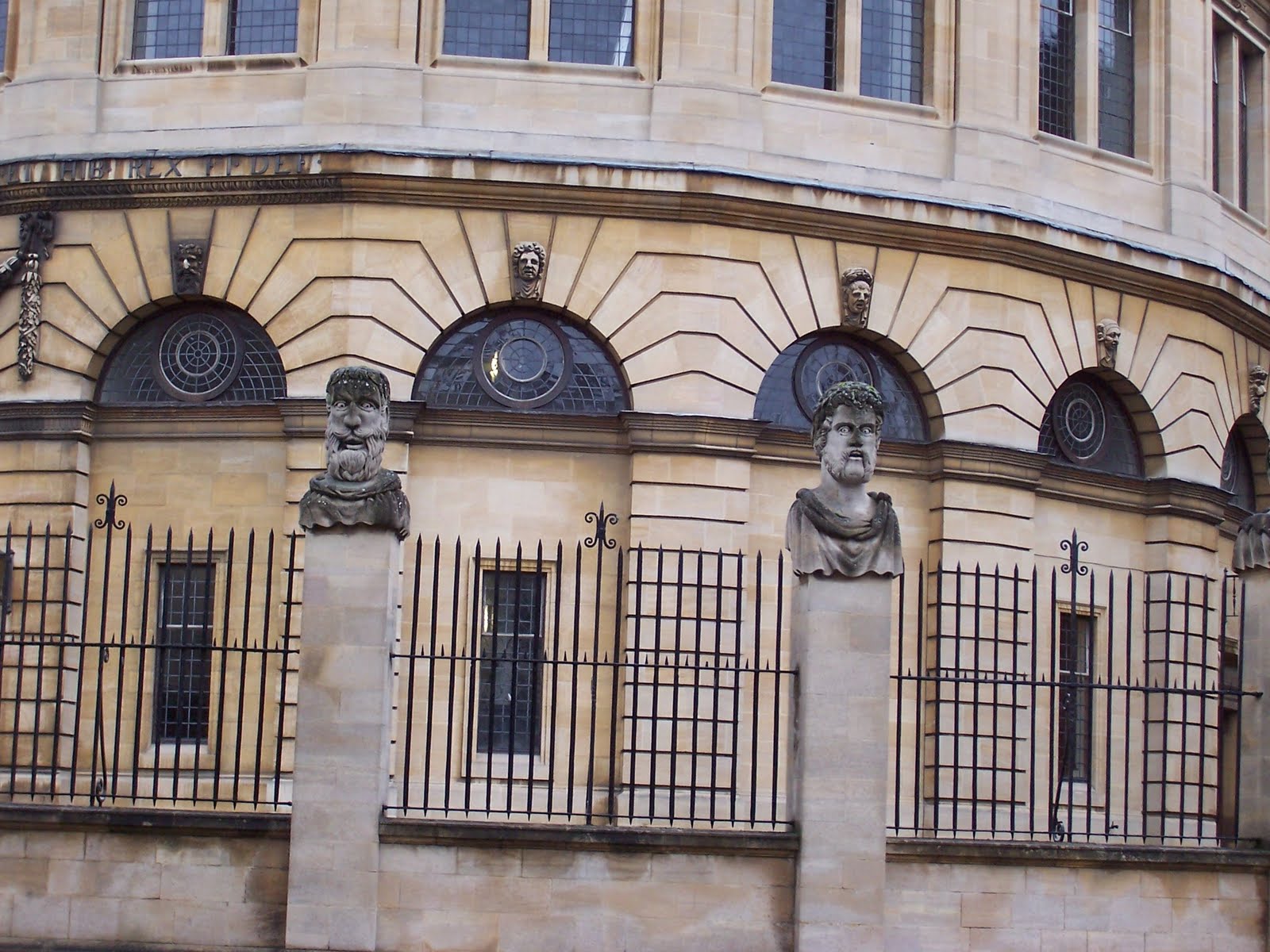
That's not really why I wanted to talk about this though. I actually brought this up so I could share a silly observation I made earlier this year. When I moved to Oxford a few months ago, I took a few tourist-type photos around the town, including these of the busts that sit near the entrance to the Museum of the History of Science on Broad Street.


View across the street from Blackwells book shop


A closer view of the busts - click to enlarge further

Don't the Oxford busts look weirdly like like the Muppet ones?! It's their weird googly eyes that mainly reminded me of the Muppet versions. I can't remember who they all are, but this is outside the Museum of the History of Science, so it's a pretty safe bet that Aristotle is among them.

If you haven't seen The Muppet Christmas Carol, go forth immediately and get hold of a DVD or find when and on what channel it's showing this Christmas. You won't regret it.

A few more Christmas/Saturnalia posts from the archives:
Joyeux Noel
The Roman Mysteries: The Twelve Tasks of Flavia Gemina
Chelmsford 123: Peeled Grapes and Pedicures
Discworld: Hogfather

Happy Christmas everyone!*

*Or whatever holiday greeting you prefer.

Thursday, December 16, 2010

Place-holding

Hi folks! I had planned a proper post for today but am stuck in bed with flu, and need to recover enough to drive to the airport tomorrow, as I'm away this weekend. I'll be back next week with the next episode of I, Claudius and something Christmassy!

Tuesday, November 23, 2010

Chelmsford 123: Peeled Grapes and Pedicures (and Nine Circles of Thesis Writing)


I had planned a Xena post for today, but that ran into technical difficulties, so, since the Christmas season is coming up, I decided to start getting in the mood with this Saturnalia-based episode of Chelmsford 123 instead. In this episode, Aulus and Functio plan to have an orgy to celebrate Saturnalia and to make the stupidest man around king for a day, but Badvok, as king, declares that he’s changed the rules and is now permanent King of Britain.

Considering this is a 1980s British sit-com (i.e. it’s about slobbish losers trying to get laid, Yes, Minister aside of course) set in ancient Rome, it’s something of a miracle that it took six episodes to get to the orgy. There is some concession to history, as Functio’s wife makes a comment about Romans and boys and Aulus points out she’s mixed them up with the Greeks (and people will continue to do so, Aulus). But really, this episode is playing with cultural stereotypes of Rome and it knows it. And, to be fair, the British are as much into complete sexual liberty in honour of Saturnalia as the Romans are.

I was entertained by a conversation between Functio and his young daughter, who asks what an orgy is, because my parents gave me the exact same answer when I was younger and watching I, Claudius (‘it’s a sort of party’). We also get to hear Badvok start a speech with ‘Friends, Britons, Countrymen!’ which is obvious but funny anyway. As a former inhabitant of Ipswich, I also found Badvok’s confusion when he was told to meet ambassadors from the East pretty amusing (Well, I once met a man from Ipswich...' Ipswich is a town in East Anglia, on the east coast of Britain). Badvok also tries to learn Latin and is given the traditional British Latin class drill ‘Amo, amas, amat…’ and, on being told there are two ‘yous’, declares that he’s abolishing all plurals. I think a lot of people probably wish he’d been successful there.

There’s something almost politically savvy and satirical about Badvok changing the rules of Saturnalia to make himself king forever – this is, after all, roughly analogous to what Caesar (consul, later got himself elected Dictator for Life) and Hitler (democratically elected) did. However, I’m not entirely sure political satire is the main point of this story – though lawyers certainly come in for some stick when Aulus tries to consult a money-grabbing one (played by Angus Deayton!). And Badvok certainly comes to regret his decision when he realizes that not only does being King entail some work, it’s also extremely dangerous.

Aulus manages to scare Badvok out of being king and all ends well, except for Grasientus, who’s stuck in a cell with Badvok and a cow. And so ends Series 1 of Chelmsford 123, on a reasonably high note, since this episode had a decent few laughs and played on some nice ancient themes – politics, kingship and the ever-present Roman orgy.

On an entirely unrelated note, earlier today Nathan Bransford posted on the Nine Circles of Writing Hell. This was an hilarious account of writing a novel corresponding to Dante's Nine Circles of Hell, which could almost apply as well to writing a thesis as writing a novel. And so, with all due acknowledgement to Bransford and to Dante, whose work this really is, I present for your amusment the Nine Circles of Thesis-Writing Hell...

With apologies to Nathan Bransford and Dante Alighieri

First Circle - Limbo

I want to do a PhD and get to call myself Doctor and wear a fabulous floppy hat and look like Harry Potter for the third time. What’s that? I need an original research idea for a thesis? Ah…

Second Circle - Lust

Oh this is it! This is The Idea. This is going to completely change the face of scholarship! This will get every bit of funding going and become a book straight away and I will get invited to conferences to be keynote speaker because everyone will be totally in awe of my amazing insight!

Third Circle - Gluttony

(Sung, a la Finding Nemo) Must keep writing, must keep writing, writing, writing…

Fourth Circle - Greed

You know what, this is going so well, I think I’m going to submit it early and get it out as a book by next year.

Fifth Circle - Anger

I can no longer see anything except words upon words in Times New Roman, I dream about my thesis, when I eat I imagine I’m eating my thesis. I hate my thesis. I have never hated anything so much in my entire life. Not even a Pot Noodle.


Sixth Circle - Heresy

This eminent scholar has no idea what she’s talking about! She clearly doesn’t understand the evidence or the theory and I don’t know how she ever became so well known, she’s obviously an idiot! I’ve devoted two chapters to bringing her down, point by point… who did you say my external examiner was?

Seventh Circle - Violence

Dear IT department, there has been a slight accident with the printer…

Eighth Circle - Plagiarism

Who needs a million frikkin’ references anyway?!

Ninth Circle - Treachery

Oh examiners, I know, the whole thing is the biggest pile of rubbish you’ve ever read, never mind giving me a PhD, you should probably take away by BA right now and I promise I'll never show my face in academia again!

Tuesday, September 21, 2010

Horrible Histories on television


Am in the middle of moving house and have an insanely busy start-of-term type couple of weeks coming up, but while I was packing yesterday I happened to catch Horrible Histories on television, so here are a few quick thoughts while I get my life together!

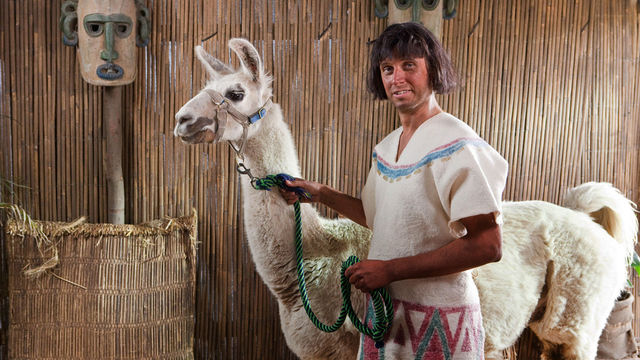
The Horrible Histories television programme uses cartoons in the style of the book illustrations along with live action comic sketches that tell children various weird and wonderful facts about the world. Rather than spending an entire episode on one period of history, the episode I saw jumped about between various places and times, with a very wide geographical and chronological spread - they must have covered a decent proportion of books in one episode! So each period just gets a quick sketch or two and some fun facts. Some periods were talked about in a more general way, others were attached to what looked like regular segments on medicine, religion and so on. At first I was thrown by the sudden switch, but after a few minutes I realised I really liked this format, because any time it switched to a period you weren't so interested in, you knew another one would be coming up soon. I'm actually interested in pretty much every period of history, but not everyone is, especially children, so this seemed like a nice way to keep their attention through the whole programme. There was one rather nasty segment on Stupid Deaths - nasty not because of the deaths, which were presented in a comic-book style, humourous way, but because of the Death figure with a very odd voice who presided over it. I think it was supposed to be funny, but it was just unpleasant. Other than that, though, the sketches were fairly amusing and informative as well.

As I watched, I wondered why the stuffed rat who was supposedly in charge kept popping up with signs syaing 'This really happened!' and' That's true!'. It's a history programme, I thought - the children watching this are far too young for a lecture on how we don't really know anything about history and it's all argument not fact, won't they just believe all of it? The answer appeared later in the programme, as the show included both a segment on 'Scary Stories', with a Vile Victorian theme, and, to my groaning despair, the story of the Trojan War. The programme didn't claim truth for these, and they specifically described the story of Achilles as a story that inspired the phrase 'Achilles heel', so they weren't intending to suggest this was really history or that any of it was true (especially all the stuff about Achilles being nearly immortal!). And the bit where they dramatised Homer's description of Achilles chasing Hector around the walls of Troy was hilarious. But I did wonder - wouldn't it be easier to just stick to history, and do a special episode on myths and stories every now and again? If I was a small child with a short attention span and lowish reading skills, I don't think I'd notice the difference between that section and the others. It's no wonder so many children are convinced it really happened.

I enjoyed the show a lot, and it looks like a fun way to get children interested in history. I even learned a thing or two about Incan llamas! But real history is so full of weird and wonderful things, I wish they'd just stick to that so I don't have to disillusion people years later!

Monday, August 23, 2010

Le Retour!


Well, I'm back.

As I'm sure you'll all be completely unsurprised to hear, I didn't get quite as much done as I'd meant to while I was away. I did make some headway though, and upcoming attractions over the next week or two will include recaps of the last two episodes of Spartacus: Blood and Sand, which seems to have been successfully recorded, a review of Vicki Leon's popular history book How to Mellify a Corpse and possibly something Star Trek-y...

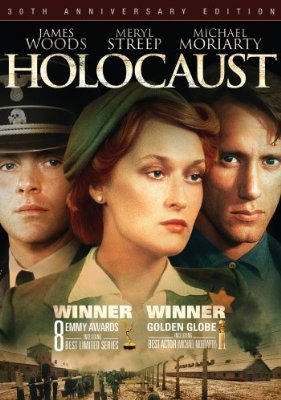
In the meantime, I thought I'd do a round-up of various Classics-y things that came up while I was away that aren't really substantial enough for a full blog post by themselves. We were staying in a gite in Morbihan, Brittany, and I managed to buy rather too many books and DVDs in both French and English - it's a good thing we went by car. Spoilers follow for J. V. Jones' The Barbed Coil, Holocaust Part 1 (dir. Marvin J. Chomsky, 1978) and especially for The Island (dir. Micheal Bay, 2005).

The reason I didn't get as much reading done as I'd meant to was that I spent the whole of the first week of the holiday stuck deep into a 600-page fantasy novel! The novel in question was J. V. Jones' The Barbed Coil, which was very enjoyable and made really interesting use of various illuminated manuscript traditions, complete with a name-check for the beautiful Lindisfarne Gospels (which I once wrote a rather mediocre essay on while doing a module on Anglo-Saxon archaeology). This is a book that is crying out for an illustrated version! Anyway, there wasn't much that was specifically Classics-y, other than references to illuminated manuscripts throughout history in general and in Egypt more sepcifically, but there was a brief bit of Latin near the end. The book is about a war and features a lot of (rather intimitely described) fights and battles, with a middling-size body count in terms of named characters and an enormous body count in terms of redshirts over the course of the story. Towards the end, a new character appears. He is called Pax. I won't tell you what happens to him, but I was fairly sure he'd be OK!

The gite we were staying in came complete with a DVD player and a selection of DVDs, one of which was The Island (I also finally got the chance to see Madagascar and Shrek the Third!). Ewan McGregor and Scarlett Johansson's characters in The Island grow up in a very isolated community where they are only given as much education as they absolutely need. In a rather nice use of Latin, Sean Bean's bad guy realises something is not quite right with Ewan's character when he reveals some knowledge of Latin - not the meaning of the word in question (renovatio) but how to spell it and that it was used as a boat name. Latin is particularly useful for this. It's often used for boat names, presumably because if you're naming a boat, you want something meaningful but not necessarily too obvious, and putting it into Latin achieves that nicely (though, knowing me, I'd just end up calling a boat the Dawn Treader!). Latin is also something that a lot of people know a little of, because a lot of people are interested and it's very much still in use in certain areas (like boat naming) but that you wouldn't necessarily include in a very basic education programme that focussed on the essentials. All in all, it was nice and satisfyingly logical way to incorporate some painfully obvious symbolism (renovatio means 'renewal, rebirth') into a fun movie that was more thoughtful than I expected from Michael Bay.

While we were in Brittany, we visited the Musee de la Resistance Bretonne near Malestroit, which is an excellent museum that combines plenty of information (some of which is available in English) with a couple of more interactive, though still tasteful, displays to engage younger visitors. In the souvenir/bookshop, Mum spotted in the 1978 American mini-series Holocaust on DVD, which we hadn't seen elsewhere, so we bought it. Holocaust, unsurprisingly, is not easy viewing but it is very good and by following a large cast of characters, it is able to cover more aspects of the period than most films. Along with the Jewish Weiss family, the series follows a young SS officer called Dorff and, in the first episode, we see him put on his SS uniform for the first time. His young son hides, crying, and is frightened of him. Dorff then draws attention to the similarity with the famous scene in The Iliad in which Hector's baby son cries and is frightened at the sight of his father in his helmet. Actually having Dorff draw this comparison has an interesting effect, in that what is really does is remind the viewer even more strongly that Dorff is no Hector. Not only do we see the child frightened at the unpleasant uniform (with our own adult knwoledge of what the uniform means), we are also reminded of others who have fought with better reason. The aim of the heroes on both sides in The Iliad is to acheive honour and glory in open battle (not a nice thing by any means, but rather less secretive), while Hector is a defender rather than an agressor. These marked contrasts with the activities of the SS only serve to make the sight of Dorff in his uniform even more horrifying than it already was. The character, of course, is busy comparing himself to Hector, so the allusion also serves to reinforce his own self-delusion.

Time for me to get back to catching up on housework and e-mails - it's been a while since I've been away for as long as two weeks! Spartacus and book reviews to follow as soon as life has returned to some semblence of normality!

The picture at the top of the page is of the Cairn de Barnanez, a dry stone tomb in the shape of a stepped pyramid, with two distinct phases of construction that was in use through to medieval times.

Tuesday, June 15, 2010

Bits 'n' Bobs


Hello all!

This is a quick place-holding blog! A new Spartacus review will hopefully go up tomorrow, if we can work out how to work the Sky Plus thingy. If not, Spartacus will go up next Sunday or Monday, after the repeat. I can't watch it live tonight, as I'm giving a paper in Birmingham.

I'm also planning to post on Part One of the Doctor Who finale this week, as it appears (from the trailer) to feature not only River Song, but also Stonehenge and some Roman soldiers! However, I won't be able to watch Doctor Who live either, as I'll be at a conference in Milton Keynes on Saturday. So, the Doctor Who review will definitely go up on Sunday, once I've watched it on the Iplayer.

In the meantime, CBBC are currently repeating series 1 of The Roman Mysteries, everyday in the morning (just before lunch I believe - unfortunately it's not on the Iplayer or viewable outside the UK). My reviews of Series 1 are all available already:
Series One is on this week and next week, then Series Two will be on for the two weeks after that, so I'll try to get at least one Series 2 review up while it's on, though I won't be able to keep pace with the whole series!

Finally, I have an interview next week! So, I have much preparation to do - please forgive me if the frequency/length of my posts suffers a bit!
By the way, the photo is of a Roman aqueduct near Split, Croatia, which is still in use. I just think it's cool!

Saturday, June 12, 2010

Clash of the Titans (dir. Desmond Davis, 1981)


Yesterday was the launch of the latest issue of Rosetta, the departmental journal of the Institute of Archaeology and Antiquity at the University of Birmingham, and also the annual changeover of the editorial team. I don't have anything in this particular issue, but I'm a specialist editor and I was books reviews editor a couple of years ago so I still have some connections to the journal. For the launch, the team hired the Electric Cinema in Birmingham, one of a few cinemas with a claim to be the oldest working cinema in the UK (it closed for a little while, but is open again now) and put on a special showing of the 1981 original Clash of the Titans.

The Electric is a lovely cinema - it has an arthouse feel to it, with a small bar, cakes on sale and sofas and tables at the back of Screen One from which you can enjoy the movie in real comfort, but it shows major blockbusters as well as arthouse movies and classic screenings. I saw classic French film noir Rififi there a few years ago, a film I would never normally have watched on television never mind gone to the cinema to see, but which I was taken along to by my housemates, and it was brilliant (Rififi is the one famous for a half-hour long silent heist scene, though the rest of the movie is good too!).

Anyway, we were there to watch Clash of the Titans together and see how it compared to the recent re-make. Reactions to the film varied - some had forgotten that certain elements of the new film actually came from the old film, some were more impressed than they expected, others dsiappointed that it wasn't quite as good as Jason and the Argonauts (and contained rather more nudity!). The one thing that was universally popular was the cute little mechanical owl that sounded like it was related to The Clangers, which was more than a bit ridiculous, but far too cute to dislike.

I spent much of the film thinking that no Titans were clashing in this version either, but that maybe I could forgive it since 'Titans will Clash!' was not its tagline and assume that perhaps 'clash of the Titans' was a metaphorical reference to the clash between the 'titanic' deities Zeus and Thetis. Until, that is, two thirds of the way through the film one of the Stygian witches declared in a grandiose manner that pitting Medusa against the Kraken would be putting 'a Titan against a Titan!' Oh dear. As I mentioned when I covered the re-make, not only are neither Medusa nor the Kraken Titans (Medusa is a Gorgon, the Kraken is from an entirely different mythology), but I confess I really don't consider holding the dead head of one of them up at the the other one to be a 'clash' anyway. Ah well, they tried. At least they didn't use the terrible tagline.

There were a number of things about this film that worked better than the corresponding elements in the re-make. Most importantly, the ridiculously high calibre actors playing the gods, chiefly Laurence Olivier as Zeus and Maggie Smith as Thetis, actually had something to do, and real emotions to play. This is because, in this story, the gods experience and act on typical human emotions and human concerns, rather than seeming remote and disconnected. While, as Plato pointed out, this may be theologically unsound, it makes for a much more interesting story and is, in a sense, closer to the way the ancient Greeks told stories about the gods.

On the other hand, the older film does not contain the interesting idea of man railing against the gods that was so central in the newer version. In this film, no matter what terrible and senseless things the gods do, no one ever questions their power or their superiority. Considering what the gods can clearly do, this seems very sensible, but it is perhaps grating to modern sensibilities to see an innocent young woman led out to sacrifice without anyone so much as mentioning that this seems a bit unfair.

Andromeda herself is a curious mixture. At first she seems rather empty, without much personality, and rather shallow (it is initially implied that she was happy to marry Calibos before he was 'uglified', which would make her a wee bit on the shallow side, but once engaged to Persues, she suggests that she was never really that attached to Calibos anyway). On the other hand, she can be brave and stand up for herself, and the moment where she tells Perseus he's not her master yet and she'll do what she likes is quite good. Later, she is led calmly out for sacrifice to save her people - but starts to struggle and try to get away the minute she actually lays eyes on the Kraken. So, all in all, an odd and not entirely consistent character.

The Kraken itself has, perhaps, not aged as well as some of Harryhausen's earlier creations, looking rather like a cross between King Kong and Godzilla, with some extra tentacles thrown in. Whereas the skeletons in Jason and the Argonauts look as good now as they did when the film was made, both the Kraken and Medusa look rather bulky, clumsy and stilted in their movements, especially Medusa. Though I have to confess, during the Medusa sequence, the sofas became simply too comfortable and I nodded off for a few minutes, so she may have looked great in between the bits I saw! (I understand that I was not the only person this happened to).

This appeared on I Can Haz Cheezburger today, and made me laugh

The backbone of the plot, which is cut or altered in the new film to make way for the showdown between Aslan and Voldemort, is an original story that seems to be a strange corruption of elements of The Iliad with a bit of nineteenth century monster-within literature thrown in. Thetis, Maggie Smith's character, in Greek mythology is a sea goddess who is the mother of Achilles, played by Julie Christie in Troy. Here, she has a different son, Calibos, who is cursed by Zeus and made into a monster, and he becomes monstrous in personality as well, cursing Andromeda in turn for refusing to marry him and going around murdering people and making friends with vultures (he reminded me a little of the Phantom of the Opera - original book version). Thetis does not react very well to this and it is she that demands the sacrifice of Andromeda. Poseidon once again does nothing except let the Kraken out (in two very amusing sequences where he pops down to the sea bed looking like he's holding his breath) and Hades doesn't appear at all. Perhaps the new version was inspired by Disney's Hercules.

There are lots of fun touches in this movie. I like the statuettes of the mortals that the gods use, which look like playing pieces, and I was amused that the gods don't actually seem to have anything to do except stand around and have a chat in their pretty white robes when they're not cursing mortals. It was nice to see Tim Piggott-Smith, who usually gets given rather slimy or quietly tragic roles, getting to be properly heroic for once. Thetis' reference to Zeus trying to assault her as a cuttlefish got a laugh from everyone, and the conversation between goddesses was nice. Maybe the new version was inspired to cast Atia of the Julii as Cassiopeia by the casting of the Empress Livia as the same character in 1981 - and, just as in their respective TV series, the two are similar, but Livia is more imperious, more powerful and less interested in frivolities than Atia.

Less good stuff included the talking shield, repetitions of the word 'Invisible!' and once again the 'Stygian witches', which don't seem so much like the Fates in this one apart from the one eye thing, but seem to have got lost looking for Macbeth. Perseus' sudden cry of 'We have a flying horse!' got a laugh from everyone, but I'm not sure it was supposed to. Perseus' outfit was rather silly and not nearly as practical as the new one and why did Burgess Meredith's Ammon (a name of Zeus in myth) feel the need to throw cats around? Cruelty to cats is Not On!

The bit at the end about how the stars named for the characters would shine on 'even if we gods are abandoned or forgotten' was rather nice, and this was one of very few moments of philosophical intropection, nearly all from Zeus (though Ammon quotes Herodotus' 'call no man happy until he is dead'). Zeus implies that in the future, the gods may 'no longer be needed', which implies a milder version of the new film's hero's insistence on ignoring them as far as possible, and Zeus also notes at the beginning that a hundred good deeds cannot atone for one murder.

The very cute Clanger-owl, easily the best thing in the movie!

All in all, not the best movie ever made, but certainly not the worst either. I think watching it with a large group of friends helped, as this is a film best enjoyed as a light, frothy evening's entertainment, possibly with some alcohol. It hasn't stood up as well as some other, similar films of the time though, partly because the special effects have aged more noticeably than some others, and the plot and characterisation are too thin to compensate.

Tuesday, May 11, 2010

The Roman Mysteries: The Dolphins of Laurentum (TV adaptation)

Another Roman Mysteries post already! I usually try to space things out a bit (unless they're actually on TV as Doctor Who is at the moment), but I'm still getting the hang of juggling the paid work and the proper-but-unpaid work, and I had this post ready drafted, so it's going out today. Upcoming attractions, when I get the chance, will include some more Stargate, another episode of Rome (as soon as I have time), The Mummy (which needs even more time!) and possibly an episode of Charmed, which I've never watched, but which appears to have some Greek goddesses in it...

Well, there’s no difficulty in telling Gaius and Marcus Flavius Geminus (otherwise known as Hugh Beringar) apart in this episode, as Captain Marcus turns up in a terrible state, with some kind of nasty disease and infected feet. He’s been shipwrecked in a tsunami caused by the eruption of Vesuvius (and, presumably, related earthquakes). This means we get to see our old ancient medicinal friends, maggots!

Lupus actually wants to hire an assassin to kill Venalicius, which is rather shocking. I mean, I understand the sentiment, but that’s still a pretty dire thing to try to do, especially for a small child. But then, I'm always peculiarly sentimental about small children. Don't even get me started on Thomas Hardy...

Just to add to Marcus' troubles, he is also horribly in debt, and Gaius can't help because his farm has been destroyed by the volcano. I love the way Flavia quickly recruits Pliny the Younger to help her smuggle her valuables to Jonathan’s house when the debt collector comes. Pliny comes off very well here. From his letters, it’s surprisingly difficult to get a sense of his character, since they were written for publication and are rather self-consciously literary and keen to show off. It would be nice to think that he was as he’s portrayed here – a bit bookish, a bit pleased with himself, but ultimately kind and generous. I doubt the real Pliny would have harboured seroius romantic intentions - the kind that are respectable for children's television - towards a poor Jewish doctor’s daughter though.

We also discover that Gaius and Marcus don’t just happen to be identical twins, narratively speaking, they’re identical twins for a reason! Gaius must pretend to be Marcus to save them from the debt collector. For some reason when I was younger I, and I think a great many other children, loved stories about identical twins (I was obsessed with the Sweet Valley High books and Sister, Sister on the TV. Come to think of it, that coincided with my dolphin phase...). I don’t know what exactly appeals to children so much about this idea, but something does, though unusually here it is adults who play the identity-of-the-twin game.

The children go to stay with Pliny by the sea, where they swim with the titular dolphins and Lupus, who was a sponge diver in Greece, tries to find treasure in a sunken wreck. The diving sequences are beautiful, taking full advantage of filming in the gorgeous blue Mediterranean sea and introducing a new, pseudo-Roman way of counting seconds, substituting ‘legionaries’ for ‘Mississippi’. I say ‘pseudo-Roman’ because this is English rather than Latin but I’m sure a similar Latin word would work just as well and it sounds much less out of place than ‘Mississippi’. Some of the CGI and photoshopping on the dolphin sequences is a bit dodgey though.

Miriam and Pliny the Younger

The eventual revelation concerning the relationship between Lupus and Venalicius is genuinely surprising, which is nice. Venalicius as a helpful person is also rather surprising, and his slow, agonising death from the bends is really horrible. In this version, Lupus’s father’s death was an accident and Lupus became mute through psychological damage – I’m not sure what happened to Lupus’ father in the book, but since Book!Venalicius cut Lupus’ tongue out it is unexpected to find Venalicius trying to help them and to see Lupus forgive him. Although, on the other hand, the greater the crime, the more virtuous the forgiveness, and it allows the first weight to be lifted from Lupus' mind.

Best thing of all about the episode though – actual spoken Greek! I still have trouble recognising spoken Greek but I suspect this was proper ancient Greek. I don’t think I’ve ever seen subtitles in a British children’s programme before – brilliant stuff!

Friday, April 30, 2010

Xena Warrior Princess: Cradle of Hope

Whew, I've posted a lot this month! There are a few reasons for it. I've been trying out different posting patterns to see what works - not anything I'd stick to rigidly, but a vague plan. This month, I was playing with posting Mondays, Wednesday and Fridays, but I think that's going to be a bit too much in the end, partly because every now and again, something interesting - Doctor Who, at the moment - comes on on Saturday and I want to blog it while it's fresh. So next month I think I'll try posting Tuesdays, Thursdays and other days when something interesting comes up - we'll see how it goes. This month has also been my first full month of unemployment. I've got loads of non-paid work I need to be getting on with and a massive pile of job applications to do, but not so many tight deadlines, hence the increased blogging. Finally, I am horribly superstitious and don't like having 13 posts in a month! Crazy, isn't it?! I think in future I should stick to my more usual 9-12. I have got a bit of paid work now, so I won't have so much time anyway.

In this episode, Xena and Gabrielle rescue Pandora’s granddaughter, also Pandora, from an angry mob while simultaneously rescuing a baby who, it is prophesied, will one day be a king. Unfortunately they end up being attacked on all side with only a few hours left to save the word from losing Hope forever (or not, as it turns out).

This is also the episode that features Xena posing as a veiled dancer, looking like a harem girl, which may be more memorable to some. The bit where they start throwing a baby around like a football, might, on the other hand, be the most memorable bit.

There are more dreams at the beginning of this episode, and a female soothsayer who seems to be mixing up half a dozen methods of divination at once – prayer to a god (Zeus), stones, dreams and some kind of vision (stones really could not give that much information). She prophesies that an infant orphan will one day rule instead of the king and the child is put in a Moses basket (very appropriate) and sent down river, only to be discovered by Xena and Gabrielle.

The idea of the prophecy that a baby will rule, followed by an attempt to kill or capture the baby, is very Classical, and Near Eastern, and Biblical. There are lots of stories of that nature, the most historical ones being those connected with the Persian monarchy that appear in Herodotus (Astyages dreamed that his infant grandson Cyrus would overthrow him and tried to have him killed, but as usual the general who was supposed to kill the child didn't want to, in this case because it meant killing a royal. Cyrus eventually overthrew Astyages). Gregor proves to be wiser than any of them by simply adopting the child as his heir, thus saving the kid the bother of usurping him at a later date.

The version of the Pandora story used here features a wooden box, rather than a jar, and includes the detail that Hope was trapped inside the box. However, here, the fact that Hope was trapped apparently means that we all still have hope, as opposed to all other desires, which are fleeting, rather than that everything is hopeless. My copy of Hesiod, in which this detail first appears, has an explanatory note saying that Hope remaining in the jar means men still have Hope, and Hesiod is just being inconsistent in his symbolic use of the jar, which would fit the interpretation here (though I have to confess, the tone of Works and Days being what it is, I wouldn't be surprised if Hesiod had had the more negative interpretation in mind). I have to admit as well that I was rather relieved when the box turned out to be empty. I know the whole point of Xena is to dramatise mythological stories, but this particular story really works better on a metaphorical level than a literal one.

Unfortunately, presumably in order to fill time, the episode gets more and more ridiculous as time goes one, with some bizarre and inexplicable use of slow motion (the director must have been getting bored) and Xena and Gabrielle literally throwing a baby around as if they were Jareth the Goblin King in Labyrinth.

Jareth, in the middle of throwing the baby around.

One final, random observation – the currency is apparently dinars. Interesting choice. I would have expected drachmas, sestercii or denarii, but I guess dinars is as good as anything else!

Tuesday, February 23, 2010

Chelmsford 123: The Girl of my Dreams

Hello again everyone! Back from holiday, which was brilliant and involved hardly any work. (I quite often go to parts of the Roman Empire on holiday and tour archaeological sites, which I love doing and which is partly why I choose those places, but does mean there is an element of work in the holiday. This time, I went to New York City, so I was able to fully enter the 21st century - or at least the 20th - for most of the holiday, except for an hour or so photographing pots and statues in the Metropolitan Museum of Art). Unfortunately, however, the airline have lost my suitcase (after waiting a full day for them to do a two and a half hour journey, they turned up with the wrong one - never check baggage in to KLM). This means I have to wait in for it, which means I can't go and see Percy Jackson and the Lightning Thief in Birmingham this evening, which means I probably won't get around to seeing it until it appears in Blockbuster or on Sky Movies. Sorry about that - my wonderful words of wisdom on it will have to wait.

This episode sees Badvok, Aulus, Grasientus and Functio beseiged in Aulus' villa by an army of furious women who demand a male sacrifice, or they will sit outside until the men starve. The episode tries to get around the fact that this plot is based on the idea that their leader wants to avenge the attempted rape of her daughters by making the daughters very, very ugly, implying no one would want to rape them anyway. (sarcastic voice on) Well, that makes it OK then (sarcastic voice off). This motivation is sometimes attributed to Boudicca, though according to Tacitus' Agricola, rape in general in only one of a number of grievances that led to the revolt. Modern retellings seem to feel the need to explain why a woman is taking arms by making the offence a close personal one - the rape of her own daughters - whereas Tacitus says that Boudicca led the revolt simply because the Britons did not have male primogeniture at the time and leaders could be of either gender, something apparently conveniently forgotten by modern authors.

The episode claims that the story of the fearsome tribe of women (the Silugae) who beseige the men, only to move on when they realise they've got the wrong town, and eventually raze the town they're after and put some man's genitals in a jar, is told in Tacitus' Histories. As far as I can tell without actually re-reading the entire Histories myself, this isn't true - the Histories tell the story of the Year of the Four Emperors. The revolt of Boudicca, which seems to be the inspiration for the episode, is described in Tacitus' Agricola and in Cassius Dio (and the Roman governor who fought was, in fact, Paullinus). It's a shame, because the crack at the end, about how maybe we shouldn't take either Tacitus or Suetonius too seriously, would be quite funny if it was based on a real example. There's also a rather nasty scene where the men prepare to eat Grasientus alive - OK, it's meant to be funny, but it is a bit gross for my tastes.

The best bit of the episode is the first scene, where Aulus goes to a dream interpreter to find out what the horrible blob in his dream means. The dream interpreter inspects the entrails of a goat to try to find out - this is actually pretty accurate, dream prophecies were sometimes verified by extispicy - checking the entrails of a sacrificed animal. The dream interpreter appears to do the New Zealand All Blacks' Haka first, then stabs the goat, which he says establishes that the goat is dead. It's pretty funny. Afterwards, still with no answers, Aulus wonders how he has offended the gods and suggests that perhaps the gods have gone vegetarian and they should be sacrificing carrots, which is even funnier. There's a fairly amusing section towards the end where the men compare war cries (the British 'arrrrgggghhh!' vs the Roman 'Dulce et decorum est pro patria mori') but if only the rest of the episode had lived up to these first few minutes!

The New Zealand All Blacks rugby team, performing the haka