Showing posts with label Buffy/Angel. Show all posts

Wednesday, February 9, 2011

Buffy the Vampire Slayer: I Was Made to Love You


Somewhat unusually, today I actually want to argue that, in the case of this particular example, rather than using or working with classical culture, the modern retelling actually has very little to do with its classical predecessor at all. Several scholars (especially Paula James of the Open University) working on classical reception have discussed 'I Was Made to Love You' as a re-telling of the myth of Pygmalion which, on one level, it is. It is the story of a 'perfect' woman built by a man who wants to be with her sexually and romantically - which is the story of Pygmalion. However, I think that the themes explored in the episode are really very different to the themes of the myth, and that the classical story has little to do with the modern re-telling.

This story has been re-told many times, especially in the twentieth century, either in the literal form of robots or mannequins coming to life, or, following George Bernard Shaw, in the metaphorical form of a man trying to model a real woman into a more ideal version. The level of interest in the statue/robot/woman herself varies, though it is worth pointing out that whereas Ovid, the main classical source for the story, focuses on the process of production, obsession with the lifeless statue and prayer to Aphrodite to have the statue brought to life, few modern 're-tellings' do the same. Bernard Shaw was clearly interested in working with the myth, titling his play Pygmalion, and both his play and My Fair Lady, the musical based on it, focus on the process of transforming a young woman physically (through accent) and socially. However, most of the other examples that spring to mind, like Weird Science, focus on the activities of the woman once brought to life and on the implications of creating a fully grown woman, and probably owe more to Mary Shelley's Frankenstein than to the myth of Pygmalion. Even The Stepford Wives, which brings the focus back onto creating the perfect woman, is told in reverse, from the point of view of a woman trying to escape being 'turned into' a robot, the focus on the existence of the women, rather than on the process of transformation.

'I Was Made to Love You' also focuses on the created woman, rather than the creator (who would get more attention in the following season) but I think this episode is much more concerned with its place within season five of Buffy the Vampire Slayer than with ancient myth. IWMTLY is, perhaps surprisingly given its largely light tone, the crucial, turning-point episode of season five. It sits directly between the two biggest game-changing episodes of the season - the revelation of Spike's love for Buffy in the preceeding episode 'Crush' and the death of Buffy's mother, discovered at the end of this episode and dealt with in the following episode, 'The Body'. (An argument could also be made for the importance of 'No Place Like Home', in which Buffy discovers Dawn's true nature, 'Blood Ties', in which Dawn discovers the same, and 'Checkpoint', in which Glory's nature and intentions are revealed, but these are plot points, episodes which move the mechanics of the plot along. Even 'Into the Woods', I would argue, exists simply to get rid of Riley. 'Crush' and 'The Body' are the real emotional turning-points of the season, where the themes of this season - what love is and whether it is dependent on a physical state or relationship, and death - are brought home). Essentially, all the content of IWMTLY reflects the changing state of Buffy's relationships brought about by these two episodes.

IWMTLY opens with Buffy in a state of distress over Spike's affection for her, worrying that there is something wrong with her that attracts crazy vampires. April is a clear rebuttal to this idea. April was created for the sole purpose of being Warren's perfect girlfriend, but Warren has abandoned her for an imperfect, real woman. There is nothing about the way Buffy behaves or lives her life, the episode insists, that can attract or repel men and trying to remodel herself to be a better girlfriend will do her no good.

April's empty 'perfection' and her sole purpose in life of being Warren's girlfriend is also a recurring motif in the episode, emphasised by one of very, very few conversations between Anya and Tara, without any of the 'core Scoobies' (Buffy, Willow, Xander and Giles) present. Anya and Tara are 'the girlfriends', the people who exist on the edge of the group and who drop off when their relationship ends (when this does happen, Anya eventually comes back and Tara maintains contact, but the fact remains that their position within the group is dependent on Willow and Xander, emphasised by the fact that their previous conversation alone with each other took place in Giles' bathroom while the others were arguing and they were waiting for them to finish). By repesenting them having a conversation about their own lives with each other, the episode tries to avoid the very plausible accusation that these two, especially Tara, are depicted on the show almost entirely in relation to their sexual partners and their own lives and interests tend to be sidelined.

The real importance of April's lack of purpose beyond Warren, however, is to highlight another of the main themes of season 5, that of Buffy's nature as The Slayer. Buffy herself is, to a great degree, a created woman, made into a Slayer by a prehistoric group of men, and she questions what this means for her throughout this season. If there is a conscious parallel with the myth of Pygmalion, it is here, in the exploration of what it means for a woman to be a literal creation of men. April asks Buffy what her purpose is if it is not to love Warren and Buffy has no answer - just as Buffy herself finds it difficult to determine a purpose for herself beyond slaying, as her nature as the Slayer drives away all her romantic paramours and threatens her relationship with her sister. Whedon has frequently discussed how this was a crucial theme for series 5 and it is treated overtly in 'Fool for Love', 'Intervention' (in which a robot version of Buffy herself is created, just to really push the metaphor) and 'The Gift', among others.

The most important overall theme in this episode, though, is death. The whole season is driven by the lead-up to Buffy's death and her mother's death, which partially precipitates Buffy's own sacrifice by removing the strongest tie she has to the world. The robot girl's name is 'April', which may be a reference to the rhyme put to music by Simon and Garfunkel, 'April Come She Will', which ends with 'August, die she must'. April has a limited battery life, which she has already outlived, and her demise is inevitable. The swing set she and Buffy sit on reflects April's literal youth and her childlike innocence, but it is also significant that, unbeknownst to Buffy, at the exact moment she sits and comforts the dying April, her own mother is dying, alone, in their house. April's death quite literally marks the end of Buffy's childhood - it is a death of innocence and of childhood comforts like 'when life gives you lemons, make lemonade.' It is impossible to understand the significance of the episode without acknowledging that the whole story is created and informed by that moment at the very end when Buffy walks into her home to find her mother's dead body in the living room. Whedon had been planning this character death since the end of season 3, and this moment comes before anything else in this episode and shapes the entire story.

I don't know whether Joss Whedon and Jane Espenson, the writer of this episode, have read Ovid's Metamorphoses, though I'm sure they are familiar with the story of Pygmalion. I have no idea whether they had the Pygmalion myth in mind in creating this story (Joss or Jane, if you're reading, please let us know!). But I don't know that I really consider this to be an example of classical reception, of a use of the classical past in modern popular culture. I can't help thinking that the resemblences between this story and the myth of Pygmalion are largely coincidental - that this episode is concerned with exploring particular themes in the world of Buffy the Vampire Slayer ('perfect' romantic love, the historical manipulation of women by men which is given metaphorical form in the creation of the Slayer, death and innocence) and that, while the myth may have provided initial inspiration, it has little to do with the development of this story.

Of course, on the other hand, postmodern literary theory tells us that we should be considering the response of the reader rather than trying to discover authorial intent, so in that respect, this is very much an example of classical reception. If it makes viewers think of Pygmalion in its treatement of the attempt to create the perfect woman (though Pygmalion was rather more successful), then it counts as reception of that myth, and we can never really discover the author's intention anyway. I do think, though, that there is something different about this sort of use of classical myth to the more overt uses of Greek and Roman culture and history that I usually look at, and that this example really has very little to do with using the classical past, and more to do with using a useful recurring motif that happens to be classical (the manufactured woman) to work within its own mythology.

Thursday, November 25, 2010

Buffy the Vampire Slayer: Pangs


Today is Thanksgiving in the US, a festival I have celebrated several times over the last few years with American friends (we had a delicious dinner last year, my friend is an excellent cook!). I can't be with them this year, so I'm missing out on Thanksgiving, but I thought I'd at least do a celebratory post. As you can probably tell, I've been watching through a lot of old Buffy DVDs lately, so of course this, the only Thanksgiving episode of Buffy, seemed the natural choice.

'Pangs' is another classic comedy episode of Buffy, though it also features the first return of Angel since going over to his own show and a fascinating discussion about the problem of how we remember the past, something very close to my current research. Best of all, this is where Spike starts to become integrated into the main cast, albeit bound in a chair at this point (what on earth do Giles' neighbours think?!).

Early on in the episode, Anya calmly informs Buffy and Willow, who are aghast, that,

'To commemorate a past event, you kill and eat an animal. It's a ritual sacrifice, with pie.'

She's more or less right. To really be a ritual scarifice, the animal ought to be killed on an altar and its bones dedicated to the gods, and ancient rituals varied in ther reasoning behind them, but Thanksgiving roughly fits the bill. Some ancient rituals did commemorate past events, but many were explained by myth and were more related to the natural cycle of the year than commemoration; the events they commemorated, being mythological, are closer to stories people chose to pass on and celebrate than to modern commemorations of much more recent events. At first glance, this might seem to separate them from Thanksgiving, but actually, Anya is not quite accurate in her summation. Although Thanksgiving does commemorate a past event, that's not its main purpose as a festival. Thanksgiving is a harvest festival, something we still celebrate in churches and schools over here in the UK (usually at the end of September or beginning of October) and this function, of marking the point in the year where the harvest is brought in and giving thanks for having food for the winter, is probably more significant for the development of the festival than the commemorative aspect, though the latter has become more significant in recent times.

Much of the episode is taken up by an argument between Willow and Giles over whether Buffy should slay the vengeful Native American spirit who is going around killing people and chopping off their ears. Leaving aside the specific argument about the vengeful spirit (I tend to take Xander's side there, who has been given syphilis by the spirit and is not happy about it) the question of how to remember controversial past events is always a delicate one. When the past event is still having an effect on the present, the cultural memory of it is much more than memory, and any attempt to remember the past will be completely dominated by present issues - Voyager's 'Living Witness' is an excellent fictional example of this.

The last word in Willow and Giles' argument, in the end, comes from Spike, whose argument has a number of advantages over Giles' attempt to, as he bitterly points out, make many of the same points. Spike is evil, so he can say potentially offensive or controversial things without causing offence, because we expect evil characters to say offensive things. Like Giles, he's British, which gives him a certain distance from the particular issue (not a lot of distance, granted, since many pilgrims came to America to escape persecution in Britain, but he still has slightly more distance than the American characters). But most importantly, Spike uses an analogy with ancient Rome to make his point, which allows him to highlight brutal truth without sounding too heartless.

Ancient Greece and Rome (along with Persia, Babylon and other Near Eastern places) hold an unusual position in our cultural memory, because we don't connect them particularly strongly with a modern political situation. We make a mental break at the end of the Roman Empire and you don't hear too many people in North Africa complaining about these pesky camels those Italians brought over, or people from the various Roman provinces complaining about how the Italians occupied our country - in fact, we tend to be rather proud of it. The Romans conquered and subjugated half the known world, but whereas more recent examples of this behaviour are condemned, we praise the Romans for it (probably because of all the roads and irrigation and stuff).

So when Spike needs to make a fairly brutal, but true, point about how history works, the Romans are the perfect example. Their conquering is usually considered in a fairly positive light, so by pointing out that more recent situations are no different (though I suspect the Romans were quite a bit more violent than the Pilgrim Fathers) he is able to demonstrate the problem without getting too wrapped up in past wrongs at the expense of the present. Also, they way he puts it is brilliant:

'You won, all right? You came in and you killed them and you took their land. That's what conquering nations do. That's what Caesar did, and he isn't going around saying "I came, I conquered, I feel really bad about it". The history of the world isn't people making friends.'

(James Marsters' delivery of 'I feel really bad about it' is hilarious).

It's a harsh point, but also a true one, and using the Romans allows him - or rather, the show, since Spike is evil and doesn't care - to make it without directly offending anyone still feeling the cultural pain of historical wrongdoing (the Romans invaded my country, but I think I'm OK with it). Most importantly, though, it's really, really funny.

Sunday, November 7, 2010

Nemesis


'We're your nemeses-sis-ses!'
(The Trio, an inept gang of nerds attempting to be supervillains in Buffy the Vampire Slayer, season 6).

Nemesis is a Greek goddess of vengeance and retribution. A daughter of Night, like a lot of Greek deities she's an abstract concept as well as a personified goddess. In addition to being in charge of retribution for wrongs done, she was also responsible for ensuring that human fortunes stayed in balance by punishing people who'd just had a bit too much good luck (balancing out any times Fortune/Tyche had got carried away). It's this last bit that gives the word it's modern meaning. Boiled down to just the concept, without the goddess, Nemesis now usually refers to a person or thing responsible for the downfall of another, and is usually used in a very personal way, with one person being another's personal nemesis.

For this reason, the word is most frequently used in science fiction, comic books and spy thrillers. Because these genres tend to focus on a particular hero gifted with unusal strength/cleverness/gadgets, who takes out normal, puny bad guys ten at a time, the big bad guy who must be defeated at the end of the film is sometimes referred to as, or refers to themselves as, the hero's nemesis. You can see where the word got this usage from clearly enough, from the abstract punishment of someone with too much good fortune to the downfall (except it never is, of course) of someone with excessive gifts or natural/supernatural ability. There's little left of the original Greek idea in the modern usage though, as the idea of the 'nemesis' has become something else, related to the Greek goddess, but not quite the same.

The tenth Star Trek movie, for example, is entitled Nemesis (dir. Stuart Baird, 2002). This is actually a movie I have all sorts of problems with, not least the fact that, brilliant as Tom Hardy is, he looks nothing whatsoever like Patrick Stewart and I'd have trouble believing that they were even related, never mind genetically identical. But the point of the title is that supposedly, in this movie, Picard meets his nemesis. The reason Shinzon is Picard's nemesis is not that he's the strongest or even the most personally affecting villain Picard's ever faced (I would say the Borg Queen in First Contact is both of those) but that he is, essentially, Picard. He is the person Picard might have been if he'd been raised by Remans (as in Romulus and Remus - I've posted on the origins of the Romulans in Star Trek, and I'm sure it's a subject I'll return to again at some point!). One of the most important themes in Nemesis is the question of nature over nurture, and how far someone's personality is due to their genetic (or, in Data's case, electronic) make-up, and Shinzon is the embodiment of this. He's not so much Picard's nemesis as his dark side, or alter ago, or Junigan Shadow, or one of the various multitudinous ways to refer to aspects of a person's personality that are usually hidden and that are often given physical form in science fiction and fantasy. The tragic consequences of his actions bring him more into Nemesis territory, as the general all-round cutsey happiness of Riker and Troi's wedding at the movie's beginning is slowly destroyed, but for the most part this is a more modern development of the nemesis theme, most closely connected with modern genre fiction than Greek myth.

The modern use of the word is not confined to genre fiction, however. Agatha Christie also used Nemesis as the title for one of her Miss Marple mysteries, which I am chiefly familiar with from the Joan Hickson-starrring TV adaptation (dir. David Tucker, 1987). Jason Rafiel, a millionaire, leaves Miss Marple a legacy in his will if she will solve a murder which his son has been accused of. The use of nemesis here is closer to the Greek idea. Rafiel does not know that his son is innocent (and may even have believed him to be guilty) and he calls Miss Marple his nemesis; if she proves his son's guilt, she will be the downfall of his descendants, so she is his nemesis in the modern sense. However, since Rafiel is a millionaire, the whole situtation is also his nemesis - the divine evening out of his good fortune by depriving him of his son, which Miss Marple will complete if she proves his guilt. The Greek sense of the word might also apply to the poor murder victim, who, as it turns out, has been the victim of too much love; love which eventually, in a twisted woman's mind, became fatal (the murderess is played by Margerat Tyzack, who played Antonia in I, Claudius, and who is absolutely brilliant here, cold and chilling and utterly creepy). The girl was too blessed with affection, and divine nemesis stepped in and killed her. I find the Miss Marple mysteries tend to be more emotionally affecting and less Cluedo-y that the Poirots anyway and this one is one of the best - terribly sad, affecting and an intriguing mystery, and the TV adaptation boasts some spectacular performances (as well as Tyzack, Liz Fraser will break your heart as the alcoholic mother of another murdered girl).

The word nemesis will, I'm sure, continue to be used for a number of villains who gain the title simply for being particularly difficult to kill, but I think it is the most powerful when some sense of its Greek meaning is retained - when the 'nemesis' in question avenges some past wrong or puts a serious dent in the hero's good fortune.

Sunday, October 31, 2010

Buffy the Vampire Slayer: Halloween


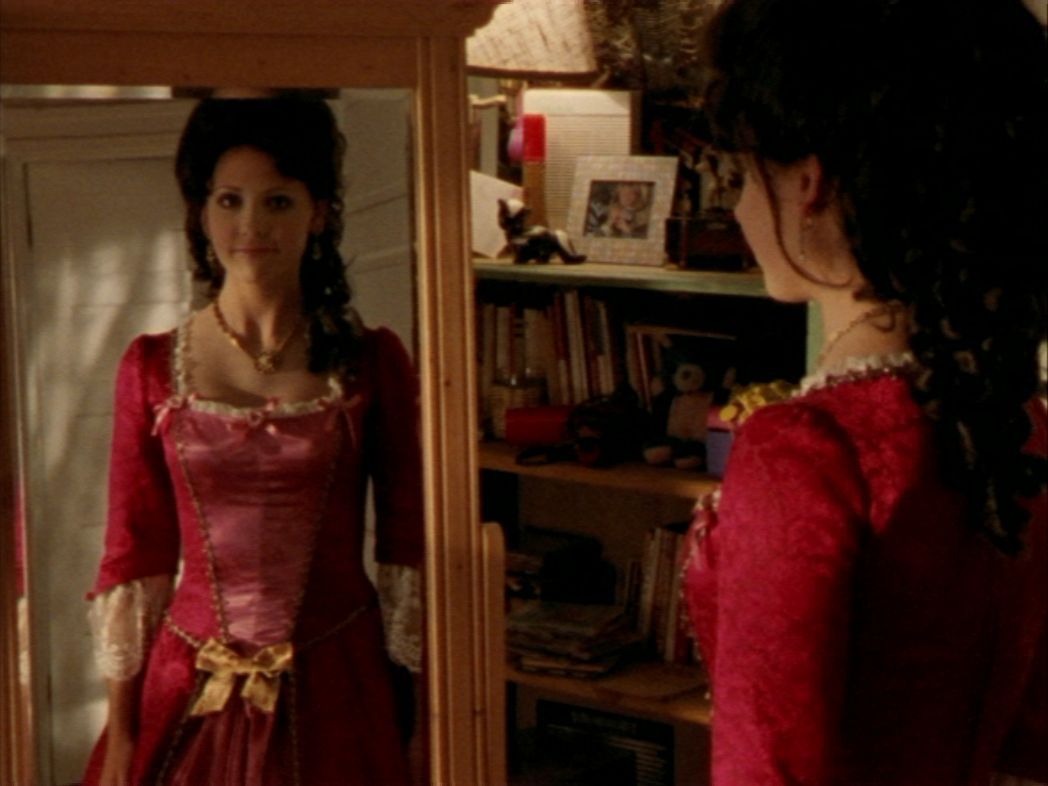
'Halloween' is another classic comedy Buffy episode (and no one ever seems concerned that Willow is technically dead for most of the story - she certainly doesn't have Buffy's level of angst about it). The concept (everyone turns into the people they're dressed as) has loads of potential and Buffy as a helpless eighteenth century noblewoman is very amusing, though it's a shame the dress is such a hideous shade of bright pink - someone really needs to tell costume designers that getting an action-oriented character into a girly dress doesn't mean said dress has to be pinker than candyfloss (see also an episode of Firefly whose title I can't remember and, to a lesser extent, Hermione's dress in Goblet of Fire). This is also the episode that establishes that vampires and nasties supposedly stay home on Halloween and gives us lots of Cordelia flirting with Angel, so we can all enjoy the irony of Willow's attempts to assure Buffy that Angel would never go for Cordelia.

The reason everyone turns into their costumes is that the shop-owner, Ethan, has performed some kind of spell or ritual. Ethan, an old 'friend' of Giles's, apparently worships chaos and wanted to create, well, a chaotic situation. To perform his rituals, the words for which are, of course, in Latin, Ethan kneels in front of a double-faced bust that apparently represents Janus, a Roman god (whose name Ethan correctly pronounces 'Yanus', as the Latin word is 'Ianus').

Giles claims Janus stands for 'the division of self, male and female, light and dark'. Which, er, he doesn't. But it does go very well with the theme of the episode, in which we see the tougher (and more chivalrous) side of Xander, the weaker side of Buffy, the sexy side of Willow and the Dark Side of Giles - an excellent plot development that stopped Giles from being a tweed-wearing, tea drinking walking stereotype and gave us the sublime 'Band Candy' in season three.

Janus, from the Vatican museum

Janus was the god of doors and gateways and, like a door, looked both ways, hence the double head. He was also a god of beginnings, which is why he gives his name to January, the first month of the year. He stands, not so much for division, as for liminal spaces, that is, places or situations that exist on the borders, neither one thing nor the other. He is usually, though not always, depicted with two identical, often bearded faces. Ethan's bust is a bit different, with one plain and serious face and one bearded face which is modelled after 'comedy' masks from ancient theatre, so the whole effect essentially plays on the well known modern juxtaposition of comic and tragic masks. This is an unusal way to depict Janus, but it works very well for the episode's theme and the comic mask is nicely creepy and provides a more interesting look for the prop than a standard Janus bust would. (Greek theatrical masks are seriously creepy, especially the comic ones, how anyone sat through plays looking at them I don't know!)

Ethan's fantastically creepy Janus

Gates and especially doorways seem to have been used in Roman magic spells; certainly, the witches in poetry (who may or may not have anything in common with real magical practices) often refer to liminal places like cross-roads (Theocritus' Idyll 2) or doorways in their spells. So Janus is a fairly logical god to attach to a magic spell. He doesn't, however, have anything to do with Chaos. Chaos, parent of Night among others, was an important part of creation mythology, but not connected with regular worship or cult practices. If you were looking for an ancient deity to worship as the embodiment of chaos, well, there isn't one, but you'd be closer with Bacchus or Cybele.

'Halloween' is a brilliant episode, hilarious and sweet as all the best comedy episodes are (plus it's the introduction of Ripper Giles!). It ends with Ethan's ominous note, 'Be seeing you,' which is presumably a reference to classic British TV series The Prisoner, and suitably creepy. The episode's use of Janus is also very effective. Although the nature of the god has been altered somewhat from Roman mythology, the use of the double-faced god as a symbol of the division of self does work rather well and the use of the theatrical masks for his faces is a stroke of genius. The episode's emphasis on their incarnation of Janus as a symbol of one divided being does rather lose the emphasis on looking both forward and backward that gives the month of January its name, but having been transposed to Halloween, it works rather well, bringing out hidden aspects of the regular characters just as the mythology of Halloween suggests that the night brings hidden things, always present but not usually seen, out of the darkness.

If you're in the mood for more spooky-type classical references, here are some more Halloween-y posts from the archives:

Neil Gaiman's The Graveyard Book and Stardust
The Mummy (1999)
True Blood season two
Charmed, 'Oh my goddess!'
Satanic sit-com Old Harry's Game
Other Buffy and Angel posts: Giles the Classicist, 'Storyteller', 'Restless', Angel's Oracles, 'Bewitched, Bothered and Bewildered'
Harry Potter posts: Books 1-3, Books 4-5, Philosopher's Stone, Chamber of Secrets, Half-Blood Prince

One of Chris Riddell's beautiful illustrations from The Graveyard Book

Sunday, September 26, 2010

Buffy the Vampire Slayer: Bewitched, Bothered and Bewildered


One of Buffy's classic comedy episodes - something this show did particularly well, most of them were hilarious - in 'Bewitched, Bothered and Bewildered', Cordelia dumps Xander on Valentine's Day and he tries to get his revenge by persuading Amy the witch to cast a love spell on Cordelia, so that he can hurt her the way she hurt him (Xander is not actually that nice a character sometimes, though he is very noble when Buffy comes on to him under the influence of the spell). Of course, it all goes horribly wrong.

The reason the spell goes wrong is that Cordelia is already in love with Xander and has only broken up with him because her friends were teasing her, so the spell rebounds off her and onto every other woman in Sunnydale - or, as Giles suggests, because Amy got it wrong and Cordelia's necklace, which she used in the spell, protected her rather than targeting her. Or, perhaps, the reason it goes wrong is that Amy calls on entirely the wrong ancient goddess for her spell. Amy's spell invokes 'Diana, goddess of love and of the hunt'. Diana (Greek Artemis) was indeed goddess of the hunt, but she was not the goddess of love - that was Venus/Aphrodite. Diana, like Minerva/Athena, was a virgin goddess, and therefore extremely unlikely to help someone with a love spell. Perhaps Marti Noxon, the writer, thought Venus was a bit too obvious and would distract the audience by calling to mind the many, many uses of Venus as goddess of love in popular culture in everything from pop songs to bridal couture to women's razor blades. Still, she could have used the goddess' Greek name, Aphrodite.

This is not the only spell Amy casts in this episode. As she and Buffy, both under the influence of the first spell, fight over Xander, Buffy uses her Slayer power and hits Amy, and Amy responds by using her witch's power to turn Buffy into a rat. The specific spell is, 'goddess Hecate work thy will, before thee let the unclean thing crawl!' Hecate continued to be used for transformation spells throughout the series, for Amy's second attempt in this episode, on Jenny Calendar, cut off by Xander ('Quit with the Hecate!'), for Amy's own transformation of herself into a rat in 'Gingerbread' and for Willow's brief attempt to turn a high school student with an enchanted jacket (yes, really) into a woman in 'Him'. This is more appropriate since Hecate, a minor goddess existing on the fringes of ancient religion, was the goddess of witchcraft. The ancient Hecate doesn't have a particular connection with transformation, metamorphosis or transfiguration - she was associated primarily with ghosts, necromancy (in Greece and Rome, this meant raising the dead to get them to make prophecies) and the night. For spells relating specifically to metamorphosis, I think I'd have been inclined to go for Circe, the divine witch (daughter of a sun god and a nymph) who turns sailors into pigs in the Odyssey. However, Hecate is appropriate enough, since she was goddess of witchcraft in general and that would include metamorphosis, as it does in the Odyssey and in Apuleius' Metamorphoses (also known as The Golden Ass).

Buffy used Latin and classical references for magic spells very frequently - it's something of a go-to ancient language for the show, something I talk about at more length in a paper that will be published online soon. Greek occurs much more rarely, presumably because it's a less well known ancient language, though it is used for the name of the oldest vampire, 'Kakistos' - the worst of the worst (in season three's 'Faith, Hope and Trick'). It is used there to emphasise Kakistos' extreme age, as Greek is probably older than Latin, and the best known part of Greek history predates the best known parts of Roman history.Greek is better known and more acessible that the oldest languages, Egyptian, Akkadian or Sumerian, while still emphasising that Kakistos pre-dates Latin and the Romans (Dawn claims to have learnt Sumerian in season seven, which given the difficulty of Sumerian and the amount of time she's been around is extremely unlikely).

In this episode, however, the spells are in English rather than Latin, because rather than incantations in which the words, in the appropriate language, produce the magical effect, these are actually prayers to pagan goddesses asking the goddess to produce a magical effect. Both forms of magic spell or incantation were used in Greek and Roman magic. Perhaps goddess-magic appealed because magic in Buffy is strongly associated with women and femininity. For all Willow's mocking of the group she meets with at college in 'Hush', who are all about feminine power and baking cakes, there are very few male practitioners of magic in Buffy - one metaphor for a drug dealer, one warlock and Giles and Ethan, who don't generally self-identify as warlocks or wizards (Ethan does, to an extent, but he's drunk at the time!). This episode is about romance and about Xander inflicting something on the women of Sunnydale (none of whom are too pleased with him afterwards) and Amy, the witch, has gained her magical power from her mother, who was also a witch. And, of course, the ancient deities of sex and love from many cultures are almost always goddesses, probably because they start out as fertility goddesses, and it seems logical for a fertility deity to be female. So, although Noxon has misidentified the goddess of love, it probably seemed natural for these spells which are connected to love and to what these women will do for love to come in the form of incantations invoking goddesses.

The invocation of Hecate for transformation is one of the few fairly stable spells in Buffy - although love spells and vengeance spells appear quite often, they tend to be different every time. Hecate may have been re-used partly because the rat transformation spell, which was re-used in season three, was so specific, or perhaps just because this (very good) episode and its spells were particularly memorable. It certainly helps that the language of the spell is English and therefore easy to remember and follow! Other ancient deities appear from time to time throughout the series, interspersed with spells of the magic-words type, but Amy's dark-eyed, glowy invocations of Diana and Hecate are certainly among the most notable.

Sunday, August 1, 2010

The Roman Mysteries: The Sirens of Surrentum


The moment when Buffy the Vampire the Slayer changed from a good show into a great one was 'Innocence' - the episode where, having slept with Buffy and experienced a moment of perfect happiness, Angel loses his soul, dons the Black Leather Pants of Evil and, well, becomes evil. There's a scene towards the end of the episode in which Buffy's blissfully ignorent mother, Joyce, asks Buffy what she did for her birthday and Buffy replies sadly, 'I got older'. It's a beautiful, bittersweet moment that neatly sums up everything the viewer has just been through over the past two episodes. The Sirens of Surrentum is to the Roman Mysteries series as 'Innocence' is to Buffy - it is the moment where Flavia Gemina who, being a Roman girl, has to grow up rather faster than Buffy, learns some things she maybe didn't want to know about men and women and gets older.

Minus the sex and evil vampires, obviously. (Though I do love 'very kissing' as a child-proof description of sex).

As you'll have gathered, this is definitely a book for older readers of the Roman Mysteries series. I understand from my teacher friends that kids 'do' the Romans at Key Stage 2 - which I think is 8-9 year olds, or possibly 7-8 year olds - in the UK at the moment, which would be the perfect age for them to pick up The Secrets of Vesuvius or The Pirates of Pompeii. By the time they work their way up to The Sirens of Surrentum they should be that wee bit older and starting to be interested in the opposite sex, rather than running away from them because they have nits. (This is what we used to do in my primary school). This is probably also one for the girls, though there is plenty of poison and wild boar hunts to keep the boys occupied too - but really, what the book captures perfectly is what it feels like to be an eleven-year-old girl, and the minefield that is trying to understand adult relationships at that age.

This is something which is much more complicated for Roman girls, of course, because at eleven they are nearly old enough to get married and certainly old enough to be engaged. Not so for boys, who marry much later, though Jonathan and, especially, Tranquillus are clearly thinking about it already. But for Flavia, Pulchra and Nubia, the question of romantic relationships is not just something they can wonder about idly for fun, as it was for my generation, but an urgent problem.

I think my favourite aspect of the book, though, was actually something that reminded me of my MA year rather than the last year or two of primary school. Here's an insight into the workings of my brain for you all: I have studied both Lucan and Suetonius at some length, and Lucan was the subject of my MA dissertation. It took me ages - I won't even admit to you how long - to realise that 'Tranquillus', Flavia's betrothed is, in fact, Suetonius Tranquillus, one of my favourite ancient authors. It was only when he said he wanted to be a biographer that the penny dropped. On the other hand, a very brief mention of the Latin word 'nefas', which refers to a crime or sin of enormous proportions carrying with it an element of religious pollution, immediately had me primed for a reference to Lucan. (I didn't remember his wife's name, so I didn't work out the exact connection, but you say 'nefas', I think 'Lucan').

I'm not sure I should send kids running off to read Lucan, but for anyone with a strong stomach, his Civil War is absolutely brilliant. I focussed on the necromancy scene, which features Erichtho, one of the nastiest witches in literature.

My other favourite part (how many is that now?!) is Flavia's speech on the subject of suicide, which I won't spoil by quoting here. It's beautiful. (It also reminded me of an episode of Buffy the Vampire Slayer, but I think that might be my obsession with Buffy talking). And I will make some attempt to redeem my powers of deduction by saying that, once I realised Polla actually was being poisoned and not just suffering from a debilitating disease, I worked out the solution to the mystery myself.

Odysseus and the Sirens. I love this vase. See also the blog's current background!

The children, as good Romans, observe that poison is considered to be the resort of women and cowards, and refer to a few famous cases - I absolutely loved the use of figs on the tree that are pre-poisoned, which took my right back to I, Claudius, and I loved seeing Suetonius gather information for his most famous work. I was a bit horrified at Locusta's actions though, and almost - almost - sympathised with Felix over his response. I liked the lists of various poisons and their antidotes, which I will carry with me when I watch or read Agatha Christies in future, as Christie often uses the symptoms and/or antidotes of poison as vital clues.

There were some nice introductions to ancient philosophy here as well. They were necessarily over-simplified, of course, partly to fit the plot and partly for space and comprehension value, but the characters themselves explained that they were simplifying things, so that's fine. It was a shame that Platonism had to be missed out, but certainly Stoicism and Epicureanism were the big names at this time and the easiest to place at polar opposites to each other. (No room for the Pythagoreans and their beans, but that can't be helped!). It will be fun for any readers with a passing knowledge of Christianity to spot Philodemus' affiliation, and the way philosophy was discussed and handled in general was nicely done. Most importantly, there was an emphasis on philosophy as relating to moral character and life choices more than religion, which is more of a shared experience for everyone who isn't Jewish or Christian, which is an aspect of the ancient world far too often ignored by modern writers desperate to make some kind of point relating to their views on religion (good or bad!)

It's a shame Flavia can't marry Suetonius, as he seems a good sort, despite his obsession with naked women (he's just an early developer!) and I seem to remember that he has rather a lot longer to live than Flaccus, who look set to be her ultimate partner. Also, really, I'd worry about someone whose name is 'Flaccus' (it's just a reference to his floppy hair, kids!). Flaccus does seem to be the sanest person around, but I sort of hope it wasn't actually him who snitched on Flavia and Suetonius, as that was rather mean. Still, we can start to see what the future might hold for Flavia and Jonanthan (who should remove Pulchra from her parents as soon as possible I think!), though it remains more uncertain for Nubia, who once again functioned as the voice of reason and experience throughout, and Lupus, who's still a bit too young!

View from near Sorrento (Surrentum) across the Bay of Naples, towards Vesuvius

Sunday, December 6, 2009

Angel: The Oracles

The Oracles' tenure on Angel was pretty short-lived. They were introduced as a handy plot device in 'I Will Remember You', a first season episode that's a fan favourite and that I'm very fond of, but I have to confess the description I read of it once (I can't remember where I'm afraid, but it might have been Keith Toppings' Unoffical Guide) that it's basically fan fiction made canon is rather accurate. First, someone needs to explain the plot to Angel, then later and more importantly, someone or something has to turn back time for him.

Enter the Oracles, who fulfil this function in a nicely detached manner. There's nothing specifically Classical about oracles - various cultures have them, though the English word is from Latin. The term 'oracle' refers to a shrine where it is believed that the gods, or a god, answer questions. Sometimes they do so through a human being who speaks, often saying unintelligible things which are 'interpreted' by the priests, or the god might speak through wind or water, or through dreams. The human variety is probably the best known.

These are certainly not Classical in that sense, as these two are not humans, but higher beings of some kind. They exist in some parallel dimension and say things like 'I like time' when given a watch. They also require gift-offerings - that's more common, as a visit to an oracle would usually require a sacrifice and possibly a financial donation as well.

What makes Angel's Oracles Classical is their aesthetic. I'm not sure what's with the weird face paint, but the loose tunics are definitely meant to look vaguely Greco-Roman, as is the marble building they're in (though the arches are all wrong - they're pointed, which looks more like medieval gothic).

The motto over the gateway is also written in Greek. It's supposed to say 'Gateway of Lost Souls' apparently, but as far as I can tell it actually says 'Gate through/because of (dependant on case, which is impossible to tell here) [word that I can't track down without spending a few hours with a big dictionary] [word that sounds like psuche, soul, but doesn't match any of the case endings for psuche].

The Oracles are bit wasted in this show. They're a fun concept (though Angel does tend to chat to the Powers That Be a bit too often) and the actors are good, nice and quirky, with some fun dialogue. But they only appear twice more; in 'Parting Gifts', to explain why they won't turn back time every time something bad happens, and then they get murdered in 'To Shanshu in LA'. I'm not sure what kind of higher being can be killed with a scythe, but there we go. It's a shame - with some better Greek classes and a bit more to do beyone plot exposition/device, they could have been fun.

Hmm, two Joss Whedon posts in a row. I must branch out next time.

Wednesday, September 2, 2009

Buffy the Vampire Slayer: Restless

My thesis on dreams in ancient literature is slowly getting nearer to being finished, so in honour of this impending momentous occasion, I’m going to take a short break from blogging about Classics and blog about my two favourite appearances of dreams in TV drama – more specifically, science-fiction and fantasy. Buffy the Vampire Slayer and Star Trek: Voyager, two of my favourite shows, both did episodes devoted to dreams, so the next two blog posts will cover these: ‘Restless’ from Buffy, and ‘Waking Moments’ from Voyager. Normal Classics-centred service will resume after these two.

(Actually, there is some Classics stuff in this episode. The Voyager episode... not so much).

‘Restless’ was one of three gimmick episodes in the vastly underrated fourth season of Buffy the Vampire Slayer. I didn’t get into Buffy until season 4 was on BBC 2, so I have a fondness for it anyway, and I really like its lighter tone. I think long-running shows need a balance of dark and light and, if they’re going to tip a bit far one way or the other, I’d rather they favoured the light side, on the whole. I also think it does a pretty good job of looking at the scaryness that is going to uni for the first time, and I was sad that the university was so completely dropped from the later seasons (I think its good to have a mix of characters, so Buffy dropping out to join Xander and Anya in the real world was OK, but Willow and Tara seemed to almost give up on it as well).

When SFX ranked every episode of Buffy from best to worst, both the best and the worst were in season 4 – ‘Hush’ (best) and ‘Beer Bad’ (worst). I disagree with them on both counts (for best I’d have gone for ‘Becoming Part 2, with ‘The Gift’ in second place, and for worst, a tie between ‘Hell’s Bells’ and ‘Seeing Red’, both of which I refuse to watch) but it shows the mixed reactions season 4 tends to provoke. Unusually, it’s the gimmicky episodes that tend to draw the highest praise – ‘Hush’, with much reduced dialogue, ‘Superstar’ is an alternate universe episode which is quite well thought of, and ‘Restless’, an episode almost entirely made up of dream sequences with which Whedon chose to round out the season, in place of the usual massive climactic fight (shifted here to the penultimate episode). And it’s brilliant, because it’s unusual, intriguing and, most importantly, very funny as well.

‘Restless’ opens with our heroes coming back to Buffy’s mother’s house for some R&R following their latest victory over evil (I always wondered just what they do after these things). Xander’s idea of a relaxing movie is Apocalypse Now, and they all fall asleep in front of it.

The first dream we see is Willow’s. And – yay! – it opens with an actual Classics reference! Willow and Tara are in Tara’s room, and Willow is painting Tara’s naked back with Greek poetry. The poetry she is writing is Sappho’s 'Hymn to Aphrodite' (Fragment 1 of Sappho’s works – Willow is soon going to run out of space if she wants to copy the whole works). Sappho is one of the absolutely miniscule number of pre-Christian female writers whose work has survived (in fragments; the other reasonably well known woman, also a poet, is Sulpicia) and is the most famous, known for her love poetry addressed to women (hence ‘Sapphic’, and ‘lesbian’ is derived from the island of Lesbos, where she lived). Aphrodite is the goddess of love, so this is a particularly appropriate poem for Willow and Tara, beautifully rendered in capital letters, the way ancient Greek is preserved on papyrus fragments (before it is edited into something much easier to read!). Willow explains how safe she feels with Tara, but she is soon on the move, taking part in a bizarre production of Death of a Salesmen. Whedon has gone on record as saying that everything in ‘Restless’ is symbolic of something, except for the fabulous Cheese Man (‘I wear the cheese. It does not wear me’). On the DVD commentary, he explains the significance of the red theatre curtains, which are very Freudian. To be honest, I hadn’t noticed that before, and now that I know, it just looks crude and a bit icky – less subtle than Austin Powers eating a sausage. I prefer the Sappho.

You can actually read the Greek - it's very cool

If anyone can tell me what Harmony’s milkmaid outfit symbolises, I’d be very grateful!

Everyone keeps telling Willow to take her costume off, and she is confused, until Buffy rips off her season 4 hippy chick bright clothes and reveals her season 1 ‘softer side of Sears’ outfit (what is Sears? What is it’s softer side? Why do American’s find this so funny??!!) complete with season 1 longer, darker hair (which Anya refers to as 'a Greek tragedy'), in a classroom from the dearly departed Sunnydale High School. The symbolism here is pretty darned obvious (Willow is afraid everyone, especially Tara, will see through her cool new costume to the geek within). It does contain Xander’s classic allusion to the magic=sex metaphor that’s been running through the whole season though – ‘Sometimes I think about two woman doing a spell, and then I go do a spell by myself’.

Xander’s own dream has more of this delightful male obsession, as the camera swoops away from Willow and Tara’s first implied kiss to focus on Xander’s stunned face. I’m glad their first onscreen kiss wasn’t here though – much as I dislike ‘The Body’ (too depressing), their kiss there is much more touching and natural.

Xander’s dream follows Willow’s as Willow is attacked by a mysterious, savage figure. Sex is pretty prominent feature in Xander’s dream (surprise surprise) as it opens with Joyce trying to seduce him before moving to a playground where Giles and Spike are playing on the swings and Buffy is in the sandpit. Giles says Spike, rather amusingly dressed in tweed, is like a son to him and that he is training him to be a Watcher. Xander says he was into that for a while, but has moved on to other things, and he goes to join Anya in the ice cream van he has been working in – which is where Willow and Tara show up. The best bits of Xander’s dream are yet to come though, as first he finds Giles and Anya, on the UC Sunnydale campus, speaking French which he can’t understand (but which gives me an opportunity to practise, excellent) and then wanders into his own personal Apocalypse Now, with Snyder as Colonel Kurtz (which all made a lot more sense once I had seen Apocalypse Now). Xander’s dream is mostly about questioning where he’s going, since he (along with Anya) is not in college, as the girls are, and ending up back in the basement, where he is attacked by the savage figure.

Whedon explains in the commentary that the dreams are supposed to get creepier as they get along. I’m not sure if this is what he was referring to, but the beginning of Giles’ dream, with Buffy, and a watch, and Giles saying something very odd about women and men, is definitely creepy. Luckily Spike turns up pretty quickly, doing some hilarious poses for a group of photographers and admirers. Then it get even better – the undoubted highlight of the episode (apart from the Cheese Man) is ‘The Exposition Song’, in which Giles explains that their spell in the previous episode has angered a primal force, and adds a final line asking Xander to please not bleed on his couch, as he’s just had it steam-cleaned. As the savage figure scalps him (in a shot that looks just like Sylar’s MO from the much later Heroes), he realises who it is – the First Slayer, who ‘never had a Watcher’.

The First Slayer, complete with spooky skull-effect make-up

Finally, we get to Buffy’s dream, much of which foreshadows the arrival of Dawn at the beginning of the next season (not that we all knew that at the time). As Buffy wanders though the dream (they all wander from set to set, taking advantage of the layout of the main Buffy sets at the studio), she sees her mother living in the walls (which is definitely creepy) and Riley and Adam planning world domination via the medium of coffee makers that think (which is hilarious). Eventually Buffy ends up in the desert, where she fights the First Slayer, first with weird prose poetry (‘I walk. I talk. I shop. I sneeze. I'm gonna be a fireman when the floods roll back. There's trees in the desert since you moved out, and I don't sleep on a bed of bones’) and then with, you know, fists. Eventually, Buffy just gets fed up and decides to wake up, and somehow, everyone is safe.

(Pedantic whinge of the day: the spell in question names the four of them as four parts: Spiritus=Spirit, Animus=Heart, Sophus=Mind, Manus=Hand. Oh. Dear. For starters, ‘sophus’ is Latinised Greek, while the rest are Latin, and Buffy apparently incants a spell in Sumerian. ‘Sophos’ is Greek for wisdom, not mind. ‘Animus’ is a Latin word referring to the logical, rational part of the soul (as opposed to ‘anima’, the emotional part of the soul) and it can also mean ‘heart’. ‘Spiritus’ is closer, meaning breath of life or spirit, and ‘manus’ as hand is fine.)

I love ‘Restless’ I think its weird and wonderful. It was also a lot of fun, the first time round, watching it again after seeing season 5 and seeing what elements foreshadowed elements of that season.

The dreams in ‘Restless’ are all, of course, symbolic – no message dreams here. Although Whedon goes to a lot of effort to make them really bizarre, like real dreams, and includes the Cheese Man to ensure there is at least one random element, the level of symbolism in these dreams marks them out as being purely literary. They’re like puzzles for the viewer to figure out (some of which, I confess, I have yet to figure out myself – others are more obvious). ‘Restless’ is a very self-conscious piece of writing. Even leaving aside the fact that these are all dreams, and the science-fiction aspect of the concept, these are still not the sort of dreams a person might really have, even if they look more like them than a lot of fictional dreams do. They are also, since the show is technically in the horror genre, relatively creepy. This all contrasts strongly with the use of dreams in the more ‘science’-oriented Voyager – of which, more later...

Thursday, August 27, 2009

The West Wing: He Shall, From Time to Time

Well, I'm in the new place, squashed but intact, and desperately behind on the thesis, but remaining confident that the final draft WILL be ready by Monday. In the meantime, a quick blog post.

This is the episode of The West Wing in which Leo and the audience discover that President Bartlett has a relapsing remitting form of MS (aptly described by Bartlett as 'the good kind'. He eventually starts to develop early signs of the bad kind in season 4 and gets slowly worse, in an very accurate portrayal of the early stages of the disease).

But, of course, that's not what we're interested in here! The interesting bit Classics-wise comes at the end, when Bartlett has recovered from his attack and is preparing to give the State of the Union. One person from the line of succession (or however you describe it in a republic) has to stay out of the State of the Union in case Guy Fawkes blows them up, and Bartlett decides to give a little pep talk to the chosen person, just in case. The person in question (The Secretary of Agriculture) walks in and it turns out he's The Mayor! So now I'm spending the entire scene expecting him to turn into a giant snake and eat Bartlett. Anyway, The Mayor has brought Bartlett a present: the Constitution of the United States of America, translated into Latin.

Harry Groener as Mayor Richard Wilkins in Buffy the Vampire Slayer.

Latin is used a lot on The West Wing. Bartlett, being both a Catholic and something of an amateur classicist, loves it and refers to it frequently (comparatively speaking) and it's even used in episode titles - not just for religious references, like 'In Excelsis Deo', but Roman proverbs like 'Post Hoc Ergo Propter Hoc' as well (all of which I'm sure I'll post on at some point).

I have to confess, though, I'm a bit confused as to why anyone would want a copy of the Constitution in Latin. Harry Potter and Winnie the Pooh make sense, they're a good way to practise, but the Constitution? Does anyone read that for fun? The Mayor explains that it was a school project that got published, which does make more sense, and that he's highlighted an appropriate passage, which Bartlett reads and simultaneously translates, because now he's just showing off. It is this passage that the title of the episode is taken from.

The whole thing is really just an excuse to have Bartlett read that particular part of the Constitution out loud, in tones of due reverence. The first series of The West Wing is, in some ways, the most fun because it's still so in love with its concept. This episode is just thrilled at the whole idea of the State of the Union, and the wonderfully-named W. G. Snuffy Walden's music swells with pride as Bartlett walks out. Even the MS storyline, which the show would do such great things with in Season 2, was originally written because Aaron Sorkin wanted to engineer a situation in which the President would be sitting in bed watching daytime TV (and getting quite into it). So the Latin is really just a tool to get Bartlett waxing lyrical about the State of the Union.

It is an appropriate present for Bartlett though, who does love his Latin, for the above mentioned reasons. The Mayor doesn't mention whether the Latin in question was Classical Latin or Vulgate Latin (the Latin used by the Catholic Church) but, being a school project, it was probably Classical. Bartlett would love it either way, since he's also interested in Classics, a character trait which, in some cases, allows for very interesting parallels to be drawn between the US and the Roman Empire. But I have a thesis to finish, so that will have to wait for another day!

Sunday, July 5, 2009

Buffy the Vampire Slayer: Storyteller


I’m away at a conference all next week so I’m not sure whether I’ll be able to post anything. I had hoped to leave y’all with a really nice, long, detailed post like my Troy post below, but unfortunately I got sidetracked watching one of the longest Wimbledon finals in history (I think I actually cried a few tears for Andy Roddick at the end of that). So I’m afraid this is all I have time for before I finish my packing and get sorted for the conference. This episode of Buffy is not really related to Classics – basically, it has one joke relating to Classics in it that I find so funny I decided to base an entire post around it. It does have some universal themes though, which can be applied to Classics as much as anything else and in fact, considering the nature of ancient historical writing – often more interested in telling a good story than reporting accurately – and classical epic poetry, it could be considered particularly relevant to classical history.


I’m not a huge fan of season seven of Buffy the Vampire Slayer, for various reasons,* but ‘Storyteller’ is a work of comic genius and includes the funniest Classics-related joke in Buffy history (OK, that might not be that hard, but still). This is the epidsode in which Andrew, ex-supervillain, tried to record the gang's work for posterity, but his version of events is a bit... interesting.


I’m sure Andrew’s fantasy set-up with the library, the armchair and the fireplace is making fun of something, but I think it must be an American programme that I haven’t seen. Andrew pronounces ‘vampire’ ‘vam-PY-re’, presumably because he thinks it sounds cool. He speaks for many pedantic viewers when he questions how it’s possible for vampires to show up on video (because the camera uses mirrors).


Andrew is trying to leave a legacy for future generations, which is a decent enough idea – the Greeks would certainly have approved. Only Buffy has a problem with it – everyone else quite sensibly points out that it would be nice to have a record of their achievements if they do manage to save the world (as an historian, obviously, I approve of this sentiment).


Much of this story revolves around the Hellmouth, which always strikes me as very underworld-y. ‘Hell’ is a Christian concept, but classical mythology always put Hades, the land of the dead, firmly underground. That’s about where the similarity ends though.


The bit with the wind machines around the breakfast table really has to be seen to be fully appreciated. Suffice to say, it is completely hilarious. It doesn’t seem to be on YouTube at the moment, though there’s a tiny clip in the promo.


The intense feeling of relief experienced by the viewer when Andrew moves away to discuss how boring Buffy’s speeches have become is a testament to just how tiresome her seventh season speeches were. Andrew’s re-writing of his own history with the other two late supervillains is both very funny and an important reminder that no historian, especially those telling their own history, is entirely to be trusted.


Anyway, I am spending far too long on things that are not, strictly speaking, Classics related (though the themes of storytelling and how we record our own lives have an obvious relevance for anyone working in any historical field). We eventually come to a flashback showing Andrew and Jonathon in Mexico, explaining how Andrew came to stab his best friend to death, and that is where we see the reason this episode appears on a Classics blog. Andrew has been led astray by the First Evil in the form of his late friend Warren (long story), who has

promised him that, if he obeys its orders, the three of them will all be reunited and will live as gods.


This is Andrew’s idea of what it would be like to live as gods.


He’s got the laurel wreaths and white robes from classical mythology, and mixed them with instruments that might be classical lyres (like the one Nero played) or might be angelic harps. He’s placed the whole thing in a field of beautiful flowers which presumably is meant to be the Elysian fields, or something similar. The gold is pretty self-explanatory; I don't know where the unicorn came from, and I think it would be best not to ask. It is one of the funniest things I’ve ever seen (though this may say more about my sense of humour than anything else).


Anyway, a whole bunch of other stuff happens and Buffy eventually has to force Andrew to stop telling stories and face up to his own actions and their consequences. Really though, Andrew doesn’t need to stop telling stories – he just needs to tell the right ones. Buffy has a point though. Romanticising horrible things can become a serious problem when the romantic story becomes the only story and the nasty reality gets forgotten. I could suggest all sorts of real life examples, but I’m sure you can think of them yourselves.


And so, I'm off to the conference, which should be very interesting (its about Classics in children's literature). I'll try to get another post up if I can, but otherwise, I'll be back next week.


*The potential Slayers are so annoying I want to rip my own arm off and throw it at them (thank you Friends for that line), Buffy herself becomes a cold and emotionless walking soapbox, they still can’t work out how to deal with Spike, the First Evil was never my favourite villain anyway and the ubervamps are just dull. And I have never yet forgiven Buffy the Vampire Slayer for season six.

Wednesday, June 10, 2009

Buffy the Vampire Slayer: Giles the classicist?


An explanation for this post: I've been presenting at a multi-disciplinary poster conference all day. My thesis is on whether Romans believed that dreams might foretell the future or provide a way to communicate with gods or the dead. Several times today, people asked me whether I believe that dreams can tell the future. Slightly flustered, I tried to answer, while also trying to explain that that isn't what my research is about - I'm not looking at whether dreams might be divine or not, but whether Roman writers thought they might be divine or not.

Anyway, after an (exhausting!) day of presenting, I thought I'd write a blog about a representation of a Classicist in popular culture. Except I can't think of any! There are plenty of archaeologists, a few scattered Classics teachers, but no professional researchers who are Classicists or ancient historians (or historians either). Its no wonder no one knows what I do for a living.

So the closest I could come was Giles from Buffy the Vampire Slayer. Giles works in heritage management (he used to work in 'a British museum, or the British Museum, I'm not sure' - Willow, 'Welcome to the Hellmouth') but his knowledge of ancient languages suggests he must have a classics background, so he's as close as I could get.

When Giles first appears, he seems to be the worst sort of British stereotype - always in tweed, uncoordinated, useless at fighting etc. All that changed in 'The Dark Age', when his dodgey past as a dabbler in dark magics is revealed and he suddenly gains a whole bunch of fighting skills he never had before. Giles is always at his coolest when he's being his nastier alter ago, Ripper - as when he reverted to teenagehood (and his own accent instead of the fake posh one) in 'Band Candy' and when he coldly murders Ben in 'The Gift'. What it says about me, that these are the bits I like, is probably best left unexplored!

As a lone Brit in America (well, except for Spike) Giles gets some great one liners. Two of my favourites are:

'I just think it's rather odd that a nation that prides itself on its virility should feel compelled to strap on forty pounds of protective gear just in order to play rugby' ('Some Assembly Required')
'"Do you like my mask? Isn't it pretty? It raises the dead!" Americans!' ('Dead Man's Party')

Unfortunately for me, if Giles was studying dreams in ancient Rome, he really would be looking to find out whether dreams actually do predict the future. Ancient texts in Buffy (as in most sci-fi and fantasy shows) are used to find out how the magical thingummy of the week works. The ancient text is always absolutely accurate and our heroes are always able to translate it precisely (see earlier post-come-rant on Night at the Museum 2). In my (real) world, no ancient text can be precisely translated, they are very rarely accurate and regularly tell outright lies, and I have yet to discover an ancient artefact or spell with actual magical powers. But I guess that just isn't very interesting!


'Xander, don't speak Latin in front of the books!'
Giles, 'Superstar'