Showing posts with label The Roman Mysteries. Show all posts

Wednesday, March 9, 2011

The Roman Mysteries: The Trials of Flavia Gemina (TV adaptation)


Image © 2008 LEG

The Roman Mysteries TV adaptations are being repeated every day on CBBC from 11.25am this morning, so this seemed a good time to review the next episode in Series 2. Major spoilers for both the book and the TV episode follow.

The book on which this is based on is one of the warmer, cosier Roman Mysteries, in which the main, apparently criminal mystery for the most part exists only in Flavia’s mind. In the book, this warmth is counter-balanced by the tragic ending, one of the saddest of all the Mysteries (in fact, for me, I think it may be the saddest. The Slave Girl from Jerusalem also has a tragic ending, but in that case I was about equal parts terrified and sad – it’s interesting to note that neither tragedy is entirely impossible in the modern Western world, though both are now much less likely).

The TV episode changes this ending by replacing the character death from the book with a muted break-up instead. To compensate for the resulting absence of serious danger (and to provide some exciting action sequences) the TV episode ups the ante on the book’s other main plot, concerning the escaped animals intended for the arena. This story is also heavily modified to be more appealing to a twenty-first century audience, as Taurus the sympathetic animal trainer desires freedom for both himself and his animals, a thread entirely absent from the book (as far as I remember - this may be the moment to confess I've left my copy in Wales!). This makes the story considerably less historically accurate – in a slave-owning society, animal rights were not a priority. The animal sequences themselves, though, are well done and the transposition of Nubia’s bravery when facing a lion so that she confronts the lion to save Aristo, and has much less success taming it, has the desired effect of demonstrating in a dramatic, visual way her feelings for Aristo.

It was nice to see a modified version of one of Flavia’s dreams from the book, which in the novel play an important role in both the plot and in Flavia’s character development. The dream is shot in quite effective whitened out colour (over-exposed, possibly?), though I’m not sure why the director decided not to show Flavia’s mother’s face. I suppose it makes the transition between Flavia’s mother’s dream-ghost and the living Cartilia watching over her more obvious and clean, but it’s so obvious that they’re desperate not to show the mother’s face that it’s rather distracting, and given the changes to the ending of the story, this is a less important point to make anyway.

Jonathan’s role in this episode is filled by Polla Pulchra, from The Pirates of Pompeii, because of a scheduling conflict. For the most part, this works fine – the writers use the substitution to their advantage in some sequences, such as an early scene depicting Flavia’s childish and unreasonable behavior in which she is rude to Pulchra as well as to Cartilia. Pulchra’s interactions with Lupus, however, are a bit too Jonathan-like and his presence is missed – though I was impressed to see that Flavia’s dream wedding (or rather, nightmare wedding) briefly featured Jonathan rather than Pulchra, which shows a nice attention to detail.

This was a fun episode, which included several pleasant moments of humour, and it was nice to see more of Flavia’s household (Caudex appears again, and of course Aristo plays an important role) in a more everyday context than the series’ dramatic opener. However, where the book was driven by significant character development for Flavia and, to a lesser extent, Nubia, the TV adaptation glosses over that aspect a little. By diluting the emotion of the ending and presenting Cartilia as a more flawed character, the TV version strips some of the life-changing development from Flavia, which is particularly unfortunate given that this story has been moved to a later point in the series. However, it does drive home the most important point – that Flavia will soon have to grow up, and that her father is looking for suitors for her. This will become even more important over the next few episodes.

Wednesday, February 16, 2011

Interview with Caroline Lawrence


Following yesterday's review of The Man from Pomegranate Street, Pop Classics is delighted to present an interview with children's author Caroline Lawrence, author of The Roman Mysteries
, in which she discusses writing for children, writing about history and the fate of poor little Popo. Enjoy!


Why did you want to write novels set in the ancient world?

I read Mary Renault’s magnificent historical novel The Last of the Wine when I was 18, and it was the first thing that really sparked my interest in history, and Classical History in particular. My overriding desire was and still is to GO BACK IN TIME TO ANOTHER WORLD, be it the world of Classical Greece, Imperial Rome or – more recently - the Wild West. Because of Renault’s book, I studied Classics at University, including Greek and Latin.

Which Roman-set books, films etc influenced your writing, if any?
Two writers were huge influences on my earliest books, (The Thieves of Ostia and The Secrets of Vesuvius.) They were Mary Renault and Gerald Durrell. The wonderful 1966 film A Funny Thing Happened on the Way to the Forum was - and still is – my favourite ‘Classical’ film. I was also deeply impressed by Fellini’s Satyricon, though many aspects of it disturbed me. I saw it while I was an undergraduate at Berkeley, studying Classics, and I remember thinking ‘That’s what it would have been like!’

Steven Saylor and Lindsey Davis have also been wonderful literary role models and great inspiration, but I only discovered them after I’d begun writing my own books. The film Gladiator hadn’t come out when I was writing my first book. It was a terrible disappointment, mainly because my hopes were sky-high and it was SO inaccurate.

What made you choose the reign of Titus as the setting for these stories?

My starting place was the eruption of Vesuvius in August of AD 79, and when I discovered that Titus had just become emperor it seemed the logical conclusion to learn all I could about him. It is fitting that my series ends with his death just over two years after he became emperor. In fact, the final mystery is this: Was Titus death natural or was he murdered? And if the latter, whodunit?

Why did you decide to write children’s novels?

When I first determined that if I didn’t ‘start writing now, I never will’, I was teaching primary school. I also had a son aged about 12. Through him I had rediscovered the joy of kids’ books. The best of these can be enjoyed by adults as well as children and are often better because the plots usually clip along and the message is almost always uplifting. Some of my favourite books are children’s books. Also, I suspect my ‘mental age’ is around 11. So it seemed logical to write books for kids.

The Roman Mysteries feature quite a few historical characters alongside fictional ones. Is it easier or harder to write ‘real’ people?

Not really. I just read about them and their writings (if any) and get an idea of their character from that. Sculptures help, too. I like to get a visual image in my head. For some reason I picture Titus as William Shatner and Quintilian as Perry Mason.

Caroline's own drawing of Titus, by way of William Shatner. Now that's a mental image that's going to stick!

How didactic are your books intended to be? Do young readers seem more interested in ancient Rome as a result of reading these books, and do they learn anything?
I try to fit in as many facts as I can and make them as accurate as possible. But not dry facts: the funny, fascinating, disgusting and exciting facts. I also pack the books with sensory details of the world of ancient Rome: the smells, scents, tastes, sounds, customs, etc. My fans are usually a certain type of child - often those of above average intelligence - who are not afraid of Latin words and strange names. Ten years on from the publication of my first book, many of my early fans have gone on to study Latin, Greek or Classical Civilization in secondary school and university. I just had an email from a long time fan at Swansea who is writing her dissertation on the concept of Romance in the Roman World. She hadn’t even started Latin when she first began reading my books.

I think the Roman Mysteries walk a fine line between glossing over the more difficult parts of Roman history, and keeping the books appropriate for primary-age readers, and I think they do so very well. Did you ever worry about including too much more ‘grown-up’ material, especially in terms of sex, violence and slavery, or about glossing over these issues too much, resulting in a distorted picture of the Roman world?

That’s why I have an editor! If I am too caught up in my own world and write something too strong, violent or explicit, they usually rein me in. In almost every case, I know they are right. But as a parent and ex-primary-school-teacher I also know that you can suggest things without being explicit.

Have you ever considered writing Roman-set books for older readers or adults? If so, what would you do differently?

I tried writing a Young Adult spin-off called The Flavian Trilogy and it was deemed too strong. So I’ll have to come back to it in a year or two with ‘fresh eyes’.

What about younger readers? Do you think it’s possible to present a version of the Roman world that feels true while keeping it suitable for younger children?

I’m currently working on a spin-off for younger readers (6, 7 & 8). Its working title is The Threptus Mysteries and the first one has lots about Roman poo and sewers. I hope it will especially appeal to boys of that age group. Again, I have to use common sense, instinct and my editor!

Will you be writing any more about Flavia, Nubia, Jonathan and Lupus?

I hope to mention them in both my spin offs: The Threptus Mysteries for younger children, and the Flavian Trilogy for the YA market.

Would you consider writing about other parts of the ancient world, other periods of ancient history, or other characters?

Yes, I’m now deeply involved in the American ‘Wild’ West, which has quite a lot in common with ancient Rome. Virginia City in the early 1860’s was a ‘horse-powered’ society, with about the same level of medical knowledge as the ancient Romans, and the same tension between law and lawlessness. As with the Roman Mysteries, I am introducing ‘real historical characters’, using the rich reserve of primary sources and lots of great artefacts. For research I am travelling and watching lots of Western movies. [You can read about The Western Mysteries here, and keep up with Caroline's research in this area at the Western Mysteries blog.]

And finally... what happened to Popo?!
Popo was kidnapped by the wet nurse who lost her own child in Roman Mystery 13, The Slave-girl from Jerusalem. She spirited him away to the furthest realms of the Roman Empire: Britannia! The first book in my previously-mentioned Flavian Trilogy picks up the story when Popo is 14 and ignorant of the fact that he has an identical twin in Ostia. Let’s hope I can find the right balance when I come to revise it.

Many thanks to Caroline for taking time to talk to us!

Tuesday, February 15, 2011

The Roman Mysteries: The Man from Pomegranate Street


The Man from Pomegranate Street is the culmination of the Roman Mysteries series, offering a balanced combination of closure and threads left open for future projects. Tomorrow, Pop Classics will be posting an interview with author Caroline Lawrence in which she talks about what inspired her to write the series and about future possibilities for Flavia and friends. Today, I'm reviewing this final volume, and beware, here there be spoilers.

For anyone with any knowledge of Roman history - and, of course, the assumption is that most readers have none - this final volume ties up the loose ends and flapping questions. The most important historical event is, of course, the death of Titus, which forms the central mystery of the story. Although it's a shame to miss seeing Titus in the flesh again, his death is handled beautifully - which is to say, creepily and in a rather sinister fashion, as befits a sudden and mysterious death. The question of whether or not he was poisoned, and if so, by whom, is never definitively solved and the possibilities are both shocking and convincing (I'm must admit, I'm glad Dr Mordecai didn't turn out to be a murderer after all!). What I liked best was that the murderer, if there was one, was not Domitian - knowing that the series ended with the death of Titus and (thanks to reading one of the short stories set after this novel) with the childrens' exile, this is what I was expecting, and I was really pleased to see the story take a less predictable direction. Titus' final words, 'I have only one regret', also remain mysterious, though it is heavily implied that they referred to Jonathan's mother.

The other historical event that had been nagging at the back of my brain since reading The Colossus of Rhodes is that, by AD 90 at the latest, Flavia's beloved 'Floppy' (Valerius Flaccus) will be dead (this book is set in AD 81). This is neatly solved in this volume by having Flaccus fake his own death, to enable him to marry Flavia. This seems a rather drastic solution to their social inequality and Domitian's disapproval, but it makes for a wonderful dramatic gesture as Flaccus chases Flavia's ship in a classic last-minute romantic chase and perfectly solves the tricky problem of his impending doom - Flavia can now enjoy a much longer happily-ever-after and Flaccus becomes, essentially, a fictional character (leaving the publication of his poem, abandoned in a hurry, to Pliny).

This leaves, historically speaking, the reign of Domitian, and there are plenty of hints here concerning how that will pan out. This book is certainly not for younger readers, as Domitian's treatment of Flavia and especially Nubia, though kept at PG level, is seriously unpleasant. However, after seventeen books, I imagine that most readers have grown up with the series - perhaps not to quite as advanced an age as in the case of Harry Potter, whose characters are much older by the end, but certainly to a stage where they may start to understand the material here. Readers certainly come away with a clear picture of Domitian's character and could probably make some safe predictions for his reign before looking at a history book.

Some of the fictional threads that have run throughout the latter part of the series are left open for possible future development. After finishing the book, I realised that I am going to have to accept that poor uncle Gaius, last heard of missing following a shipwreck at the beginning of The Scribes from Alexandria, really is dead. I was rather upset to see him so swiftly killed off after being recovered, and the lack of a body results in something of a lack of closure, but it does accurately reflect the realities of sea travel, especially in an age without radar or search and rescue facilities. Or lifeboats, I suspect. And I still hold out some hope for him - I've read enough fiction to know it ain't over till the funeral dirge sounds (and given how much fantasy I read, sometimes not even then). The other major unsolved mystery is what happened to Jonathan's baby nephew Popo - more on that in our interview with Caroline Lawrence tomorrow.

The major fictional stories, however, are nicely, satisfyingly wrapped up. Nubia and Aristo's marriage occurs in a spine-chillingly awful context, but they seem happy once they're all sorted out and, much as it seems thoroughly wrong to modern readers, in ancient Rome, a twenty-something marrying a thirteen-year-old was perfectly normal. Forcing our heroes into exile provides a perfect sense of closure, to Flavia's childhood as well as to Titus' reign, to their life in Ostia and to Flavia's career as a detective (possibly). Flavia herself gets a lovely send-off as the people of Ostia show their gratitude for her help over the course of the series, in a scene that reminded me very much of Buffy's 'Class Protector' award at the end of series 3 of Buffy the Vampire Slayer, which also always makes me cry. Having seen their life in Ephesus set up at the end of The Prophet from Ephesus, we can be reasonably sure that happiness and prosperity awaits the children (with the possible exception of Jonathan, who still has a missing nephew and broken relationship with his father - that poor kid can't catch a break).

The Man from Pomegranate Street is a fast-paced read, a thrilling adventure (there's all sorts of excitement in caves that I haven't room to mention) and a satisfying conclusion to an excellent series. I felt terribly sorry for the romantically disappointed Suetonius, but we are left with a clear intimation for the future for both those left behind in Rome - the historical characters Suetonius, Pliny, Josephus and Domitian - and for those in Ephesus - the now fictional 'Jason', Flaccus having named himself after his own principal character, Flavia, Jonathan, Nubia, Aristo and Lupus. The whole series could be read as one long rite of passage, but Flavia and Jonanthan in particular really leave their childhoods behind here - as, of course, does Nubia when she gets married. Whether this is the last we'll see of them remains to be seen - tune in tomorrow...

Sunday, January 9, 2011

The Roman Mysteries: The Prophet from Ephesus


This will be another pretty short review, to avoid spoiling the last book, The Man from Pomegranate Street, as some of the story here sets up the conclusion to that book. There are minor spoilers for The Prophet from Ephesus here, though.

These books are set during the first century AD, when Christianity was a very new religion, and this volume is about the rise of Christianity, taking place in modern Turkey, where our heroes are able to meet Jesus' disciple John while investigating more kidnappings of young children. Earlier books in the series had referred to Christianity as well, of course, but this is the only one to focus on it almost exclusively. Over the course of the story, Jonathan rediscovers his faith and Nubia and Lupus, along with several old acquaintances, convert as well. Several different aspects of early Christianity (of which we know very little for sure) are depicted; the more contemplative side is represented by John, but we also see the hysteria and intensity of the crowd in some early scenes. Most heartbreakingly, we see Lupus caught up in claims of miraculous healings, which can only end in disappointment for him.

The book does not, however, fall into the CS Lewis trap of presenting only one point of view. Flavia does not convert, and her isolation when her friends get swept up in a baffling new cult that she cannot understand is just as heartbreaking. Looking for her father and frustrated in her renewed desire to get married, her loneliness enhances how alien and frightening this strange religion is to her. This provides a vital balance to the enthusiasm of the others.

Perhaps appropriately, there are not many answers at the end of this book. The mystery is only half-solved, Flavia and Nubia's burgeoning relationships are dangling in the air, and the power of the new religion to effect real change in people is suggested but as yet unproven. This seems particularly appropriate for the penultimate volume in the series, as the children grow further towards the adult world in all its murky greys. Overall, the story is a touching exploration of how some people may have encountered Christianity back when it was a relatively obscure cult surrounded by strange claims and in a constant state of flux as it developed, leaving no one quite sure where they are going but perhaps a little more confident of getting there.

Tuesday, November 16, 2010

The Roman Mysteries: The Scribes from Alexandria


As with The Beggar of Volubilis, I’m going to avoid going into aspects of the plot in too much detail because each book runs into the next and the story is not yet complete, but beware the odd spoiler anyway.

This story takes place entirely in Egypt, a place to which I have never been, though it’s on my list. Ever since I first saw the 1978 film of Agatha Christie’s Death on the Nile, I have wanted to go on a cruise up the Nile, and in this book Flavia, Jonathan and Lupus do exactly that. (You would have thought the ‘death’ part would have put me off, but no). Well, it's not exactly a cruise, it's a dangerous quest full of peril, but they go up the Nile on a boat, is the point! I’m glad I have seen Death on the Nile, as the film has some lovely footage of the Colossi of Memnon singing – incorrectly, in the film, at sunset, but whatever – and these are highlighted in the book – it’s nice to be able to put a picture and sound to the description.

The book is a great way to introduce children to some wider aspects of Egyptian history, beyond just pyramids and mummies. The pyramids and mummies are there, of course – I think child readers would feel cheated without them. Although I haven’t been there myself, the creepy atmosphere going into the Great Pyramid matches the way OldHousemate(theRomeone) described it and while there are no mummies of the traditional, jump-out-of-a-sarcophagus kind, we do get to visit the mummified corpse of Alexander the Great, which is even better, as it expands the reader’s horizons a bit while still including a mummy. And the story is based around the idea of a treasure map and a trail of clues in the form of riddles, which is nice nod to various Mummy movies, particularly the idea of the map.

But we see so much more than pyramids and mummies here. Alexandria, for a start, which enjoyed enormous fame in the ancient world but is not now depicted as often as Rome or Delphi. Movies that reference ancient Egypt tend to be science fiction and fantasy movies set in the twentieth century which head straight for the pyramids, or they’re Biblical epics, telling stories from much further back in Egypt’s past. The Roman period is not touched, as the movies like to focus on the moment just before Egypt became a Roman province, so that they can focus on Cleopatra. This story highlights Greco-Roman Egypt, post-Alexander and post-Cleopatra, a period with which children are much less likely to be familiar. From this, they can learn things like the fact that camels were brought to Egypt from Arabia by the Romans, about Alexandria and the afore-mentioned corpse of Alexander, about the tension and hostility towards the Romans among Greek and Egyptian-speaking Egyptians and about the difficulties of travelling in a desert country with only the crocodile-infested river as a highway. (There are lots of crocodiles. Poor Flavia is certainly forced to come to terms with her crocodile-related trauma in this one!).

We met this crocodile on holiday in France. It was found, as a baby, in a sewer in Paris, so they had painted its habitat like a sewer, which seemed rather a shame, as it was a bit dim and gloomy. Here, it is eyeing up my brother and myself, wondering which one of us is tastier.

The book also features a young guide boy named Abu – I don’t know if he’s supposed to be named after the monkey in Disney’s Aladdin, but it made me smile.

What I liked most about this one, though, was Nubia’s story, and for reasons that have nothing to do with Classics. Nubia learns a painful but important lesson here – that sometimes, you can’t go back to your original home. I moved house a lot as a child and felt surrounded by stories about people wanting to go home and usually getting there in the end (this is why I’m not too keen on Meet Me in St Louis. Voyager is an exception, though it annoyed me that Neelix, who really was looking for a new life, ended up abandoning the ship to live with a group of the people he’d left behind). This just makes you feel worse than you already feel. But sometimes, as Nubia discovers, you find that life has moved on and you can’t go back, but need to embrace a new life somewhere else.

There's another thing or two from this book that I want to talk about, but I'll wait until I review the last book, The Man from Pomegranate Street, since so many plotlines cross several books at this point! Only two more to go...

What, you thought you were getting away without a camel picture?! Thanks to OldHousemate (theTunisiaone) for this!

Thursday, October 21, 2010

The Roman Mysteries: The Beggar of Volubilis


This review shouldn’t contain such big spoilers as the last one, but for those who don’t like to know much at all going in, caution is advised!

Much like certain other well-known children’s series, as The Roman Mysteries passes the halfway mark (technically somewhere halfway through Book 9, The Colossus of Rhodes) it starts to build slowly towards the final conclusion, which will come in Book 17, The Man from Pomegranate Street. Some of the earlier books had cliffhangers that led on into the next book (notably between Books 2 and 3, The Secrets of Vesuvius and The Pirates of Pompeii, and between Books 7 and 8, The Enemies of Jupiter and The Gladiators from Capua) but from Book 13, The Slave-Girl from Jerusalem, onwards the stories begin to form part of one bigger story that will culminate with the end of Titus’ reign in the last book. Kids, if you can, persuade your parents to buy Books 13-17 all at once from Amazon, so you don’t have to wait for the next one! Each book still has its own conclusion, providing a satisfying ending to that book’s particular story and a conclusion to various plot threads, but the plot of each feeds into the overall story and sometimes not everything is as it seems.

The upshot of all this is that, although I have now finished the series, there are some aspects of the main plot I don't want to talk about too much here, for the benefit of anyone who hasn't read Books 15-17. (I also drafted this review before I finished the series, and I’m known for guessing the endings of things and not always being entirely right, and then I feel very embarrassed. Old Housemate/Best Friend – the one I watched Rome with – once spent 14 hours on a train with me going on about how I knew exactly who the Half-Blood Prince was, and wasn’t it obvious. I was completely wrong. I apologise to her about this from time to time).

This doesn’t matter, though, because The Beggar of Volubilis fits into one of my favourite sub-genres, the Quest story. Quests come in all shapes and sizes, often but not always in fantasy, but my favourite type is the variety where our heroes have to go on a long journey across difficult terrain to get to wherever it is they’re going. In Beggar, our heroes have been sent to find a gem for the Emperor, and thanks to a missed ship, they are forced to travel overland across the desert to get to Volubilis (in modern Morocco) from Sabratha (in modern Libya). The book’s descriptions of the desert and of life with a camel train are lovely. When I was a child, I loved stories about the desert – that’s partly why I loved The Horse and His Boy – and this is a good one. It also has something of a Famous Five vibe about it – rather than their usual practical caution, the children here run away from home and strike out on their own. They have good reasons for doing so, and it’s nice to see them standing on their own without adult assistance, making this a particularly exciting adventure for them. There are the usual fun nods to pop culture as well – in this case two pantomime artistes called Hanno and Barbarus – like Hanna Barbara perhaps?!

Also, I was always going to love this story because our heroes spent the entire time with one of my favourite animals - camels!


Camels! Aren't they gorgeous? That's me below, apologising to my camel - mentally named You B*****d in honour of Sir Pterry and for trying to throw me off sideways - here, I'm saying sorry for sitting on him wrong and making friends. He was much better behaved on the way back! These pics belong to Another Old Housemate/Best Friend, who deserves much respect and gratitude for letting me talk her into getting on a camel!

This book has a lot of fun playing around on the edges of Roman history. Basically, the titular Beggar is either a mad beggar who used to work for the Emperor Nero or, just possibly, Nero himself, having persuaded another to die in his place and escaped (something that was genuinely rumoured at the time – no member of the Imperial Family could die without someone turning up and insisting they were, in fact, the deceased and ought to be on the throne – it happened to Postumus as well). I confess, I love the idea that not only did Nero survive to become a mad beggar in North Africa, but that he was genuinely talented at playing the lyre! History assumes that he was really bad at it and that everyone around him was just toadying up to him when they gave him prizes or praised his playing, but I rather like the notion that, terrible, terrible Emperor though he was, he might really have been good at music.

[Edited to add - there was some very interesting stuff about Cleopatra in this book that I meant to talk about and forgot! Will discuss it when I do the next episode of Rome, which introduces Cleopatra].

It’s lovely to read a story that takes us beyond the well-trod ground of Rome, Athens, Egypt and the Near East and introduces us to a new area of the Roman Empire, which was not far off its biggest expansion when this story takes place. For the most part, this story is also pleasantly fun – there is certainly danger, as Flavia in particular discovers, but there is also a real sense of adventure here. This is because the children have, like Flavia’s uncle (and Jonathan’s brother-in-law) Gaius, literally run away from their problems at home and, in Flavia’s case, run away from the prospect of growing up, getting married and possibly dying in childbirth. Much as they acknowledge the wrongfulness of this, as Gaius agrees to return and Flavia reluctantly concludes that marriage might not be so bad after all, the fact that they have left behind the mourning in Ostia to travel across an exotic landscape creates a more fun and exciting story than would otherwise have been possible.

Camel outside the amphitheatre at El Jem, Tunisia. The muzzle makes me sad, but I love the coloured thing on his back.

This was a review copy.

Thursday, October 14, 2010

The Roman Mysteries: The Slave-Girl from Jerusalem


Spoiler warning – I’m going to start this review by revealing the end of the story, so turn away now if you want to be surprised!

Having said that, the reason I’m starting at the end is that when a book opens with a dedication that apologises to the actors for killing off their characters, followed by the opening sentence ‘Someone was going to die; of that he was perfectly sure’, the ending is not intended to be a surprise. When one lead female character is heavily pregnant, it’s also pretty clear who it is who’s going to kick the bucket. Alas, poor Miriam. In a way, it had to be. These books are intended to educate as well as entertain and although we know Flavia’s mother died in childbirth, that has less impact for young readers because it's the sort of old wound that you find all over children’s books. Orphans and children with missing parents crop up all the time, because getting rid of the parents frees the children up to have adventures, and their loss is rarely a source of mourning, except in Harry Potter. In the Roman Mysteries, Flavia does mourn the loss of her mother, but she does so along with all three of her friends (before Jonathan and Lupus’ mothers reappeared) and her loss has nothing of the trauma of Nubia’s, so it gets a bit buried (no pun intended). The death of a young character’s sister, however, a character we have got to know and who is barely older than our heroes, really brings home the dangers of marriage and childbirth in a pre-industrial society. Having cheated and started on the next book already, I know that this is a theme which is important in the following book, as Flavia and Nubia have to face the reality of marriage and the very real possibility of an early death, so it’s an important element to introduce. It’s a shame poor Jonathan has to suffer even more though. Much as he behaves in a thoroughly foolish manner sometimes, let’s hope God and Fortune smile on him a bit more in the remaining few books, as he does seem to get the fuzzy end of the lollipop more often than not!

Most of this story, however, is not about the misery of childbirth (thankfully). In fact, it’s a courtroom drama with some very nice fictional examples of Roman legal speeches, giving readers a flavour of what Roman justice was like. All the courtroom scenes are nicely done, but the most effective is probably the scene where one of the prosecutors attacks our heroes’ characters (which is not particularly difficult to do, given the events of the previous books). We readers know that our heroes are good and honourable and that there are explanations for all these things, but the judges and spectators do not, and respond with hostility. This is both an excellent demonstration of how Roman law worked, with character assassination at the heart of the legal proceedings (Cicero’s Pro Caelio is probably the best known example) and a sound lesson to young readers – a brief summary of selected highlights of someone’s history (all of which, in the story, were true, but misinterpreted) does not give you an accurate picture of their character.

The solution is nicely dramatic and incorporates that old favourite of pre-DNA testing courtroom dramas – the Wound That Could Only/Could Not Be Inflicted By A Left-Handed Person. Some of the other clues are really clever. Two are based on Latin (and no, I didn’t get either of them, but this is due to my usual inability to find clues in detective stories rather than a lack of Latin) and one is based on the Roman law concerning wills. Readers are not, of course, expected to pick up on these until they are explained in the narrative but it’s nice to think that someone with a good knowledge of both Latin and Roman law, and a better head for these things than me, might be able to pick up on them by themselves. And the one based on the different uses of the ablative is a lovely touch – perhaps readers who later study some Latin will be able to go back and see how it works.

The archaeological site at Masada

The other theme of this story is, of course, the suffering of the Jews in the Jewish Wars and, more specifically, the mass suicide at Masada. This is reported by Josephus, who claims that 960 men, women and children killed each other in a suicide pact (leaving the last man to fall on his sword) but that two women, one of whom was related to the leader, Eleazar, and five children escaped. In the novel, the titular slave-girl is one of these five children, and her mother was the woman related to Eleazar. In Josephus’ account, the mass suicide is an example of bravery and nobility, as in Roman culture, it was considered noble to fall on your sword rather than face execution (or, for the women and children, slavery). In the book, it is used by the prosecution against the defendant; the prosecution agrees with Josephus and calls Hephzibah, the defendant, a coward for not entering into the pact. The sympathetic characters, however, including the Roman soldiers who found the seven survivors and one of whom is one of the murder victims, unanimously view the event as a tragedy, wisely reflecting modern sympathies rather than Roman ones, as well as reflecting the very different attitude of someone who witnessed these events rather than someone who only heard them as a second hand story. The idea that Josephus bought the survivors and interrogated them on the incident is a nice one, that is perfectly plausible and would explain his intimate knowledge of events (though the extremely long speeches he includes in his account are clearly inventions on his own, in the usual tradition of Roman historians – Livy was particularly notorious for this).

This book is not actually as miserable as I’m making out here! The romantic subplot between Flavia and Flaccus (yes, the famous Flaccus) that develops over several books jumps ahead in leaps and bounds in this one. Flaccus is like a hero from Jane Austen – he can swoop in and do essential tasks only someone of his class and wealth could do (though his first, disastrous attempt at oratory is quite amusing). Hephzibah’s story is tragic but it ends well and there are a few minor characters who are quite delighted at how it turns out. The tragedy is mostly restricted to 'flahsbacks' and to the very end, and Miriam’s story is only very loosely connected to the trial (knowing she’ll probably die partly from premonitions and partly because she’s having twins, which is trickier, she needs Hephzibah alive and free to raise her children and she arranges wet nurses for the children during the story). Doctor Mordecai, who is forced to kill his daughter to save his grandsons, is the worst off, but the repercussions of this are almost entirely carried over into the next book – Slave Girl itself is a thoroughly satisfying courtroom drama with a really nice, intricate collection of clues and a satisfying conclusion.

Alas, poor Miriam. We knew her, Horatio. This image is from her wedding from the TV adaptation, but it's pretty! (C) 2008 LEG


This was a review copy of the book.

Tuesday, October 5, 2010

The Roman Mysteries: The Charioteer of Delphi


Here are some things I know nothing about: Horses. Sport. Autism. Gambling. It might just be said that I am, perhaps, not the best qualified person to judge a story about an autistic charioteer and a plot to sabotage a chariot-racing team that may or may not be connected with a gambling ring.

But hear me out before you give up in disgust! One of the few sports that does grab my interest is racing in general and motor racing in particular - specifically, Formula One (do not ask me about any other type of motor racing, you will get a blank stare). And Formula One - or motor racing in general - is probably the closest sport to chariot racing in the modern world (actually, Nascar is even closer, due to the shape of the track, but I don't watch that). Actual horse racing might be said to be fairly close, of course, but the feel of one jockey urging his one horse to beat the others is not quite the same as the tactics required for a driver to edge his vehicle around the competition, sometimes working tactically with his teammate (both sports are usually played by men, which is a great shame - my childhood dream was to be a Formula One racing driver). This is the one modern sport that captures the excitement and sadly sometimes, though thankfully not often, the danger of chariot racing. So I do know a little about the fun of watching this sort of sport, and I can tell you that the book captures that feeling of excitement perfectly.

Like the best sports movies, this story builds up a feeling of despair and a series of disastrous losses before coming out in a splendid high at the end. This must be the most exuberant conclusion to any of the Roman Mysteries I've read so far. After the downright tragic ending of Twelve Tasks, the bittersweet endings of The Gladiators from Capua, The Assassins of Rome, The Colossus of Rhodes and The Sirens of Surrentum, and the happy but slightly muted ending of The Fugitive from Corinth, this is the first I've read since The Pirates of Pompeii to have a truly happy ending - and it outdoes Pirates in sheer exhuberance and joy, which is a delight to read. The traditional arc of the sports story is emphasised by references to some of the worst aspects of Roman slavery in flashbacks to Nubia's background, followed by the best outcome of slavery for a Roman, as Sisyphus is suddenly freed with the final victory. This makes the story about so much more than which set of horses wins a race and effectively uses the Romans' slave trade to enhance the sports story, while also maintaining a sense of the horrors of the world outside the Circus.

Unfortunately, the ecstatically happy ending is undercut by the Author's Note, which explains that one of the main characters was inspired by a man who died at the age of 27. But even this cannot entirely take away the joy of the story's conclusion, since it is pretty obvious that a Roman charioteer is not someone destined for a long life - we've already seen a dozen of them trampled, dragged and battered over the course of the book. Essentially, Scopas/Scorpus (and Pegasus the horse) has made the choice of Achilles, choosing a short but glorious life over a long but dull and unfulfilled one, and since he has made the choice freely, knowingly and willingly, the book's glorious ending can still stand, even against his ultimate untimely death (not that I'm advocating the idea that any sport is worth someone's life, but we are talking about ancient Rome, where there were an awful lot of other things around that could kill you).

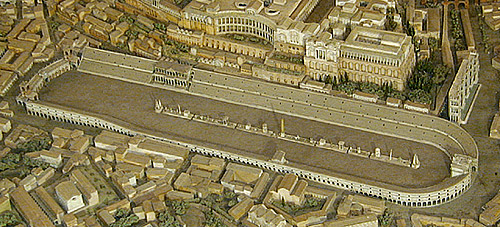
Model of the Circus Maximus, from vroma.org

As a balance to the down-to-earth horse racing, the book also makes substantial use of visions and horse whispering - which I understand is a real thing, but I know absolutely nothing about. Unfortunately my ever-reliable Nubia, normally so sensible, does something spectacularly stupid in this book, though she does at least do it for good reasons (which ensures that her actions are plausible and still within character). This is probably a good thing - her friends have done so many silly things over the course of the books that it was about time Nubia caught up - they are children, after all! And her reasoning is very noble, if flawed.

The book is also full of the usual fun references, including mentions of Incitatus without ever suggesting he was actually made a senator or a consul (hurray!) and a plot revolving around a great play on the idea of the Trojan Horse - summed up by Jonathan in this brilliant line - 'Sagitta was like a Trojan Horse... only filled with fear, not Greek soldiers' (I don't know why, but that made me smile). As I mentioned above, the book also includes an autistic character, though of course none of the Roman characters are able to identify the illness, they just think he's strange (the Author's Note explains it). I remember reading a Babysitter's Club book that highlighted autism when I was little (I was an eleven-year-old girl, this was the height of literature at the time!); I think it's the sort of thing that it's useful to highlight in children's books, so that they realise strange behaviour can be the result of illness and is not a reason to bully someone. It's also a handy reminder that people down the ages have probably suffered from the same illnesses and allergies as us, but without names for them (restrospective diagnosis is a form of scholarship I find very interesting, though it's pretty much impossible to do with any certainty, considering how difficult it still is to diagnose a patient who's right in front of you, never mind one who's long dead).

The chariot race from Ben-Hur. Just 'cause it's awesome, inaccuracies notwithstanding.

I now proceed eagerly to the next book, in hopes of seeing Sisyphus again and finding out what he does with his freedom, but also with a slight sense of dread that, life being what it is, our heroes may never be this purely happy again...

Sunday, August 1, 2010

The Roman Mysteries: The Sirens of Surrentum


The moment when Buffy the Vampire the Slayer changed from a good show into a great one was 'Innocence' - the episode where, having slept with Buffy and experienced a moment of perfect happiness, Angel loses his soul, dons the Black Leather Pants of Evil and, well, becomes evil. There's a scene towards the end of the episode in which Buffy's blissfully ignorent mother, Joyce, asks Buffy what she did for her birthday and Buffy replies sadly, 'I got older'. It's a beautiful, bittersweet moment that neatly sums up everything the viewer has just been through over the past two episodes. The Sirens of Surrentum is to the Roman Mysteries series as 'Innocence' is to Buffy - it is the moment where Flavia Gemina who, being a Roman girl, has to grow up rather faster than Buffy, learns some things she maybe didn't want to know about men and women and gets older.

Minus the sex and evil vampires, obviously. (Though I do love 'very kissing' as a child-proof description of sex).

As you'll have gathered, this is definitely a book for older readers of the Roman Mysteries series. I understand from my teacher friends that kids 'do' the Romans at Key Stage 2 - which I think is 8-9 year olds, or possibly 7-8 year olds - in the UK at the moment, which would be the perfect age for them to pick up The Secrets of Vesuvius or The Pirates of Pompeii. By the time they work their way up to The Sirens of Surrentum they should be that wee bit older and starting to be interested in the opposite sex, rather than running away from them because they have nits. (This is what we used to do in my primary school). This is probably also one for the girls, though there is plenty of poison and wild boar hunts to keep the boys occupied too - but really, what the book captures perfectly is what it feels like to be an eleven-year-old girl, and the minefield that is trying to understand adult relationships at that age.

This is something which is much more complicated for Roman girls, of course, because at eleven they are nearly old enough to get married and certainly old enough to be engaged. Not so for boys, who marry much later, though Jonathan and, especially, Tranquillus are clearly thinking about it already. But for Flavia, Pulchra and Nubia, the question of romantic relationships is not just something they can wonder about idly for fun, as it was for my generation, but an urgent problem.

I think my favourite aspect of the book, though, was actually something that reminded me of my MA year rather than the last year or two of primary school. Here's an insight into the workings of my brain for you all: I have studied both Lucan and Suetonius at some length, and Lucan was the subject of my MA dissertation. It took me ages - I won't even admit to you how long - to realise that 'Tranquillus', Flavia's betrothed is, in fact, Suetonius Tranquillus, one of my favourite ancient authors. It was only when he said he wanted to be a biographer that the penny dropped. On the other hand, a very brief mention of the Latin word 'nefas', which refers to a crime or sin of enormous proportions carrying with it an element of religious pollution, immediately had me primed for a reference to Lucan. (I didn't remember his wife's name, so I didn't work out the exact connection, but you say 'nefas', I think 'Lucan').

I'm not sure I should send kids running off to read Lucan, but for anyone with a strong stomach, his Civil War is absolutely brilliant. I focussed on the necromancy scene, which features Erichtho, one of the nastiest witches in literature.

My other favourite part (how many is that now?!) is Flavia's speech on the subject of suicide, which I won't spoil by quoting here. It's beautiful. (It also reminded me of an episode of Buffy the Vampire Slayer, but I think that might be my obsession with Buffy talking). And I will make some attempt to redeem my powers of deduction by saying that, once I realised Polla actually was being poisoned and not just suffering from a debilitating disease, I worked out the solution to the mystery myself.

Odysseus and the Sirens. I love this vase. See also the blog's current background!

The children, as good Romans, observe that poison is considered to be the resort of women and cowards, and refer to a few famous cases - I absolutely loved the use of figs on the tree that are pre-poisoned, which took my right back to I, Claudius, and I loved seeing Suetonius gather information for his most famous work. I was a bit horrified at Locusta's actions though, and almost - almost - sympathised with Felix over his response. I liked the lists of various poisons and their antidotes, which I will carry with me when I watch or read Agatha Christies in future, as Christie often uses the symptoms and/or antidotes of poison as vital clues.

There were some nice introductions to ancient philosophy here as well. They were necessarily over-simplified, of course, partly to fit the plot and partly for space and comprehension value, but the characters themselves explained that they were simplifying things, so that's fine. It was a shame that Platonism had to be missed out, but certainly Stoicism and Epicureanism were the big names at this time and the easiest to place at polar opposites to each other. (No room for the Pythagoreans and their beans, but that can't be helped!). It will be fun for any readers with a passing knowledge of Christianity to spot Philodemus' affiliation, and the way philosophy was discussed and handled in general was nicely done. Most importantly, there was an emphasis on philosophy as relating to moral character and life choices more than religion, which is more of a shared experience for everyone who isn't Jewish or Christian, which is an aspect of the ancient world far too often ignored by modern writers desperate to make some kind of point relating to their views on religion (good or bad!)

It's a shame Flavia can't marry Suetonius, as he seems a good sort, despite his obsession with naked women (he's just an early developer!) and I seem to remember that he has rather a lot longer to live than Flaccus, who look set to be her ultimate partner. Also, really, I'd worry about someone whose name is 'Flaccus' (it's just a reference to his floppy hair, kids!). Flaccus does seem to be the sanest person around, but I sort of hope it wasn't actually him who snitched on Flavia and Suetonius, as that was rather mean. Still, we can start to see what the future might hold for Flavia and Jonanthan (who should remove Pulchra from her parents as soon as possible I think!), though it remains more uncertain for Nubia, who once again functioned as the voice of reason and experience throughout, and Lupus, who's still a bit too young!

View from near Sorrento (Surrentum) across the Bay of Naples, towards Vesuvius

Thursday, July 1, 2010

The Roman Mysteries: The Gladiators from Capua (TV adaptation)


As promised, I have managed to get one review of the TV adaptations of The Roman Mysteries up while the show is still on! 'The Gladiators from Capua' was shown last Monday and Tuesday, but you can still see the last few episodes next week, starting with 'The Colossus of Rhodes' tomorrow morning on CBBC. Spoilers follow.

The Gladiators from Capua is my favourite Roman Mystery (so far) so this adaptation had a lot to live up to. This is complicated by the fact that it is almost certainly the adaptation that strays the furthest from the book, as the set-up for the television episode is completely different from the situation at the start of the novel. I’ve also reluctantly accepted that, since CBBC do not have the budget of Gladiator, it was impossible to set the story in the Colosseum, or to show the whole arena flooded to create a lake and filled with crocodiles. I am sad about this, but I accept that it is true.

Having said that, the arena set is impressive (especially on a childrens' show's budget) and the tiger even more so. The tiger provides a nice, neat solution to the problem of Flavia’s adventure in a flooded arena full of crocodiles, as a small arena with one tiger works just as well, even if it is a little less exciting, and the eventual solution – Nubia making use of her knowledge of African wild animals – is more or less the same (similar enough to feel right anyway). In the TV version, the other little girls survive – in fact, even the condemned criminal survives – which is probably also for the best, as the mass slaughter of little girls isn’t your usual family fare. There's only one problem with the action once the Games begin though – where are the audience?! Even I, Claudius managed to put in some sound effects to imply the existence of the audience we never see!

At one point, as the children escape, Domitian asks, ‘Was that meant to happen, Africanus?’ – someone’s been watching Gladiator! He even has a similar expression to Joaquin Phoenix as he says it...

For the most part, the story is reasonably well adapted. There's a subtle change to Caudex's character, from someone unwilling to kill in general terms to someone afraid of his own dark side and therefore unwilling to kill, and it works well enough, though you wonder why someone so ruthless as the gladiator trainer didn't just throw him to the lions (if this was Spartacus, he'd have gone straight to the Pits!). The way the trainer kidnaps Jonathan for the arena is a wee bit less plausible, as he’s just a child – Book!Jonathan was part of a special exhibition of child gladiators for the opening of the Colosseum, which made sense, but which isn’t the case here. On the other hand, the presence of Jonathan’s slave tattoo (from The Assassins of Rome) does make the idea of him being kidnapped by an unscrupulous slaver more plausible, and the trainer has good reason for it.

Some of the changes to the story are really extreme, partly out of necessity, since the mystery of the book doesn’t apply here. Trouble is, it’s hard to get too worked up about Domitian being under threat if you know how he turned out! But the gladiator who looks not unlike Neighbours Reject has a nice little speech where he says that they’ve been brought there to die, they might as well die for a reason, and his death was genuinely tragic. It also fulfilled the gap created by the survival of the girls and the thief by including death in the story's depiction of the arena, which it needed to feel realistic, but by giving the death to one competent, willing adult rather than a group of innocent, ignorent little girls, probably avoided a fair few complaints to the BBC. (In reality, gladiators did not die every time there was a fight, as even the Roman Empire could not provide that many highly trained gladiators! Often the fights were only to the point of surrender. However, some fights were to the death, and a modern gladiator story without anyone dying would probably feel strange to a modern audience who expect to see the extremes of the profession in a fictional representation of it).

Gladiators-eye-view of the arena at El Jem, Tunisia - I'm in the bottom left hand corner!

This is one of those cases where, because I've read the book and because the adaptation is so different, I really need to watch it twice to fully appreciate it, as the first time I spend the whole thing keeping track of all the changes that have been made (this is why I rarely read the Harry Potter books right before the movies come out). Even on a slightly confused first viewing, though, this was a good, solid adaptation and a satisfying story in its own right - if you discount the fact that the whole thing is about saving Domitian! Of course, our heroes have no idea how Domitian will turn out. He was one of the notorious 'bad' emperors, with a particularly violent temper, and may have been responsible for his brother's death - but I think the books cover that later, and I haven't read that far yet, so no spoilers please! Even if our heroes did suspect something, however, they would still have to save him - as several characters point out, they own a debt of loyalty to Rome, to the Emperor and, therefore, to the Emperor's family. Plus, well, if you allow a murder to happen you become partly responisble for it, and that's Bad, especially for children. So there's nothing wrong with this as a story hook - it's just a bit less satisfying for the viewer if you can't help feeling that they'd all be better off if they left him to it!

Tuesday, June 15, 2010

Bits 'n' Bobs


Hello all!

This is a quick place-holding blog! A new Spartacus review will hopefully go up tomorrow, if we can work out how to work the Sky Plus thingy. If not, Spartacus will go up next Sunday or Monday, after the repeat. I can't watch it live tonight, as I'm giving a paper in Birmingham.

I'm also planning to post on Part One of the Doctor Who finale this week, as it appears (from the trailer) to feature not only River Song, but also Stonehenge and some Roman soldiers! However, I won't be able to watch Doctor Who live either, as I'll be at a conference in Milton Keynes on Saturday. So, the Doctor Who review will definitely go up on Sunday, once I've watched it on the Iplayer.

In the meantime, CBBC are currently repeating series 1 of The Roman Mysteries, everyday in the morning (just before lunch I believe - unfortunately it's not on the Iplayer or viewable outside the UK). My reviews of Series 1 are all available already:
Series One is on this week and next week, then Series Two will be on for the two weeks after that, so I'll try to get at least one Series 2 review up while it's on, though I won't be able to keep pace with the whole series!

Finally, I have an interview next week! So, I have much preparation to do - please forgive me if the frequency/length of my posts suffers a bit!
By the way, the photo is of a Roman aqueduct near Split, Croatia, which is still in use. I just think it's cool!

Thursday, June 3, 2010

The Roman Mysteries: The Fugitive from Corinth

Another enjoyable and educational story, this entry into the Roman Mysteries series allows us to enjoy a road trip through some of the most famous and beautiful parts of Roman-period Greece. Spoilers follow.

Oddly enough, this one reminded me of Harry Potter in a couple of places (and not just because I'm re-reading Potter at the moment). The first was when, for a split second at the beginning of the story, I was worried that poor Captain Geminus really was a goner, as, like Potter, this is a children's series that is not afraid to kill likeable and good characters when the plot demands it (I also thought Arthur Weasley had really gone for good in The Order of the Phoenix). One other thing the two series have in common, though, is knowing exactly where to draw the line between killing off enough characters that the series doesn't feel too safe or predictable, but not killing off so many or such beloved characters that readers are put off - I think I've explained before why I refuse to read Philip Pullman any more?! (I also think killing Harry would have been a huge mistake, but that's a debate for another time).

Of course, I haven't finished the series yet, so watch Captain Geminus die at the beginning of the next book just to prove me wrong!

The other thing that reminded me of Potter was the characterisation of Flavia who, in this novel, reminded me a weeny bit of Harry in The Order of the Phoenix - coming into the very emotional, self-centred (in the sense of not being able to see other sides of things, rather than lack of genorosity) rather shouty phase of teenage years, a few years ahead of Harry of course, since girls go through certain aspects of teenage life earlier than boys. Also like Harry, Flavia has a pretty good excuse for behaving as she does, since she is still in shock and traumatised from the attack on her father.

This is a book in which the reader is expected to work out the mystery before the detective, clearly signposted early on when Flavia ignores the doctor's explanation that her father's amnesia is the result of a blow to the head and becomes convinced that he has been cursed and that she must find the culprit to get him to lift the curse (perfectly reasonable for a Roman child, but less so for a modern reader). Of course, modern readers will know, or their parents will tell them, that Flavia is wrong and the doctor is right, and so the reader is primed to look for the clues that Flavia misses, and even I managed to work out the solution before Flavia did (this is very, very unusual, I love mysteries but I'm rubbish at solving them, even the Agatha Christie ones). This is rather nice, allowing the reader to solve the puzzle ahead of their heroine and emphasising the fallibilty of our heroes, though it is an unfortunate side-effect that Flavia becomes a bit irritating over the course of the book as she refuses to see the truth. Nubia, meanwhile, is definitely my favourite character, as she is, as ever, the most sensible and level-headed of the children and the most perceptive.

The story takes us from Corinth to Delphi to Athens, accompanied by Jonathan's guide book, which is, sadly, a little under 100 years too old to be that of Pausanias, but is very similar. All three cities are clearly described, along with the route taken by the children (and their guide and bodyguard - as ever, the books remain sufficiently attached to reality that these children do not travel alone, though Flavia is in charge). We meet the real - as opposed to mythical - women of Greece, who are often veiled in public and who have less independence than their Roman counterparts - an excellent reminder of the differences between the two cultures, and the fact that Greece stayed Greece even under Roman rule. I also rather liked the references to the strong Spartan woman who's a mix of real Spartan indepedence and mythical beauty, it was a fun combination.

The Corinth canal - which didn't exist in Roman times of course - from our trip there 10 years ago

There were other fun touches too, my favourite being 'he will live long and prosper' in the Pythia's oracle, though that might just be my Trekkie brain over-reacting. Lupus finally gets something nice happening to him as well, thank goodness, though his reunion with his mother is so brief, it doesn't seem quite enough somehow and I'm holding out hope for more in the later books. Oh, and I've been watching too much Rome and Spartacus: Blood and Sand - every time Flavia says 'Great Juno's peacock!' I read 'Great Jupiter's cock!' This may be deliberate... All in all, another fun and intriguing entry into the series with a nice emotional undercurrent in the idenitity of Captain Geminus as the victim, giving the story greater interest and enotional depth.

Tuesday, May 11, 2010

The Roman Mysteries: The Dolphins of Laurentum (TV adaptation)

Another Roman Mysteries post already! I usually try to space things out a bit (unless they're actually on TV as Doctor Who is at the moment), but I'm still getting the hang of juggling the paid work and the proper-but-unpaid work, and I had this post ready drafted, so it's going out today. Upcoming attractions, when I get the chance, will include some more Stargate, another episode of Rome (as soon as I have time), The Mummy (which needs even more time!) and possibly an episode of Charmed, which I've never watched, but which appears to have some Greek goddesses in it...

Well, there’s no difficulty in telling Gaius and Marcus Flavius Geminus (otherwise known as Hugh Beringar) apart in this episode, as Captain Marcus turns up in a terrible state, with some kind of nasty disease and infected feet. He’s been shipwrecked in a tsunami caused by the eruption of Vesuvius (and, presumably, related earthquakes). This means we get to see our old ancient medicinal friends, maggots!

Lupus actually wants to hire an assassin to kill Venalicius, which is rather shocking. I mean, I understand the sentiment, but that’s still a pretty dire thing to try to do, especially for a small child. But then, I'm always peculiarly sentimental about small children. Don't even get me started on Thomas Hardy...

Just to add to Marcus' troubles, he is also horribly in debt, and Gaius can't help because his farm has been destroyed by the volcano. I love the way Flavia quickly recruits Pliny the Younger to help her smuggle her valuables to Jonathan’s house when the debt collector comes. Pliny comes off very well here. From his letters, it’s surprisingly difficult to get a sense of his character, since they were written for publication and are rather self-consciously literary and keen to show off. It would be nice to think that he was as he’s portrayed here – a bit bookish, a bit pleased with himself, but ultimately kind and generous. I doubt the real Pliny would have harboured seroius romantic intentions - the kind that are respectable for children's television - towards a poor Jewish doctor’s daughter though.

We also discover that Gaius and Marcus don’t just happen to be identical twins, narratively speaking, they’re identical twins for a reason! Gaius must pretend to be Marcus to save them from the debt collector. For some reason when I was younger I, and I think a great many other children, loved stories about identical twins (I was obsessed with the Sweet Valley High books and Sister, Sister on the TV. Come to think of it, that coincided with my dolphin phase...). I don’t know what exactly appeals to children so much about this idea, but something does, though unusually here it is adults who play the identity-of-the-twin game.

The children go to stay with Pliny by the sea, where they swim with the titular dolphins and Lupus, who was a sponge diver in Greece, tries to find treasure in a sunken wreck. The diving sequences are beautiful, taking full advantage of filming in the gorgeous blue Mediterranean sea and introducing a new, pseudo-Roman way of counting seconds, substituting ‘legionaries’ for ‘Mississippi’. I say ‘pseudo-Roman’ because this is English rather than Latin but I’m sure a similar Latin word would work just as well and it sounds much less out of place than ‘Mississippi’. Some of the CGI and photoshopping on the dolphin sequences is a bit dodgey though.

Miriam and Pliny the Younger

The eventual revelation concerning the relationship between Lupus and Venalicius is genuinely surprising, which is nice. Venalicius as a helpful person is also rather surprising, and his slow, agonising death from the bends is really horrible. In this version, Lupus’s father’s death was an accident and Lupus became mute through psychological damage – I’m not sure what happened to Lupus’ father in the book, but since Book!Venalicius cut Lupus’ tongue out it is unexpected to find Venalicius trying to help them and to see Lupus forgive him. Although, on the other hand, the greater the crime, the more virtuous the forgiveness, and it allows the first weight to be lifted from Lupus' mind.

Best thing of all about the episode though – actual spoken Greek! I still have trouble recognising spoken Greek but I suspect this was proper ancient Greek. I don’t think I’ve ever seen subtitles in a British children’s programme before – brilliant stuff!

Thursday, May 6, 2010

The Roman Mysteries: The Gladiators from Capua

Wow. I loved this book! Exciting, well paced and a real stay-up-till-2am-finishing-it job. Whether this is simply because, for a very sqeamish person, I have a quite bizarre fondness for stories about gladiators, I'm not sure, but I was hooked.

The story is set during the inaugural Games in the Flavian Amphitheatre, later known as the Colosseum, which took eight years to build and was opened by Titus in AD 80. The narrative is solidly structed to allow us three different views of the action. First we experience the Games in an historically accurate fashion, as a child or woman in the Roman Empire would have experienced them, from the very top tiers of seats in the massive amphitheatre. Then we get the experience we as readers really crave - the action is narrated from within the arena, with two of our heroes taking part in it, the Gladiator point of view. Finally, we see the action take place from the Imperial Box, so the narration can cover events from the best seats in the house. This brilliant structure allows readers to get the points of view they want, those of the participants and the people who can see the action best, while also educating child readers about how most people would really have viewed the Games (and although I referred to that first view as 'historically accurate', all the ways in which the children take part are historically plausible).

The story is also compelling, opening with a flashback featuring as yet unknown participants (I like devices like that, they always grab my interest) and carrying straight on with Jonathan's memorial service. I knew Jonathan wasn't dead and that he would come home in the end, of course, and when Tigris barked at the gladiators it was pretty obvious where he was, but there is enough tension in the story that it feels uncertain and keeps the attention anyway, since the reader doesn't know where or when Jonathan will turn up and keeps waiting for his appearance. First time readers might even wonder if he will, since The Roman Mysteries do adopt something of an Anyone Can Die policy, though I think they stay on that fine line that holds back from killing a character so beloved readers will be put off - our four heroes are safe, as are certain other characters. I think this is important in a children's book, or at least, it was for me when I was a child (I have never read another Philip Pullman book since he killed off Fred. I was that sort of child).

People dressed as centurions - not gladiators, for some reason - pose for photos with tourists outside the Colosseum

There were some fun shout-outs to other bits of popular culture, some deliberate and some that may only exist in my confused little brain. The reference to the lion and the 'unicorn' (a mistreated antelope) is presumably deliberate. During a conversation about the power of blood, the lines 'Blood is power' and 'Blood is life' leapt out at me as similar to lines from Buffy the Vampire Slayer, 'The Gift', and in a not dissimilar context, though that might just be my my obsession speaking. The large woman who wipes away tears as she sends Flavia and others out to die immediately had me picturing the giant Nurse who grows fond of Jill and Eustace but plans to eat them in The Silver Chair, though again that may just be me (though poor Flavia was being unusually dim not to wonder why only slaves and orphans were being used and why the woman was weeping). The lion and the rabbit reminded me of Monty Python and the Search for the Holy Grail, but since this was a real Roman attraction, that really is just me.

Even more effective were the call-backs to previous stories, especially The Twelve Tasks of Flavia Gemina. Somehow, the fact that Monobaz the lion had played an important and separate role in a previous story makes the resolution to this story seem more real and plausible than it would have if the whole relationship had appeared only in this book.

The book also makes beautiful and effective use of religious imagery, chiefly Christian, which is of course very appropriate for a story set in the Colosseum featuring a Christian character. The earlier conversation about the power of blood is reiterated in a considerably more life-affirming fashion and Jonathan's execution - on the third day - subtly but clearly evokes the Crucifixion and, of course, the Resurrection. Writers of certain long-running British science fiction shows, take note - this is how you use religious imagery properly.

View of the Arch of Titus, seen from the Colosseum

There is a lot of blood in this book, and it doesn't hold back in its depiction of the realities of the Games (in fact, like most modern fiction, it emphasises the amount of death and destruction, as it implies that most gladiator fights are, at least potentially, to the death) which presumably may concern some parents. In my experience, most children love gory stories, so they will lap this up. Some - child-me included I'm afraid - are a bit more sensitive, so might need this read to them by a comforting parent, and possibly followed by something lighter. I don't think any children will be too worried though (and, as the book reminds us, children in the past have put up with much, much more, as parents of viewers of certain long-running British science fiction shows might like to take into account before they complain about homicidal pepper pots). The book nicely balances Lupus' enjoyment of the Games with Flavia's traumatic experience to cover all points of view and give all children a figure to identify with, while Nubia (who, poor girl, gets given the most awful Sophie's Choice towards the end) remains a balanced observer throughout.

The depiction of the action in the Colosseum is all accurate. The books tends to describe the most spectacular events possible, but since these were the inaugural Games for the Colosseum, that makes sense. As I mentioned above, the narrative does tend to emphasise the deadly events, though it also depicts the glamour and the attraction of the life of a gladiator for some. Nubia's brother clearly is not anticipating imminent death and loves his new life, so we can infer from that that the death rate may be especially high during these opening days, and both Emperor and crowd are seen sparing people. Even Flavia briefly experiences the upside of life as a gladiator (in a scene which immediately brought some of the sweeping shots from the film to my mind, despite the watery setting of the book's middle section). On the other hand, the sheer cruelty of the Games, especially as regards the execution of prisoners, is also laid bare. Jonathan is able to become a gladiator despite being a child because Domitian has ordered some child gladiators as a novelty act, which seems pretty plausible given Domitian's character as we know it from later sources.

Well, as you can tell, I quite liked this book! My favourite of the series so far, and it will probably be my favourite overall, since it has so many of my favourite things - very tight structure, Christian imagery used well, gladiators, danger but no excessive culling of major characters and I think there was even an important dream in there somewhere as well. At some point I will watch the TV adaptation and no doubt be thoroughly disappointed with the lack of lions, flooded amphitheatres and blood and guts all over the place...

Reconstructed view of the Colosseum from the arena, from Gladiator