Showing posts with label Stargate. Show all posts

Friday, February 25, 2011

Stargate SG-1: The Curse


Quick plug: I have a new article out at Sound on Sight, on Five Films that Blur the Line Between Fantasy and Reality (I must try to come up with a snappier title next time!).

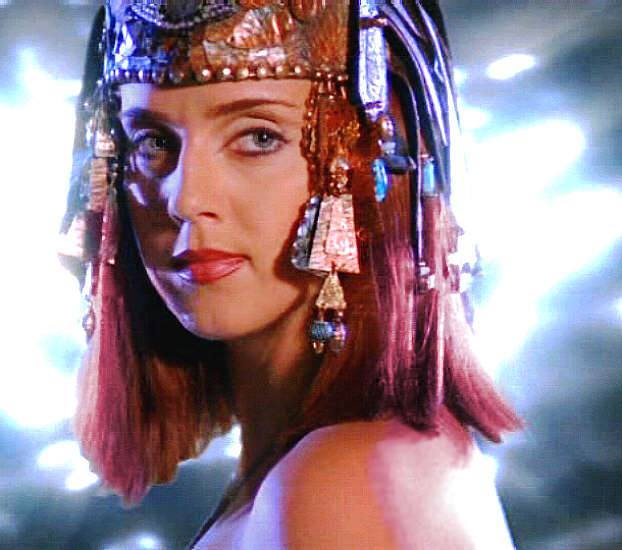
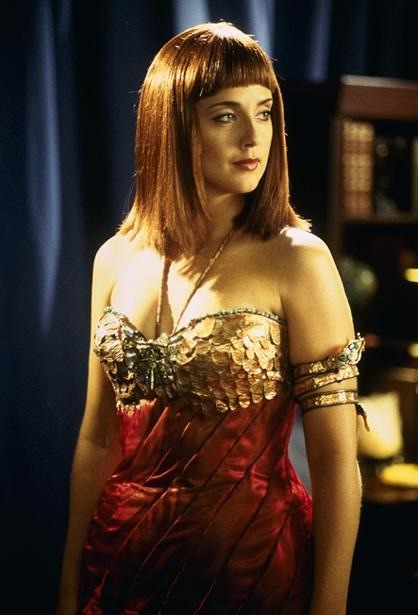
This episode of SG-1 is one of those mid-season episodes that serve to re-direct the main Goa'uld plot a bit and set up the season finale. In this case, we are introduced to a new Goa'uld, Osiris, another Egyptian deity, in the form of Daniel's ex-girlfriend Sarah (because his wife/another Goa'uld was killed off the previous year, so of course, we need to pile some more emotional trauma/sexual tension on top of Daniel). The audience ought to realise immediately that the unfortunate Sarah will end up Goa'ulded by the end of the episode as, like so many American bad guys, she has an English accent. We also see Osiris' consort Isis, in a way - her dead worm-y body is dissected by Doc Frasier.

This is also the episode that introduced us to Colonel O'Neill's cabin by the lake with no fish in it. When Daniel calls Teal'c for some translation assistance, Teal'c delivery of the phrase 'banished to oblivion' is priceless, as are his repeated offers to return to the SGC.

Events in the episode are kicked off by the mysterious death of Daniel's old archaeology professor in an lab explosion. I can't help wondering what an archaeology professor is doing is a laboratory with explosive potential. Archaeologists do work in labs sometimes, but they don't usually have to share them with the chemistry department. (Please note: this is a joke. I am aware that chemistry labs do not spontaneously conbust on a regular basis). The episode makes several references to a 'curse' of Osiris that does not, as far as I know, have any basis in any belief, ancient or modern - I presume the writers were inspired by the supposed curse of Tutankhamun. In this case, presumably, the 'curse' is down to the fact that Osiris is a Goa'uld in hibernation.

Osiris was worshipped both in ancient Egypt and later, together with his sister-wife Isis, in Greece and Rome as the object of a mystery cult. Judging by the artefacts Daniel's old professor is working with, he's focussing on Osiris' Egyptian incarnation, which, of course, fits with Stargate's general focus on ancient Egyptian mythology. I suppose, in the Stargate universe, the quite different Greco-Roman cult of Isis and Osiris developed independently as a relic of the Egyptian cult after the Goa-uld left... but I digress.

As usual, Daniel's descriptions of Osiris' mythology and attributes (chiefly the crook and flail) are fairly accurate, up to the point where the myth needs to be changed to fit Stargate's plot, and the wall painting that Steven finds looks like it properly depicts Isis and Osiris. Daniel's description of the Osiris myth conforms fairly well to Plutarch's version, which is the most coherent version we have of Isis and Osiris' mythology (evidence for the narrative from ancient Egypt itself is very scanty; Plutarch was a Greek who lived and wrote in the second century AD). For some reason Daniel insists on referring to a 'magic box' rather than a coffin or casket, which would be more accurate. Is this a dumbing-down thing on the part of the writers? Surely their viewers know what a coffin is! Perhaps they're just using a different translation of Plutarch. The punishment/banishment bit is an alteration to make the myth fit Stargate's plotline and does not appear in ancient mythology.

Daniel describes a canopic jar that he finds as belonging to Isis (he calls it an 'Egyptian burial jar' - perhaps he's just simplifying things for Carter?). In real life, a canopic jar would 'belong' to the dead person whose organs are stored in it, but the purpose of the jar has been altered for this episode - rather than storing the organs of a human being buried in the tomb, this one stores the worm-form body of a Goa'uld symbiote. It belongs to Isis because it's Isis' symbiote that is stored in it, complete with alien technology to keep it alive (except it's broken).

One of the nice things about this episode is that is presents archaeology in a reasonably accurate way, and in a much less sensationalist way than usual. One of the handy things about archaeology for TV scriptwriters is that archaeologists often have to work against genuine deadlines, and the (1990s) Egyptian government's request for the artefacts seems a perfectly plausible one. Daniel's ex-colleague Steven's book is apparently on the bestseller list, which seems unlikely - though ancient Egypt is always popular so I suppose, if it was a general introduction rather than an academic tome, that might be possible. Daniel and Sarah's envy is certainly realistic!

Given that they obviously wanted a new female Goa'uld to play with, one can't help wondering why the writers went for the male Osiris over his female consort Isis. Presumably this was because Osiris, who was killed by Seth (a god/Goa'uld the team have already encountered), dismembered, then brought back from the dead and associated with death and resurrection seemed like a more interesting choice than Isis, who is among other things healer, mother and life-giver.

This episode is a bit functional, moving the plot to where it needs to be later in the season. On its own, it works reasonably well as a murder mystery, but the simplest kind. There are two suspects (i.e. people who may have been taken over by Osiris - Daniel's colleagues are probably not natural murderers!). One looks very obviously like the guilty party so, of course, it turns out to be other one. It is lovely to see Daniel actually being an archaeologist though, and we get a trip to Egypt thrown in too! (Well, some sand that looks like it could be Egypt. It makes a change from Canadian forests anyway). Not an all-time classic, but a fun enough way to pass forty-five minutes.

Wednesday, September 29, 2010

Stargate SG-1: The Torment of Tantalus


Stargate SG-1's first season doesn't tend to have the greatest reputation - along with the first seasons of any number of genre shows - but along with several undoubted clunkers, it also threw out a few classics, and I think this is one of them. Not only does it feature a planet that resembles neither Egypt nor Canada (the dramatic medieval-looking castle on a cliff by the sea is rather fab-looking) but it is probably SG-1's most romantic episode. SG-1 produced several romantic episodes over the course of ten years, most of them tragic, but few could match this story, in which Daniel discovers that a man called Ernest went through the Stargate and never came back fifty years previously, and reunites him with his long-lost finacee Kathryn, who owns the Stargate and who kick-started the programme.

When I grew up watching Star Trek, it used, from time to time, to produce episodes in which our heroes were flung to the far sides of the galaxy by some super-powered alien thing or negative space wedgie and someone would dramatically state how far away they were and explain that it would take decades (more rarely centuries) to return home. Of course, by the end of the episode, they were all safely back in the Alpha Quadrant (TNG's 'Q Who' is probably the best, in which Starfleet are introduced to the Borg). Like Voyager and Farscape, this episode highlights what might happen if our heroes didn't make it back by the end of the episode, but unlike those shows, in which the overall arc required that they get home at some point (even if they don't stay) Ernest, in this episode, is actually stranded for five full decades. Also unlike those shows, there is no possibility of Ernest travelling for a long time until he gets home - he is literally stuck and has to wait for rescue.

Unusually for Stargate, the classical references in this episode are not literal - Latin being used as a language, the ancient gods turning out to be aliens - but metaphorical. There are a few references to various things that, in the world of Stargate, are literally true, including Ra being in Heliopolis and Thor being an alien, but the primary ancient reference is that of the title, which is from a well known Greek myth. Tantalus was once a favourite of the gods and used to dine with them, but he committed a terrible crime (which varies from source to source, but usually it's giving mortals nectar and ambrosia, the food and drink of the gods, generally revealing the gods' secrets to mortals, or serving the gods his own son as dinner to see if they tasted the difference) and was sent to the Underworld for eternal punishment. The punishment itself also varies, but it is always along the same theme, of something being just out of reach. The most common versions are that he is standing in a pool of water that drains away when he tries to drink, or standing just beneath a bunch of fruit that is just out of reach (in the Odyssey, Homer gives him both).

Ernest got stuck the wrong side of the Stargate because he was reaching for something that was just out of reach, and has come to regret it. He tells this myth (pool of water version) to Kathryn as he explains how much he wishes he hadn't come. Meanwhile, Daniel has become fascinated by an alien version of the Rosetta Stone which he is trying to interpret - an inscription in several langauges (including Norse runes) with a central version in a language made up of diagrams of elements of the periodic table (used as a universal language, which kinda makes sense... I think). But, of course, our heroes have arrived on the very day that a castle that has stood for millennia is about to come crashing down into the sea. So Daniel has to leave, to save his own life. He wants to take the risk and stay, but Ernest persuades him that he shouldn't throw his life away on something that will probably remain forever out of reach. The title could also refer, of course, to Ernest's position, stuck just the other side of the Stargate for fifty years, unable to get through.

It's nice to see SG-1 using myths as metaphor for a change. Of course, any show set in any time period on Earth can do that, and SG-1 usually has more exciting things in mind for its mythical characters (seeing them in the flesh, for one thing). That's the nature of the show and there's nothing wrong with that. But one of the reasons people value mythic stories is for their potential for interesting metaphors - a simple, familiar story can resonate more and have a greater emotional effect on people than something long and complicated, or entirely unfamiliar. Myth in science fiction doesn't always have to be aliens and pyramid-shaped spaceships; sometimes, as in any other genre, it can be all about the emotion.

Kathryn and Ernest go home together at the end, of course. Awwwwwww. (Sniff).

Thursday, August 5, 2010

Stargate SG-1: Hathor


I'm going away for two weeks tomorrow and won't have access to the internet, so I won't be blogging again until the end of August - though I am taking several books I want to blog with me so should have plenty of material ready when I get back!

'Hathor' has to be one of the silliest episodes of Stargate ever filmed, but that is why I love it. I feel much the same way about Star Trek: Voyager's 'Threshold', an episode so bad it's actually been written out of Star Trek canon entirely. 'Hathor' is a completely ridiculous, borderline sexist episode but it is also one of those so-bad-it's-funny classics you see in SF and fantasy every now and again.

Early in the episode, we hear the following exchange between Daniel and Jack:

Daniel: Hathor was the Egyptian goddess of fertility, inebriety and music.
Jack: Sex, drugs and rock and roll?
Daniel: In a manner of speaking.

This is more or less true. Hathor was a goddess of fertility and music, and, therefore, was also associated with sexuality and with the pleasurable things in life in general. However, what this episode does is take her association with sexuality and fertility and run with it, mostly ignoring her association with music, and totally ignoring the fact that she was usually represented a woman with a headress of horns, a woman with cow's ears, or as a cow.

Most of the details of Hathor's mythology mentioned in the episode are fairly accurate, including the story about how she was sent to destroy the world by Ra, but then he changed his mind. On the science-fiction side of things, Hathor is presented as a 'queen bee' type creature who produces larvae which are then incubated by the Jaffa (people like Teal'c). It is possible that this was inspired by Hathor's title as mother of all Pharaohs. In Egyptian mythology, the Pharoah was identified with the god Horus, and Horus was a son of Hathor (in some versions - she was also considered the wife of Horus at Edfu). The script refers to her as the 'mother of all Pharaohs', because one of the titles of the Pharaoh was 'son of Hathor', so that may have been what inspired the writers to give her the 'queen bee' function.

Bronze arched sistrum (musical instrument) with Hathor head decoration. Egypt, Late Period, after 600 BC. From the British Museum online catalogue.

There is, however, one rather odd reference to the ancient myths. About halfway through the episode, Carter and Doc Frasier are doing some research on Hathor, and Carter finds a website:

Carter: This one academic's web page theorises that a bunch of the sex goddesses from different cultures were actually the same woman - Hathor. The Greeks identified her with Aphrodite. There's Ishtar of Babylon, Astarte of Syria, Ceres of Rome.

Carter does point out that this is really Daniel's area and she's not sure what she's doing. But the really weird thing about this bit is that this is not the theory of a modern academic with a website. This is the sort of theory put forward by ancient academics - by philosophers and theologians and scholars in the Greek and Roman periods. Ancient scholars did not necessarily believe wholehearteredly in a particular myth or dogma - that was one of their problems with Christianity as a concept. However, they also would not necessarily assume that all the ancient deities were entirely fictitious, but rather that the different myths represented different aspects of the same truth. In a separate but related trend, as people travelled and traded and, eventually, were conquered by the Romans, different religious traditions and rituals became conflated with each other, so gods and goddesses worshipped under different names in different traditions were considered to be, broadly speaking, identifiable with each other. Called syncretism, this was a very common phenomenon in the ancient world, and Hathor herself was eventually subsumed by another Egyptian goddess, Isis, with whom she had long been identified.

The strange thing about the Stargate reference is that Carter makes it sound like it is a modern academic (with web technology!) who has created this 'theory'. Part of the reason for this is that, in the show, all these deities actually are real alien beings, but it still seems like a bit of a weird gap in the otherwise pretty good research done for the show. Surely Carter could just as easily have found out that the ancients considered all these goddesses to be the same deity? But then, she did say it wasn't her area. The actual identifications aren't totally out of the realm of possibility. Ceres was a goddess of fertility as it related to farming rather than to human reproduction, but she was identified with Isis, who was identified with Hathor.

The episode actually opens with an archaeological dig in Mexico, in a Mayan temple, where a group of archaeologists are surprised to find a sarcophagus with Egyptian hieroglyphics. As so often happens to archaeologists on TV, all their messing around with the sarcophagus opens it up and out crawls Hathor, who kills them. Luckily some of their team were outside and the appearance of Egyptian hieroglyphs in a Mayan temple makes them think of Daniel. This seems to be the first appearance of a sarcophagus in the television show, which is interesting. One of the problems with Stargate's sarcophagi for a long-running series is that they bring people back to life, which makes it hard to kill anyone or to create real tension and danger. This episode solves that problem by having it destroyed after it's been used, which seems wise.

What makes the episode so silly (in case those of you who haven't seen it were wondering!) is that Hathor's sexual power is translated here into a horrifically cheesy magical power over men (explained as some sort of chemical influence but really, there's not much point bothering with the science of it). She breathes her purple mojo on them and they become putty in her hands. The result is that the entire base, bar the few women on it and Teal'c (protected by being a Jaffa) are completely in her power. Then she has sex with Daniel for his sperm, produces hundredsof larva babies and tries to make Jack her first Jaffa (i.e. a human incubator for one of the larva babies). All of which is the direct result of two acts of stupidity at the beginning of the episode, when Daniel has a fit of chivalry and un-cuffs her, despite the fact she was trying to break in to the base and Hammond, despite everything he's seen so far, believes Jack when he calls Hathor delusional and agrees to have his hand kissed, in order to play in to her delusions. All in all, it's not Stargate's finest hour.

The men vs women plot does have some compensations. I love the conversation between Carter and Doc Frasier about being 'one of the guys', and about Frasier's ex-husband calling the Air Force 'this man's army'. Carter actually comments on the paucity of women on the base as well, which is nice to hear and which provides the show with a neat excuse for the ratio of men to woman: whereas, for example, Star Trek has no excuse for having male crewmen outnumber female, because it's set in a supposedly egalitarian future, Stargate can claim that it is simply representing the current make-up of the United States Air Force. The bit where they all have to flirt with the men to get out of their cell is very funny too and seeing Doc Frasier trying to be a soldier provides a nice opportunity to see an identifiable female character for those of us not of the military persuasion.

Still, this cannot quite make up for the fact that Hathor appears to be wearing an outift that bears a certain resemblence to the famous gold bikini of Princess Leia, or all those odd shots of her in a bathtub surrounded by swarming larvae. You also have to wonder why she doesn't just work her mojo on at least some of the women as well, though there might be an argument that, since her power is related to fertility, it only works on a female/male basis that could lead to procreation. Afterwards, the men don't seem to remember anything, which saves them from having to angst about the fact Daniel was essentially date-raped and then all his larva babies were killed, though he does look a bit depressed when he works it out. Still, if this was Farscape, there would have been a lot more angst about that. On the other hand, at least he didn't just abandon his lizard babies on some planet in the Delta Quadrant.

I have to admit, on viewing this episode again, I was surprised at just how accurate a lot of the information on Hathor was. Aside from the misunderstanding, or misappropriation, of syncretism, the writers genuinely had done their research. (And they left out the cow part, but that's hardly surprising. In fact, given the set-up of the series, they missed some great opportunities to show alien Eyptian gods that actually had jackal's heads and falcon's heads and so on). Even better, the science fiction elements of Hathor's character do seem to have been inspired by her real mythological roots, which is pretty impressive and a nice way of adopting and adapting ancient mythology for a modern audience. It's just a shame that the eventual episode, in both script and direction, was somewhat mishandled and came over as cheesy, patronising (I'm not sure if it's more patronising to men or to women!) and supremely silly. Still, points for effort and for producing something that can give us all a good laugh on a rainy evening.

Thursday, May 13, 2010

Stargate SG-1: Window of Opportunity


‘Window of Opportunity’, the ‘Groundhog Day’ episode of Stargate SG-1, is an acknowledged classic. Absolutely hilarious for the most part, its conclusion is unexpectedly dramatic, very moving and a nice reminder of an often forgotten aspect of Colonel O’Neill’s character.

It also occurs during that period in Season 4 when the writers were really pushing the Carter/O’Neill romantic subplot (coming just after ‘Upgrades’ and ‘Divide and Conquer’ and shortly before ‘Beneath the Surface’, all of which included romantic moments between the two). So, naturally, that comes into O’Neill’s consequence-free activities once Daniel has pointed out the ‘window of opportunity’ open to him and Teal’c (demonstrating that Daniel really is rather more intelligent than either of them). The best thing about it is, O’Neill is such a good officer, he resigns from the Air Force before kissing Carter, even though it really couldn’t make any difference. (We only see them kiss, but I often wonder, from his subsequent grin, whether he ever thought of doing this earlier in the loop, allowing more time for other activities...).

The time loop is started by an alien archaeologist who wants to go back in time. On their second encounter, O’Neill demands to know what kind of archaeologist carries a weapon, to which Daniel replies ‘I do!’. In science fiction and fantasy, most archaeologists seem to carry weapons – River Song, Indiana Jones and that well known amateur archaeologist Jean-Luc Picard would not be seen without their various arms. In real life, on the other hand, O’Neill would have a point, though I suspect an archaeologist who was threatened could do a fair bit of harm with a pointy trowel or a shovel.
Unable to break the time loop, our heroes come to the conclusion that they will only be able to work out how to end the loop if they can translate the text on the altar/time machine that started it all, which is a planetary history. The text is in one of Stargate’s made-up ancient alien languages, which is similar to Latin (it includes words like ‘dommo’ for ‘master’, which is similar to the Latin ‘dominus’ but, of course, doesn’t have to be at all accurate). Daniel doesn’t have time to translate it all within the 10-hour time loop, so O’Neill and Teal’c have to learn Latin and memorise the sections they’ve already translated so that they can get together a complete translation.

I must confess, I always wonder why O’Neill and Teal’c have to actually learn Latin, when surely Daniel could translate a section at a time and they could simply memorise the sections he’s already done. Perhaps, since the language is like Latin but not the same, Daniel needs their help with the translation, and they need to understand Latin to help him properly. Possibly. Anyway, the fact that O’Neill and Teal’c apparently have time to learn a new (inflected) language is often cited as an indication of just how long they must have been ‘looping’. And the sight of Colonel O’Neill reading a book called Latin for the Novice and looking like he wants someone to just shoot him now is very funny.

The episode does insist on treating language as if it were mathematics, though, as other things have done before. O’Neill testily tells Daniel that a certain word means ‘give up’, not ‘surrender’, but if the language is anything like Latin, those two things would be indicated by the same word. Daniel’s correction of ‘conqueror of time’ to ‘master of the uncertain past’, being based on context, is a bit more plausible.

This episode deserves its excellent reputation, and I urge you to track it down if you haven’t seen it, it’s hilarious. It also features a rather beautiful alien archaeological site, with a red sky, desert climate and various monumental works, some of which look a bit like stone torpedoes stuck in the sand. Plus the team get to break out the sand-coloured khaki and wear big sunglasses. All in all, a good break from the remarkably large number of planets across the galaxy that look just like Canada...

Wednesday, April 28, 2010

Stargate (dir. Roland Emmerich, 1994)


I gave a short (very short - 5 minutes!) paper on Stargate a while back, as part of a panel on 'Archaeologists from real to reel', in which I basically discussed the representation of Daniel Jackson as an archaeologist. I'll copy the text of my paper into the bottom of this post - it's really very short (not all my papers are that short!) and it's sort of half formal, half informal (it was that sort of event) but hopefully it may be of interest!

I love Stargate, it's the kind of big, cheesy fun I tend to like a lot. Also, I saw Stargate SG-1 first, so I came to the film already feeling a lot of affection for these characters - otherwise I might have been a bit more dubious about Colonel O'Neil. And James Spader is very attractive in it.

I'm never quite sure how I feel about the use of religion and mythology in Stargate in general though. On the one hand, the idea that ancient gods are really aliens is always a fun one, since it means you get to play with their mythology and even see the gods in action, offering dozens of fun episodes over the course of SG-1 and plenty of oppotunities for me to blog about it! It also fulfils that constant desire for myths to be somehow true. We do not believe in the ancient gods, but if they were, in fact, aliens, suddenly we have a way of making all their myths real, just twisted - an obscure version of euhemerism (and I'm dealing with a particular kind of fictional 'true' here - I am by no means suggesting that the gods actually were aliens and the pyramids are spaceships, those are the crazy people we walk away from slowly!). The desire to find some kind of truth behind myths is an old one and a strong one and if I could fully explain it, I'd be a happy person, but it is undeniably there.

On the other hand, throughout the history of Stargate, the team never seem to come across a religion that isn't based on the crimes of a Goauld or an, um, thing from the later seasons which I haven't seen as much of. Obviously, this is more of an issue with the television show than the original film, but the groundwork is laid in the film. It's a bit akin to Arthur C Clarke's famous dictum that 'any sufficiently advanced technology is indistinguishable from magic' in that it assumes that people will attribute anything they can't explain to magic and/or religion - it's a very Frazerian world view. And I'm honestly not sure it's true. There's a difference between believing in some form of the supernatural and attributing everything you can't explain to it, even going so far as to worship it. And there's more to religion than just 'Dear Deity, please do this for me and don't smite me and I'll kill a cow for you, thanks a lot'. Still, I suppose ancient Egypt, where Pharoahs were considered to be deities, is an appropriate culture to hijack for this sort of story, and there are plenty of historical instances to support the idea of people worshipping strangers with new technologies (I was going to say that the Romans weren't worshipped for having central heating, but Emperor-worship did develop in some places, several cultures have worshipped human rulers, and I think there might be some central American examples as well though I don't know much about that). And in the film, there's no suggestion that this is a universe-wide problem, it's just one thing that happened on one planet, which is much more plausible (with a certain amount of willing suspension of disbelief of course!).

The film also maintains much higher plausibility as far as language and culture are concerned. The Abydosians behave like ancient Egyptians because they were transported to Abydos from ancient Egypt and they speak a form of ancient Egyptian (Demotic presumably!) for the same reason. As science fiction set-ups go, this is not that unreasonable, and it does my favourite thing - actually pays attention to the language issue. By the time of the series, everyone spoke English, despite the fact that their ancient monuments were often inscribed in Latin, Greek, Egyptian and other ancient languages, which just isn't plausible at all (though I understand why they did it - it wouldn't be very practical for a weekly series to have to mess around with ancient languages every week!).

The film also features an arranged marriage that the groom doesn't realise is a marriage, and just about pulls off the resulting romantic relationship. Daniel and Sha'uri have nice chemistry and you do sympathise with his predicament, though I always find that I can't help hearing Samantha Carter's reaction from her first meeting with Daniel in SG-1 whenever I see those scenes -

O'Neill: She [Sha'uri] was a gift.
Daniel: She was, actually, from the elders of Abydos the first time we
were there.
Carter: And you accepted?

In the end they're very sweet though.

I'm sure there's more I could say about Stargate especially as it relates to Egypt (I like the alien wildlife, but actual camels are much, much cuter). I suspect a lot of it will come up over the course of the the various episodes of SG-1, though, and there's probably a limit to how long this blog post should be! So here is my very, very short paper on Stargate. This paper was given at our departmental forum, at the first session of the year, so it was a little more informal than most of my papers, as we wanted to do something fun and welcoming for new postgrads.

Stargate is a 1994 film which has since spawned the 10-year long TV series Stargate SG-1, the 5-year long TV series Stargate Atlantis and now Stargate Universe. Since I only have 5 minutes, today I will be focussing on the 1994 movie.

The film opens with the discovery of the titular Stargate at Giza in the 1920s, by a German archaeologist. Then we skip ahead to the 1990s, and the German archaeologist’s daughter recruits Egyptologist Dr Daniel Jackson, who has become an outcast in the archaeological community, to help to translate a cartouche that was found near the Gate. Daniel claims that the Great Pyramid was not built by Cheops and is at least 10,000 years old; contrary to statements made later in the series, he does not at this point claim that the pyramids were built by aliens. The Gate itself is being kept in a secret mountain base by the US air force (how and why this has happened, or how they know what it is, is never explained). Daniel solves a problem other experts have been working on for 2 years in a few hours, they get the Stargate working and a military team, led by Colonel Jack O’Neil, with Daniel in tow, travel through the Gate to an alien planet, where hi-jinks ensue.

Much of the tension in the movie comes from the conflict between Daniel, the archaeologist, and Col. O’Neil, the military man. On a broad level, Daniel, the archaeologist is made to represent science as a whole; he wants to explore the new planet and discover more about its inhabitants, and he displays a curiosity about everything. O’Neil, on the other hand, has been given orders to detonate a nuclear bomb, destroying the planet and its Stargate, in a pre-emptive strike to protect Earth (which he is willing to do because he is suicidally depressed following the accidental death of his son).

The presentation of Daniel the Egyptologist as a quintessential Hollywood scientist has two main aspects. Firstly, he is a fount of all knowledge. There is no area in which Daniel is not an expert, be it Egyptology, archaeology, anthropology, philology, cryptology, astronomy… Secondly, and perhaps more significantly, Daniel embodies the American stereotype of the science geek.

The science geek is an easily recognisable character in American TV and film. He or she wears bad glasses, often has asthma or other respiratory problems, has bad hair, wears bad clothes, and speaks in a nervous and often comic voice, sometimes with a stutter. At this point I went through some pictures of typical science geeks - Leonard form The Big Bang Theory, Frink from The Simpsons and so on.

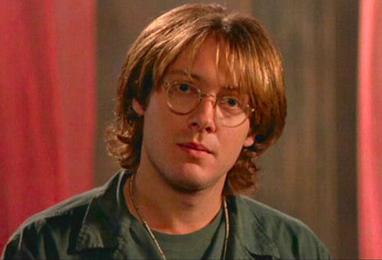
Dr Daniel Jackson wears big glasses, has long, floppy hair (in direct contrast to the military crew cuts sported by most of the rest of the cast), wears tweed with elbow patches, stutters a little and suffers from allergies, many involving sneezing a lot. He appears foolish to the air force men he works with, and has to lie about his ability to get them home to get on the team.

This view of the archaeologist as a geek is in direct contrast to the more usual view of the archaeologist as adventurer. Although Indiana Jones looks pretty geeky while teaching, he quickly becomes much cooler and magically regains the power of perfect vision before contact lenses came into common usage, as soon as he leaves the office. Other movie archaeologists are just cool from the beginning and are characterised as treasure hunters, rather than scientists or historians. I believe that the characterisation of Daniel Jackson in Stargate is entirely governed by the decision to portray him as an archetypal scientist, rather than a treasure hunter.

It should be noted that, at the end of the movie, Daniel does turn out to be the romantic hero and gets the girl, while in SG-1, although he starts out as the floppy-haired sneezing geek, by the end of ten years he has become a lot more cool, with shorter, more military hair, better glasses, tight black T-shirts, a lot more muscles and no allergies. Clearly, no Hollywood writer can resist the allure of the adventurer archaeologist, even if they start out with a very different character.

End of the paper. I didn't use this paper as an excuse to show off lots of pretty pictures of the Daniels Jackson at all, oh no, whatever can you mean...