Showing posts with label Fantasy literature. Show all posts

Sunday, May 23, 2010

American Gods (by Neil Gaiman)


I finally finished American Gods, having started it nearly a year ago! For anyone who hasn't read it, there are major spoilers ahead.

The basic premise of American Gods is that, as in the Discworld and, apparently (according to Clash of the Titans) in Ancient Greece, the gods are brought into existence by the force of people's belief, and that the millions of immigrants to America brought their gods (and leprechauns, and pixies, and kobolds, whatever they are, and various other assorted supernatural or divine creatures) with them.

Now, obviously, none of the main characters are Classical gods because by the time Greeks and Italians made it to America they were Christian. Many of the central characters are Norse gods, since it is generally believed that Vikings travelled across to America in the Dark Ages. Gaiman also includes several Egyptian deities (primarily Horus, Bast, Anubis and Thoth) on the grounds that Egyptians were travelling to America in ancient times - this, I confess, I find rather less plausible and I have a sneaking suspicion he just wanted to use the Egyptian mythology and imagery. When the central character dies part way through (he gets better) he wonders why he undergoes an Egyptian journey into death, complete with the weighing of his soul against a feather under threat of being eaten, and why he didn't get St Peter and the pearly gates, since that would be his cultural expectation, and is told that although he didn't believe in them, they believed in him. All of which reinforces my opinion that the real reason is just that Egyptian imagery is cooler!

There are also solid, important reasons for taking a more subtle approach to the Judeao-Christian imagery, though the nature of the story means it could hardly be left out. It is fairly safe to assume that the number of people who actually believe in Odin or Thoth are fairly small, if they exist at all, so those characters are free to be reinterpreted without taking pot shots at people's deeply held beliefs. Most of the mythologies present here, I confess, I have very little knowledge of - I have a vague knowledge of Norse mythology and I know Egyptian mythology of course, but the mythology I know best is classical, which isn't here. I don't know how far current beliefs are reflected in some of the other characters, especially the Native American characters, but I sense that there is an emphasis on the older, more forgetten gods, which fits the story anyway, since it is about gods who are old and neglected - modern religious figures are assumed to be living somewhere where they are worshipped, not in America.

Jesus does make an appearance though, in a suitably subtle (and unnamed) fashion, as a friendly and extremely successful carpenter who has rather a lot in common with Shadow, the protagonist. The whole scene is dealt with very cleverly, as it's not especially offensive to Christians, but at the same time it does not shy away from including the Christians deities as mythical gods among the rest. Christian imagery is also appropriated at times, chiefly in the themes of death and resurrection and the stabbing of Shadow while he hangs, dying, from a tree, while Easter appears as the Germanic pagan goddess Eostre, whose festival was in April and who in reality may or may not have been invented by the Venerable/Venomous (depending on your point of view) Bede.
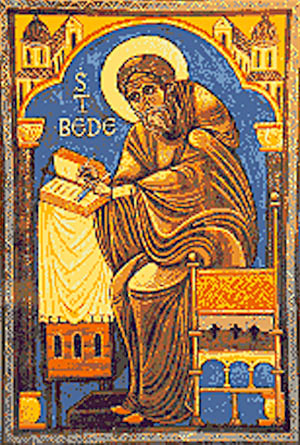
The Venerable/Venomous Bede

There are some references to Classical deities, usually brief mentions from other characters. Mithras, the 'army brat' apparently had his birthday stolen by Jesus, a reference to some of the origins of the Christmas festival, though Christmas as we know it is composed of quite a few different influences and this is a bit of an over-simplification. At one point we meet 'Media', one of the new gods, and someone asks if she's the one who killed her children - no, says another (that was Medea, who wasn't actually a goddess, though she had divine relatives) but implies that the two are very similar. Presumably this is intended to imply that Media can be deadly to her viewers. Bacchus gets a very brief mention and somehow the emperor Hadrian's deified beloved, Antinous, has made it over to America, though how he managed this is not explained.

I also thought I spotted the ghost of the Golden Bough that so fascinated JG Frazer at one point (an early twetieth century mythologist/armchair anthropologist who thought every single religion anywhere, ever was about the death and resurrection of the god of vegetation and who thought that a particular rather odd and violent Roman tradition involvoing a tree and the golden bough that must be plucked by Aeneas before entering the underworld was the key to it all). My familiarity with Norse mythology is too vague for me to be sure whether this was a reference to the Aeneid (and Frazer) or a Norse thing, but it definitely seemed a little bit Frazerian to me.

The book does assume a lot of knowledge (or, possibly, willingness to look things up) as references like these are scattered throughout without explanation. I missed many more of them than I caught (though I was quite pleased with myself for knowing who Louise Brooks was!). My knowledge of mythologies outside Europe is pretty mch non-existent and my knowledge of America is patchy and gleaned mostly from TV, so there were a lot of things that went over my head. On the one hand, this technique allows the reader to really empathise with Shadow in his confusion at this new and strange world (and those readers who are familiar with all the requisite myth systems can fell thoroughly smug and superior, which is always fun!). On the other hand, it was rather frustrasting knowing that there was a lot more to what was going on, but that I didn't know what it was.

Louise Brooks. In case you were wondering!

Overall, I enjoyed the book a lot, though I didn't really get into it until quite far through (and there was a fair amount of focus on a certain male area - but I think that's true of mythology as well, so fair enough). And although I haven't read Twilight: Breaking Dawn, I have read summaries and reviews of it, and found myself drawing some rather unexpected comparisons at the end. Gaiman is a brilliant writer though, and the short stories telling tales of particular gods and immigrants were often the most gripping parts - though I was also genuinely fascinated by the character of Shadow and by Laura. The final twists were pretty bog-standard, but done well and I must go and see the House on the Rock some day.

This is not really a book about mythology, but a book about America, and for someone like myself, who has never been further than New York, it makes fascinating reading. Unfortunately, however, that focus on America is what keeps the Classics at bay, for the Classical gods never made it to America (outside of Percy Jackson) - they remain the the Old World and, even here in Europe, are more frequently referenced as an element of our past than our present. American Gods is about the junction and the tension between past and present, about what changes and what stays the same, and something frequently (if incorrectly, in my opinion) categorised firmly with things that are of the past, like Classics, perhaps doesn't fit as well as the other mythologies that Gaiman focuses on.

(By the way and on a totally unrelated subject, did everyone - in the UK anyway - see the finale to Ashes to Ashes the other night? It was brilliant!)

Edited to add: TV Tropes has cleared up the mystery of Shadow's real name, which my hazy memory of Norse mythology had obscured - Baldur. So the stick and the stabbing may also relate to mistletoe.
Monday, March 22, 2010

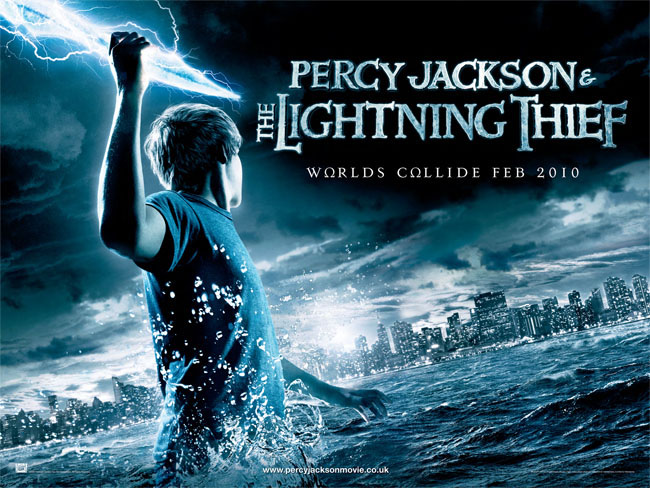
Percy Jackson and the Lightning Thief (dir. Chris Columbus, 2010)

I finally managed to see Percy Jackson and the Lightning Thief! I think a short summary is the best way to start this one. I haven't read the book, so this applies only to the movie.

The first scene gives us Boring Soldier emerging from the waters, and he's HUGE! It's quite alarming. He and 006 (also known as Boromir, Sharpe or Odysseus, but that's way too confusing) set up the plot - 006's lightning bolt has been stolen and he is Not Happy.

Percy Jackson lives with his mother, Harper Lee, and Cypher (I've met him! He's very nice in real life) who, in this movie, is even nastier than he was in The Matrix. On a school trip to the Metropolitan Museum of Art (I've been there! I got very excited at this point, the movie was starting to look like my most recent holiday album), Percy is attacked by a Fury and 007 tells his he has to get the heck out of dodge ASAP.

Percy's mother is killed in a minotaur attack and no one seems sufficiently upset about this; his best friend turns out to be a satyr and 007 is really a centaur (where he was hiding the giant horse body when he was sitting in his electric wheelchair is anyone's guess). There's some battle training and then Hades turns up, played by the Balrog, and promises to give Percy's mum back if Percy brings him the lightning bolt. For some reason, instead of trying to find out who really stole the lightning bolt so he can clear up this mess, Percy instead decides to go to the underword and just... ask Hades for his mum. Hmm. Then he accepts a whole bunch of help from Luke, a son of Hermes with a chip on his shoulder without wondering what's going on there either.

The Metropolitan Museum of Art. Watch out for Furies.

Our three heroes, Percy, the satyr and the daughter of Athena (how? Has someone else been masturbating all over Athena in an attempt to rape her?) have to collect three MacGuffins that will get them out of the underworld before they actually attempt to get in. It does not occur to anyone that if they get there and pick up Percy's mum, there will be four of them. They pick up all the MacGuffins, battling Medusa and the Hydra and getting side-tracked by the Lotus Eaters on the way, and discovering the gateway to 'Hell' underneath the Hollywood sign.

Once in the underworld they run up against all the problems they failed to foresee, but manage to get out, though they have to leave the satyr behind. The go to the gateway to Olympus, which, it turns out, is on top of the Empire State Building (I wonder how the Greeks got there before the 1930s?). If only we had shelled out the extra money to go to the 102nd floor while we were there, we could have gone to Olympus! Percy fights Luke who is, of course, actually the lightning thief and they get the lightning bolt back to 006 just in time (and get him to let the satyr out of the underworld too - how 006 has any control over that is not explained). There's a touching scene of Boring Soldier and Percy connecting and then Percy moves in full time to 'Half-Blood' camp, a strangely racist place mortals cannot access.

If only we'd realised we could have got to Olympus from here

I actually quite enjoyed this movie, and there was some good stuff in there. The reinterpretation of the Island of the Lotus Eaters as a casino where people become trapped for decades is rather good, though I'm not sure about the ethics of showing our heroes on an all-out journey to Trip City - but I guess since the drugs are shown to be A Bad Thing it's OK. I quite liked the way words in ancient Greek swam around in front of Percy's eyes and rearranged themselves into English (usually too quickly to check for accuracy, but it looked OK) but I was less keen on the explanation - apparently his brain is naturally hard-wired for Ancient Greek. Er, what?! That's not how language works!

The depiction of the underworld was quite interesting - I rather liked it, but it was a bit too Christian-hell-like for my taste (and they kept calling it 'hell' too). The ancient underworld is most emphatically not a nice place, but it's more empty and shadow-y than fire-y. Hades himself is even less successful - I'm not sure how I pictures Hades, but neither Steve Coogan nor the Balrog is it. And the movie skimmed over the uncomfortable fact that Percy's mum, as a mortal, will eventually end up there anyway.

Talking of uncomfortable, the Persephone scenes were also rather awkward, as the dark nature of the myth is kept, and further darkened (Hades is 'abusive') but her scenes played lightly, sometimes for laughs. And the depth of sacrifice Sally makes for her son is also extreme to the point of disturbing and seems to belong in a much darker and more adult story, like Dr Zhivago or something.

I did enjoy the film, and it was strongest when it was being funny in an appropriate way - 'you guys take camp way too seriously' made me laugh, and I like Luke's devotion to modern technology in the face of a life of swords and arrows. One joke did take me right out of the movie though. Gathering the children together, 007 tells Paris and Helen to stop lollygagging at the back - amusing, but since all the other semi-divine heroes are not around and presumably died a long time ago, the reference to these two jarred and took me out of the story. The movie also made nice use of the reconstruction of the Parthenon in Nashville and the leads were genuinely engaging - I could watch them again in a sequel, if the movie had done well enough to warrent one!


Yours truly at the gateway to Olympus!

Monday, March 1, 2010

The Enchanted Castle (by E. Nesbit)

The Enchanted Castle is my favourite E. Nesbit book. Five Children and It and its sequels are great fun, and the film of The Railway Children is guaranteed to make me cry just thinking about that last scene (sniffle!) but none of her other works quite match the sheer magic and, well, enchantment of The Enchanted Castle. It also plays very cleverly with the limits of one's suspension of disbelief, even as a child - finding a Princess, complete with elaborate get-up, asleep in an enchanted castle is something straight out of a fairy tale, difficult to incorporate into a contemporary fantasy without some element of irony. But finding a little girl pretending to be a Princess who inadvertently discovers that the ring she claims to be magic really is magic... somehow this is much more plausible!

Like many of E. Nesbit's books, the story is a fairly episodic series of more or less separate adventures, but some elements of the story are carried across different parts of the book. One of these is my favourite bit of magic from the story, the most 'enchanting' aspect and the one that makes the 'enchanted castle' really, properly enchanted since it seems to have little to do with the magic ring that otherwise dominates the plot (except that you must be wearing the ring in order to see them move) - the statues in the castle grounds that come to life at night. The gardens are described as like dreams during the day and like visions at night, and the image of groups of white, cold statues (they 'come alive' but stay made of marble) moving about the moonlit garden in summer is pure magic.

The statues are chiefly on two subjects - dinosaurs, which are specifically compared to those at Crystal Palace Park that I've mentioned before, and classical subjects. Just as in C. S. Lewis' later Narnia stories, the first of these magical creatures encountered by one of the children is a creature with goat's legs and the head and arms of a boy - a faun. This description could apply to either a faun or a satyr, but the woodland setting and the location, near the Temple of Flora (a Roman goddess) suggests a faun. Just like in Narnia, the faun is a woodland spirit who embodies the magic of the woods, making him a perfect introductory character for a magic wood (although the setting is an enchanted garden, it is the sort of very large, estate 'garden' that more resembles a wood in places).

Gerald discovers the faun and the dinosaur quite early on in the book, but the enchanted garden really comes into its own much later, when Kathleen accidentally gets turned into a statue herself, and 'comes alive' together with the other statues in the garden. Kathleen and Mabel make friends with a statue of Phoebus Apollo, who declares himself to be their slave and whisks them off - Mabel having become marble as well - for a night in 'his world', a magic world of living marble with seven moons reflected in the lake. There, they enjoy a 'celestial picnic' with an array of classical deities, including Zeus, Dionysus, Hera, Hermes, Hebe, Psyche, Eros and Aphrodite Urania.

During the feast, having fetched the boys, the gods hint that the origin and secret of the magic ring, which is at the heart of all the magic, is something to do with them, but dawn comes before they get around to explaining anything. Hermes tells the children when they can come back and, for one night only, talk to the statues and ask them questions without the ring. Various plot developments involving the childrens' French governess result in the French governess, her fiancee and the children reassembling on the night in question, and seeing not only the Olympian gods but all the ancient gods of Egypt and Assyria as well. The magic ring was apparently given to a mortal once, and the story ends romantically as the French governess wishes all magic away from it, leaving it to be simply her wedding ring. Magic rings are notable for their absence from Classical mythology, and I can't think of any from Egyptian or Assyrian mythology offhand either - with the exception of Plato's parable of the Ring of Gyges, magic rings are much more the province of Norse mythology (Tolkien's inspiration). I'm not sure if Nesbit is referring to a story she expects her readers to know, or if this is an invention of her own.

Like Fantasia, this story brings some magic into classical mythology, something which is sometimes lacking in other uses and re-tellings. The gods become approachable, friendly - all are described as amiable, lovely, just like your mother and so on. There is nothing terrible or frightening about them, though there is a sense that they are awe-some, in the most literal sense, when our heroes go to see them on the appointed day. In addition to the major Olympian gods, the focus is on those who are associated with parties, love and joyful things - Hebe the cupbearer, Eros, Psyche, the mortal wife of Eros. This is, perhaps, not the most faithful representation of classical mythology ever written, since it omits any sense of strife, discord or violence. On the other hand, nectar and feasts of the gods and celestial parties are, indeed, part of classical mythology, so perhaps it is better to say that Nesbit has carefully selected those aspects of classical mythology that best suit her purpose. And the result is that, like Fantasia and like Nesbit's depiction of ancient Babylon in The Phoenix and the Carpet, this story makes classical mythology something far more appealing, far more magical and wonderful, to young readers than drier, sometimes more faithful, re-tellings. The less pleasant aspects of Greek mythology are generally not very suitable for children anyway, so it can be fun to indulge in something a joyously warm, comforting and 'enchanting' as this story.

Tuesday, December 1, 2009

Dr Horrible's Sing-Along Blog Musical Commentary


I don’t usually post two days in a row, but it’s my viva tomorrow and then things get pretty hectic, so just in case it’s a few days before I get another chance, I’ll post now. Also, I really love this!


OK, we’re descending deep into geekery with this one, so all you “normal” people, you may need to look away. This was passed on to me yesterday (thanks Gideon!) and it’s totally awesome but also so embroiled in levels of post-modernist… something… that the geek universe might just implode.

http://www.youtube.com/watch?v=EgYdhm_q7lg

Dr Horrible’s Sing-Along Blog, for those who haven’t heard of it, was an internet production put together by Joss Whedon during the writer’s strike the year before last. I saw it at the time and it’s fab, with almost annoyingly catchy tunes, but I found the ending a bit too… Whedon. I won’t say more in case you haven’t seen it – watch it, it’s great. Also, I love the horse.

I hadn’t heard this before, but it appears to be a musical commentary on the blog. So this is a fictional musical commentary on a fictional musical blog of a fictional character. Whew.

The link is above, but these are the relevant lyrics:

Homer's Odyssey was swell,
A bunch of guys that went through hell,
He told the tale but didn't tell,
the audience why.
He didn't say, "Here's what it means"
And "Here's a few deleted scenes"
"Charybdis tested well with teens"
He's not the story,
He's just a door we open if,
our lives need liftin'...

But now we pick - pick - pick - pick - pick it apart,
Open it up to find the tick - tick - tick - of a heart,
A heart...
Broken.


The point Joss is making here, obviously (and I suspect only half-ironically) is that, in this age of DVD commentary and wall-to-wall media coverage and internet crazyness, we’ve lost something – the true appreciation of narrative, pure and simple. (Of course, some people don’t get into all that and do just enjoy the simple narrative, but I suspect the people listening to the fictional musical commentary on the fictional blog of the fictional character are not those people). JRR Tolkien would have thoroughly agreed (I told you we were deep into geekland). In his paper ‘Beowulf: The Monsters and the Critics’ Tolkien told a little story about how someone took apart a tower to see how it was made and, in doing so, destroyed the original tower, from which it was possible to see the sea. Tolkien meant to criticize people like me, who analyse literary works to try to discover something about their history, but it could equally apply to the modern obsession with knowing as much as humanly possible about the process behind the stories we tell.

In a way, Whedon has a point. There is something wonderful about how little we know about Homer. He is a complete mystery – perhaps not even one person, perhaps not even two people, with dozens if not hundreds of anonymous oral poets behind him, we don’t know where he was from, we don’t know where he went, we don’t know when he lived. (Yes, I realise I will get a bunch of comments about how he was a blind poet from Ionia and probably ten different opinions on exactly how many poets worked on the Iliad and the Odyssey. The point is, it’s all guesses and theory – we don’t know anything). All we have are two poems which tell wonderful stories (with the occasional really dull, if useful, digression about ships).

On the other hand, we should be wary of over-romanticising. Homer may not have explained what he meant (more’s the pity) or included deleted scenes (though, given the length of the Iliad and the Odyssey, there might be a few in there) but you can be sure he wouldn’t have included Charybdis if it didn’t go down well with audiences, teen or otherwise. Homer may not have had access to the internet, or Sky+, or polled his listeners every week, but he still had to deal with people, and he still had an audience to please.

Homer is also one of the most (over-)analysed writers in history. The lack of deleted scenes and commentary doesn’t stop people from analyzing every word of every sentence of those two poems, it just means there’s a greater chance of them being wrong. Homer isn’t here to tell us that actually, Dumbledore is gay, Spike was originally supposed to die in season 2 and the Ring was written long before the emergence of nuclear weapons. And wouldn’t it be wonderful if he was?!

Information from the author isn’t, as is widely believed, infallible. Firstly, they sometimes lie – apparently, Animal Farm is about animals. Even more importantly, there may be things that influence an author – world events, personal circumstances, things they’ve read or seen but forgotten – that do so subconsciously, so they can’t tell you where something came from or what it means because they’re not sure themselves. But they can put their readers, or viewers, right on the really big mistakes. They can answer the big questions, like why on earth does Aeneas leave the underworld via the gate of false dreams? Just what on earth was Virgil getting at – or is it the world’s most irritating manuscript error?!

So overall, I think the commentaries and dissections and interviews are a good thing, and if anything we do survives us, it may be better understood by the historians and literary analysts of the future. On the other hand, the point still stands. I imagine Whedon picked Homer – along with the caveman’s bison – because he stands at the very edge of history, where it borders on myth. It is possible, if you let yourself, to be swept away by Homer and to let yourself get completely swept up in the grandeur of something we don’t fully understand, which is wonderful for precisely that reason. As Tolkien said, from the top of the tower, we can see the sea.

Although it would be nice if he’d explained the point of the catalogue of ships…

Thursday, August 13, 2009

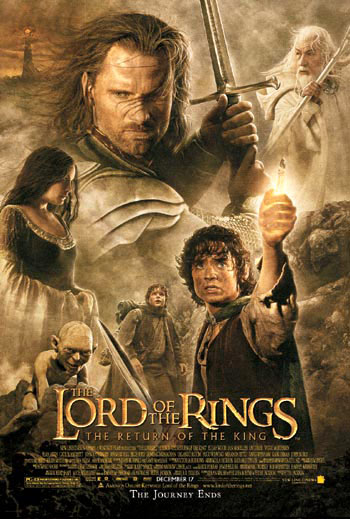
The Lord of the Rings: Journey to the Underworld

As I've mentioned before, katabasis, a journey down to the underworld (the land of the dead) was a popular theme in Greek mythology. Hercules went down there, Theseus popped down for a bit of attempted kidnapping and Orpheus' problems in this area are well known. Odysseus also stopped by near the entrance for a visit, and Aeneas got a guided tour. However, despite the frequent hero-traffic, the underworld was, essentially, a place the living could not access. It was situated underground, or at the edge of the world, or both and was the realm of Hades and his abducted bride Persephone. The spirits of the dead existed here, but it was often depicted as a grim place where the dead had no real energy, substance or intelligence (in the Odyssey, Odysseus has to feed the souls of the dead blood before they can recognise him or speak to him).

Elements of the underworld and of heroic katabasis crop up all over the place in fantasy literature. Sometimes, the underworld is literally the land of the dead, as in Greek myth (like that depicted in Maggie Furey's Artefacts of Power series, which I haven't read in years and must re-read...), sometimes it is just a similar sitation that is reminiscent of the ancient underworld (as in Harry Potter and the Half-Blood Prince).

The Lord of the Rings doesn't include a great deal of obviously classical mythology; Tolkien was more inspired by ancient Norse and Germanic myths, and he disapproved of mixing and matching mythologies in the way that C. S. Lewis did. However, the appearance of the Paths of the Dead in The Return of the King is pretty clearly influenced by ancient katabasis.

Strictly speaking, the journey to the Paths of the Dead is not a katabasis in the sense that it is not specifically a journey to the land of the dead. There are a couple of different afterlives in Tolkien's mythology, with one for men (and, presumably, hobbits, dwarves and so on) and a separate one for Elves (I'm not sure what happened to Orcs. I haven't read The Silmarillion or all of the Unfinished Tales, so maybe someone who has can enlighten me!). The Paths of the Dead don't go through any of them; rather, they go under a mountain where a group of oath-breaking military ghosts have been cursed to remain until they fulfil the oath they broke. Like the Harry Potter example, this is reminiscent of katabasis, as the characters have to go underground and walk through a place filled with dead people, rather than a literal katabasis. The dead are also somewhat more lively than the classical variety, though perhaps even more unpleasant.

I have to confess, although normally I'm a sucker for an underworld story and am particularly interested in epic descriptions of the underworld, the Paths of the Dead has always been one of my least favourite bits of The Lord of the Rings. In the book (which I first read aged about 10 or 11) I was never quite sure what was going on - Aragorn had joined up with his old buddies and wandered off somewhere, Gimli didn't like it, then we don't hear from them again for ages. By the time they finally turn up again I just want to get back to Frodo.

The film had the potential to do something pretty cool with this section, and I am generally in favour of having the dead show up at the Battle of the Pelannor Fields, since it makes it clear how useful they are, though I think perhaps they shouldn't have won quite so easily - maybe have a slightly smaller army of dead people so it takes longer. My biggest problem with them, though, is that they're green. Why are they green?! It's not an army of the dead, it's an army of Borg. Or maybe they're all related to Slimer from Ghostbusters. Anyway, they look weird.

Why, why are they green?!


I suppose part of the problem is that there's so much going on by this point, one thing is always going to seem less interesting than the others. I love the story between Merry and Theoden in the book, and Eowyn is my hero(ine) so I guess anything that takes me away from that story is bound to seem less interesting. I think I also prefer actual katabasis - that is, a journey to the place where we go when we die - to these similar journeys, which have some of the same elements, but don't offer that privileged glimpse into the next life that real katabasis does.

On the other hand, the disadvantage of a classical journey to the land of the dead is that most of them (with some exceptions) are utterly miserable. The dead are empty and shapeless. If they can talk, they say how much they envy the living, or they continue to mourn wrongs done to them while alive, or the cause of their death. The whole place is dark and shadowy, and although descriptions of Tartarus are sometimes included, we rarely see any sign of the Elysian Fields or the Isles of the Blest (though follow the link for a rare exception from a work of satire). Only in comedy is there any hope for a decent afterlife; all of which is rather depressing for all concerned. A scene like the Paths of the Dead allows the author to indulge in some properly gloomy, scary, spooky underworld imagery without suggesting that this is what all the characters have to look forward to when they eventually die, and this may be its greatest achievement.

Monday, August 3, 2009

Stardust (by Neil Gaiman, film dir. Matthew Vaughn 2007)

Stardust is a novel by Neil Gaiman (originally illustrated by Charles Vess, but I only have the text-only version) which was made into a film in 2007. Apparently it takes place within the same universe as American Gods, but since I'm partway through reading American Gods, I don't want to know any more! The story follows Tristran, a young man who promises to bring a girl he likes a fallen star from beyond a mysterious Wall, not realising that the star is actually a very annoyed young woman called Yvaine.

Most of the elements of Stardust's fantasy world of Stormhold come from various parts of British and Celtic folklore, like the lion and the unicorn (book only). However, there are a few Classical references scattered around the place. Most obviously, the King's seven sons are called Primus, Secundus, Tertius, Quartus, Quintus, Sextus and Septimus. As well as being Latinate versions of first, second, third etc, this actually reflects some old Roman naming practices, in which children were named for their number - Quintus for a boy, Quinta for a girl. Many children did not survive infancy, so a family might only have a Quintus and a Sextus reach maturity, and sometimes children were named directly for their parent - Octavian and Octavia were the children of Octavius, not the eighth son and daughter. The King's only daughter is called Una, one - obviously he knew he would have lots of sons but only one daughter.


This is a tapestry I got in France of a different story, involving a lot of knights (hence all the shields), which I can't remember right now, but it's a lion and a unicorn...

The witches also have some Classical roots. In the film, their leader is called Lamia. In Greek myth, Lamia was the beautiful queen of Libya, daughter of Belus and Libya, who had children by Zeus. Hera killed her children in a rage, so Lamia took to devouring other children. Over time, her face became ugly and bestial. The Oxford Classical Dictionary describes her a 'nursery bogey', and Diodorus Siculus describes her briefly in the same way (20.41).

The witches also use the ancient divinatory technique of extispicy; killing an animal and examining the entrails (and various other bits) in order to read omens from it (like reading tea leaves. But with more blood). The witches seem to forego the necessary ritual to accompany the sacrifice, but the technique is definitely the same one.

I love both the book and the movie, though I confess a very slight preference for the film. I'm not the biggest fan of bittersweet endings and the film is really beautifully made - an all-star cast of brilliant actors, gorgeous costumes and set design, fabulous music (by Ilan Eshkeri) and sweeping landscapes, mostly from Scotland and Wales (though I think the incredibly cold beach, which highlights the most amazing colour contrast between orange costume and blue sea, might have been Iceland). It's also very, very funny. (And yes, I like Robert de Niro in it. He makes me laugh. Michelle Pfeiffer admiring her own naked body in a mirror is another highlight). The film also gives the witch a stronger ending to her story. And I want Claire Danes' dress. The book is great as well though - somehow Gaiman makes the oldest cliché sound, if not fresh, at least plausible.

Castle Combe, Wiltshire, where the village of Wall was filmed for the movie

Friday, July 24, 2009

Narnia: Prince Caspian adaptations


Just a short one again, I'm afraid, as I am snowed under with work at the moment.

In my conference paper, I talked a fair bit about Prince Caspian, which features the most significant references to Greek myth in the Narnia series. I won't repeat that here, since I'm hoping to publish it at some point, but I was reminded of something that I've always wondered about in the BBC adaptation.

In the book, having been introduced to the Old Narnians, Caspian joins them for a party. The Old Narnians are all the magical and mythical creatures of Narnia - talking beasts, dwarfs, centaurs and so on. (The New Narnians are human Telmarines, many of whom do not believe in the existence of the Old Narnians).

The party consists of fauns, dryads, centaurs and talking animals, all dancing round a big bonfire on the Dancing Lawn. I had always imagined it to be a bit like the 'Pastoral Symphony' section of Disney's original Fantasia, all friendly fauns, Pan-pipes and greenery. In both the major adaptations of Prince Caspian, however, it looks quite different.


Ridiculously over-cute cherub - Cupid - things, from the Pastoral Symphony section of Fantasia. I'll do a post on that some day too.

Prince Caspian is probably the hardest of the Narnia Chronicles to adapt - or maybe second hardest, after The Last Battle. Both adaptations do reasonably well, and both have their flaws (yes, I do have opinions on what these are, no, I don't have time to describe them all now!).

The BBC adaptation of the Dancing Lawn scene has a very different feel to it from what I (at 6 years old!) had expected from the book. Most prominent among the attendees, other than talking animals, are human-looking characters wearing grass skirts. I assume these are supposed to be related to dryads in some way - though dryads are female and these are male. Their dark hair and grass skirts look very different to the usual pseudo-medieval European Narnian costuming, and, rather than Pan-pipes, they play a pounding, rhythmic drum beat.

The recent film adaptation (dir. Andrew Adamson, 2008) goes a different route again. Here, we have gone back to a Greek theme, but with a different feel. There isn't a party at the Dancing Lawn, but a meeting, and, in addition to the usual suspects, the attendees include minotaurs (which exist in the plural in Narnia), who were previously among the bad guys in The Lion, the Witch and the Wardrobe. The whole thing is made to feel much darker, as is the movie as a whole.

A minotaur fights with the good guys in the recent film adaptation


There are advantages to both approaches. The BBC version emphasises the wildness of the Narnians against the medieval Telmarines and, depending on taste, the party maybe feels a little more exciting with that drum beat. The film version, on the other hand, keeps the essentially Greek feel of the original, but loses all sense of joy or exhileration, in favour of concentrating more fully on military matters. I can't quite decide which I prefer - thoughts, anyone?


By the way, the image at the top of the page is the front cover of the edition of Prince Caspian I had as a child, which is still around, falling to pieces in a box somewhere under my bed in my parents' house.

Saturday, July 18, 2009

Discworld: Pyramids

Pyramids is one of my favourite Discworld novels. It's quite an early one - the seventh - and it's a standalone novel, featuring none of the regular major characters. I would really love to see it made into a movie - it's a perfect choice, as it requires no prior knowledge of the Discworld and plays on well known images and themes relating to ancient Egypt and Greece.* Also, in my head, Chidder is very sexy.

(*Not like the current Sky adaptations though - a proper movie, maybe directed by Joss Whedon, Mike Newell or Alfonso Cuaron. The Sky adaptations are all right, but they seem to be so busy messing around with sets and costumes, they're not funny).

The hero of Pyramids is Teppic (King Teppicymon XXVIII), who becomes King of the ancient land of Djelibeybi when his father dies in an unfortunate accidental suicide (overcome with the pressure of having to make the sun come up, he thought for a moment that he was a seagull, and tried to fly). Teppic has been sent away to Ankh-Morpork to be educated (the opening sequence, as he takes his final exam at the School of Assassins, is a brilliant pastiche of the British driving test) and he returns to the Old Kingdom with a lot of new-fangled ideas, mostly involving plumbing...

Mostly, Pratchett plays with the mental images everyone already has of Egypt - pyramids, camels, cats, crocodiles. The well-known notion that pyramids preserve cheese is tweaked for the Discworld so that the pyramids actually store time, becoming the basis of the plot. Egypt is not my area of expertise, but to the best of my knowledge, Pratchett's representation of Egyptian religion is actually not that far out - according to Jan Assmann, whereas Mesopotamian and Greek observations of natural phenomena were focussed on foretelling the future, Egyptian observations of the same things focussed on maintaining order in the present and ensuring that things contined as they had before. (This is probably the result of the vital importance of the regular, annual flooding of the Nile to Egyptian farming).

Teppic orders the biggest pyramid ever to be built for his father (who wanted to be buried at sea) and is then forced to flee the country saving Ptraci, his father's favourite handmaiden, from being fed to the crocodiles. (I first read this book when I was about 14 and it was years before I worked out how to pronounce the names to get the joke - I had been pronouncing them 'Puh-trah-ki and Duh-jeli-baye-bi, when of course, it should be Tracy and Jellybaby). Just as they cross the border, the pyramid's stored time cause a rupture in reality and the whole country disappears, trapping Teppic and Ptraci in neighbouring Ephebe.

Ephebe is the Discworld's version of ancient Greece. It is ruled by a Tyrant, using a strange new political system that Teppic thinks is called 'mocracy'. A little way from the border, Teppic and Ptaci discover the philosophers Xeno and Ibid, shooting at tortoises, because Xeno insists that it should be locially impossible to shoot a moving tortoise. Teppic is then invited to a symposium (which is almost exactly like an ancient Greek symposium, except for the plate-smashing at the end - a bit of moder Greece seems to have crept in there) where he meets a few more philosophers and other assorted ancient Greek types, all in uniform of white sheet and grey beard.

Xeno is the Discworld counterpart of Zeno of Elea, whose Achilles paradox argued that Achilles could not catch a moving tortoise. Copolymer, 'the greatest storyteller in the world', who tells Teppic the story of the Tsortean War ('Wossname's armour shone like shining armour. Fight and a half, that fight. Between thingy, not the one with the limp, the one with red hair...') is presumably Homer. Iesope is Aesop, obviously, and Antiphon is Aristophanes. I can't think of anyone in particular analogous to the Discworld's Ibid; the name reflects tha Latin abbreviation, often used in older scholarly works, meaning 'in the same place'.

Copolymer's full version of the story of the Tsortean war, by the way, is brilliant - a perfect combination of epic epithets, like 'red hair' and so on, with the sort of oral storytelling that more often happens among drunk friends in a modern context. It also includes all sorts of little details from the real Trojan cycle, thrown in with everything else, like Copolymer's reference to 'the one with the limp' (which might be Philoctetes; 'Oedipus' also means lame, but he isn't part of the Trojan War cycle) who 'didn't want to go, said he was mad' (that was Odysseus).

Teppic is actually looking for Pthagonal (Pythagoras), who is glumly complaining that the diameter of his pie should divide into the circumference three times, not 3.14....... etc. This is the most significant use of classical philosophy in Pyramids, for the novel is based on the idea that the world really is, as Pythagoras said, all based on mathematics. This, coupled with the added notion that camels are the greatest mathematicians in the world (because they have so much time to think out in the desert, and they have to do quite complicated sums to get their legs to move properly) is what leads to all sorts of hi-jinks involving disappearing countries and exploding pyramids.

Teppic gets his camel, You Bastard, to take him back to Djelibeybi; meanwhile, the absence of the kingdom in between them has led Tsort and Ephebe to re-start the Tsortean war. Except, this time, both sides have built battalions of wooden horses and are sitting, waiting for the other side to come and take them in. Ephebe, which up to this point has chiefly represented classical Athens, now becomes a combination of ancient Mycenae (Agamemnon's kingdom) and classical Sparta - one young soldier has been told to come back with his shield or on it (Plutarch, Moralia, 240 anon16), and while briefly facing certain death, the captain gets as far as 'Go, tell the Ephebians - ' before giving up as the army arrives (Herodotus, 7.228).

Once everything has been sorted out and the country restored, Teppic leaves and Ptraci becomes Queen - at which point she turns into Cleo from Carry On Cleo, calmly seeing visitors in her asses' milk bath (for which she plans to install plumbing). She was halfway there already anyway - the handmaidens in Pyramids are just like Carry On hareem girls. The ending of the book is wonderful and takes tying things up neatly to a new level - it involves use the ouroboros, the symbol of the snake eating its own tail.

There's probably lots more I could say about Pyramids, but I really have to go work on my thesis now, so I'll leave it there. One final note: there's a review of a film I hadn't heard over at The Life of Antoninus Pius, but which sounds like it might be very entertaining...

Me, on possibly the greatest mathematician in the world, in Tunisia. I named him You Bastard - in an affectionate way - because he kept trying to throw me off in revenge for me having sat on him wrong. We made peace during a break in the ride and hewas much nicer on the way back!

Edited to add: I forgot to mention the Sphinx! Teppic gets the traditional Greek riddle but has a fabulous, unique solution - having failed to get the answer, he insists that the question is unfair and it should be amended to 'What, metaphorically speaking, walks on four legs just after midnight, on two legs for most of the day (barring accidents), until at least supper time, when it continues to walk on two legs or with any prosthetic aids of its choice?' The Sphinx gets so confused, he is able to slip past it.

I also forgot to mention the dreams, a subject currently close to my heart. The dream about the seven fat cows and seven thin cows is an ancestral dream of the royal family here, with one cow riding a bicycle or playing an amusing instrument.

I love these references - I love the way they gently poke holes in the mythology, whether its the obscurity of a riddle or a dream report that lacks dream-like qualities. Plus, its just really funny.

(And I'll say no more on the religious issues; in the Great Religious War of Fantasy Authors, I'm on the side of J. R. R. Tolkien, C. S. Lewis and J. K. Rowling, rather than that of Philip Pullman, Terry Pratchett and Douglas Adams - whose sci-fi is so crazy it's practically fantasy).


Me and Y. B. again, making peace. I'm a bit fond of these pictures!

Thursday, July 16, 2009

Harry Potter and the Half-Blood Prince (dir. David Yates 2009)


A few random thoughts on the new Harry Potter movie...


Warning: SPOILERS contained within. Only read this if you've already seen the movie, or don't care!


Went to see the new film last night and I loved it, though I did feel a bit like there were two scenes missing at the end (the fight between the Death Eaters and the kids/Aurors, and Dumbledore's funeral). I liked the extra bit at the Weasleys' house, but I was expecting Lupin to go all werewolf on the Death Eaters' collective asses, and was kinda disappointed when he didn't (because of Tonks' random reference to the first night of the cycle). That would've been cool. I loved how funny it was though - I was dreading all the teen romance, but it was done really well and it was hilarious. The felix felicis potion was also done really well - I think 'pincers' may be my favourite line in the film. ('Felix' means lucky, and 'felicis' is the genitive of 'felix', so I guess this means 'Lucky thing of lucky things'...) Also we finally got to see more of Snape and Draco, yay! (Mmmm, Alan Rickman).

There isn't as much Classics-y stuff in the last two books as in the earlier ones - something I'll talk about more when I do Book 7, which largely (though not entirely) substitutes it's own invented 'fairy tales' for actual myth or folklore. The main threat in Half-Blood Prince is more human than magic, though the wizards use magic instead of guns. The scene in the cave is reminiscent of a katabasis, that is, a part of the story where the hero goes down to the underworld, the land of the dead. The Greek underworld appears to welcome these visitors on a regular basis - Hercules, Theseus, Orpheus and Odysseus all pop down for a visit - and the scene showing all the Inferi (Potterverse zombies) surrounding Harry and Dumbledore and their tiny boat is definitely underworldy. (I want to do some more posts on pop culture examples of katabasis, so I won't say too much on that now!). A couple of my friends described the Inferi as 'all the Gollums' which I guess is a good point, though they looked somehow even grosser than Gollum to me. I did think that the Pensieve is looking more and more like Galadriel's mirror with each passing movie though.

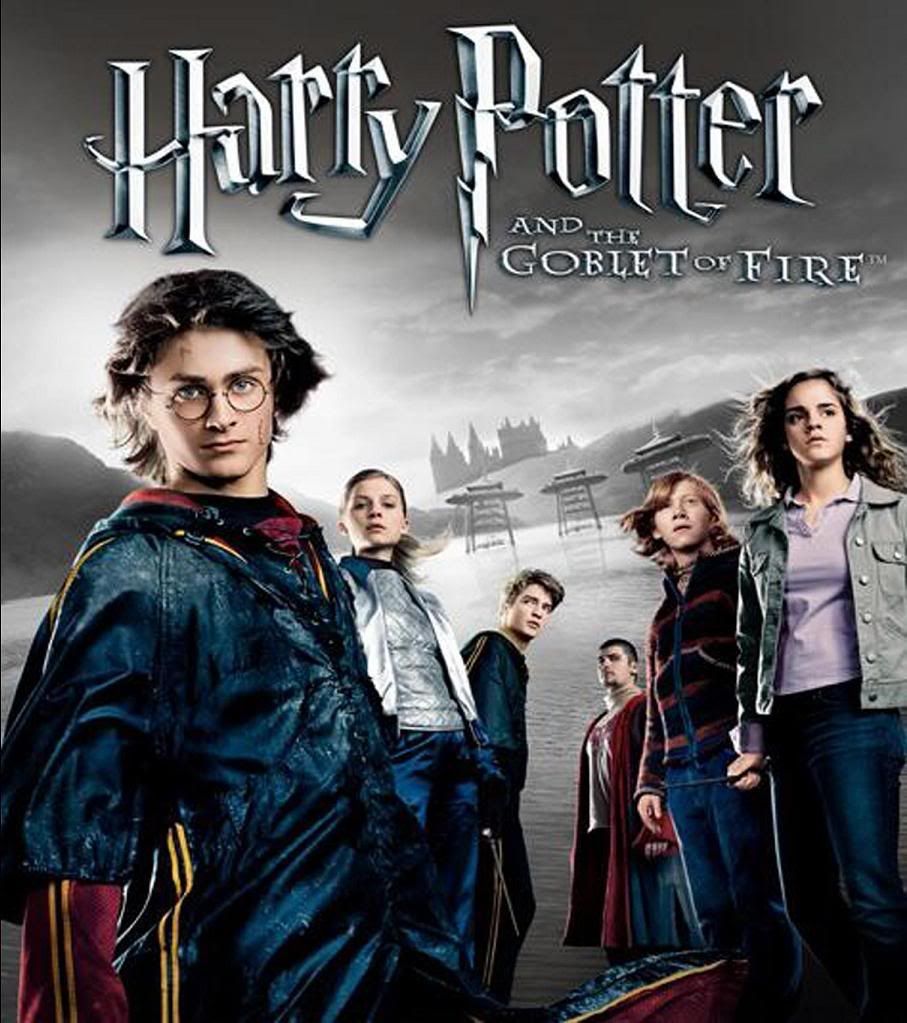
I think Goblet of Fire is still my favourite of the films, and, unless the filmmakers do something amazing with the two parts of Deathly Hallows, I think it will stay that way. I really liked this one though, and I think it needs a second viewing to really enjoy it - on the second viewing, it's so much easier to just enjoy the film without constantly thinking about all the stuff that got moved around or taken out (and without the idiots who were sitting behind me and talked loudly all the way through the film). Oh, and I have to confess, I did cry a little bit - I was doing fine until everyone put their wands in the air to remove the Dark Mark with candle-like wandlight, at which point the tears started rolling!
Mmmm.

Sunday, June 28, 2009

Ancient ruins in pop culture

I was at Stonehenge this morning and discovered that there are big plans afoot to move all the roads that run near it so that it can be surrounded by green fields. I must admit, I’m not wild about this idea – I actually like seeing the modern and the ancient next to each other, and we can’t recreate the monument’s original setting, as it would have been surrounded by trees.

Anyway, this is what made me think about the use of ancient architecture to tell later-set stories. Ancient monuments can provide wonderful dramatic settings – in the 1978 film adaptation of Agatha Christie’s Death on the Nile, the apparently deranged Jackie stalks her former friend Linnet and former fiancée Simon on top of one of the pyramids at Giza and, complete with monstrous echo, at Abu Simbel. The ancient setting, and Jackie’s reciting of tourist information at her shocked friends, adds a sinister air to the whole thing, especially when Linnet and Simon stand, dwarfed by the enormous statues at Abu Simbel, with Jackie above them, looking down in satisfaction as they cower before her (see the video here).

Ancient ruins can also be sad and melancholy. In The Lord of the Rings, there are no real ancient ruins, but the story is full of relics of bygone eras from Tolkien’s mythology, such as this passage from The Two Towers.

‘The brief glow fell upon a huge sitting figure... The years had gnawed it and violent hands had maimed it. Its head was gone...
Suddenly, caught by the level beams, Frodo saw the old king’s head: it was lying rolled away by the roadside. ‘Look, Sam!’ he cried, startled into speech. ‘Look! The king has got a crown again!’
The eyes were hollow and the carven beard was broken, but about the high stern forehead there was a coronal of silver and gold. A trailing plant with flowers like small white stars had bound itself across the brows as if in reverence for the fallen king, and in the crevices of his stony hair yellow stonecrop gleamed.
‘They cannot conquer for ever!’ said Frodo. And then suddenly the brief glimpse was gone. The Sun dipped and vanished, and as if at the shuttering of a lamp, black night fell.’
The Two Towers, ‘Journey to the Crossroads’.
From the film of The Return of the King, moved from its place in the book. I think there is an Alan Lee illustration of this scene, but can't find it at the moment.

Tolkien’s imagined ruins add both melancholy and hope to the scene, and his characters find meaning for themselves in seeing the ancient remains. The 2001-2004 movie adaptations use similar imagery, setting Frodo and Boromir’s confrontation in The Fellowship of the Ring next to a giant fallen head of a statue and making much of the Company’s first sight of the Argonath, which also formed a big part of the advertising campaign for the first film.

The 2006 film version of Tristan and Isolde has the lovers meet in the ruins of a Roman villa. The ruined house increases the romantic atmosphere, because there is something inherently romantic about ruins. Maybe this idea is a relic of Victorian and Edwardian photographers who liked to set up photographs of their subjects lounging about ancient ruins, or maybe its all Byron’s fault. It’s hard to say. But there is something about a ruin that seems to scream ‘romance!’ across our collective consciousness. In this case, the romance is heightened by the idea that the villa belongs to a more ‘civilised’ era, and may have been a happy family home, in contrast to the dark, medieval misery Tristan and Isolde are living in. (Of course, the family who lived in the villa might have been utterly miserable and hated each other, but this is not the first thought that comes to mind).

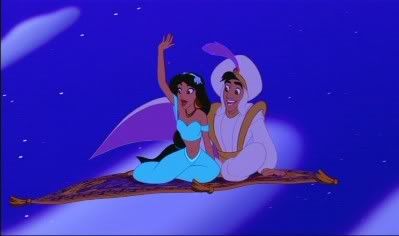
Disney’s 1992 Aladdin also uses ancient ruins to romantic effect, in this case the Parthenon, which Aladdin and Jasmine fly around on the magic carpet. They also pass by the Sphinx at Giza, where an Egyptian workman is just finishing off the nose – and is so surprised to see two people fly past on a magic carpet that his hand slips and the tip of the nose falls off. In jokes like this are the most fun part of using ancient ruins, and of allowing outside characters to interact with the architecture we already know.

Jasmine helpfully waves at the unfortunate Sphinx artist

(Aladdin and Jasmine, by the way, get all the way to China from the Middle East in an evening – I hope they have some kind of windshield for that carpet).
Many of these uses would not be possible in a modern-set story, depending on how much access one can get to ancient ruins. Obviously, I am in favour of preserving ancient ruins as much as possible, but I think it's a shame if this is done at the expense of allowing people to enjoy them, and allowing new stories to take place among the ruins of the old.

Friday, June 19, 2009

Discworld: General Tacticus

He was trying to find some help in the ancient military journals of General Tacticus, whose intelligent campaigning had been so successful that he'd lent his very name to the detailed prosecution of martial endeavour, and had actually found a section headed What to Do If One Army Occupies a Well-fortified and Superior Ground and the Other Does Not, but since the first sentence read "Endeavour to be the one inside" he'd rather lost heart.
-- (Terry Pratchett, Carpe Jugulum)


I went to see a production of Terry Pratchett's Monstrous Regiment, starring my ex-housemate, in London yesterday, which I really enjoyed - I'd never seen a Discworld stage play before and it was really funny, a really good evening out.

Promotional material from the production

Since the play was about the army, I was reminded of this elusive character, who is mentioned in a number of Discworld novels (I don't know how many, but I'm sure there's a website somewhere that does!). When I was a first year undergraduate studying ancient history, I was briefly very confused because, thanks to the Discworld, I thought that Tacticus was named after Tacitus, and that Tacitus was, therefore, a famous military commander and military historian (which isn't a million miles from the truth but isn't quite right, at least not in the way that I was imagining). Of course, I also thought that Spartacus was called 'Sparatacus', because that's what Cher calls him in Clueless. How I eventually got to PhD level is mystery.

The possible Classical and other antecendants of General Tacticus are listed at the Discworld wiki here, which appears to be reasonably accurate (I checked it against the Oxford Classical Dictionary!). On the etymology of 'tactics', see the Online Etymology dictionary here; although they don't mention Aeneas Tacticus, it wouldn't surprise me if the word came in to popular usage partly because of his name.

However, until today, I'd never heard of these people (I had a vague notion there was an ancient Chinese book on the Art of War, but that's about it). I had, however, heard of Tacitus, who did write some military history, though his work is more a record of past military maneouvers than a guide to future military endeavours. Tacitus' chief surviving works are the Histories, the Annals, Agricola and Germania, and he is an important written source for Roman Britain. He did serve in the army, but is not known for his military achievements.

Most people reading Discworld novels, like me, won't have heard of Aeneas Tacticus. They might have heard of Tacitus, but the historical characters Pratchett evokes when he writes this character are different - in addition to Sun Tzu, the author of the Art of War, most people will think of Julius Caesar.

General Tacticus' habit of conquering everything in sight certainly owes more to these two than to obscure Greek military historians and Pratchett deliberately recalls Caesar with the title of Tacticus' journal Veni Vidi Vici: A Soldier's Life. Pratchett might reasonably assume that the majority of his readers will have heard of Caesar, so it is Caesar who is actually Tacticus' real-world counterpart, though their stories end rather differently. Caesar declared war on his own city-state, Rome, in an act of civil war, conquered it and, by adopting Octavian (Augustus) as his successor, caused the end of the Republic and beginning of the Empire. Tacticus, however, declared war on Ankh-Morpork from a leadership position in another city and destroyed its Empire. Perhaps this change is the result of Discworld's position at the far cynical end of the Sliding Scale of Idealism vs Cynicism.

Caesar. Just look at that expression. You do not want to mess with this guy.

Thinking of great conquerers of Antiquity might lead some to think of Alexander the Great, but, great military leader though he was, Alexander was also an alcoholic with a quick temper who enjoyed the luxurious benefits of being ultimate ruler rather too much, and Tacticus feels more like a Caesar than an Alexander to me. Additionally, Discworld's 'old' language Latatian is clearly Latin, while Greece is more usually represented by Ephebe, which doesn't seem to have its own language, or if it does, it isn't discussed.

I like General Tacticus and his practical but not always helpful advice. He reminds me very much of this helpful section from The Hitchhiker's Guide to the Galaxy:

BOOK: What to do if you find yourself stuck in a crack in the ground underneath a giant boulder you can't move, with no hope of rescue. Consider how lucky you are that life has been good to you so far. Alternatively, if life hasn't been good to you so far, which given your current circumstances seems more likely, consider how lucky you are that it won't be troubling you much longer. (Douglas Adams, Fit the Eighth)

General Tacticus' advice is generally as helpful as this to our heroes when in a sticky spot, but Vimes seems to find him useful in Jingo anyway. In the end, though, Tacticus may only be the second greatest military thinker in the history of the Disc. The greatest is probably the man who has, as per Tacticus' advice, carefully avoided getting into a war in the first place, while ruling the world through commerce instead.


Veni, Vidi... Vetinari.


(The artwork is not mine: The top illustration is by the late Josh Kirby, and this one is by Tealin - visit the website here for this and many more Discworld images)

Thursday, June 4, 2009

Harry Potter: Books 4-5 - Centaurs and Sphinxes


Harry Potter and the Goblet of Fire is an odd one for me - the book is my least favourite of the series, but the film is my favourite of the films so far.

Being annoyingly serious for a moment, I can't stand the house elves sub-plot in the book, because I don't think slavery is a suitable subject to play for laughs. All of Ron's justifications for enslaving the house elves - that they like it, that they were born to serve etc - have been used of real slaves by real slave owners, and the way Hermione is treated by both the other characters and the narrator for trying to win rights for the house elves - laughed at and ignored - seems totally inappropriate to me, especially in a book aimed at a young audience.

I don't get the main plot of Goblet of Fire either - why on earth would Voldemort hatch such an incredibly complicated plan to get his hands on Harry, when surely Wormtail could just kidnap him in Hogsmeade? Why would the Triwizard Tournament have such ridiculously unbendable rules in the first place, how could Harry be magically bound by a contract he didn't sign and why didn't the Ministry cancel the tournament when it became obvious that something very dodgy was going on? For me, all of these are worse problems than the question of why Gandalf didn't just fly to Mordor on an eagle in The Lord of the Rings.

But, for some reason, in the film, none of this bothers me! I get swept up in the story and stop worrying about all these things and, best of all, the house elves sub-plot is gone! Patrick Doyle's music is sublime and the film has some really powerful sequences - Harry and Cedric racing each
other to get to the Goblet, Harry nearly becoming overcome with competitive ambition and abandoning Cedric, the entire scene in the graveyard, especially Ralph Fiennes who is amazingly good at playing pure evil (is there anything more chilling than his cry 'I want to see the light leave your eyes!') and, most brilliantly horrible of all, Harry appearing, clutching Cedric's body and weeping, among a crowd of cheering schoolchildren, parents and a brass band playing eerily cheerful music.

Goblet of Fire has the usual mix of Classical, Norse, Celtic and other mythologies, but the bit I'm picking up on today, ironically, isn't in the film. I also have to confess that I haven't read the book in a while and don't have it in front of me - I have several copies of Philosopher's Stone in several languages (including Latin and Ancient Greek) but Goblet of Fire is at my parents' house, so I'm relying on the internet to refresh my memory.

During the third task, in the maze, Harry encounters a Sphinx who asks him a riddle. Sphinxes (body of an animal, usually a lion, head of either a man or a woman) are known from art all over the ancient Mediterranean, including from Egypt, Mesopotamia, Minoan and Mycenean art on Crete and mainland Greece, and later Classical Greek art. In literature, the best known sphinx is the one that harrassed Thebes until she met Oedipus. Oedipus himself is much better known for the later parts of his story, but it is his defeat of the sphinx that gets him married to his mother in the first place (see the pretty decent Wikipedia article here).

The Greek sphinx's riddle is a simple and traditional riddle, in which the words of the riddle need to be understood symbolically in order to produce the answer. The riddle Harry's sphinx asks is a bit different:

"First think of the person who lives in disguise,
Who deals in secrets and tells naught but lies,
Next tell me what's always the last thing to mend,
The middle of middle and end of the end?

And finally give me the sound often heard,
During the search for a hard-to-find word.
Now string them together, and answer me this,
Which creature would you be unwilling to kiss?"
(Thanks to Mugglenet - the editorial here is somewhat out of date, but makes interesting reading.)

The answer Harry gives, correctly, is 'spider'. This is more like a series of crossword clues than a riddle, relying on word play. If this riddle had appeared in an ancient Greek text, it would make no sense at all as soon as it was translated into another language. The last bit is especially odd, as the one creature in all the Harry-Potter-verse that one would least want to kiss is obviously a Dementor. Sure, kissing a spider would be pretty unpleasant and certainly gives me nightmares, but its not a particuarly clever observation.

Its a nice idea to use a sphinx - a suitably scary-looking creature - and a riddle in the maze, playing on not only Greek mythology, but also echoing JRR Tolkien's The Hobbit, which features riddles heavily in what would turn out to be its most important chapter. I find the riddle itself somewhat disappointing though - for several rather better designed riddles, see the aforementioned Hobbit, 'Riddles in the Dark'.


Two enormous sphinxes guard the entrance to some of the Near Eastern galleries at the British Museum. The picture on the left, which unfortunately came out a bit dark, gives some sense of the scale of these - compare the size of the person with the statue.


Harry Potter and the Order of the Phoenix is actually one of my favourites of the books, while the film is not my least favourite, but definitely comes behind 3 and 4. The first time I read Order of the Phoenix I didn't like it - because it was too well written. JKR really excels at describing teenage-dom in all its glory and misery, and just as the Yule Ball (both film and book versions) reminds me of every teenage dance that left half the attendants in tears or sulks, the OWLs in Book 5 are just too well-described.

Explanation for non-Brits: OWLs are the wizardly version of British GCSEs, playing on the old exams taken by my parents that GCSEs replaced - O-Levels, standing for Ordinary Level (hence Ordinary Wizarding Level). Whereas most other sensible countries have 1 set of school-leaving exams, when I was at school we had 2, and now we actually have 3 (I was the in last year group to take old A-Levels, thank goodness). Students can leave school at 16, after taking GCSEs, or can choose to stay and take AS-Levels and A-Levels, and university requires A-Levels or equivalent.

Although I have done many, many exams since and have two degrees with a third hopefully coming up soon, I remember Year 11, GCSE year, as the most horrifically stressful of the lot (closely followed by MA year, FYI). I only took 3 A-Levels, but 9 and a half GCSEs, which is still less than many others do. The worst part was the pressure put on us by the teachers - 'this is the most important year of your life, how you do in these exams will affect your future career, you must study, you must work', etc etc etc. All of that comes across so clearly in Book 5 that I was taken right back to the age of 16 and I hated it. Later, I read it again, put a bit more distance between it and me, and loved it. I do have a bit of a fondness for ridiculously long fantasy books.

The most intriguing use of Greek mythology to me in Order of the Phoenix is the depiction of the centaurs. I grew up with a Narnian view of centaurs - wise, noble, vicious and brave in battle it's true, but absolutely peaceful unless forced to fight. Harry Potter's centaurs are actually closer to the Greek version. Greek centaurs were imagined as, for the most part, a gang of wild, drunken, violent rapists, presented as the opposite of human civilization. There were occasional exceptions, and both Narnian and Potterian centaurs get their astrological skill from Chiron, who seems to have tutored half the heroes of Greek mythology (see Wikipedia again). However, star-gazing aside and leaving out the rape and alcohol parts, Potter's centaurs are much closer to Greek centaurs than Lewis' noble heroes. Like Greek centaurs, they live in the wild forest, in opposition to human civilization (represented by Hogwarts) and whatever it is that they do to Umbridge is, thankfully, left undescribed.

I like the Classical rendering of the centaurs, and I like that they are so different to Narnian centaurs (while retaining the useful divinatory astrological knowledge) but I must admit, I'm always a little disturbed at the way Hermione deliberately leaves Umbridge to their mercy, and that they would have killed Hermione and Harry without Grawp (my least favourite character of all, by the way). But then, Umbridge was pretty nasty, and its a very effective scary set piece.


A Roman mosaic showing a very unusual image - a female centaur. Unfortunately I didn't write down the exact date of this piece. The mosaic is in the museum at Tunis and is therefore probably Imperial or Late, since Carthage was repopulated under Augustus.

Hmm, between anti-slavery campaigns and the woes of the British educational system, that ended up being a rather more earnest blog than I had anticipated! I'll have to find something more light-hearted to look at before tackling Jesus Christ Superstar...

Thursday, May 21, 2009

Harry Potter: Books 1-3


I am going to break Harry Potter into manageable chunks, and cover books and films together unless there's a major difference between the two. So here are some thoughts on Harry Potter and the Philosopher's Stone, Harry Potter and the Chamber of Secrets and Harry Potter and the Prisoner of Azkaban.

The US title for the first book drives me crazy. The Philosopher's Stone was something people actually believed might exist in the late medieval and early modern period - a stone that would turn lead to gold and produce the elixir of life.

Let's get some of the major Latin references out of the way first:

Albus = Latin for 'white'
Remus = one of the two brothers who founded Rome, who were suckled by a wolf
Lupus = Latin for 'wolf'
Vol-de-mort = French for 'Flight of death' (not Classical, but worth mentioning!)
Expecto patronum = Latin for 'I am expecting a guardian'
Oculus reparo = Latin for 'I repair the eye'

All the spells are Latin except for 'Avada Kedavra' (which is from the same root as Abracadabra). I won't list them all here, but if anyone is curious about a particular spell, ask me about it in the comments.

I love Harry Potter. Its not great literature - Rowling's writing is somewhat basic (count the number of times she has to say 'he, Harry' because she hasn't made the subject of her sentence sufficiently clear) and there isn't a single original idea in all seven books, but they're great, fun reads. As I spend all day reading thick and often impenetrable books for work, sometimes in different languages, I find it increasingly difficult to get into fiction books in the evening - it's so much easier to just put in a DVD. But there are no problems there with Harry Potter, the stories are exciting and fast-paced and time spent reading it just flies by.

Contrary to popular opinion, my favourite of the films is number four, The Goblet of Fire, but out of the first three I like Prisoner of Azkaban very much. The other two are fine, the first sets up the world of Harry Potter nicely, but they're a bit... bland.

Book One's Fluffy is presumably inspired by Cerberus, the dog that guarded the entrance to Hades, the Greek underworld (see description here). The name 'Fluffy' is great, but unfortunately what he's guarding isn't anywhere near as exciting as the underworld; just a bunch of supposedly protective charms and spells that three 11-year-olds can get through.

Book Two's basilisk is also Classically named - see Pliny the Elder's description here. The Wikipedia article is also good. The basilisk is pretty cool and pretty scary, though I always think it's cheating to have Fawkes destroy its sight. Still, it's a good scene, and I think Dan Radcliffe first showed some real acting skill in that movie, when he thinks he's dying and tries to persuade Ginny to leave without him - I feel really sorry for poor little Harry at that point!

Professor Snape, in the third film, is absolutely right about the origin of the word 'werewolf' (from the Anglo-Saxon wer, man), though werewolf stories were known in Greece and Rome too (see here and here, at LXI and LXII). The first time I read Book Three, before I started to study Ancient History and before I had done much Latin, I didn't realise Lupin was a werewolf - something I have since become somewhat embarassed about (see above)! I like Prisoner of Azkaban a lot - as a book, its one of my favourites. I was genuinely surprised by some of the plot twists and Rowling's treatment of lycanthropy ('werwolfism', from the Greek) as an illness puts an interesting twist on an old tale.

The use of Latin for the magic spells in Harry Potter is similar to its use for the same purpose in Buffy the Vampire Slayer. Latin is old, and therefore mysterious. Its also a language that relatively few people can really read, but that a lot of people know little bits of. A lot of us, for example, known the meaning of a motto that we've come across in Latin (like that of the RAF, Per Ardua Ad Astra - Through hard work to the stars). Anyone who's Catholic or who has enjoyed classical Catholic music, like a Requiem Mass, will have heard some Latin. So its an old mysterious language, but one that, at the same time, sounds familiar and which has some words that are almost recognisible - like 'oculus', eye, in 'oculus reparo', the spell to repair spectacles. This makes it especially effective as a magical language. The fun thing for me is translating the Latin spells back into English!


Me at my MA graduation, wearing the Gryffindor House scarf I knit myself and looking very Hogwarts, I think!

Next up: Monty Python's Life of Brian. More Harry Potter to follow at a later date!