Showing posts with label Gladiators and arenas. Show all posts

Sunday, July 3, 2011

Top Five Gladiatorial Combats


I'm once again buried under an enormous pile of exam marking, so forgive me if things are a little quiet around here this week! Once I emerge, I can promise posts on Priam playing Augustus, some more Classical Places, more maenads and vampires, more Rome and more Xena.

In the meantime, I've been giving serious consideration to the Top Five Roman-style Gladiatorial combats in popular culture (that I've seen). Spoilers follow.


5. Spock and McCoy vs Flavius and Achilles in Star Trek, 'Bread and Circuses'
Why? Becuase any gladiatoral combat that ends in a double Vulcan Nerve Grip is a great gladiatorial combat.
How Roman is it? I'm not aware that the Vulcan Nerve Grip was known in ancient Rome. The replacement of the audience in the arena with a television audience works brilliantly, and the network's need to provide an entertaining combat is surely representative of something that must have been an issue for Roman lanistas.

4. The Face-Dude vs Spartacus in Spartacus: Blood and Sand, 'The Thing in the Pit'
Why? Of all the many, many fights we've seen on Spartacus: Blood and Sand and the prequel series Spartacus: Gods of the Arena, this is by far the most memorable. It's a face! It's a face!
How Roman is it? There's no evidence of a Fight Club-style set-up like this in ancient Rome and with gladiatorial combats available regularly, why would you need one? It gives the show a nice change of pace for an episode though.

3. Spartacus vs Draba in Spartacus (1960)
Why? It's a tense scene, a pretty decent fight - but it's the expression on the face of Woody Strode, as Draba, as he throws his trident at Batiatus and Crassus and then launches himself at them, that makes this a memorble and chilling fight and a great end to an intriguing character. Plus, of course, it's a turning point for Spartacus himself.
How Roman is it? I can't see why Crassus would randomly demand to see two gladiators killed purely for the amusement of himself and two friends, when they could be killed for the amusement of hundreds. On the other hand, there's be nothing to stop him and he wasn't exactly the tender type.

2. Katniss and Peeta vs Cato and the muttations/ Katniss vs Peeta in The Hunger Games
Why? Just when you think The Hunger Games can't get worse or more horrible... it gets worse and more horrible. Cato meets such a nasty end you actually feel sorry for him, and then we finally get to the resolution we all knew was coming since about page 15. And very satisfying it is too.
How Roman is it? Like Star Trek, these gladiatorial games have replaced live audiences with television, which I suspect is what would have happened if the Romans had invented television. With much more space to explore the concept, Collins really gets into how that removal of the audience from the horror of what's happening might affect such a series of games, which is really interesting. Beyond that, well, there's a character called Cato. That's about it. Again, if the Romans had known how to genetically mutate animals, they probably would have done so - but they didn't.

1. Maximus and his men vs 'Scipio Africanus' (actually several female gladiators) in Gladiator
Why? Undoubtedly the highlight of a great film, this fight is the lead-in to the famous 'My name is Maximus Decimus Meridus...' scene, and it does a fantastic job of showering Maximus in glory right before his big moment. The way he uses his military training to beat the odds, the re-writing of the history of the Battle of Carthage (much to the announcer's embarrassment), the excitement of the fight itself and the way the gladiators band together to face the emperor when it's over, all go together to make the best scene of gladiatorial combat in the movies, topped off with Hans Zimmer's majestic score.
How Roman is it? I'm not sure the Romans would have chosen a bunch of women to represent Scipio Africanus, but otherwise this all looks pretty good to me. Perhaps the number of old soldiers in Maximus' group of fellow gladiators is a bit on the implausible side.

Honorable mention goes to the lovely little British arena in The Eagle, and the beginning of a beautiful friendship. There aren't many gladiatorial combats that can claim that!

Thursday, April 7, 2011

The Hunger Games Trilogy (by Suzanne Collins)


I have a new article up at Sound on Sight, on Actor Allusions in films (casting gags, mainly). And now, on to The Hunger Games...

I was loaned these books by Old Housemate(theRomeone) who is forever trying to get me to read really good books and I am always resisting, as I often find it hard to find the time to read fiction. She has excellent taste, though, so I persisted with these even though I was unimpressed by the first few pages – thrown into a really depressing fantasy (actually it’s science fiction, but it often feels like fantasy) universe where the narrator seemed to be telling me stuff rather than showing me, in the often-pretentious present tense (more on that below) and which sorely needed to find the funny. The books never did quite find the funny, though a few attempts were made later on, but as soon as the main plot kicked in somewhere within the first fifty or so pages, I was hooked. (Cleolinda found some vaguely funny bits, and if you need a reminder of the plot, Mark Reads… can lighten up some of the grimness as well as providing a handy summary). If you enjoy SFF books at all, go away immediately and read all three books, because they are very, very good and seriously compulsive (I have not been this obsessed with staying up late to read a book in a good while). And because there are lots of major spoilers – and I mean MAJOR, I’m about to spoil the climax of the entire trilogy – in this write-up.

All done? Good. Did you enjoy them?

I loved these books, especially the first two. I could predict almost every major plot development over both The Hunger Games and Catching Fire, but that’s a good thing, because the structure of the Hunger Games is such that there are only a limited number of ways it can end, and I thought Collins went for absolutely the best conclusion in both cases (i.e. she concluded them the way I would have done). I was really disappointed about two thirds of the way into The Hunger Games, when it looked like Peeta and Katniss were just going to be allowed to win together, and immensely relieved when the rules were changed again and we got the face-off that the set-up practically promised us. I was surprised and disappointed that we didn’t see more of the Victory Tour in Catching Fire, as I’d been looking forward to seeing more of all the Districts, but going back into the arena was another of my predictions, and I’ve had a fondness for the scenario where one of our heroes gets captured ever since I first read the words ‘Frodo was alive, but taken by the Enemy’ at the very end of The Two Towers.

Mockingjay was much harder to predict and for me, without the structure of the Games, it was a little less successful. It was a bit more wandering in its plot and I was denied the climactic scenes I was anticipating – Peeta was rescued without Katniss even being present, which was a big disappointment, and while the climax of both the previous two books was directly related to Peeta and Katniss’ relationship, the finale of the third was thematically broader, which for me, ruined the expected dramatic climax of their romance (which was left to be finished off in the last paragraph of the last page – not nearly enough space for a relationship that’s driven much of the plot of all three novels). I’m really not sure how I feel about killing off Prim either. Since the entire plot was started by Katniss’ determination to save her, her death at the end gave the finale a sense of crushing futility and instead of finishing the book with the sort of warm smile you get from a successful action/romance (like the first two), you finish the third feeling like Marvin the Paranoid Android, wondering what the point of Life is. This may appeal to some readers, of course, but I’m soppier than that (I wouldn’t have given Mockingjay such a high death count either – Finnick, at least, I expected to survive, and Cinna, one of my favourite characters, was this series’ Uncle Gaius – I kept expecting him to turn up again and he never did).

I think my favourite thing about these books was that it was the nice guy who was clearly destined to end up with the heroine (it’s presented as a love triangle, but really, it was never going to be Gale). Weirdly for someone who’s quite into vampire novels at the moment, and with the notable exceptions of certain blond vampires, I actually like nice guys and don’t find brooding, sulkiness, ‘darkness’ or the threat of domestic violence remotely appealing in a love interest. I’m also related to artists and enjoy art myself, so while cake-decorating may seem kind of a lame special skill, I liked it, and it reminded me of the beautiful use of shop-window decoration in Pleasantville, one of my favourite films.

The whole set-up is basically Big Brother meets a Roman gladiatorial arena. The Games lean more towards the Big Brother side of things, as so much of how they play out is determined by editing and the distance of the television viewer from what’s happening in front of them. Roman viewers, much closer to the violence occurring before them, could decide whether someone who was down should live or die, whereas breaking the rules of television shows, although it happens and the conclusion to Book One is based on that, is rarer. It is also worth noting that not too many societies force children to fight each other to the death for the entertainment of adults. The sacrifice of children is something you see in myth (being fed to the Minotaur, for example) and in modern speculative fiction (Torchwood’s Children of Earth, which I hated with a fiery passion) but is extremely rare in real life, for obvious reasons (child soldiers are very real but are another thing all together). Still, this is SF, so it works very well on a metaphorical level.

Jennifer Lawrence, who has been cast as Katniss in the movie version. Some people have complained because she's blond. Personally, I'm a great believer in the efficacy of hair dye, though her skin being too pale might be more of a problem.

The names in these books are all over the place, from the fairly normal (Primrose, Madge) to the weirdly spelled (Peeta) to the somewhat odd (Finnick, Haymitch) to the deliberately strange (Glimmer, specifically called attention to as a weird name). Some have suggested Peeta is a joke, as in pitta bread, because he's a baker's son - maybe it's because of my British accent, maybe it's the Classical allusion, maybe both, but I read it as a weirdly spelled form of 'Peter', the rock. The majority of characters from the Capitol (named after both the Roman and American institutions, presumably) have Roman names. For the most part, their precise names – Octavia, Venia, Flavius and so on - seem to have little significance beyond the fact that they’re Roman. Even Cato seems to have little in common with his namesake, while Brutus is not named for the Roman connotations of king-killing (appropriate as that might be) but for the modern connotations of brute force and strength.

Some, however, are more significant. The best known Roman Cinna fought with the populist Marius against the dictator Sulla. Titus, the tribute who goes mad, is probably named for Shakespeare’s particularly violent Roman-set play, Titus Andronicus. Castor and Pollux are twins, as in Greek myth but given their Roman names, and Dr Aurelius, the psychiatrist, is probably named after Marcus Aurelius, the philosopher-emperor and author of the Stoic-influenced Meditations.

When I first heard the name ‘Plutarch’ and thought he was a bad guy, I was stupidly disappointed, because Plutarch is one of my favourite ancient authors. I was equally absurdly pleased when he almost immediately turned out to be a (relatively) good guy after all (and Katniss is really stupid for not cottoning on to the significance of the mockingjay). Having said that, Plutarch doesn't really have much in common with his namesake, though it is he that quotes Juvenal’s famous pronouncement (in a satire) that all the people need to keep them happy are bread and circuses, panem et circenses. I don’t know whether Collins had come up with this when she named her future America Panem, or if it’s a happy coincidence (I initially thought Panem was just intended to evoke all-encompassing land and sound a bit like PanAm) but she uses it very well.

The one Roman name that is definitely significant is that of President Snow, known only by his surname for much of the trilogy. Mockingjay reveals his first name to be Coriolanus, a legendary figure from Roman history made famous by Plutarch and by Shakespeare’s play. Coriolanus mistreated the poor and betrayed his people, but stopped just short of actually marching on Rome – thoroughly appropriate for Snow, who mistreats the poor of the Districts and uses people horribly, but stops just short of destroying Panem entirely by avoiding a nuclear war.

The book is written in the present tense, as I mentioned above, but where in some cases this can seem pretentious, here, Collins actually makes the vivid present work. This technique was frequently used by ancient epic poets to make their action sequences especially exciting and really put their readers or listeners in the moment. This trilogy is the first time I’ve seen this technique work in a modern novel. Collins includes a number of flashbacks and explanations that are written in the past tense, so the reader does not become totally weary of the present, and this ensures that the action in the present tense scenes (the majority of the books) really does feel more vivid. This is combined with a very clever use of first person narration that allows the reader to understand things the protagonist is too preoccupied, dense or both to notice while allowing them to experience the various fights, escapes and so on with her. (With this in mind, it was perhaps not wise to have several of the major events of Mockingjay occur while the heroine is unconscious...)

I’m doing a lot of work on cultural memory at the moment and I was interested to see that Collins brought up the issue of preserved arenas both at the beginning and the end of the trilogy. Before entering the arena, Katniss remarks that old arenas are tourist attractions where families visit and adds ‘They say the food is excellent’. This was extremely poignant and had the desired effect of making me feel a bit guilty about wandering about Roman arenas in a very good mood, picturing scenes from Gladiator. There is a cross in the Colosseum which is a memorial to the Christians executed there, and as I mentioned in my post on Tunisia, El Jem is apparently a more emotionally affecting experience if you visit on a quiet day, but generally speaking those of us who visit these places have to remind ourselves to consider just how many people died in them. And the food is very good. However, Collins lost me a bit in the epilogue to Mockingjay, when she says that the arenas have been destroyed and replaced by memorials. For the last hundred years, we have remembered, not by pulling things down and replacing them with a monument, but by preserving them. A trip to a concentration camp is enough to almost silence a bus-full of noisy, rowdy sixteen year olds who have discovered that they can buy beer in the Czech Republic, and while preserving every inch of the Western Front would disrupt travel across France, a section at Vimy Ridge has been deliberately maintained so that tourists can experience just how close the opposing armies were. We put up memorials where we cannot preserve the real thing, and we use them particularly in the hometowns of soldiers who died in foreign countries, but where we can preserve the horrors of the past, we do, because the strongest and most evocative way to remember is to go there (the experience of standing in a gas chamber is unforgettable). Preserving, rather than destroying, the evidence of horror is how we remember it.

I actually have photos of various friends pretending to be lions in the cells under the amphitheatre or pretending to be horses in the Circus Maximus, but I didn't think any of them would thank me for publishing those on the Internet, so instead, here's me grinning like a loon in the Place of Horrible Death and Destruction while all the surrounding tourists do the exact same thing.

Although I said that Mockingjay was harder to predict than the others, if you’ve ever read Animal Farm (or, like me, read the last page or two and thought ‘OK, that’s what that’s about’) you’ll have an inkling where the story is going. Several of the themes of the trilogy, including the perils of living in a dictatorship, the brutality of a regime putting down a rebellion and the ability of human beings to be entertained by the suffering of others, are particularly pertinent to ancient Rome as well as to the modern world, which makes the use of Roman motifs especially appropriate, even if the plot weren’t based around the Roman concept of the gladiatorial arena. If only the ending had just a little bit more soppy romance (guess I am a sucker for a romance after all) and a bit less of a feeling of the soul-destroying inevitability of Fate, it would be perfect…

Tuesday, April 5, 2011

Spartacus Gods of the Arena: Paterfamilias


This episode, like the previous one, continues to take the horrible things inflicted on various slave characters seriously, which is good, but rather depressing. We also get a couple of fights in the arena, but even these are a bit low on mad gushing fountains of blood and actually not quite as powerful as DSG's melodramatic rain-battle in the previous episode - I get the sense the show is saving itself up for the finale...

Batiatus gives his troops - sorry, gladiators - an inspiring speech and declares DSG to be Doctore, and appears to give Gannicus some kind of promotion. Everyone is inspired.

The abbreviated English is all over the place now, which is kind of cool - though it is reaching the point where I expect people to start talking about how 'I shall stick sword of mine into the belly of my opponent and then drink wine of Batiatus' or even 'blood of the having-been-stabbed gladiator pours by/before a group of males which may or may not include some women', just to make it sound really like Latin.

Batiatus is in a good mood, which given he's having a threesome with two beautiful women, has bested his business enemies and has a magically swift-healing face (the bruises are gone, there's just one scratch left) is not really surprising. The mood is slightly dented by the arrival of his father, who does not appear to be remotely amused (perhaps he's wondering why he, an Antipodean, has managed to produce a Scottish son).

Batiatus' father is very cross, and Xena flies into a panic, hoping that a fancy dinner will somehow placate him (and correctly pointing out the power of the paterfamilias over them all). Meanwhile, the Silly Beard Men, having received the Mark, experience the joy of initiation rituals and overreact, while Crixus appears to be auditioning for an Easter film, running around with an enormous plank of wood on his shoulders. He still hasn't cut his hair and beard, which increases the sense that he's about to be crucified - presumably he's going to have an Important Haircut when he dispatches Gannicus in the last episode. All the gladiators, and Wife as well, seem to like Pater very much, possibly because he wasn't in the habit of making them rape each other or fight to the death on a rich person's whim.

Pater throws his support behind DSG when Barca starts kicking off, so Barca and his worse half turn their attention to sexually harrassing Crixus, which displeases the Silly Beard Men. Pater meets up with Max from Neighbours and Not!Octavian who as good as accuse Batiatus of the whole Not!Octavian-beating-nicking-Varus'-business plot from last episode. Pater happily goes along with them and doesn't seem to have enquired what exactly happened to Batiatus' face that prompted all this, which introduces me to the novel experience of feeling sorry for Batiatus.

Gannicus gives Crixus a pep talk and gives him a tip on how to best Barca and/or his worse half (that'll come in handy later). Gaia starts reminiscing about Gannicus' sexual prowess and Xena shows an unusual degree of humanity by suggesting that they possibly shouldn't discuss Wife's emotionally traumatic rape in front of her. At this very moment, Varus turns up with a friend wanting to use the household as a brothel-come-live-pornography-factory and threatens to take his business elsewhere if they don't oblige so Xena, trying to avoid putting Gannicus and Wife through that again, offers a gladiator and a virgin (both the offered virgins actually look reasonably happy about it at this point - either they fancy every gladiator in the ludus or they're confident the rich pervert will pick someone good. Later developments suggest the latter). Clearly whatever happens in the rest of this series is so traumatic that it hardens Xena and Batiatus into the virtual pimp and madam they've become by the main series, as she genuinely looks uncomfortable with this arrangement.

Earring is cross with Batiatus for plotting without him and Pater has made a deal with Max and Not!Octavian which involves Gannicus not appearing in the Games, off with a fake injury, and others being paired against each other - Barca against someone random, and Crixus against Barca's worse half (given the absence of said worse half from the main series, we can guess how that will end).

Crixus. I think this might be his Determined Look (not to be confused with Constipated, though the two may be quite similar).

Varus' hideously creepy friend (who has no virgin slaves in his house, and it's not hard to guess why not) examines Naevia and Doomed Slave, who is obviously going to be chosen because Naevia was still a virgin at the beginning of the main series - though given the way she's sexually assaulted here before he chooses, she hardly gets off scot-free. He then gives directions to the pair of them in a dark and creepy room while explaining why he picked the grossest gladiator in the ludus to the weeping girl. I can only assume he's going to die really horribly at some point because he's one step down from Satan on a sliding scale of evil.

The Silly Beard Men have eaten Barca's worse half's pigeons, which results in a brawl in the canteen (sadly lacking in sloppy food to throw around in a food fight). Crixus refuses to join in because he doesn't yet wear the Mark (or, maybe, because he's the only sane one there and has no desire to join in an extra beating). Pater and Batiatus interrupt to give them their instructions for the Games, which the gladiators then choose to discuss while wandering around naked, treating us to excellent views of Barca's backside and Crixus' manhood. Clearly we'd seen too many breasts and not enough of the last chicken in the shop so far this episode. Gannicus continues the Wise Mentor advice, possibly hoping to die nobly fighting a monster on the cliff edge or something equally apporpriate to a Mentor character.

Xena is not happy about all the pimping being in vain and starts pouring Pater wine - I'd be careful about drinking that if I was him. He declares that the fight between Crixus and Barca's worse half will be a test of which of him and Batiatus is a better lanista. And with that, we finally get to the Games themselves, where Crixus gets one last pep talk from Batiatus - the man must be running entirely on the power of inspirational speeches, since we've seen much more of that than of actual combat training (which mostly consisted of verbal and sexual abuse from Barca).

The first fight begins and Barca nearly gets the audience, then throws his opponent right at them before Varus grants life - which leads to boos, thus ensuring the death of Barca's worse half, while Pater keels over in a fit of coughing (bet it was that wine). Max and Varus insist that he address the crowd while standing right on the edge of a high platform and I half expect them to push him off. The crowd boos Crixus (who is wearing fabulous Mercury-wings on his helmet) and cheers Barca's worse half, though they can't be that excited, as no one has got their tits out yet. Barca's worse half's helmet has horns on it that make him resemble the Highland cow from Neverwhere.

Crixus bleeds early, which is Rule of Television No, 702: In any fight, the eventual winner must bleed first so that it looks like he's in trouble, to make sure the rest of the fight is sufficiently tense. We go into slow motion as Barca's worse half nearly gets him, and Crixus gets that final burst of energy always seen in these things, jumps up, follows Gannicus' advice by making sure his opponent loses the spear and does for his opponent in one stab wound, without even needing audience approval. Said opponent's last words are 'Barca has taught you well', which is sort of sweet. Crixus does that champion arms-in-the-air thing he did so often in the main series and back at the ludus, he gets the Mark at last. Gaia points out that Crixus might be quite attractive to Xena and Barca tells him he fought well, which is short for 'I'm pretty upset that you killed my partner, but I know you only did what you had to and you're clearly pretty handy with a sword, so let's be sort-of friends'.

Pater declares that all the excitement has persuaded him that he should stay put until he dies, which gets him a narrow-eyed Plotting Look from Batiatus. I'd recommend deadly nightshade Batiatus, I'm pretty sure that's one of the tasteless and quick poisons.

The introduction of Batiatus' father introduces an interesting new dynamic into this episode, but the really interesting parts are Xena's reactions to her increasingly seedy and abusive use of her slaves and gladiators. She looks uncomfortable and slightly ashamed, but remains determined to do what she has to to keep Varus' business, and her expression in response to Gaia's comments about Crixus is a nice bit of foreshadowing of their relationship (which, of course, she somehow convinced herself was mutually affectionate in the main series). We can see how she goes from a relatively normal person who only slept with her husband in the first episode of the prequel series to the madam and adulteress she has become by the main series clearly, hardening herself to the perversion she's facilitating while starting to see the attraction of gladiatorial sex for herself. (As a sign of her more innocent outlook, she also has much nicer and more natural-looking wigs in this prequel series). Whether Batiatus' transition from ambitious man to cutthroat pimp and murderer will be as well dealt with remains to be seen - there's something rather pantomime villain about that last look he gave his father that suggests his transformation may be rather less subtle.

Tuesday, March 29, 2011

Spartacus Gods of the Arena: Missio


Like the first season episode 'Great and Unfortunate Things', this episode was much lower on sex and violence than usual and rather more depressing (not to mention difficult to be amused by). As with that episode, this almost certainly makes it a better show, but you can't help feeling a tiny bit of guilty disappointment, because when you sit down to be amused by ridiculous levels of public nudity and people being hacked up in interesting ways and instead are made to really care about the horrible tortures being visited on the characters, it can be a bit of a sobering experience.

Batiatus is still alive, just about, but his appearance is now scaring small children after the almighty beating inflicted on him by Max from Neighbours' minions. (I'm reminded of Max's character in Neighbours, and temporarily amused by the idea of Max suddenly giving up on the whole responsible single father thing and getting in to the hired hit men/organised crime business instead. That could been an interesting development for the character - and actually, I wouldn't put it past Neighbours when it's in an overly melodramatic mood). We skip to a week later, at which point the girl from Hustle comfortingly reassures Batiatus that his wounds look 'less gruesome' (in fact, you can barely see them, at least from the back, though the bare bottom randomly on display was a little distracting). His face is still a bit bruised, though.

Max and Not!Octavian are enjoying some good plotting while our old friend with the fabulous earring goes pot-shopping (actual pots, not drugs, though knowing this show, probably both). Max insists on accompanying Earring to visit Batiatus.

Hustle-girl fancies Crixus, which Naevia clearly doesn't yet since she doesn't know his name. Hustle-girl flirts with a slave-girl we don't know (who is, presumably, doomed). DSG, Crixus and Gannicus engage in gladiator-style pissing contests, which are of course a bit bloodier than the regular kind.

We discover that Silly Beard Man speaks a different langauge, which makes a pleasant change. He speaks it to another man with a silly beard, so presumably they are from the same place, and everyone else must be speaking Latin. Historically, after the Spartacan revolt, lanistas stopped putting gladiators who spoke the same language or were from the same place together, because one of the reasons the revolt was as successful as it was was that the rebels could all communicate. That hasn't really come up in the series though, possibly because the makers don't think blood and tits go very well with subtitles (they obviously haven't seen enough Fellini). There really ought to be more languages around, but they are making up for this lack by going all out on the abbreivated English. I think 'Close f**king mouth' is my favourite short-English-Latin-thing so far.

Batiatus reminisces about his father's greatest gladiators, so of course, we get to see them all (they all have their own colour palette, it's like a rainbow of gladiators. It reminds me of a picture book I absolutely loved as a child, about a little girl who goes on an adventure in a rainbow and visits a series of brightly coloured lands with various exciting flora and fauna - only this version has fewer cute animals and more fake blood.). Earring tries to persuade Batiatus to sell Gannicus to Max, and they argue, but Xena gets between them. It emerges that Quinctilius Varus is coming to Capua, looking for gladiators (not, presumably the Quinctilius Varus, but his grandfather). Batiatus is feeling the strain and decides that all gladiators that surrender will be sent to the mines (a worse fate than the arena, since the work is constant and there's no opportunity to win your freedom, plus the silver was worth more than the slaves so slaves died quickly).

Gannicus boasts that he would beat and kill DSG if it came to it, because he has never seen the Scream movies and doesn't realise that saying things like this gets you an automatic one-way ticket to Deadtown. This worries DSG's wife, while Gannicus feels that, as they are slaves, there's no point worrying about the future since they can't make any decisions, which is a fair point and explains his cheerful demeanor and lack of resentment over his position. After passing Barca snogging in the corridor, presumably to remind us that he's still alive, Crixus tells Gannicus he wants to become champion and Gannicus points out this means he must never lose, which is fairly obvious given Batiatus' current mood.

These are the smiles of two people who don't realise they're in a TV show and are therefore guaranteed much misery for daring to look this happy

At this point, having seen Barca's boyfriend go down to his knees but nothing more than that, most viewers are probably starting to wonder what happened to all the sex. This is a good thing, as the episode is all about plot and dialogue and character, but I'm not 100% convinced everyone in the audience will see it like that.

Once again in the spirit of pointing out the obvious, Batiatus has to explain the difference between slaves and recruits to his current Doctore. He then compares Xena to Venus and she tells him he's blaspheming, which is nonsense, Roman religion didn't work that way. If comparing beautiful women to goddesses was blasphemy, there would be no time to punish murderers, robbers and so on because the courts would have been completely tied up prosecuting poets.

Hustle-girl has decided to try to snare Varus as a husband while Batiatus' minion distracts Not!Octavian from a planned meeting with him (and they're really getting carried away with the abbreviated English now, everyone seems to have entirely forgotten that English actually has a definite article 'the' and indefinite article 'a', even if Latin doesn't. What I really want is for someone Greek to turn up and start speaking in a ridiculously verbose manner with no abbreviations at all, to reflect the fact that Greek does have definite and indefinite articles). Batiatus' minions do for Not!Octavian as Max had done for him, though they nearly get carried away and kill him - luckily Silly Beard Man has more self-control, but the minion who let the guy see his face gets his throat quite spectacularly cut. No simple line of gushing blood is enough for Silly Beard Man, he practically rips out the whole of the guy's neck. He's obviously missing the usual level of blood and guts as well.

Varus appears and he looks sensible and fairly sane so far - that won't last. Xena and Hustle-girl persuade him to come to their villa where they ply him with wine and all three of them convince him that Not!Octavian's gladiators are rubbish, Batiatus' are much better, and wouldn't he like to hire the men he needs from Batiatus instead. Varus asks for a demonstration and Hustle-girl suggests Crixus should fight Gannicus, even though he's not even marked as a gladiator yet (and is sporting a pronounced limp). Varus then insists that, rather than using wooden practice swords as even Batiatus points out is only practical, they should fight with proper swords.

Considering all we've seen so far this episode is a brief glimpse of Batiatus' bottom, Barca kissing his boyfriend, one cut throat and a few memories, I was expecting this fight to be quite something. It's actually fairly tame, though, since both of them have to survive this episode - Hustle-girl saves Crixus, but annoys Batiatus by focussing more on her marriage plans than on gladiator-shopping. Xena encourages him to trust her, which is bound to end badly as well. Though I guess I should stop saying that, since this is all ultimately leading to the bloodbath we saw at the end of season 1 anyway.

Batiatus takes his temper out on his Doctore and fires him from the position, then tells Gannicus he has to go do whatever Varus wants him to do. Varus decides he wants to watch Gannicus have sex with DSG's wife because he's too tired to do it himself. Given that they've allowed her to get married, Batiatus and Xena actually look a little embarrassed about this, not that that stops them. They're clearly much less into rape and sexual abuse at this point than they would be by the time of the main series. Meanwhile, the old Doctore gives the mark to the Silly Beard Men (Syrians apparently) without the oath, and when DSG challenges him, picks a fight with him with the steel swords still lying around from the earlier demonstration.

Feeling the need to make up for lost time, the director now gives us close-up shots of Gannicus' backside while he shags DSG's wife, and Varus masturbates, all while DSG has an especially dramatic showdown with the old Doctore in the rain which ends with him spearing the guy just as everyone else reaches their happy moment. That's two episodes in a row that have put together images of sex and fighting - perhaps they needed more time for plot and dialogue but didn't want to lose either sex or violence, so started just putting them all together... To be fair, though, this scene is rather well done and although the rain, darkness, cliff edge etc in the fight is a bit over the top, it works on a dramatic and emotional level.

DSG has to 'fess up to Batiatus, but Batiatus acknowledges that it was his fault really and agrees to send his wife along 'when she's finished her duties'. Which currently consist of getting dressed and feeling guilty while Batiatus orders her not to tell DSG. She goes away to wash, and she would be sitting in the bottom of the shower looking miserable if the Romans had had showers.

Hustle-girl, meanwhile, joins Xena and Batiatus for a threesome and the director tries to use the last minute or so to make up for the unusually low amount of sex in the rest of this episode. The final scene, though, belongs to DSG and his wife both feeling guilty, as she reassures him that they do what they have to do in that house.

There was an astonishing lack of either blood or tits in this episode, by Spartacus' standards. This series is also taking the issue of slaves forced to have sex with their masters or with each other much more seriously than season 1 did. Where, previously, we've watched Batiatus casually rape slaves while chatting to Xena, Naevia getting Xena started and various slaves ordered to have sex with each other and it's been presented almost as background noise, here the dilemma of a slave in such a position is fully explored and the implications for DSG's wife are shown to be serious and traumatic. This was a good, solid, dramatic episode and the series seems to be heading in the direction of some quality drama - though if they're going to become too serious, they're going to need to start putting some jokes in soon, or it'll start to get really depressing.

Saturday, March 26, 2011

The Eagle (dir. Kevin Macdonald, 2011)


I really enjoyed this movie, a lot more than I thought I would. It dragged a bit in the middle, but was largely entertaining and really nicely – well, skillfully is perhaps a better word – filmed, Kevin Macdonald’s documentary background really contributing to creating a realistic-feeling world. It also helps that the source material (Rosemary Sutcliff’s boys’ adventure novel, The Eagle of the Ninth) provides plenty of opportunities to see different aspects of life both north and south of the wall, so we see more than just Scottish woodlands, pretty as those are. Spoilers follow.

First of all, I suppose it’s necessary to point out for the umpteenth time that scholars now believe the ninth legion didn’t get lost in Scotland at all. I’m not sure how much that really matters – it’s a good story, set in a time and place for which evidence is pretty sketchy, so why not? It’s also worth pointing out that, this being the story of the recovery of the Eagle of the Ninth, one character discusses re-forming the legion at the end, so the Ninth recorded running about in the Rhineland later could easily be the re-formed version.

All the Romans in the film speak in American accents, with the British characters in a variety of British regional accents (Jamie Bell uses a toned down version of his natural Geordie, the British physician is Welsh and the Picts, of course, Scottish). This makes a refreshing change from The Queen’s Latin and also really emphasises the Romans’ position as an occupying force. This could be done by giving the Romans English accents and the Britons Welsh or Scottish accents, but to an English viewer (and I realize the Scots and the Welsh will feel very differently about this!) the use of ‘foreign’ accents to represent a foreign invading force works particularly well. The Picts speak Scots Gaelic, as in Centurion and presumably for the same reason – although Welsh would be more accurate, viewers would probably be confused as to where they were, or why the inhabitants of Scotland sounded Welsh. The film also seems to imply that all British tribes, north or south of the Wall and including all Picts, speak the same language, which seems phenomenally unlikely to me, but there you go.

The film features a gladiatorial sequence which I almost totally loved (thumbs pointing the way everyone understands, accurate or not – see the reasoning behind Scots Gaelic). We got to see something not-fighting happening in the arena, which we hardly ever see, and it was taking place in a rickety, wooden, tiny local amphitheatre, which we also see very rarely (though the small amphitheatre where Proximo is based in Gladiator is similar). But, of course, as always, we had to have a fight to the death, because it’s physically impossible for any TV producer or film-maker to show us gladiatorial combat without fatalities, or near-fatalities, despite the economic craziness of the idea of just about every fight being to the death (a Roman might not care about slaves or their welfare, but they still cost money. The worst place to be a slave was a silver mine – silver was worth even more money. Executions are another matter, of course – there were plenty of those in the arena). Still the story wouldn’t work otherwise, so fair enough.

The film is very well shot, though the opening few shots did appear to be trying to make Romans in Britain into Apocalypse Now, which was interesting. Most British-set historical films try to make Britain look like The Lord of the Rings, which works pretty well because JRR Tolkien was British and it looks right – Apocalypse Now doesn’t fit quite so well. The performances are all fine, though all three of us who saw the film agreed that its biggest flaw was that we couldn’t quite ‘believe’ the relationship between Esca and Marcus. We felt like a whole bunch of character development from the book had been left out (none of us have read the book, but that was the sense we got) and the film played up the hostility between them far too much, making their eventual trust and friendship feel like it came out of nowhere. This wasn't the actors' fault - Bell in particular was very good - more a script/editing problem perhaps.

Mark Strong as a veteran of the Ninth, unrecognisible under Aragorn-hair and a slightly dodgey American accent

I was also genuinely shocked by how much you can get away with in a 12A these days. Back when The Fellowship of the Ring came out, I remember hearing that the orcs had to bleed black blood because red blood would raise the film’s certificate, and poor Boromir manages to die of multiple arrow wounds without, apparently, bleeding at all (he just looks sort of wet). In this film, however, we see a head chopped off – and we see it fall right off and blood spurt from the neck and everything – we see a leg chopped off, we see stabbings and although the camera does cut away from this one, a small child is murdered right in front of our heroes. I was a sensitive child (I’ve only very recently becomes somewhat immune to massive amounts of blood and gore on screen) and would have been completely traumatized by this. Which leads me to another minor problem – the film doesn’t really know what it wants to be. The book is a children’s book, but this is not a children’s film (see above!). On the other hand, as one of my friends pointed out, there were no women in skimpy outfits (no women at all, in fact, at least none with any lines), the blood-letting was relatively tame for a modern sword’n’sandals movie, there was no swearing… (‘and it would have been much better if there was’, he added). It doesn’t quite fit with modern grown-up swashbuckler type films, but it’s too gory for kids, so it sits a bit awkwardly in the middle somewhere (though, personally, I can live quite happily without skimpily-clad women, blood, guts and swearing! I’m an old-fashioned girl who enjoys a good Errol Flynn swashbuckler, where no one bleeds at all). Aside from that, though, the fight sequences were excellent – I especially liked seeing the Roman turtle formation (I think that’s what it’s called – where they all create a sort of box with their shields to protect themselves) in action, and we saw exactly how effective it could be in close combat and how the training and tactics of the Roman army could work against far bigger forces (all in miniature, with a small skirmish, but it worked well).

The part where the excellent realism-style filming falls down comes as the story goes on and we drift into the less plausible parts of what is, in its origin, a light adventure story. Our hero has a leg wound that is slowly killing him and he can’t walk any further… but after a night sitting in a freezing river (full of lovely gangrene-carrying bacteria, presumably), cuddling the titular Eagle (this is a man badly in need of a teddy bear) he is magically made well enough to fight a bunch of crazy Picts and end up one of the battle’s few survivors, then walk all the way home and cheerfully present the Eagle with nothing more than a limp. The serious tone of the fight sequences also brought home rather sharply the notion that the old Ninth Legion soldiers’ wives and children are probably not very impressed that they’ve run off to die in defence of a shiny metal bird (I mean, if it was the owl in Clash of the Titans maybe it would be worth it, but this one doesn’t even click…).

The Seal People's body paint makes more sense when you see how well it camoflages them against the rocks where they live

I’d recommend this film, because it is an entertaining story and offers a nice slice of first century life, beautifully filmed (the shot as our heroes pass through the gate in the Wall and head out into the wild lands on the other side is particularly effective). Just be prepared for a slightly over-long mid-section, slightly too-silly finale and slightly too gory product for a 12A certificate!

Thursday, March 24, 2011

Spartacus Gods of the Arena: Past Transgressions


Just when the gap between series of True Blood was becoming too much to bear and we were all left alone in the dark, crying out for a good drenching of blood and gore spliced in with lots of shots of people's naked bodies doing all sorts of enjoyable-looking things with each other - Spartacus is back! Hurray!

Well, sort of. Season 2 was delayed while star Andy Whitfield received treatment for cancer, so in the meantime this prequel series, set in Batiatus' gladiator school, was made. Tragically, Whitfield's cancer has recurred and the part has now been recast for Season 2, which will go into production soon.

Since we know so little about the historical Batiatus and anything we do know was covered in the series proper, this is basically pure fiction, which is rather fun. The practical aspects of ancient Rome are one the things Spartacus usually does reasonably well (horribly obvious greenscreen work aside) so this promises to be a particularly satisfying slice of almost-Roman life.

We open with a flashback to Batiatus, Xena and the others' sticky ends from the Spartacus: Blood and Sand season 1 finale, followed by some choice moments of throat-cutting, head chopping and general blood-spilling from the series as a whole. Batiatus' end is given a sense of genuinely epic tragedy, his ambitions finally destroyed in a bloodbath that also spells doom for his entire household. This is, of course, rather necessary to make us care about seeing exactly how he ended up in such a position, but it really is very well done and only the flashback to Barca's and Mrs Spartacus' deaths remind us how throughly he deserved it by the time it came around.

And then - half a face! This gladiator didn't even bother to aim for the neck. We must be Quite Far Into The Past, because the colour has gone a bit green, Xena has her own hair and Batiatus is wearing some kind of hair piece. The white-haired guy from season 1 is a friend of Batiatus and sporting some truly fabulous earrings. Neither are running the show - they appear to be providing gladiators but a blond guy who looks a bit like the older Octavian from season 2 of Rome is running the show. Xena is with them, watching, because this show is still very much not interested in the idea that women could not sit quite so near the action during a gladiatorial show, accurate or not. I must say, the young make-up on all of them is pretty impressive - I wonder if they're all botox'ed up to the hilt.

We're introduced to Batiatus' current (i.e. past) champion gladiator, who has a long name beginning with G (Gannicus, according to IMDB - is that a Roman name? It's unusual, anyway, and he's supposed to be Celtic...) and whom I shall therefore refer to as G.

Tits! Both out at once, less than five minutes in. Not!Octavian is unimpressed when Batiatus' gladiator does for his own No. 1 in a scene reminscent of that bit in The Addams Family where Wednesday and Pugsley perform the final scene of Hamlet in the school talent show. At which point the rock music kicks in, and everyone who hasn't just been bloodily slaughtered is having a rather good time.

Il Doctore isn't here yet either, rather a slightly shorter and stockier New Zealander is training G. I hope Crixus and our own DSG (Drill Sergeant Guy) turn up soon. This one talks about hubris, our Greek word of the week, which I believe was mentioned before - are the writers running out of Latin/Greek vocabulary?

As Xena and Batiatus wander around the streets, people are being mercilessly flogged as if they were auditioning for a Mel Gibson film and a whole row of naked slave girls are waiting to be sold. This is actually reasonably accurate, unlike the tits on display in the arena, though, I hope, a bit less of a turn-on. (Possibly. Don't tell me, I don't want to know).

I hope they're not going to keep up the Matrix-green colour palette all series long. I can't see the blood properly.

Next, Batiatus and Not-Yet-White-Haired Guy have a chat while using the loo which is, again, entirely accurate. Spartacus is a programme that strives even more than the others (and Rome and I, Claudius went quite far with this) to present Rome as Other, as a mad, violent place totally unlike our own society. In this episode, they're doing this unusually well. Most shows (including, frequently, this one) depict Romans engaged in all sorts of extreme and sometimes horrific behaviour in an attempt to make them seem exotic and wild, when in reality, some behaviour is considered beyond the pale in most societies. This, however, is a perfect example of a way in which Roman society really was different - and rather less delicate - than ours, since this is a perfectly accurate representation of Roman toilet facilites (and the same goes for the line of naked slave girls. The whipping I'm not so sure about but crucifixions were, of course, carried out in public so that's probably fair too). (If you want to know more about Roman toilets, see Caroline Lawrence's posts on them here and here).

Thanks to Caroline for this screenshot of the sponge stick and toilets - the sponge stick having just been used, so it's being handed to a slave for cleaning

Next up, we're introduced to Crixus! Yay! He's got long hair and beard, so he clearly hasn't got himself properly trained up yet. Batiatus buys him.

We haven't had a sex scene yet and we've got all the way past the first commerical break, so the slaves have a quick orgy of sorts to make up for that. This is intercut with gladiator training because sex and violence can be metaphorically related, you know (I almost expect someone to sprout fangs and drain the nearest girl's blood at any minute).

G has a lady-friend who seems much more cheerful than most of the non-Xena women on this show so far. And a-ha! Doctore! He's off sick apparently, with some exciting scars that have somehow disappeared by season 1 of the main show. And he has a name, but I'll stick to DSG, it's quicker to type. He is apparently married to G's lady-friend, so that'll end well (note saracsm mode). It's a shame that after all the exciting accuracy of the toilets, we have to have married slaves - slaves could not marry, and although they might have relationships, their masters could forbid these (as we know from season 1!). The aim seems to be to present DSG as less Other than his surroundings - he is One of Us, with a lovely wife who is presumably going to cheat on him, which will help us to understand and sympathise with him.

We also see Naevia, looking happier than usual as well, and Xena appears to have a genuinely pleasant and sane (and brunette) friend - which apparently means we need a lesbian subtext to their friendship. Considering Xena liked using Naevia to get her started in season 1, this actually makes sense, as she is presumably bisexual, though that's not a thread that was really followed in season 1. We discover that Xena and Batiatus have recently go
t rid of Batiatus' irritating father. Xena would apparently never sleep with any man except her husband, 'let alone a filthy gladiator.' Ah. Irony.

Crixus bonds with some fellow gladiators who say they were eight of them when training began and now there are three. This is really daft. It was bad enough when season 1 depicted Batiatus throwing away valuable gladiators on party favours and rich people's whims, b
ut making them train so hard that more than 50% of them die is utter nonsense. Sure, that was his right as their owner, but slaves are still valuable property and you'd have to be as rich as Crassus to throw them away so easily. It's no wonder Batiatus never fulfilled his ambitions.

Ooh, there's an exciting cliff-shot. It sort of looks like Saruman's army should attack it.

Xena's friend spots Xena and Batiatus having sex, tits flying everywhere, and masturbates to it while standing up in the corner of the room, entirely unnoticed, which is something of an acheivement, though they were probably too preoccupied to notice any noise she made anyway.

Crixus is practicing with a man sporting a very, very silly beard. DSG is fighting Barca, who has also been raised from the dead thanks to the flashback. Not!Octavian accuses Batiatus of having no business sense, which is true, but in this particular case (that of Crixus) Batiatus is actually right for once. Not!Octavian has a creepy blond accomplice who looks very familiar for some reason and who I think is probably evil... (Later: oh my goodness it's Max from Neighbours! Not sure why I would think he's evil on that basis, I quite liked Max, though I seem to remember it all going a bit pear-shaped with him shortly before I gave up on the show).

Batiatus explains to DSG that he wants to replace his current Doctore because the previous one is his father's man and implies there might be a promotion to Doctore in it if he g
ives him some good advice. Advice given, the immediate reward is an extra conjugal visit (if you take out the 'wife' part, this is probably a bit more accurate - allowing slaves to form sexual relationships would cheer them up and produce more slaves for you, so it makes sense). This means we see DSG having sex, which if I recall correctly didn't happen in the main series - clearly, someone thought he deserved a bit of action too.

G is standing on the edge of the cliff singing drunkenly about his cock. DSG tries to persuade him that this probably isn't a good idea, but sadly he doesn't go plunging off the cliff as I'd rather hoped - he's only been around for half an hour and I'm already sick of this guy. Luckily, the whole point of this series to to see how Crixus replaces him, so he'll get his comeuppance eventually.

Batiatus and Not!Octavian have a little grudge match in the street, which someone points out is not really proper but they do it anyway. G is set against a huige guy whose armour is, despite this, too big for him, called Otho. Batiatus has rather stupidly boasted that G could beat any of Not!Octavian's men blindfolded, so G is forced to do just that and does surprisingly well (endearing himself to me a bit more in the process). Unfortunately, DSG's wife is rather impressed by this as well. Slimy peroxide blonde guy is impressed and Batiatus' fortunes are looking up at last, or so it seems.

Barca's boyfriend obviously hasn't turned up yet because he's snogging an older man, who will therefore almost certianly die horribly soon. G refuses to share his reward wit
h the newbie gladiators which doesn't win him any friends among them.

Back in the villa, I love the way Batiatus still sometimes speaks in weird, abbreviated English ('expect late return' etc). It's presumably a way of emulating the brevity of Latin, a language with many fewer words than English in which you can say things much more quickly, and it's brilliant.


Xena's friend provides some drugs for them. Slimy Blonde
wants to buy G for the opening games of a new arena, to fight for Not!Octavian's ludus. When Batiatus refuses, he kills his guards and beats him up, then pisses on him for good measure. Meanwhile Xena has a sex scene with her friend (obviously, when she said she wouldn't sleep with another man, she was being particularly literal). End of episode.

Xena's friend Gaia, who you may remember as the original woman in the BBC's con-man drama Hustle. Whether or not it's significant that she's named after the goddess of the earth remains to be seen.

All in all, an excellent start to the prequel series. It's great to see these characters back from the dead - one of the most worrying things about season 2 is that so many of the most colourful characters have been bumped off. Everyone seems a bit more cheerful here (not that this will last, of course) which gives the show a greater energy and prevents it from falling into scenes of characters moping about, as season 1 occasionally did. I'm also really enjoying seeing more of life at the ludus, and being able to sit back and let the story happen without co
nstantly wondering when they're going to rebel - I'm really going to miss the ludus when the main series returns. I just hope they're not planning to keep the colour palette slightly green the entire time, or I'll expect Morpheus to turn up with a red pill (maybe there's just something wrong with my screen!).

Wednesday, March 16, 2011

Classical Places in Popular Culture: Tunisia


I have a new article up at Sound on Sight, in defense of odd-numbered Star Trek movies.

Bit of an experimental post, this. I thought it might be interesting to look at some places from the Classical world (which I'm loosely defining as anywhere conquered or invaded by Greeks or Romans!) and how they're portrayed in modern popular culture - whether they appear much in their Classical context, whether they're more closely associated with other periods or events, their most famous pop culture appearance and whether or not it's Classical, and so on. The selection of places is entirely determined by where I happen to have visited in the years since I was first given a digital camera.

Whadd'ya mean, blatent excuse to show off my holiday photos?!

I visited Tunisia in April 2008 and all my photos date from that visit (the film stills are, of course, not mine).

Modern Tunis is built on the site of the ancient city of Carthage, one of Rome's most infamous enemies, home of Hannibal (who fought Rome in the Second Punic War and tried, famously but with only a very little success, to bring elephants across the Alps). Carthage was utterly destroyed at the end of the Third Punic War in 146 BC (I was very sad to discover that the story of how the Romans sowed the ground with salt to prevent re-growth is now considered to be untrue. It was a good story).

Carthage was rebuilt under Augustus, supposedly something planned by Julius Caesar but not yet carried out when he was killed. It became a thriving city in the province of Africa Proconsularis and was the eventual home of one of my favourite Latin authors, Apuleius.

The museum in modern Tunis is excellent and contains many interesting archaeological remains, both Roman


A charming piece labelled 'Drunken Hercules'

and some Punic items.


The remains of Roman Carthage are somewhat spread out, and unfortunately the coach tour OldHousemate (thecamelridingone, of course) and I visited it with only had time to take us to the most visually spectacular part, the site of the Antonine Baths. (By the way, before anyone judges us for going with a big coach-group of tourists, please bear in mind that this really is the easiest and safest way for two young women to explore the sites of Tunisia!).

That's me, dwarfed by the pillar!

The history of Tunisia since the fall of the Western Roman Empire is long and complex and I don't pretend to be an expert in it - suffice to say, modern Tunisia is inhabited by both Arabs, from later invasions, and Berbers, who are believed to have been there since pre-Roman times.

Tunisia/Carthage's most notable appearance in ancient popular culture was, of course, its role in Virgil's Aeneid. Book 4 of the Aeneid, which tells of the death of Dido, the queen of Carthage who had fallen in love with Aeneas, is one of the most dramatic and enjoyable books in the poem (Books 7-12 get really dull, I find). Meanwhile, Hannibal's exploits ensured that he remained famous from the Roman Republic all the way through to the present, where he makes a sort-of appearance in Gladiator - it is Hannibal's army that is supposed to represented by Maximus and his colleagues, while the female chariot-driving gladiators (inaccurately!) represent the Roman forces led by Scipio Africanus.


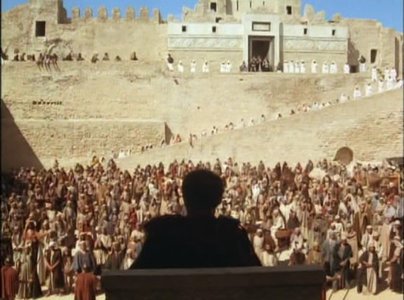
However, Tunisia/Carthage is only very rarely allowed to represent itself in popular visions of the ancient world. Rather, because until recently Tunisia, along with Morocco, was one of the most stable and friendly-to-the-West countries in the whole of North Africa and the Middle East, both countries have frequently been called upon to represent ancient Palestine in films about the life of Jesus. This ninth-century Islamic fortress in Monastir has been used to represent various parts of Jerusalem in Jesus of Nazareth...


...and it has also been used for the odd less reverant Biblically-themed production.


The desert sands of Tunisia have also been useful for representing first century Palestine


and the cave-homes the southern Berbers still live in are so unusual they've been used to represent a planet far, far away.


One of the biggest oases in Tunisia, in the Atlas mountains, was used to represent an Egyptian cave in The English Patient.


As you can see, Tunisia rarely represents itself on film, at any period, and its Classical period is little seen beyond recreations in the arena. The exception, however, is popular travel documentaries. Michael Palin and motorcycling pair Ewan MacGregor and Charley Boorman all visited the amphitheatre at El Jem, one of the largest and best-preserved Roman amphitheatres in the Classical world.

The old, juxtaposed against the slightly-less-old and the newer-still

Camel! This was the first camel we saw up close in Tunisia, as we made our way south

Both Palin and MacGregor & Boorman observe how creepy and unsettling the atmosphere still is in the tunnels underneath the amphitheatre, where criminals and animals were kept - but of course, they all visited at a very quiet time, apparently in complete isolation! There's not a soul in sight in either programme (Palin's Sahara and MacGregor and Boorman's Long Way Down). The experience is a bit different for the rest of us - OldHousemate(thecamelridingone) and I visited as part of a large coach party full of German, Dutch and British tourists and we weren't the only party there at the time - so, rather than experiencing a creepy atmosphere, we were surrounded by excited children, giving the whole place the feel of a playground rather than an horrific place of death.


Palin also visited Dougga, a well-preserved archaeological site in the north of Tunisia, where he looked at the toilets (the Roman ones, that is). We didn't go to Dougga because that coach trip was full, but it's a good thing we didn't, as it clashed with the much more exciting trip to El Jem, the Berber caves, the camel-riding site in the desert, the salt lake and the mountain oasis. We can go to Dougga next time.

The salt lake, empty of water for most of the year

Tunisia certainly doesn't lack interest from filmmakers and television producers (recent events notwithstanding) but I think it's a shame that its own Classical past isn't explored more often in modern popular culture. Perhaps it has been and I'm just not familiar with the works - there must be a film about Hannibal out there somewhere, surely?! Anyway, I hope to see works that exploit Tunisia for its own (preferably Classical, since that's my area of interest!) past in the future, as well as using to represent just about anywhere else.

Tuesday, January 18, 2011

Tron: Legacy (dir. Joseph Kosinski, 2010)

Went to see this last night, and enjoyed it, especially the very cool race across the grid near the beginning, though I'm still not sure I really get much more from the 3D (I liked the 2D sequence on top of the tower at the very beginning, which made my stomach drop more than the 3D!). It was painfully obvious where costs had been cut on making Jeff Bridges look younger (filming from behind his head!) and the CGI for that effect looked a bit weird and, for some reason, made him resemble the late, great Patrick Swayze, but it was a fun concept. The story was sweet, if predictable, and there was plenty of genuine emotion with a decent payoff. And it starred Patroclus! (doing rather better here, and much less reminiscent of Hansen).

There were a couple of fairly random Classical references floating about in there. There were gladiatorial games, of course, though these have been designed to resemble generic computer games more than actual gladiatorial combat. I saw the original Tron a long, long time ago on TV and can't really remember it, but the way the discs-as-weapons were used here reminded me of The Matrix more than anything else, all dodging in bullet time rather than actual fighting. The one-on-one setup reminded me of playing Street Fighter on my cousin's Super Nintendo many years ago and even the amphitheatre had been made triangular, rather than round, to make it look more in keeping with the original Grid. All in all, there wasn't must left of Roman gladiatorial combat in here except the idea itself, which soon gave way to the brutal but cool race sequence.

Then there were the names. The use of Classical names in science fiction vaires enormously, from the very obviously symbolic (people called Ariadne are good at mazes) to the so-symbolic-it's-almost-silly (just why would anyone call a spaceship designed to fly towards the sun Icarus? That is never going to end well). Then there's the Tron: Legacy approach - throw some mythological names at your characters and see if something symbolic comes out. So we have Micheal Sheen's fabulous Castor/Zuse, the highlight of the film, a mad, scenery-chewing combination of the Volturi, David Bowie and Caligula. But why is he called Zuse - Zeus, spelled funny - and why does he name himself Castor? Castor is one of twins and you would usually expect to see the name used in that context, or perhaps in connection with horses, but neither applies here, unless it's a reference to his dual identity. Zeus killed his father, which might be the analogy they were going for there, but given that Zeus' main, most important qualities are being Chief god, lightening god and general ruler, he doesn't really seem to fit with Sheen's rather daft, definitely not as powerful as he'd like to be, character.

A quick look at the cast list also reveals that the women who originally kitted Sam out for the Games were called 'Sirens.' Because they lured him to his death? Except they didn't, they just changed his clothes, and he didn't die anyway. Because they're sexy? But the Greek sirens weren't necessarily all that sexy. Hmm.

Brother points out that the writers probably just thought the names sounded cool, which is quite likely and fair enough (I seem to remember throwing Celtic names at random at a fantasy story I was working on once with no idea what significance they might have!). The fact that these are the only Classical names in an otherwise electronic-sounding nameverse (Clu, Tron, even Cora) makes them stand out enough that you feel they must have some significance, and there are definitely random bits of symbolism thrown into this film in other places, suggesting we should be on the lookout for it (Sheen's line 'Behold the son of our maker!' is the most painfully obvious, sounding like it's come straight out of the King James Bible). And Zuse/Zeus seems an odd choice if it doesn't mean anything, since he's one of the best known and most obviously symbolic Olympian gods. But the whole thing does make more sense if we assume the writers just liked the sound of the names, and the film really doesn't need to add extra layers of symbolism that don't quite match together - the electronic-Nazis story that forms much of the plot is quite enough to be going on with!