Showing posts with label TV. Show all posts

Thursday, July 21, 2011

Rome: Son of Hades


I have a new, light-hearted, article up at Sound on Sight, on Ten Films to Watch now that Harry Potter's Finished.

Things are not all well in Rome, as The Godfather chucks The Other Godfather's head on the floor without even bothering to find a wastepaper basket. On the upside, he's stopped rocking. Eirene complains that The Godfather's house is a house of death and will adversely affect any children they might conceive, and Dodgey promises to think about getting them out of it. However, The Godfather is sitting in bed sulking (given that he's caused the deaths of his wife, children and Caesar, this is understandable) and refuses to budge, or to get rid of the now rotting head in the corner of the room.

Cleopatra is in town and Antony pretends not to be interested in her to Atia, who doesn't approve of him having sex with anyone who outranks her. Octavian demands the money he's inherited from Caesar, and Antony evades the issue. He leaves to meet with Cleopatra, who is dressed in a more Roman style than usual, albeit with a very large Egyptian ankh pendant round her neck. He notes that she's changed (probably because she appears to be sober this time). She claims she doesn't remember him. Posca tries to bring the meeting back to the point - the preservation of Cleopatra's throne as a client kingdom - and he and Cleopatra's nurse/companion neogtiate the deal while Antony does his level best to have sex with her with his eyes alone.

Cleopatra demands an official declaration of Caesar's paternity of Caesarion, but while she is willing to prostitute herself for a good cause, she demands payment up front, and Antony has to confess that he'll never make Caesarion Caesar's legal son (he's got enough trouble with Caesar's legally adopted son as it is). When he tries to touch her, she slaps him (which is rather satisfying). The whole scene very effectively sets up Antony and Cleopatra's relationship, in Rome's narrative; he is besotted with her, and she is using him. It's also notable for the being the longest she appears to be sober in the series.

Cicero tries to tell Antony some true but dull and unpleasant facts about famine, mob wars, riots and so on. Antony shows him a list of candidates for the elections Posca claims to have found among Caesar's papers and Cicero notes how many of these Posca seems to turn up, while referring to the candidates themselves as wretches. Cicero's dialogue here really nicely reflects the real Cicero's dry wit, and Bamber is excellent as usual. He also points out Antony can't kill him because he needs him to run the Senate, and Antony has to point out that won't be the case forever. Poor, foolish Cicero. Meanwhile, Antony hasn't paid Posca either.

Dodgey grabs Antony on the street and asks him for help dealing with The Godfather, and rather surprisngly, Antony agrees and goes to get him out of bed personally. Antony has a right royal go at him over the whole letting-Caesar-die thing, demanding to know why he hasn't committed suicide like a good Roman (The Godfather's excuse is rubbish, by the way), then orders him to sort out the mob wars he's started, thus solving one of his own problems at the time. It's a lovely bit of reverse psychology and is actually genuinly nice of Antony, even if he is helping himself as well.

Antony and Atia share a bath in which, unusually, they are in water up to their necks. He insists repeatedly that he's not interested in Cleopatra and Atia really should have noticed that he's protesting too much, though she is reassured that he refused to raise Caesarion above Octavian. It's quite a sweet scene and it seems that Antony and Atia really like each other, as opposed to their many other relationships, which tend to be based on sex alone.

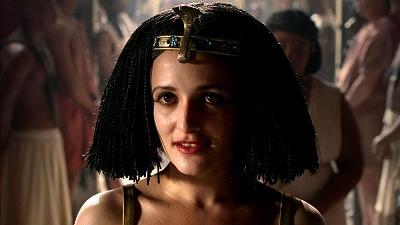
Next day they hold a fancy dinner at which Atia enjoys humiliating Servilia until Octavian rats out her plan to have the woman murdered to Antony and she has to cancel it. Cleopatra turns up in full Egyptian Queen garb - short black dreadlocks wig and all - and Antony makes it even more obvious that he would really, really like to have sex with her. Everyone eats in as aggressive a manner as possible and they all stare at each other even more intensely than the cast of I, Claudius during Claudius' opening this-is-who-everyone-is narration.

Timon, Atia's torturer, hitman and occasional lover, goes home, where it turns out he is Jewish and has a wife, children and a recently returned brother. This is part of a sub-plot that eventually had to be hastily concluded when the show was cancelled early and it doesn't really go anywhere, so I'll skim over it for the most part, though it does lead Timon to an interesting personal crisis later on.

Cleopatra tells Atia to kiss her because she's her friend for life and Atia hisses at her to die screaming, which is mildly amusing but not a terribly good idea politically.

There's yet another new Godfather in town - let's call him The Don - who is putting people in sacks with snakes and that sort of thing. An announcement goes out for a big meeting of the captains of the collegia where they are all to try not to kill each other for a few hours, as they will be under Lady Concord, meaning violence would be extra specially naughty. The Godfather turns up, freshly shaved, and they all settle down to meet and I swear, I half expect a helicopter to appear in the doorway and gun them all down. The Godfather announces that since he killed the previous godfather and he's BFFs with Mark Antony, he'll be taking over mob rule in the city. When a few object, he smashes up the statue of Concord, snaps that he's a son of Hades and f*cks Concord in her a*se, and draws his sword, ready to kill anyone who doesn't do what he says. It's a pretty effective strategy.

Atia is nagging Antony about Cleopatra and Octavian is nagging him about his money, which he needs so he can give the people the money Caesar promised them in his will, for starters. Octavian has hired a lawyer and Antony is forced to tell him outright that he's not giving him the money. (Amusingly, throughout all this, Octavia calmly eats lunch and makes polite requests for the fruit salad). Atia insists that they need Antony's protection and sneers at Octavian's suggestion that he can protect them (it's fun for TV writers to give characters lines they'll seriously come to regret later). Later, Octavian tells Octavia his plan to, essentially, take over the world, and she laughs at him (something else she'll regret later).

Octavian has the town crier announce that he will fulfil the terms of Caesar's will and give everyone money, the result of selling his own property and borrowing three million sesterces. Antony and Atia are very cross and Octavian explains that he's decided to enter public life and this is his way of doing it. He suggests that he and Antony make a public display of unity and makes a very sensible argument in favour of this plan, but the other two are distracted by the whole borrowing-three-million-sesterces business and a full on brawl ensues in which Antony nearly kills him (largely because Octavian hit Atia and called her a whore - it's sort of sweet, or it would be if Octavian wasn't Atia's son). Atia manages to stop Antony actually murdering her son, just about, but Octavian is distracted by the fact she's taken Antony's side and has to be comforted by Octavia.

Dodgey is a bit nervous about The Godfather's lack of respect for the gods, but sticks with him anyway. He hires a brothel supervisor with bad attitude called Gaia to work for them, thus putting one of this season's least satisfying storylines in motion. He also hires another old comrade from the Thirteenth called Mascius.

Servilia and Cicero are celebrating Antony's problems and Cicero dismisses Octavian, but Servilia points out Caesar chose him, and they probably shouldn't ignore him. Cicero persuades her that Brutus shouldn't come home yet, which upsets her.

Octavian leaves to stay with his friend Agrippa in Campania and prepare for his political career and we see him ride away, covered in bruises from Antony beating him. The camera pulls away to reveal, in a cartload of slaves on the same road, Niobe's sister and all The Godfather's children, still very much alive but thoroughly miserable. End of episode.

This is the last we see of Max Pirkis as Octavian, which is a great shame. Since Pirkis was still in his mid-teens at the time of filming and Octavian needed to age from nineteen (his age at Caesar's death) to, as it turned out, 33, over the course of season 2, the change is understandable, but it's still annoying, as Pirkis had done such a good job with the character. His portrayal of Octavian as a slightly weedy but hyper-intelligent and thoroughly ruthless young man is spot on and the audience can both understand why everyone underestimates him, and see how very wrong they are to do so. Simon Woods, who plays the older Octavian, takes his cue from Pirkis' performance and maintains his character interpretation pretty well, but for me, the character belongs to Pirkis.

Essentially, this episode is composed of set-up for season 2, following on from episode 1, which dealt with the fall-out from season 1. Antony and Cleopatra, Octavian's ambition, The Godfather becoming The Godfather and Dodgey's relationships with Eirene and Gaia are all moving into new stages. As such, there's not so much to say about this episode itself - it does its job nicely, but everything in it has to be understood as part of what is to come in later episodes. One thing I do like very much about season 2, though, is that I think we get slightly more of the actual history; or at least of historical characters, if not history itself, which takes a beating from several directions and for several different reasons as the series goes on.

All my Rome reviews are listed here

Monday, July 11, 2011

Imperium: Augustus (dir. Roger Young, 2003)


I'll be away at a conference for the rest of this week, at which Penelope Goodman is speaking on this 2-part 2003 made-for-TV movie about the life of Augustus, and the DVD was cheap, so I thought I'd watch it.

There's no way to beat about the bush here: it's not good. The writing is bad, the music is bad, the costumes are bad, the CGI and matte paintings are bad, the ADR which presumably replaces several actors' Italian accents with roughly English ones is especially bad and even the acting is bad, which is surprising, as Peter O'Toole, playing Augustus, is usually excellent. The Lion in Winter, this ain't. It's not even up to Troy's level.

I'm not even going to start on the historical inaccuracies here. Let's just say this re-imagines Caesar and Augustus as great defenders of the people fighting vaguely referenced 'nobles' and leave it at that. I do feel the need to point out that Augustus was not of excessively 'humble birth', as he was part of one of the most ancient families in Rome through his mother. And Cicero is lumped in with 'the nobles' despite the fact one of his defining features is that he wasn't noble. And Cicero appears to be part of the conspiracy against Caesar, which he equally famously wasn't. And... OK, I'll stop now.

The open hostility between Livia and Augustus is very odd. Livia's characterisation is quite interesting and she is much less the cut-and-dried villainess than usual - indeed, it is implied she may be largely innocent. She certainly comes under suspicion of poisoning people though, and without Robert Graves' conceit, that Augustus simply had a gigantic blind spot where Livia was concerned, or Rome's interpretation, that they're both evil incarnate but bound by mutual desire, their relationship makes no sense. Augustus was descended from the Julians twice over (biologically through his mother and by adoption through Caesar) so although Livia was usefully aristocratic, he didn't need to be married to her for that reason. They had no children together and divorce was common amongst the Roman aristocracy, especially in pursuit of an heir, so if they were that hostile to each other, they wouldn't have stayed married.

The almost entirely terrible dialogue did include the odd gem, such as:
Julia: Did you want me to spin the wool for my own dresses like I did when I was a little girl?
Augustus: Perhaps with slightly more wool.
And Augustus carefully avoids a split infinitive, as one is compelled to when speaking Latin, when he announces his intention 'formally to denounce' Julia. O'Toole is no BLESSED in the shouting department though, not any more.

I'm not even going to think about Russell Barr's portrayal of Maecenas. I've seen schoolboys play pantomime dames with more subtlety.

Cleopatra's death scene, which could rival vampire shows for linking sex and death and features what looks more like a cobra than anything else to me, is also better left with the less said the better.

Part 2 is a slight improvement on Part 1, as the sub-plots concerning Julia's unhappy political marriage to Tiberius and the possibility that Livia is poisoning everybody kick in, plus a bit of Antony and Cleopatra, always at least mildly entertaining. It also features a rather fun scene involving Augustus smashing lots of glasses and saving a slave from a flogging, which I have a vague notion may have some roots in an actual historical incident when Augustus ordered a friend not to kill a slave who'd broken something, though I can't remember the details. An assassination attempt on Augustus features the two most incompetent would-be assassins in history but does have the advantage of providing a thoroughly satisfying explanation for Julia's banishment and Augustus' adoption of Tiberius.

On the other hand, Part 2 contains the most bizarre scene of all in which, after nearly 100 years of civil war, a (really rather small) bunch of Roman soldiers suddenly twig that civil war means offing your friends and relatives and refuse to do it. What did they think they'd all been doing for the previous several decades?

Oh, and there's a random bit of sneaky Christianising at the end as well - 'if the gods have sent someone to save the world, I am not that man' says Augustus, and then the film finishes with a reminder that Jesus was born during the reign of Augustus. All this achieves is to make it really seem like we've slipped back in time to the 1960s, when this sort of thing was quite common in Roman dramas. It certainly doesn't belong in a drama about a man who died when Jesus was 14(ish).

Overall though, this is notable largely for being the most postive and friendly account of the life of Augustus since he wrote his own autobiography. He did it all for Rome, it's all Mark Antony's/Cleopatra's/Livia's/Tiberius's fault, Augustus just wants peace and love and fluffy bunnies. Really, truly, honestly guv. And if you'll believe that, you'll believe anything.

Friday, July 8, 2011

Xena Warrior Princess: Is There a Doctor in the House?


My review of this episode is slightly hampered by the fact I haven't seen 'Hooves and Harlots', in which Gabrielle is apparently 'inducted' as an Amazon, but I maintain episodic television shows ought to be comprehensible no matter where you start! I feel the same way about book series, much to several friends' frustration.

The episode takes places in a healing temple (which looks distinctly Eastern of some description to me - whatever it is, it sure as heck ain't Greek!), in the middle of a civil war, and most of it revolves around arguments between Xena, who's practicing her battlefield medicine and teaching it to a young healer called Hippocrates, and Galen, the old physician who insists only Asclepius, the (correctly identified) god of healing, can decide who lives or dies.

The war was caused, according to the other side's leader, by the Thessalians (from an actual part of Greece) trying to force the 'Mitoans' (not from an actual part of Greece) to adopt their religion. This is spectacularly unlikely in an ancient context. The only religion that demanded that everybody worship their god and no other was Christianity, and they didn't start the more violent kind of evangelism until the medieval period. The only religion persecuted to that extent by polytheistic ancient pagans was, again, Christianity (because the Christians refused to worship the major gods, and therefore might endanger others) but the pagans were quite happy for Christians to worship their god, as long as they worshipped Jupiter etc. as well. Occasionally an emperor might take against a particular cult - the cult of Isis suffered this way once or twice - but always because of a specific grudge against that specific cult, not because they were against other religions in general.

Galen and Hippocrates are both named after famous ancient physicians, though Hippocrates is the better known - he is clearly the Hippocrates, he of the oath (we see him starting to write his famous works, all attributed here to Xena, at the end), whereas Galen is more of a fictional character designed to demonstrate how much superior Xena's practical healing is to his religious ritual. The real Galen was a Greco-Roman physician who lived in the second century AD and whose writing on medicine was still being used as a practical guide throughout the medieval period and even beyond.

Healing temples are something I happen to know rather a lot about, but instead of typing out a lecture, I'll just link to my paper on the subject, which is currently available here. As far as the argument between Xena's practical healing and Galen's more overtly religious methods goes, I personally suspect that all these places practiced practical healing as well as religious rituals, but proving it either way is pretty much impossible. Civil war aside, chances are these temples were usually filled with people whose problems couldn't be cured by local healers or practical healers anyway, and pilgrimage to the temple was their last resort - I suspect there were healers there who did their best, but there was often little they could do anyway.
 
If you were going to have a baby, on the other hand, as Gabrielle's friend Ephiny is, you wouldn't want to go anywhere near a male healer of any kind, they wouldn't have a clue. You'd need a midwife, and they would definitely favour practical healing, though I'm sure they'd have some religious rituals as well.

Ephiny is apparently an Amazon, who was on her way to Athens because her recently deceased other half wanted their baby born there. At first, she doesn't specify why - better medical care? You'd want Cos or even Epidauros for that. Citizenship? You can't get that from geographical proximity, you have to have two Athenian parents. In the end, it turns out the Athenians are 'more tolerant' - presumably of mixed race marriages between centaurs and women. There's no historical evidence for that, oddly enough!

The other main storyline of the episode follows the Mitoan leader who is eventually persuaded that war is, generally speaking, not a good idea. It takes a story, a baby centaur, lots of preaching and several deaths (including, briefly, Gabrielle's) to convince him, but he gets there. I love that Gabrielle self-identifies as a bard. The nice little story she tells about finding peace in yourself is not, you'll be unsurprised to hear, an actual Greek myth, though Artemis turning people into hunted animals features in actual myths.

Not a bad episode, but a woman giving birth to a centaur? Really??!! At least when Doctor Who featured human/kitten hybrids, we didn't have to actually see the birth. And if Xena did an ancient Caesarian section that left the mother alive, she really does have magic powers. We do get another great disclaimer though: Being that war is hell, lots of people were harmed during the production of this motion picture (but since television is a dramatic medium of make believe, all casualties removed their prosthetic make-up and went home unscathed).

Sunday, July 3, 2011

Top Five Gladiatorial Combats


I'm once again buried under an enormous pile of exam marking, so forgive me if things are a little quiet around here this week! Once I emerge, I can promise posts on Priam playing Augustus, some more Classical Places, more maenads and vampires, more Rome and more Xena.

In the meantime, I've been giving serious consideration to the Top Five Roman-style Gladiatorial combats in popular culture (that I've seen). Spoilers follow.


5. Spock and McCoy vs Flavius and Achilles in Star Trek, 'Bread and Circuses'
Why? Becuase any gladiatoral combat that ends in a double Vulcan Nerve Grip is a great gladiatorial combat.
How Roman is it? I'm not aware that the Vulcan Nerve Grip was known in ancient Rome. The replacement of the audience in the arena with a television audience works brilliantly, and the network's need to provide an entertaining combat is surely representative of something that must have been an issue for Roman lanistas.

4. The Face-Dude vs Spartacus in Spartacus: Blood and Sand, 'The Thing in the Pit'
Why? Of all the many, many fights we've seen on Spartacus: Blood and Sand and the prequel series Spartacus: Gods of the Arena, this is by far the most memorable. It's a face! It's a face!
How Roman is it? There's no evidence of a Fight Club-style set-up like this in ancient Rome and with gladiatorial combats available regularly, why would you need one? It gives the show a nice change of pace for an episode though.

3. Spartacus vs Draba in Spartacus (1960)
Why? It's a tense scene, a pretty decent fight - but it's the expression on the face of Woody Strode, as Draba, as he throws his trident at Batiatus and Crassus and then launches himself at them, that makes this a memorble and chilling fight and a great end to an intriguing character. Plus, of course, it's a turning point for Spartacus himself.
How Roman is it? I can't see why Crassus would randomly demand to see two gladiators killed purely for the amusement of himself and two friends, when they could be killed for the amusement of hundreds. On the other hand, there's be nothing to stop him and he wasn't exactly the tender type.

2. Katniss and Peeta vs Cato and the muttations/ Katniss vs Peeta in The Hunger Games
Why? Just when you think The Hunger Games can't get worse or more horrible... it gets worse and more horrible. Cato meets such a nasty end you actually feel sorry for him, and then we finally get to the resolution we all knew was coming since about page 15. And very satisfying it is too.
How Roman is it? Like Star Trek, these gladiatorial games have replaced live audiences with television, which I suspect is what would have happened if the Romans had invented television. With much more space to explore the concept, Collins really gets into how that removal of the audience from the horror of what's happening might affect such a series of games, which is really interesting. Beyond that, well, there's a character called Cato. That's about it. Again, if the Romans had known how to genetically mutate animals, they probably would have done so - but they didn't.

1. Maximus and his men vs 'Scipio Africanus' (actually several female gladiators) in Gladiator
Why? Undoubtedly the highlight of a great film, this fight is the lead-in to the famous 'My name is Maximus Decimus Meridus...' scene, and it does a fantastic job of showering Maximus in glory right before his big moment. The way he uses his military training to beat the odds, the re-writing of the history of the Battle of Carthage (much to the announcer's embarrassment), the excitement of the fight itself and the way the gladiators band together to face the emperor when it's over, all go together to make the best scene of gladiatorial combat in the movies, topped off with Hans Zimmer's majestic score.
How Roman is it? I'm not sure the Romans would have chosen a bunch of women to represent Scipio Africanus, but otherwise this all looks pretty good to me. Perhaps the number of old soldiers in Maximus' group of fellow gladiators is a bit on the implausible side.

Honorable mention goes to the lovely little British arena in The Eagle, and the beginning of a beautiful friendship. There aren't many gladiatorial combats that can claim that!

Thursday, June 30, 2011

Quantum Leap: The Curse of Ptah-Hotep

I love Quantum Leap. It's the perfect blend of fantasy, character drama and humour and like Doctor Who, it has the great advantage that if you don't like one week's story, you've still a good chance of liking the next one, which will be completely different. It's such a sweet show, I can't really imagine anyone actively disliking it!

The show's premise was a combination of soft science fiction and ideological fantasy. In each episode, Dr Sam Beckett 'leaps' into a person (oddly enough, usually an American) living sometime between 1950 and 1990 (although the show was theoretically set in 1999, since it was filmed in the late '80s and early '90s, he never leaped into anyone from the 1990s). Taking the other person's place, he 'sets right what once went wrong', repairing relationships, solving mysteries, saving orphanages and that sort of thing, often saving the leapee or someone close to them from death by crime/accident/wrongful execution/illness that he can cure with his 1990s knowledge of medicine.

This episode plays with the themes of mummy movies, as Sam leaps into an archaeologist who disappeared, together with everyone else with him, while excavating the tomb of King Ptah-Hotep II (not, as far as I know, a real Egyptian king, but it is a real Egyptian name, deriving from the god Ptah and 'hotep', often used as a suffix in Egyptian names and meaning, in context, 'Ptah is content'). This gives the writers a chance to play with some tropes that aren't usually part of their toolkit.

Usually, the only science fiction/fantasy element of the show was the leaping itself. As the series went on, and particularly in Season 5, other elements started to creep in (a possible vampire, aliens, a leap outside Sam's lifetime that wan't ususally possible according to the show's internal logic, and most notably an opposite 'evil' leaper). This episode appeared late in Season 4, before the vampires and aliens, but after an early episode playing with horror themes and the works of Stephen King ('The Boogieman') and more particularly, after 'It's a Wonderful Leap', which featured an actual angel. The great thing about this is that the audience isn't quite sure what to expect. Al suggests that the mysterious deaths that start to occur are murders, carried out by someone who's after the treasure for themselves, and that would be the sort of solution you would anticipate from Quantum Leap at this point. However, there's just enough doubt in the audience's minds to add a really nice layer to the mystery - not only, who is doing the killing, but is it a living human being at all?!

In the end, it turns out that there is a murder plot, of sorts - but there is also a mummy, and we see his hand, though thankfully not any more of him. I'm never quite sure how I feel about Quantum Leap doing these more overtly fantasy/science fiction stories, as it doesn't quite fit the tone of most of the show, but on the other hand, it does provide a nice change of pace and it wouldn't be a proper mummy movie without an actual mummy.

Another nice thing about this episode is we get to see a bit more of Sam as a character, in a way that isn't always possible. A while back, I wrote about how TV and film archaeologists are always ridiculously over-qualified and somehow manage to be experts in just about everything, never restricted to their own field like normal people. Well, Dr Sam Beckett really takes the biscuit here. He ought to be Dr.Dr.Dr.Dr.Dr.Dr.Dr. Beckett, at least, as he has seven degrees that come with the title 'Dr' (six PhDs and an MD), though his qualifications, along with his life story, can be changed sometimes if he affects his own past while leaping. It was established way back in Season 1 that one of his PhDs was 'Ancient Languages', including ancient Egyptian (an unusual subject - Classics, Egyptology or Ancient History would be more normal - but plausible. Ish.) and apparently it still is, as he can still read hieroglyphics. He also gets very excited about being in Egypt, about working with fellow archaeologist Ginny - with whom, refreshingly, he develops no romantic attachement and has an entirely professional relationship, despite the tiny tiny shorts she's wearing - and about their discovery, because he's genuinely interested in Egyptology and ancient history. It's fun to see Sam enjoying one of his own areas, rather than having to throw himself into someone else's, and of course it means the episode avoids the usual issues of how he can fit in and convince people there's nothing wrong with him, as he knows what he's talking about.

An episode with a mummy in it can't take itself too seriously, and there are some great moments of humour in here (like Al's assessement of a camel as an ugly horse - he's quite wrong of course, camels are beautiful). Other attempts work a bit less well; Ginny notes that claustrophobia is 'hardly a good trait for an archaeologist', but most archaeologists don't work in tiny underground tombs, they work in the open air! (Though some work in cellars and trenches, which looks even more claustrophobic). If she'd said 'Egyptologist', which is what her character actually is, that could have worked.

This isn't one of Quantum Leap's finest hours - the best episodes of Quantum Leap tend to be those which deal with serious subject matter in a dramatic way, or the romantic episodes, or those which are really broad comedy and involve Sam wearing women's clothing. It is also indicative of the slide into more and more 'out there' episodes in Season 5 that would culminate in the show finishing at the end of that season. It's good fun though, and it's nice to see that old Ancient Languages PhD brought out again - even I have to admit, that's not one that he needs to use terribly often in the course of leaping.

Friday, June 17, 2011

How I Met Your Mother: Desperation Day


I realise this post is hopelessly wide of the proper time of year, but we only just got to see this episode in the UK! If I wait until next February I'll never remember it.

This is How I Met Your Mother's Season 6 Valentine's Day episode. I watched the first few episodes of the first series and then moved house without my TV, so I've only just recently started getting into the show again. This was a pretty good episode - I especially enjoyed Marshall and Ted's reversion to their teenage years, since they're supposed to be roughly the same age as me and I recognised my old Gameboy and MarioKart obsession, and while we don't go out and pick up random men, my single friends and I have been known to get together on Valentine's Day, usually to watch romantic comedies. Any wearing of purple is accidental though.

The reason I'm blogging it is that Barney's explanation of 'Desperation Day' (February 13th) involves a fantasy Roman-set sequence with the main characters dressed up as Romans. You can tell they're Romans because they're wearing white sheet-type things with leaf-crowns on their heads and Cobie Smulders as Robin even has a go at speaking The Queen's Latin (though since no one else is doing that, it sounds pretty weird).

Now, I know that the object of comic fantasy sequences in How I Met Your Mother is not historical accuracy, but I would be a traitor to my profession if I didn't point out a few salient points. The sequence springs from Barney's statement that 'Weddings were forbidden under Roman law, so St Valentine performed them under threat of death', to which Ted adds, 'That's actually true'.

Er, no it's not.

Does anyone know where this idea comes from? There were a few Valentines mentioned in early Christian matryologies, at least two of whom were supposedly martyred in the third century AD, so Valentine as a Roman makes sense enough. But Valentine's Day as we know it originated in the Middle Ages and the only people who weren't allowed to get married in ancient Rome were slaves. Is this a medieval tradition? Was St Valentine particularly connected with slaves? Is it a random bit of Catholic folklore (though if so, it's not on the Catholic Encyclopedia)? Is it fiction invented for the show (though I think Ted's comment rules that out)?

While I'm nit-picking, Romans didn't wear white for weddings, or not all white anyway. Bridal veils were 'flame-coloured' (opinion differs as to exactly which colour is meant by this!).

This was one of those times when I wished I could switch off my inner historian and just watch the show, because while I was staring at the screen mentally yelling 'What? NO!' the dialogue was moving on and was very funny, as Barney said 'Wait! There's more' and Ted put in 'This won't be [true]'. The fantasy sequence was funny too - I kinda love St Desperatius, who probably ought to go make friends with Bilious the Oh God of Hangovers, 'Player, play on' sounds Shakespearian but sort of works because Shakespeare is so well connected with Rome in the popular imagination, and Robin wins the prize for an actually historically accurate joke with her line, 'Fifteen and still unmarried!' (Barney's 'And I thought Pompeii was smoking' is also reasonably historically accurate, but not as funny).

The best resource I could find for St Valentine was the Catholic Encyclopedia which, while obviously biased, is a pretty good reference tool for Late Antiquity, as it usually cites its sources (though 'tradition' broadly means 'not the slightest idea', I think). Please comment if anyone knows of an ancient source that refers to St Valentine, as I'm genuinely perplexed on this one!

Tuesday, June 14, 2011

Rome: Passover


Previously on Rome, Season 1: Death. Sadness. A total lack of Shakespearian dialogue.

As this episode opens, Mark Antony emerges from the Senate, fresh from Caesar's murder, looking shell-shocked. We know what a substantial proportion of the audience is expecting; a Shakespearian speech. No sign of that yet, though, as he's too busy fighting off assassins sent by Cassius. This is actually much more historically accurate than Shakespeare - in fact, the whole episode is much closer to some kind of amalgamation of the various accounts than most depictions of this particular event. This, I suspect, is because the long, drawn-out process that was Caesar's funeral and Antony's popular victory over Brutus is much better suited to a slowly building television episode than to a film or even a novel. (There is one major inaccuracy, which is Octavian's presence - he wasn't even in Italy at the time. But they make it work, story-wise, so I quite like it).

Brutus is having a Lady Macbeth moment, madly washing his face and shaking like a leaf. Everyone's feeling Shakespearian today. Servilia tells him he must be strong but the poor guy looks in need of a valium.

Posca weeps over Caesar's body and this moment is truly tragic - and is blended straight into a shot of the Godfather, still holding Niobe's body and weeping too. Then the pesky child who caused all the trouble by being born makes the mistake of showing his face and the Godfather attacks first him, then his daughter who actually hadn't done anything wrong at all (except lying). Unusually for a Roman father, he is actually angry because his daughter didn't have sex outside marriage. Luckily Niobe's sister reappears from nowhere to comfort the daughter as the Godfather storms off, cursing them all. As he wanders off he hears all the cries of 'Caesar is dead!' in the streets, at which point he realises he's really f*cked up this afternoon.

Atia is actually crying and being comforted by her old slave woman, though whether she's upset or panicked is hard to say. Octavian sensibly points out to Octavia that the fact it's partly their fault should not be mentioned. Atia has called Timon to get them out of the city. Octavian suggests waiting to see what Antony does but Atia is convinced he must be dead because he hasn't come to get her. Atia orders the slaves to fetch the money and household gods (yay for random bits of historical accuracy and a sort of allusion to the Aeneid!) at which point, much to Timon's irritation, Antony actually does turn up and immediately strips (he does have blood on him, to be fair).

Antony thinks the Godfather was paid off, but Atia somehow knows what really happened. She then proceeds to rip into Antony for not taking on half the Senate with his bare hands. Antony's plan is to raise an army in the north, which Atia objects to because it's 'ghastly'.

The Godfather has a strange encounter with a weird old soothsayer who nuts him on the head, presumably to rob him. Dodgey, meanwhile, blissfully unaware of what's going on, is busy proposing to Eirene, who accepts, apparently on the strength of his promise to buy her lots of shoes.

Antony and his gang go to get Calpurnia, because it'll look bad if they run off promising to avenge Caesar and leave his wife behind. She is watching a wet nurse squeeze milk into Caesar's dead mouth, and I'm sure some researcher got this from some obscure ancient source but seriously, did anyone really do that? What if there weren't any handy lactating women around? Hmm. Calpurnia is puzzled as to why no one has come to pay their respects to Caesar, which suggests either she's lost it through grief or she was bizarrely clueless in the first place. She refuses to budge and insists that they must read Caesar's will (Hayden Gwynne is excellent here by the way).

Posca reads the will and it reveals that Caesar has adopted Octavian and left him everything, except Posca himself, who has been freed. Mark Antony is Not Impressed (to such an extent that this requires Capital Letters). He takes up a defeatist attitude and declares that none of it will count because Brutus, Cassius and the rest will take it all, but Octavian points out that the name 'Caesar' is still his, no matter what happens. This prompts him finally to take charge as head of the family and put his foot down, insisiting they stay where they are and giving Antony, who wants to eat Brutus et al's livers (with fava beans and a nice Chianti?), detailed instructions on how to keep them all alive. In the end, as Posca and Antony argue, it's Atia who has the final say, swayed by the idea of lots of money and this greatest of victories over Servilia. They stay.

Ian McNeice, the town crier, unsug hero of the series, I think. Fabulous use of traditional rhetorical gestures.

News of Caesar's death finally reaches Dodgey and Eirene and they ride for Rome. The Godfather wakes up in a puddle with a head wound while Niobe's sister (Esther Hall, best known these days for those annoying BT ads, putting in a great performance of silent weeping while she tries to comfort the daughter and dresses Niobe's body) and the kids get a visit from the local mob.

Cicero enthusiastically congratulates the conspirators and tells them how disappointed he is that they didn't include him (as he really did in his letters). He assumes they've killed Mark Antony and points out what a bad idea it is to leave him alive, to which Brutus sulkily tells him to kill him himself. Cicero, a man who knows which side his bread is buttered, immediately tries to run away - unfortuantely, right into Antony, who's just walked in.

Dodgey finds the Godfather, who has made it back to his house and gone catatonic. He tells Dodgey he was going to kill Niobe before she did it herself (I still don't think he would have). Now, while he was in a funk and after he cursed them, all the children and the sister have disappeared. Kevin McKidd's performance is wonderfully jittery, and for once Dodgey is the sanest person on the scene, which is worrying in itself.

Cicero straight away gets Brutus to confirm to Antony that he wasn't involved in the assassination (goodness that man is a weasel!). Antony points out that killing Caesar does not appear to have been a popular move (he says many people 'will worship Caesar until they die' which is a rather nice line considering Caesar's later deification). He further points out that if all Caesar's actions are nullified, none of them hold their positions any more (as Octavian had pointed out to him earlier). He tells them he wants peace and stability and James Purefoy finds a wonderful way to enable the audience to hear the fact that Antony's lying, knowing Octavian has put him up to this, but sounding convincing enough to swing Brutus and Cassius. He pretends he wants to retire and persuades them to organise Caesar's funeral jointly with him, so they don't have to fight and kill each other.

Cassius, Servilia and Cicero (in his roundabout way), try to persuade Brutus to kill Antony, but Brutus, unaware that Octavian is pulling the strings, doesn't see brutish Antony as a threat. They hug and Antony gives him a kiss that's Judas Iscariot and Micheal Corleone all rolled into one. It's a wonderfully tense scene and for a moment you wonder if, against all historical record, Brutus really is going to kill Antony. Purefoy's expression as he walks away speaks volumes and you really feel the idiocy of Brutus, thinking this man is not a threat. Antony does stop to murder Pompey's illegitimate son on the way out, to make himself feel better.

Dodgey cleans the Godfather up and it finally occurs to him maybe he shouldn't have cursed his own children. Dodgey tries to reassure him that they'll come back, blissfully unaware they've been taken and sold into slavery by the mob.

Caesar's funeral, complete with eulogies by Brutus and Mark Antony, is announced for the next day. Servilia comes to pay her respects to Caesar and Calpurnia spits on her (yay!). Then she spits on her again (yay again!). Then she lets her past (boo!).

Octavian fills Dodgey in on the whole sorry saga, which unfortunately involves admitting to the fact the whole business with Niobe and the Godfather was his fault. Since he's quite powerful, Dodgey forgives him and offers to help him avenge Caesar. The Godfather, meanwhile, is rocking.

Next morning, Antony is feeling confident and his threat to have sex with Atia's old nurse is really quite amusing (especially Atia's response, that she'd eat him alive). This is a really heavy episode, and the moment of lightness, in anticipation of what much of the audience knows is indeed going to be a pretty successful day for him, is very welcome. Also, Atia's funeral dress really suits her, but that's neither here nor there.

The Godfather is still rocking and wants to wait for the children before having Niobe's funeral, which is not a good idea in a relatively hot country. Luckily he has Dodgey, and it's really nice to see Dodgey looking after him for a change, rather than vice versa.

 Solemn Funeral Face

Funerals happen and everyone looks appropriately solemn (except Dodgey, who's... drinking). Then doors are opened to the crowd, and it's finally time for some speeches - this is where, historically, the famous 'Friends, Romans, Countrymen!' speech comes in and much of the audience knows it and is waiting for it.

Except we don't get to hear it.

In a sense, I can see why the writers didn't want to include the actual speech - who wants to take on Shakespeare?! But to be honest, I can't help feeling they've chickened out a bit. Antony goads Brutus with what a successful speech he's made and insists Brutus must leave the city, but it's hard to enjoy his success when we haven't heard a word of the speech. (Servilia refuses to leave and Antony is fine with that because he wants to crow over her in person). The speech must have been quite something because Cassius is hugging himself as he's been kicked in the stomach and he's taken over rocking from the Godfather, but still - without hearing it, we're not feeling it.

Dodgey and the Godfather come home to find a neighbour looting the place ('only for things I lent!') who tells them that the mob have taken the children. The Other Godfather is in the pub, where one of his friends is describing Brutus and Antony's speeches, including the display of Caesar's bloody toga and everything. This would have been so much more impressive if we'd actually seen Antony do it, rather than hearing the badly-accented mob minion's drunken version. The Other Godfather did not enjoy the speeches and insists on 'observing the decencies' and we're all waiting for him to explain the importance of 'respect', but he doesn't.

His irritation doesn't last long, as Dodgey and the Godfather show up and murder them all. The Godfather looks like a demon from Hades, all covered in blood with mad eyes, and he responds as one might expect to The Other Godfather's calm assertion that he raped and murdered the children. The episode ends as he carries The Other Godfather's head towards the river to dispose of it.

Well, that was a cheerful hour! Thank goodness for Antony's voracious sexual appetite, it was the only smile in it - as was to be expected, but that doesn't make it light viewing, nonetheless. This is a very good episode, really tight, effective, well paced, maintaining an extraordinary level of tension, with stunning performances all round. Just don't watch it in a bad mood, it'll only make it worse.

The title of the episode is very interesting - 'Passover' means freedom from slavery to Jews (suggesting a certain sympathy with Caesar's killers?), the sacrifice of one to save many to Christians (the sacrifice of Caesar which will eventually be to the benefit of Octavian and, through the Pax Augusta, all of Rome?) but I think the most relevant connotation of the word is the notion of sparing the first-born son. By passing over Antony and Octavian, now Caesar's son, the conspirators have signed their own death warrents.  

Mmm, James Purefoy.

I still think some part of Antony's speech should have been shown (personally, I would have shown visuals of the crowd lapping up the speech and Antony displaying Caesar's bloody toga while playing the score loudly over the top so we couldn't hear the words). Without any kind of visual, it's hard to really appreciate its impact, and if you looked away from the screen for a few moments, you'd wonder what on earth put Antony ahead of Brutus. On the other hand, the seeds of Antony and Octavian's eventual split are very effectively shown with a few words and a few more facial expressions, and among the excellent performances, Max Pirkis' ever calm, calculating Octavian stands out, a man who knows exactly what he's been given the minute he hears Posca read Caesar's will...

Friday, June 10, 2011

Horrible Histories: Crazy Caligula

I've just acquired a positively frightening amount of work to do by next Tuesday, covering for someone, so I'm afraid I'll have to take a little unplanned break from blogging for a few days! In the meantime, I thought y'all might enjoy this video from the Horrible Histories TV series, which I blogged about a while back.


The interesting thing about this video is the selection of bits of information about Caligula that can be presented to children, since quite a lot of his reign would have to have a 15 rating! It's worth noting that when the video says 'True' it actually means 'found in Suetonius' - this is not, in fact, quite the same thing as 'true'. It's real gossip - whether it's real fact or not is quite another matter! (and the whole horse-consul business inevitably comes up again). I should also add that this is not the real Josephus, he worked with Vespasian.

Monday, June 6, 2011

Doctor Who: A Good Man Goes to War


Dirty great spoilers for the most massively over-hyped episode of Doctor Who thus far follow, so look away now if you don't want to be spoiled.

'Over-hyped' does not necessarily mean 'bad' - I very much enjoyed this episode, though some of the dialogue was perhaps a wee tad on the melodramatic side. The repetition of how the Doctor would face his darkest hour really didn't ring true for me. He accidentally got some people killed (which is bad, admittedly) and got tricked. Oh dear. This is the same man who committed acts of genocide against both his own race and their enemies, yes? I don't think this was actually his darkest hour, somehow.

It probably was Rory's though. I wasn't sure about the reappearance of the centurion costume at first. It was last seen in the context of Amy and Rory's honeymoon sex games in the Christmas special and did look rather silly, especially since the futuristic soldiers were wearing current-style uniforms. As the episode went on, though, I realised just how effective the costume actually was. The Nurse Sontaran, who came from a society entirely obsessed with warfare (like the Spartans, I suppose, but wearing more clothes thank goodness), was a clear mirror for Nurse Rory Williams, who, for this episode at least, has metamorphosed entirely into a solider and to whom the title refers, just as much as it refers to the Doctor (Amy's opening lines, which play with audience expectations and must have led a fair few fans to think for a second or two that the Doctor really was the father of Amy's baby, are an inidication of how much the characters are intended to be viewed in a similar way throughout this episode).

Uniform, as far as I can tell (never having been in any armed forces myself), is a very important thing to members of the armed forces. It changes according to promotion or demotion, it marks you out from the enemy and it is a badge of honour that declares that you have served your country and risked your life for it. To wear a uniform you're not entitled to would be utterly wrong. But once you've served and worn a uniform, even if you leave, you always have something of a right to it - for example when characters in Dad's Army wear their old First World War uniforms if they haven't got Home Guard ones. Rory is dressed as a Roman because he served in the Roman army as a centurion. I'm still a little unclear on exactly what was going on with the plastic Romans in 'The Pandorica Opens' and 'The Big Bang' and I'm not entirely sure what their relationship to the actual Roman army was, but I think it's safe to say that somewhere over the course of two thousand years, Rory probably did some active service as a Roman soldier. The uniform in this episode doesn't represent Romans, it represents Rory the soldier, a Rory who fights and hunts down his enemies, rather than healing, as he did in a former life.


Ralph Fiennes at the Hay-on-Wye literary festival, last Saturday. It's relevant, I promise - read on!

This is especially satisfying for me as a Classicist because it's a reminder of the similarities between ourselves and the past. I'm sure I've talked before about how people from the past can be represented as either very like ourselves, or entirely different from ourselves, depending on the writer's intentions (and in fact I'm giving a paper on the subject in July). Often the Romans are the Other, the not-us, but this episode, by mixing up Silurians, Sontarans, Cybermen and Romans together with Moffat's weird militaristic future church (the Roman Catholic Church perhaps?)  deliberately draws parallels between military forces from different times and places, between lots of good men and women going to war. By a weird coincidence, I was at the Hay festival this weekend and went to a talk by Ralph Fiennes about his new film version of Shakespeare's Coriolanus (sadly not out until next year) which does exactly the same thing, moving a Roman story about war and warriors, dramatised by Shakespeare, into a modern setting, because as Finnes sees it, the characters and themes and emotions of the story and timeless and universal. (The film looks brilliant, by the way). Because Romans are often viewed as so different, with all the orgies and so on, drawing the audience's attention to the similarities between us and them can be particularly effective.

River was a bit too preoccupied to do anything archaeological in this episode, though I will say, give a child a 900-year-old cot, what do you expect them to grow up into? Half the internet guessed the big revelation - and pointed it out to the other half - weeks ago, so no surprises there and although it's logical and kind of fun, there is a slightly uncomfortable Twilight-y edge to the Doctor banging Amy's daughter - he didn't imprint on her, did he?! Also, why didn't she just regenerate in 'Forest of the Dead'? Maybe she'd run out of regenerations. This does solve one niggly problem though, that of Alex Kingston growing older while her character grows younger. We can go as young or as old as we want and we don't even need an actress that looks like her! Sorted.

As I said, I enjoyed this episode a lot, though I look forward eagerly to the day I don't spend half an episode of Doctor Who wondering what the frell is going on. I also hope we get to see more of Hugh Bonneville, Space Pirate! in the really stupidly titled next episode, as he was totally wasted here. Matt Smith was brilliant though - I have finally been converted. And maybe, just maybe, we'll actually get to find out some more about the Doctor's own family and possibly even where Susan came from in the next bit of the series, now that Amy, who is not a person to let a thing go once it's been brought to her attention, has started asking questions...

Edited to add: I complete forgot to praise the use of language in this episode! English, as a language, has an unusually enormous vocabulary and there are loads of words that you just can't quite translate from one language to another. It was wonderful to see this not only acknowledged but used as a plot point!

Edited to further add: I should probably also draw attention to the fact that Amy's father was called Augustus and River was 'in the care of' Father Octavian. Octavian and Augustus were, of course, the same person. Is this just a really obscure, nerdy in-joke, or is there a deeper meaning to it?

Tuesday, May 31, 2011

Rome: Kalends of February


I was wrong in my last review; it turns out that, somewhat counter-intuitively, this actually is the episode in which Julius Caesar gets murderlised. There is a reason for this - it's on the Kalends of February that, in the Rome version of events, Caesar announces he will be creating a hundred new senators, which proves to be the final straw for the conspirators and, indirectly, the downfall of Niobe. In real life, Caesar would have filled the vacant seats in the Senate (caused by all those messy civil wars) much earlier than a month before he died, but we probably shouldn't let that bother us.

As the episode opens, Dodgey Soldier and The Godfather (formerly known as Boring Soldier) have become minor celebrities, thanks to their dramatic exit from the arena last week. Dodgey is still recovering from his wounds, but The Godfather is busy having it away with his wife in front of an audience as part of a truly peculiar ritual on their new land while she expresses surprise that Caesar (who has just given them the land, hence the ritual) might be a bit put out that The Godfather took it upon himself to rescue a condemned criminal.

Pullo makes a bid for freedom from the 'hospital' (I'm pretty sure the Romans didn't have those) and is brought back to The Godfather's house to make even more of a nuisance of himself. Niobe catches Eirene holding a knife to this throat and points out this would not end well for Eirene herself, who would definitely be the prime suspect if Dodgey were to be found murdered. She then orders Eirene to look after Dodgey, possibly as some kind of punishment? It doesn't make much sense. Eirene spits in Dodgey's food. Good for her.

Caesar has decreed that a hundred new senators will be created and tells The Godfather that he will be one of them. Caesar did fill vacant seats with his own supporters, including centurions and men who'd fought for him, but as I said, I suspect he did it a lot earlier than a month before his death. The reason for the placement of The Godfather's promotion here, of course, is to tie his and Niobe's story to Caesar's for the finale. The Godfather is Caesar's most feared bodyguard, thanks to his antics in the arena, so the conspirators have to get him out of the way, so they spill the beans about Niobe's affair to him just as they're murdering Caesar. It's an ingenious way of tying the stories together (even if it is a bit reminiscent of Carry of Cleo in the set-up) and works rather well, and according to Cassius Dio Caesar did have a bodyguard of knights and senators. The only minor problem with this is that it does mean one of the more fascinating aspects of Caesar's personality and behaviour towards the end, his supposedly casual attitude towards the possibility of his own assassination, has to be left out, which is a shame.

We are reminded of Caesar's close relationship with both Antony and his slave/freedman (never have quite worked out which he is) Posca which will make the scenes of Posca trying to save Caesar and Antony finding his body that much more poignant. I particularly like Caesar and Antony's exchange, in which Antony wants to know why Caesar trusts him. Caesar tells him 'If you were going to betray me, you'd have done it long ago' and Antony replies 'Don't think I wasn't tempted,' which is a nice reminder of how ruthless they all are while also, strangely, reinforcing Antony and Caesar's mutual loyalty.

I'm delighted to see Calpurnia's ominous dream get reasonably full treatment - we don't see the dream itself, but her concern and Caesar's dismissal of it as just a dream feel both sweet and true. Brutus and Servilia, meanwhile, are attempting to gain the favour of some god or other for their assassination attempt, in a slightly odd scene that seems intended to be generally portentous.

Dodgey goes out to get a prostitute/floozy/one-night-stand but sends her away when Eirene spots them heading into the house together. Miraculously, from this point on, Eirene softens towards him. Yes, girls, when a man has brutally murdered your lover, all he has to do is refrain from sleeping with a prostitute in front of you and you will find yourself suddenly drawn to him, so eventually all will be forgiven. (Please note all readers of any gender: This Is Sarcasm).

The conspirators and Cicero stand symbolically high up and sneer at the new senators, while Caesar waves at them, looking like he knows something's up. Later on, they discuss the knotty problem of getting The Godfather out of the way for the main event without killing him and therefore making themselves unpopular. Brutus insists on the importance of killing Caesar on the Senate floor because this somehow makes it honourable and not murder, which is especially ironic given that Caesar wasn't killed on the Senate floor, the Senate were meeting in the Theatre of Pompey that day and he was killed there (underneath the statue of Pompey, as depicted in Shakespeare's version).

Niobe and The Godfather have a sweet bedroom scene together because Niobe is Doomed and this is Poignant and Tender. Servilia sleeps alone because all her lovers realised what a psycho she is and left her. She suddenly remembers that she knows all the gossip about The Godfather because Octavia told her, having heard it from Octavian during their secret-swapping, and that this may prove useful in getting him out of the way. She then invites Atia and the kids over for Murder Day, while Dodgey tells Eirene he's going out to a shrine to ask for forgiveness and asks her to come with him. Eirene does, because she's clearly insane.

The town crier (who, by the way, uses the most fantastic gestures which I assume come from Quintilian's description of the gestures used in legal speeches) informs us that the Senate is in session and the plinky-plonky Music of Doom informs us that Sh*t is About to Go Down. Some old woman claiming to be working for Atia comes up to The Godfather and tells him the truth about Niobe's baby and he runs off in a fury, leaving Caesar to the knives. Mark Antony is also dragged off and Posca can't go into the Senate anyway.

Caesar's murder finally gets under way, starting with a remarkably undignified scuffle but carrying on in suitably bloody fashion while Brutus watches with his mouth gaping open like a fish. Finally, Cassius shoves a knife into Brutus' hand and forces him to put the last cut into a dying Caesar. Caesar, having received multiple wounds to the lungs, says nothing, though he does give Brutus a rather heartbreakingly sad look. He then pulls his toga over his head, which is both historically accurate and genuinely sad.

I can see why the writers decided to leave That Line out. Saying it in Latin would sound daft because very little Latin is used in this series. Saying it in English means having to choose between Shakespeare's 'Brutus' or Suetonius' teknon, which could be translated as 'child', 'boy' or 'son', words which all have different connotations in English. Not all ancient sources attribute any last words to Caesar at all so it's perfectly acceptable to assume he said nothing (especially given all the stab wounds in the chest area). The scene is also rather effectively played so that you can almost hear Caesar saying The Words as he stares at Brutus, even though he doesn't actually say them. I have to confess, though, that if it were me, I would have had him say 'And you?' (leaving out the vocative 'Brute?'). Those words are just so expected, thanks to Shakespeare, that it's almost disappointing not to hear them, or some of version of them.

We interrupt this assassination fallout to return to Niobe and The Godfather. He rants and rages and waves a knife at her. She tells him she thought he was dead and promptly throws herself off the balcony. Since Niobe was one of my favourite characters, this is rather upsetting, but story-wise it works. We suspect The Godfather would never actually have stabbed her, but he had the legal right to do so and presumably she was also motivated by guilt and worry about their future. The first time I saw it, I was torn between feeling that this was a suitably tragic and dramatic end to this particular plot, and worrying that I wasn't remotely interested in The Godfather (formerly known as Boring) without Niobe.

Cassius gloats over Caesar's body and Brutus continues to look like someone just ran over his puppy, as if he can't quite believe what he's done. Mark Antony makes it in to the historically inaccurate scene of the crime, sees the body, and backs away, looking angry, sad and probably a little bit nervous as well, though none of them go after him.

Servilia explains all this to Atia as if it were her personal triumph over Atia and nothing to do with dictators or politics at all (perhaps she's right). She also informs Atia that she's going to make her suffer, presumably blissfully unaware that Caesar adopted Octavian in his will and she will, therefore, come to regret this bit of crowing quite a lot. Octavian is certainly not impressed with this turn of events.

We see The Godfather cradling Niobe's body and looking at the unfortunate toddler like he doesn't know what to do with him, which he probably doesn't (the child actor here looks impressively like Niobe).

And after all that fantastic drama, what do we finish on? Dodgey and Eirene walking away from a roadside shrine, hand in hand. I suppose it's nice to end on a more peaceful image, one that's about forgiveness and love rather than death and destruction, but it's a bit frustrating after such a fantastic climax to end on the one note that, for me, really doesn't ring true.

This is a great season finale, which ties up Niobe and The Godfather's story nicely while leaving the historical story on a note that certainly represents an ending, but also creates something of a cliffhanger, as Mark Antony walks away into Shakespearian fame. The double climax of Niobe and Caesar's deaths is very effective and the decision to deal with Caesar first and Niobe second works as well - the audience know what happens to Caesar, so his death is dramatically satisfying but without the thrill of the unexpected, ensuring that Niobe's quieter death has maximum impact, as the audience have no idea what it going to happen to her, so her story keeps their attention even after the big events at the (inaccurate) Senate have taken place. The acting all round is great and of course it's a necessary shame to see Ciaran Hinds' Caesar go, he was brilliant in the role. James Purefoy as Mark Antony is probably the most impressive, in his combination of calm, anger and distress conveyed entirely through a facial expression, but Hinds' dying moments are also tragically beautiful. For me, the only shame is that Dodgey and Eirene's story, which I find peculiar and totally implausible, has to intrude on an otherwise excellent finale, but on the upside it does give us a prettier image to go out on, ready for more blood and guts in season two.

Sunday, May 22, 2011

Xena Warrior Princess: Death Mask


'So he's the one that made you so... aggressive?' Understatement of the week goes to Gabrielle. After a steady diet of Spartacus: Blood and Sand and True Blood, both of which feature blood-drenched revenge stories in which normally Stoic characters snap in postumous defence of dead loved ones, it's quite strange watching the more family-friendly Xena version. Xena's on an arc of redemption, and unlike Spartacus, Eric Northman or her own alter ego Lucretia, she must fight the case for bringing the bad guy to formal justice (even though she later knocks out a bunch of guards just because she can't be bothered talking her way in to court). Her brother Toris, to her chagrin, is after the more traditional sort of revenge.

This episode is set firmly in Medieval Fantasyland. Bad guy King Cortese's crown looks sort of Viking-Anglo-Saxon-y, only slightly more geometric (it kind looks like something from Stargate) while his robes are brightly-coloured pseudo-Oriental style. His guards do look a bit more ancient.

There's nothing overtly Classical in this episode, but of course, revenge stories go back pretty far in human history. In Greek myth, vengeance was an obligation in certain cases - the most famous stories explore the ramifications if that obligation conflicts with another, equal one. So for example, Orestes is pursued by the Erinyes (Furies) because he was obliged to avenge the murder of his father, but this required him to commit an equally horrific crime, and murder his own mother. In the end, Athenian justice unsurprsingly comes down on the side of the father, but still, it was a dilemma.

Xena's story does share some qualities with Orestes'; like Orestes, Xena's brother unexpectedly discovers his long-lost sister while hunting his family's murderer and needs her help to succeed. Xena herself is, of course, much more physically proactive than Orestes' sister Electra, a character who first appears in Aeschylus' play Libation Bearers in a fairly passive, information-delivering role, takes a bigger role in Sophocles' Electra and actually jumps in and gets her hands dirty in Euripides' Electra. Xena is closest to Euripides' Electra, who holds the sword as Orestes kills Clytemnestra, but Euripides' Electra is actually more bloodthirsty than the redemption-seeking Xena. All the same, there's a definite Orestes-and-Electra vibe to the two siblings working together, and in Gabrielle, they've even got a third wheel wandering around in the background, as with Orestes' friend Pylades.


Gabrielle spends much of the episode hanging out with Cute Village girl, leading to amusing scenes like this.

The episode is somewhat marred by Cortese's mad over-acting and Xena's weird springing jumping move partway in but on the upside it does have lines like:
King Cortese: 'I want them for execution by the morning!'
Guard: 'What time?'
I also like the climax, in which Xena offers Toris the death of Cortese, but tells him that it won't make him happy, and he will cross a line he can't go back over (though this would be more effective if the same character hadn't been working as an assassin at the beginning of the episode). For someone whose village was wiped out, Xena has a surprisingly large number of living relatives, but it's always nice to see them every now and again. I hope future episodes will explore Gabrielle the Trainee Warrior's relationships with her family as well, since she's changed so much since they last saw her.

Saturday, May 14, 2011

Rome: The Spoils


So, when we last left Rome, before Spartacus: Gods of the Arena started, Dodgey had just demonstrated why he's called Dodgey, Boring was being boring, Caesar had Triumphed and Atia was trying to persuade Octavia she's not a psycho, with limited success. This episode opens with Dodgey murdering someone, so presumably he's now a hit-man on top of everything else. Boring, however, is now a magistrate and has started to meet his clients as patron, which involves sitting in a chair, throne-like, surrounded by his family. Quite why his entire family want to watch all the proceedings I'm not sure, but he's pulling off the big man in town thing rather well (being mean to former friends etc) so I think the time is right to re-christen him The Godfather.

The Godfather (formerly known as Boring) insists that Pullo is 'dead to him' and tries to persuade his old friend that he can't help Caesar's disgruntled veterans. Dodgey is not doing so well, getting robbed by prostitutes and turning down tasty mouse for lunch.

Caesar invites The Godfather and Niobe to one of Atia's dinner parties (he calls it a symposium, but those were men-only-except-dancers-and-prostitutes Greek dinner parties, so he's being misleading there). Caesar also has himself declared Dictator for Life and has the fifth month named after himself, which causes Cassius to look like he's swallowed something sour. Brutus, meanwhile, is just mildly amused at a bunch of graffitti showing him stabbing Caesar, to emulate his ancestor who killed the last king. Brutus notes that the plebs like to see the rich fight because 'it's cheaper than the theatre and the blood is real' and I can't help thinking he probably has a point there.

It's time for Cassius and Brutus to start having Shakespearian conversations about Caesar, death of, the future of the Republic, etc. but they stay impressively far away from actual Shakespearian dialogue for the moment (it's just so tempting for writers, when such juicy dialogue is right there ready to use).

Dodgey is getting really sloppy and I can't help thinking maybe he's attempting the Roman version of suicide by cop. He's going soft, letting old ladies live and hallucinating them afterwards. The Godfather has managed to get something for Caesar's veterans and for his old friend but the bit of land in question does not please, so the old friend continues to whinge and I kind of wish we could set Dodgey on him. Although I've seen the series before so I know what happens, I can't help thinking that maybe this should be Dodgey's purpose from now on - he can just be unleashed on anyone who's excessively annoying.

Mark Antony enlists Octavia to help him get back in Atia's good graces, which is interesting considering the two of them (him and Octavia, that is) will end up married with a daughter someday. Niobe is terribly nervous which is rather sweet, while the others talk about her in the way that the characters in Gosford Park talk about the girl with only one evening dress. Octavian approaches The Godfather to ask him to help Dodgey, who's on death row for murder, having murdered one of Caesar's enemies (so Caesar can't help because he doesn't want the blame). Caear absolutely forbids them to help him, so of course they will.

Atia and Mark Antony have make-up sex and even they come across as quite sweet fo once. Poor Niobe is less happy, having overheard the comments about her dress. Octavian sends Timon to find a lawyer for Dodgey and quite frankly I'm amazed that Timon is still alive, I'd have thought he'd be a goner ages ago. Having a lawyer does Dodgey no good, of course, because he's guilty as sin, though it's quite fun seeing the court case. I especially liked seeing an open air court case, as many of them were in ancient Rome (on Roman law-courts in general, see Caroline Lawrence's excellent summary here). And it isn't a proper Roman drama without a court case, though name-checking Cicero and then doing a court case he's not in is just a tease (even I, with my all-consuming hatred of Cicero, would be intrigued by seeing him in action in the courts, though probably no actor could live up to his reputation). The Godfather turns up so that his old friend can whinge at him again and explain his plan to save Dodgey, which The Godfather has to talk him out of. Dodgey is condemned to death in the arena, to no one's surprise.

Caesar and Brutus have slightly double-edged dialogue about fathers and sons (still umming and aahing around the possibility of Caesar being Brutus' father) and Caesar asks Brutus to deal with a problem he has in Macedonia, which Brutus refuses because it's hard to stab someone in the back from a distance of several hundred miles. Caesar admits he doesn't entirely trust Brutus, which Brutus has the cheek to be annoyed about. Caesar points out he can order Brutus to go and Brutus just gets crosser until eventually he gets so cross that he resorts to sarcasm.

Dodgey prays for Eirene and The Godfather to Janus, Gaia and Dis, which actually kind of makes sense for someone who's about to die (Janus, god of doorways, of ends and beginnings, Gaia is earth, in which the dead are buried, and Dis is the underworld). He's then sent into an arena which is much, much smaller and less impressive than anything seen on Spartacus: Blood and Sand or Gods of the Arena. This is probably reasonably accurate, since Rome had no permanent arenas at this time, though I would have thought the capital city would have had a slightly bigger and more impressive temporary arena, all the same.

Dodgey is no Spartacus, or Maximus; he just sits on the ground and tells the other gladiators to kill him, no matter how much they taunt him. This is all very dull for the audience and is wasn't planning suicide-by-lawyer before, he is now. That is, until the gladiators insult the Thirteenth Legion as a whole. That gets him going, and he's up and chopping. I have a feeling this scene looked more impressive the first time I saw it, before Spartacus: Blood and Sand - now it can't help but look kind of tame by comparison.

I do fondly remember the next bit though, one of the highlights of the series. Dodgey gets attacked by a steady stream of gladiators while The Godfather watches, Dodgey killing them all, yelling 'Thirteen!' all the while. Eventually a big gladiator with an evil-looking mace (literally, it's got an evil spiky head on it) comes out and stands over Dodgey, who's a bit tired out by now, ready to finish him off - and suddenly, The Godfather runs right on in, also shouting 'Thirteen!' and takes on evil-mace guy (and there is a fairly gory leg-chopping shot in there as well, plus a prolonged death). Evil-mace guy finished, he helps Dodgey up and they just walk out of the arena. It's all very touching and bromance-y and you feel so uplifted by the whole pride-brotherly-love-friend-saving thing that you forget that a) assuming you're in a culture with a death penalty, Dodgey fully deserves his several times over and b) Dodgey is a condemned criminal, it doesn't matter how many 'house' gladiators you kill off, or how many friends help you - you still have to die, unless the emperor himself happens to be around to save you, and they don't have an emperor yet. You can't just walk out and decide you've now paid your debt to society.

It is revealed to the audience that it really was Caesar, through his chief slave and a thug, who ordered the murder Dodgey was sent down for, and we cut straight from this into Brutus telling Servilia he'll get together a murder plot with Cassius. He's quite upset about it, but clearly he really doesn't like Macedonia (and who could blame him, considering what's in store for him there - maybe he's psychic). End of episode (which felt shorter than usual - I must have been watching longer things lately).

This is a nice little episode, made up mostly of quiet moments and then building to a rousing finish and nicely dramatic climax - Dodgey and The Godfather finally become truly sympathetic, interesting characters and we're really getting to the meat of the political story now, to the bit you can't help eagerly anticipating from the moment Caesar appears on screen. There's still a fair amount of plotting to come first though, and the next episode ensures we don't get too excited too quickly by calling itself 'The Kalends of February' - it's not all over just yet.