Showing posts with label Harry Potter. Show all posts

Monday, July 18, 2011

Harry Potter and the Deathly Hallows Part Two (dir. David Yates, 2011)


There isn't really very much that's Classical in Harry Pottter 7b - aside from the usual Latin names and spells - but I'm nothing if not a completist so I'm covering it anyway! Spoilers follow.

Harry Potter 7b (thanks to Kermode and Mayo for that nickname) does contain a dragon, so perhaps this is a good time to discuss ancient dragons. Dragons as we imagine them are generally either Eastern (the long ones, especially if they're friendly, like that one that looks like a dog in The Neverending Story) or Norse (the fire-breathing, treasure-hoarding ones). However, the word 'dragon' comes from the Greek drakōn, Latin draco, both of which essentially mean 'large serpent'. In Classical myth, a dragon is long and toothy, more like an Eastern dragon or perhaps a wyrm-type of dragon, but it doesn't really have any special qualities other than size. A dragon guarded the Golden Fleece, but that was more because it had been placed there as a suitably scary monster rather than because dragons had any particular connection with treasure hoarding. Whereas modern pop culture dragons, aside from usually having a heavier shape, tend to have certain qualities - cleverness, a weak spot in a thick hide, a fondness for treasure - ancient dragons really are just big snakes. The dragon in the film is definitely a modern-by-way-of-Norse dragon.


The dragons that pull Medea's chariot as she makes her escape, and the dragon that guarded the Golden Fleece swallowing Jason - as you can see, they're basically just big snakes.

Draco Malfoy's first name, of course, means dragon, but it is also the name of a legendary ruler of Athens who brought in a set of incredibly harsh laws in which the death penalty was laid down for just about everything. These laws were repealed by Solon, except for the murder laws, and it's Draco of Athens that gives us the word 'draconian' for a particularly harsh set of rules. Draco Malfoy is named for the mythological creature - in fact, for the mythological creature in its Classical, big-snake form, given that he's a Slytherin through and through. But I can't help feeling that the most harsh of the ancient law-makers is a pretty suitable connection for him as well!

I really enjoyed the film, and almost everything I wanted to see in it was there. (The exception was the wonderful scene where Professor McGonagall enchants a bunch of school desks to go after the bad guys, which I loved, but I understand why it wasn't included). I was a bit sad to see Draco still refusing to stand up for, well, anything, but I'm very glad the scene with Narcissa and supposedly-dead Harry was kept, which was one of my favourite parts of the book. Mrs Weasley kicked bottom, though I expected her to shout louder! Poor old Fred's death scene got a bit curtailed, which was a shame, and I wanted Neville to kill the snake in front of the whole school, not just Ron and Hermione. And the entire film felt a bit like one big climax with no build-up - since all the build-up was in 7a - which I guess is justified after ten years and eight movies, but does make it feel a bit incomplete. Though we did get to spend almost all the movie in Hogwarts again, which was great.

There were some parts I absolutely loved. Neville and Luna make a great couple. Perhaps my favourite moment of all was Professor McGonagall telling Mrs Weasley that she'd always wanted to do the spell that makes the statues turn into an army. Helena Bonham Carter as Hermione on Polyjuice Potion was completely wonderful and, bizarrely, had better chemistry with Ron, though the kiss in the Chamber of Secrets was nice. Ron yelling 'that's my girlfriend!' like he's secretly been wanting to do for eight movies was good too. Snape's death and the revelation of his memories were great and I cried - I especially loved that they got the shorter wig back for some of the sequences set in the past - though I did wonder how Voldemort thought he could win the wand from Snape if he got a snake to kill him (because he disarmed him I suppose).

The epilogue worked better on the film than it did in the book for me. I think it's because the railway station is such a symbol of the world of Potter, because Harry's offspring is trundling along an identical cart to Harry's and most importantly, because the original John Williams score comes back. The use of the first movie's music all over the end section - with it's more magical, enchanting and especially more upbeat sound! - really brought the story full circle and was the perfect way to demonstrate that all is well in the wizarding world once again. It was like that moment at the end of Revenge of the Sith where the two suns appear on Tattooine and the original score plays and you just want to watch the whole set of movies all over again from the beginning (in Star Wars' case, from No. 4, of course). It's actually the perfect ending for the film and for the series, and I foresee many circular viewings of the films that both start and end with the flawed but magical first film in the future!

Sunday, November 21, 2010

Harry Potter and the Deathly Hallows Part One (dir. David Yates, 2010)


Last Harry Potter post for a few months, I promise! The new film was brilliant, I loved it. There are spoilers for both the film and the other half of the book below, so if you haven't read the book, stop reading now!

Like most of the later stories, direct Classical references are restricted mostly to the Latin spells, and to Xenophilius Lovegood not quite living up to his name (roughly, 'brotherly lover of foreigners/strangers'. Betraying your guests to Lord Voldemort definitely constitutes a breach of xenia, guest-friendship, the often unwritten rules surrounding visits and relationships with other families/rulers/warriors etc).

What is really interesting about Deathly Hallows for me, though, is its use of folktale. 'Folktale' is a really difficult thing to pin down and define. There are whole academic journals devoted to 'folklore', but it is also possible to argue that, at least in the ancient world, 'folklore' as a separate category did not exist. Where does 'myth' stop and 'folklore' begin? Often, the answers suggested have a slight air of snobbishness about them, with 'folklore' being stories told by 'ordinary people'. More satisfactory is the idea that myth is inextricably connected to religion, while folklore is not, but in the ancient world, even this doesn't entirely hold up. Various sections from the Odyssey are often identified as folklore (most convincingly, the instruction to Odysseus to carry his oar inland until he finds a place where no one knows what it is, and settle there - there's an excellent article on this by William Hansen in Lowell Edmunds' Approaches to Greek Myth). But most of us would happily place the Odyssey under 'myth'. And although some ancient myths are closely tied to religious practice, not all of them are, so where do we draw the line? This perhaps becomes easier once we move out of the ancient world and into the Christian era in the West, since the division between official religion and other supernatural stories suddenly becomes much stronger.

The invented folktales in Deathly Hallows, I think, bear the closest resemblence to the Franco-Germanic folktales collected by the Brothers Grimm (many of their stories came from middle to upper class French ladies, so how close they are to the oral tradition among German peasants is hard to say). The three brothers, in particular, is a common theme among European fairy tales. Classical mythology also lacks such a strong Death figure - Hades is the god of the underworld, and would come closest, but Persephone is also frequently referenced in her role as Queen of the underworld while Hercules or Mercury sometimes lead people down to the underworld, so there isn't so much of a single figure to focus on. (By the way, I realise I've been using 'fairy tale' and 'folktale' interchangeably, which is also a bit naughty - see JRR Tolkien's 'On Fairy Stories', which is a brilliant deconstruction of the term 'fairy tale').

I'm never quite sure how I feel about the fact that the folktales here are actually inventions by Rowling. Of course, I realise, they have to be, because there are no real stories about an Elder Wand, Resurrection Stone or Invisibility Cloak of Death. And the existence in the Potterverse of a whole community of wizards the rest of us know nothing about means that the appearance of invented fairy tales does not stand out as much as Joss Whedon's similar use of invented fairy tales in the Buffy episode 'Hush', which is an absolutely fantastic episode but did, on first viewing, leave me thinking 'Is this a fairy tale I don't know about?!' I find it a shame, in a way, that after seeing so many 'real' mythological beasts and tales from all over Europe, we end on 'fake' ones, but they have a very real feel to them which works rather nicely. The shadow puppet representation of the story in the film is really beautiful - it has an incredibly spooky feel to it, the look is perfect for a folkloric tale and the sequence also lifts the film at a point where, judging from the noise the kids behind us in the cinema were making, children might be starting to get restless.

Hermione selects a number of really uncomfortable looking campsites in this film, and this one has to be the worst - the muddy estuary underneath the second Severn Bridge!

There is one important difference between these and genuine, orally transmitted folk tales though. 'Real' folk tales, which are traditional and have no one identified creator, do not tend to carry a moral message. This is not to say we can't draw moral messages from them, often extremely dubious ones ('Beauty and the Beast' has some particularly dodgey implications about male/female relationships). But that's not usually their primary objective, probably because the telling and re-telling of them tends to dilute any such object. There are, on the other hand, related tales which are like folk tales and are sometimes called fairy tales, but which have a specific message to impart to the reader or listener and which tend to be the inventions of specific authors - Aesop's fables, Hans Christian Andersen's fairy tales or Oscar Wilde's short tales, for example. The Tales of Beedle the Bard are of this type. Ron's reference to his mother saying 'midnight' instead of 'twilight' suggests that these stories have a strong oral tradition, but Hermione's copy has a clear author, Beedle (plus a real life author, Rowling), and the story has a clear message - you cannot cheat Death. (Of course, these are actually about 'real' Potterverse things and are presumably 'true' in the story, which makes them a bit different, but I think going into that would just confuse the issue!).

As for other stuff... well, I loved it. I think the decision to split it into two films was genuinely the right artistic decision, as this film was so much better paced, since it could take its time over everything. I think the split point was well chosen, though I would have added a final scene with Lupin, Tonks and the baby to lighten it up a bit and give the film a slightly stronger sense of closure - as some critics have pointed out, it does stop rather abruptly, but all it needed was an extra conversation with a more rounded-up feeling to it. And who would have thought, when he turned up as an unbelievingly irritating character on a par with Jar-Jar Binks in Chamber of Secrets, that Dobby would end up having a death on roughly the same trauma level as Simba's dad in The Lion King or Bambi's mother?! (What that an animatronic Harry was holding by the way? Whatever it was, it was very good). I bawled like a baby at that bit.

I was rather surprised to see Bill and Fleur's wedding, as I had assumed that this would be altered to Lupin and Tonks' wedding, since we've seen basically nothing of their romance on screen and we're supposed to care about their family in Part Two, whereas Bill and Fleur don't do much of significance in the rest of the story. Still, it was nice to see Fleur and Madame Maxime again (shame there wasn't time for Krum). I loved seeing poor Hermione leave her parents and Harry and Hermione's little dance was very sweet (though my friend pointed out that Harry dances a bit like a Dad at a wedding). It was wonderful to see John Hurt back as well - Chris Columbus should be saluted for casting fabulous actors in tiny cameos in the first film, when we had no idea where they were going to end up (I think we're all particularly looking forward to Mrs Weasley's finest hour in Part Two).

The film has a muted, depressed tone - obviously - and the numerous references to Nazi Germany were blindingly obvious, though no less effective for that (though I did think that the woman under interrogation being dressed as if she was from the 1940s was going a bit far. And why did our heroes' tent look like a bunker - couldn't Hermione have brought some cushions? And a better radio?). The locket, thankfully, did not resemble the One Ring too much, though the one good thing about that particular blatent steal is that at least, unlike certain hobbits, our heroes go for the very sensible option of sharing the wearing of it. I really never, never wanted to see that much of Harry and Hermione in the evil vision though.

It's partly because of the very well presented depressed tone that it might have been nice to see the baby at the end - ending on a tragic death makes dramatic sense, but does result in everyone leaving the cinema feeling kind of downcast, which isn't really what I look for in Harry Potter! These are minor niggles though - this is a brilliant adaptation, one of the best yet, and to be fair there is plenty of (genuinely funny) humour scattered throughout. Not quite as good as Goblet of Fire, but highly recommended.

I love Hermione's dress for the wedding, it's such a beautiful colour. And I want her lovely beaded bag, gigantic magic expansion room or not!

Thursday, November 18, 2010

Harry Potter and the Order of the Phoenix (dir. David Yates, 2007)


I realise I have gone a little bit Harry Potter mad lately, caught up in the excitement about the upcoming release of Deathly Hallows Part 1. I promise, after I've seen and reported on the new film next week, no more Harry Potter for a good few months!

This is the movie where David Yates took over the Potter series and stayed. I like Yates’ direction, though for me, it’s never quite matched the sweeping style of Newell’s or the innovation of Cuarón’s. My biggest problem with Yates as director is that he got rid of Patrick Doyle and hired his TV colleague, Nicholas Hooper, to write the music. Hooper’s music for the films is – well, it’s not awful, that’s would be unfair and untrue, but it does not work for the movies. His style screams ‘television’!, all abrupt changes in mood with every scene telegraphed by a horribly obvious theme that falls under a clear heading of ‘comedic’, ‘scary’, ‘creepy’ and so on. It’s horrible and it grates on me like fingernails on a blackboard. Where is the cheerful creepiness of parts of Williams’ score for Prisoner of Azkaban, or the sorrowful, romantic sweep of Doyle’s work on Goblet of Fire? After two movies in which music was used so beautifully and so effectively, being condemned to this bland, TV-style, soulless music for the rest of the series is utterly depressing.

Ahem. I may have got carried away in what I realise is not my area (though my brother is a musician, so it’s something we tend to discuss a lot!). As you can tell, this is just one of those things that really bothers me (I also get very cross about the yellow door at the very end of Return of the King. Sam should be living in Bag End and the door should be green!). And the music for Half-Blood Prince is a bit better. Generally speaking, this movie does a good job of condensing the longest book in the series, though I think perhaps parts of it have been too condensed – it sometimes feels like the film is rushing from plot point to plot point with no time for any actual emotion and no time to really feel for the characters. The highlight of the film has to be the final sequence in the Ministry of Magic. We see another excellent, intense performance from Daniel Radcliffe as he writhes on the floor, half possessed by Voldemort and moving like a snake, and the use of flashbacks to pull him back to himself was inspired (they look so little in the early films!).

There are plenty of interesting little touches that I notice on multiple viewings as well. I paused on the photo of Harry’s parents to see if Lupin was there and caught Dumbledore and Pettigrew giving each other distinctly suspicious looks – a lovely beat that it would take I don’t know how many viewings to see. Imelda Staunton and Maggie Smith arguing on a flight of stairs, each taking increasing steps up to try to stand above the other, is genius and Filch quietly torturing the scientists in the painting he’s removing is another tiny and creepy moment. Umbridge’s robe is shaped like a regular academic robe, not a wizard’s robe, and so is Snape’s; clearly, academia is evil! I also love the giant pendulum in the exam hall. Helena Bonham Carter as Bellatrix is fantastic casting, though I find her delivery just a bit too stilted – I had imagined Bellatrix’s madness to be less shouty and more contained with bursts of violence (more like Drusilla from Buffy the Vampire Slayer, probably). Neville using Petrificus totalus on someone else is strangely satisfying, after his experience in Philosopher's Stone. I’m not sure why Sirius is suddenly half naked when he switches forms though, as McGonangall always manages to keep her clothes on.

Order of the Phoenix has one particularly important Classical reference; the centaurs. I’ve talked before about how Narnian centaurs bear little resemblance to wild Classical centaurs (both on the blog and in my paper here). Harry Potter’s centaurs are much closer to their ancient counterparts; wild, uncontrollable, dangerous. I have to confess, I’ve always been slightly uncomfortable with Umbridge’s fate in this story, awful as she is. Hermione didn’t really have much choice, but still, the unspecified horrible things the centaurs apparently did to her always left a bit of a sour taste in my mouth.

These centaurs are not entirely like the ancient versions, however. Like the ancient exception, Chiron, and like Narnian centaurs, they’re astrologers (though we don’t see that in the film). More importantly, Umbridge’s biggest mistake is her intolerance and the bigotry she shows towards them. Like the vampires in True Blood, this is a bit of a mixed message, as the centaurs really are wild and dangerous, but Umbridge’s biggest mistake is still her unforgiveable rudeness in saying some really nasty things about fellow sentient beings.

The name of the Order is also an example of the way phoenixes have come to represent resurrection and new life in modern culture. On one level, presumably, Dumbledore named the Order after his pet, but the name is also significant because of its connotations of something rising from the ashes. This was not an aspect particularly emphasised in ancient myth, though it existed, but of course in our Western, broadly Judaeo-Christian culture, the resurrection aspect has become the most important. Names are important in this story – the naming of Dumbledore’s Army not only allows Dumbledore to take the blame and keep Harry in school, but is also an indication of Harry’s innate goodness and the fact that he does what he does out a genuine desire to help people, not, as Fudge believes or as Umbridge or Voldemort do, out of a desire for personal power. I’m not sure what special power of phoenixes Fawkes uses to help Dumbledore escape – possibly it involves their ability to carry very heavy burdens, established in Chamber of Secrets – but it’s very cool.

I posted on Harry Potter and the Half-Blood Prince when it came out, so I shall return at the weekend with some thoughts on the new movie, and then move one and leave Potter alone for a while!

Sunday, November 14, 2010

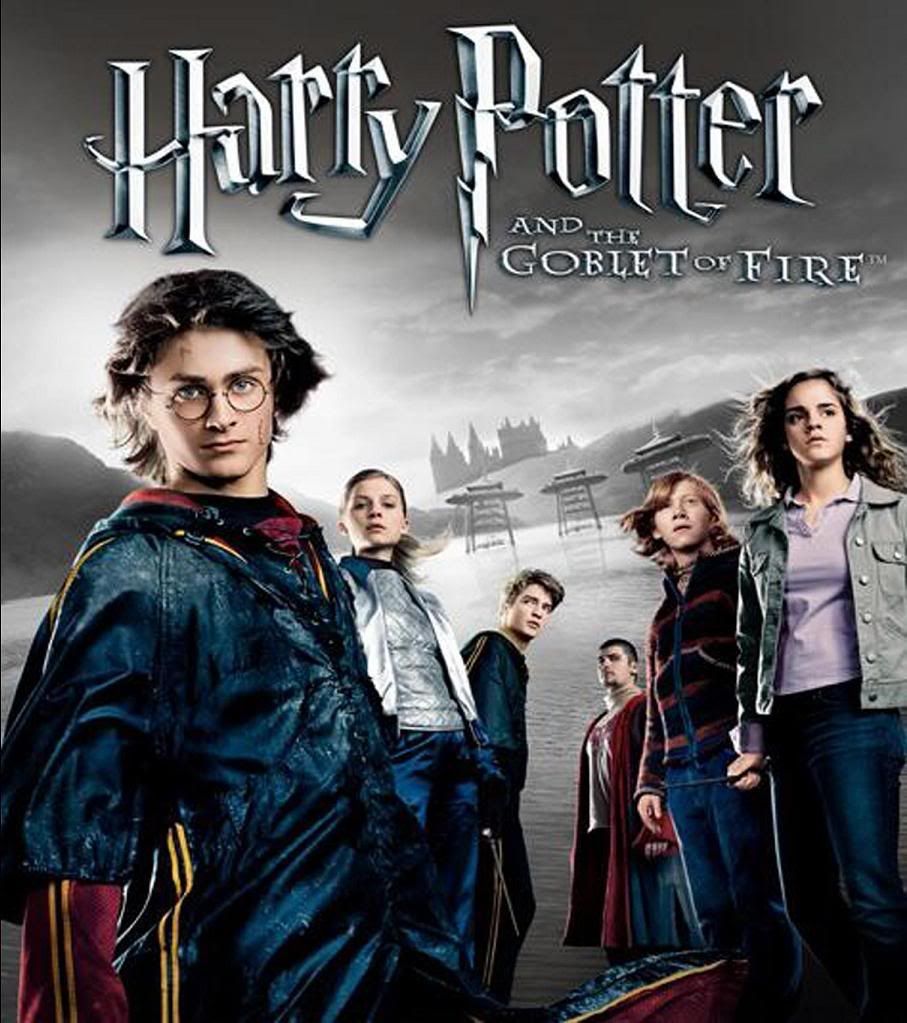
Harry Potter and the Goblet of Fire (dir. Mike Newell, 2005)


Well, as I’ve said many times, this is my favourite Harry Potter movie. There’s so much good stuff here – Eric Sykes! Doctor Who! Ginny getting plenty of screentime even when she has few lines! The random new people from Prisoner of Azkaban disappearing! Robert Pattinson! (much more attractive here than in Twilight, though rather too young for me even back then). Viktor Krum! Evil mermaids! Ralph Fiennes! Magic tents! A Christmas Ball! And a beautiful, sweeping score from Patrick Doyle.

This is also, of course, the pivotal book and the point at which the series starts to grow up. I think the moment where Harry weeps over Cedric’s body is quite possibly the best bit of acting Daniel Radcliffe has done for the series and the scene is played out with a fantastic intensity. The whole final section with the maze has a much more intense feel to it than Potter has had so far; I’m particularly impressed by Harry and Cedric’s desperate race for the trophy. The decision to put that slightly off, far too cheerful fanfare over Harry’s return was a stroke of evil genius and George from Drop the Dead Donkey will break your heart. Then, of course, there’s the graveyard scene, the creepiest, most terrifying and best scene from all the books and so far, from the movies as well (though Harry’s possession by Voldemort at the end of Order of the Phoenix gives it a run for its money). 'I want to see the light leave your eyes' gives me the chills every time.

The decision to make Beauxbatons and Durmstrang single sex schools works brilliantly, as it gives each school a really strong identity and makes for a very impressive entrance. It is a bit unfortunate that, since this means that the only female Champion came from a school with no boys, it does rather imply that boys make better Champions (and it doesn’t help that Fleur is, let’s face it, kinda wet and a bit rubbish). The selection of the Champions itself, though, includes another wonderfully done moment where Snape notices something’s wrong with the Goblet before anyone else.

Unfortunately for me, with the removal of the sphinx from the book (a very wise decision, and it would have thoroughly ruined the pacing during that crucial maze section) there’s very little particularly ancient or Classical in this movie, beyond the usual Latin spells (periculum is from the Latin for danger). So, um, I shouldn’t really be blogging it. But I’m nothing if not a completist and I didn’t want to leave out my favourite of the movies!

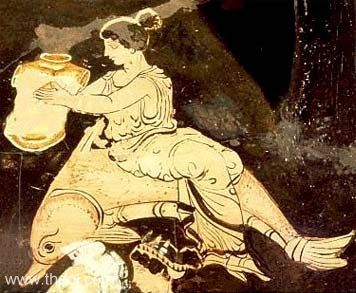
There is one ancient element in the film – the mermaids. Mermaids are not particularly big in Classical mythology, though they do crop up. Modern representations of the Sirens from the Odyssey sometimes picture them as mermaids, but in ancient art the Sirens are usually half woman, half bird and in the Odyssey, there’s nothing to suggest they aren’t simply women. The Assyrian goddess Atargatis, for various reasons, ended up half woman and half fish and Lucian still knew of this story in the second century AD. Aelian describes some sea monsters in the Indian Ocean that sometimes have the faces of women, with spines for hair – these sound the most similar to the film's freaky-looking mermaids than most. The Nereids, sea nymphs led by Thetis, were also sometimes depicted in mermaid form, though oddly enough it is rarely suggested that Achilles’ mother herself was half fish! The word ‘mermaid’ is Anglo-Saxon (‘sea-woman’) and I suspect that the modern view of mermaids, as attractive half-naked young ladies given to singing to sailors, is a later development (I don’t know how far back the identification of the Sirens with mermaids goes, but that may have had an effect on the development of mermaid folklore).

Nereid nymph riding dolphin, Apulian red-figure pelike. C5th B.C., J. Paul Getty Museum, Malibu. From www.theoi.com. This one has feet, but there's a mermaid-like look to the way she's sitting...

I love the interpretation of mermaids here. The friendly Narnian mermaids were based, in their fishy part, on dolphins, but these rather more ambiguous mermaids are based on sharks. They are not exactly evil creatures as far as the story is concerned, but they are pretty nasty and the really ugly look they’ve been given, complete with quite the attitude, always makes me think of them as the Evil Mermaids. Best of all is the contrast between these ‘real’ mermaids with the stained-glass window mermaid in the Prefects’ Bathroom (another nice touch, giving the usual moving portraits a fresh visual spin). The stained glass mermaid, the film suggests, is pure folklore; beautiful, elegant, obsessed with arranging her hair despite living under water. If mermaids really exist, it is implied, they are dangerous wild animals, not naked seductresses.

Dragons are pretty ancient as well of course, though these dragons owe more to Norse and Anglo-Saxon tradition (I would have loved to have seen the Chinese Fireball realized, but we don’t even see the miniature – it doesn’t sound like it has the good nature of ancient Eastern dragons, but maybe it looked like them?). The word is Greco-Roman (Greek drakon, Latin draco) but back then it meant any very big snake, and Greco-Roman mythology is much more interested in snakes, which crop up in all sorts of contexts, than in the sort of giant lizard that is usually pictured in the West when you hear the word ‘dragon’.

I’d better stop there, as I could go on about why I love Goblet of Fire all day. Though I could live without the mental images that always spring to mind when Cedric tells Harry about the bathroom and looks like he’s propositioning him…

Alas, poor Cedric.

Thursday, November 4, 2010

Harry Potter and the Prisoner of Azkaban (dir. Alfonso Cuaron, 2004)


Prisoner of Azkaban is commonly referred to as the best of the Potter movies. My personal favourite, which I genuinely think is the best movie, is Goblet of Fire. Although I'm glad that Cuarón took a less literal approach to adapting the books than Columbus, producing a more streamlined, movie-like plot with much better pacing, I think the movie really suffers from leaving out any explanation of who Mooney, Wormtail, Padfoot and Prongs are and the significance of Harrry's patronus being a deer. It would hardly have taken very long to pop in a quick explanation during Harry and Lupin's final conversation in Lupin's office and surely this must be an obvious gap in the plot to those who haven't read the books. The movie is also a little bit too arty for my taste sometimes. There are lots of extra little touches that I love, including the Night Bus squeezing and jerking its way around, the man who can't be bothered to twirl his coffee spoon with his fingers but is using magic instead, the repeated motif of the clocks and timepieces that foreshadows the final act and the long-suffering cleaning lady at the Leaky Cauldron. But sometimes the camera does an especially swirly move, or there's a very obviously carefully staged moment, like the slow pull back from Uncle Vernon waving at Aunt Marge while Dudley appears to be watching Strictly Come Dancing on television (clever, since it hadn't started yet), that's just so obviously staged and designed to be terribly arty, it takes me out of the story. And why has Dean Thomas been virtually replaced by a completely new student, and CrabbeOrGoyle by a ganglier student? Every time I see one of these random new people it sets my teeth on edge (besides, I like Dean Thomas, he does normal things like supporting a football team).

Cuarón is also responsible for casting Micheal Gambon, a decision I am Not Happy With. Gambon is a fantastic actor (brilliant in Gosford Park, for example) but he just doesn't get Dumbledore. Richard Harris sometimes lacked a bit of sparkle, but you could always feel the repressed power of Dumbledore when he played him. Gambon has a bit more twinkle - though not much, really - but provides no feeling of hidden power or depth at all (it doesn't help that he's made it clear in interviews that he doesn't really care about the material. If you do an acting job for money, fine, but if you take on a role that means so much to hundreds of kids, you should at least make some effort to understand the character). And his accent is awful, veering all over the place and most often sounding like some bizarre combination of Irish and Canadian.

Still, Prisoner of Azkaban is a very, very good Potter film and features one of my favourite Potter-y things, the choir singing 'Double, double, toil and trouble' (with toads!) to John Williams' excellent soundtrack - Williams seems to have been much more inspired on this one, providing a wonderfully rich variety of styles in the soundtrack while maintaining an overall unity (I especially like the Tudor-like bits for the castle). David Thewlis is not how I pictured Lupin - I had quite the thing for Lupin in the books and pictured him as, well, no offence to Thewlis but a bit sexier. Still, his performance is excellent. Some of Cuarón's changes to the overall setting seem a bit random - the bridge thing has proved popular in subsequent movies but doesn't actually have much of a purpose beyond being pretty, and why he changed Professor Flitwick's look is anyone's guess - but it's wonderful to see Hogwarts looking like it's really in Scotland, complete with Scottish weather and beautiful Highland landscapes, and lovely steep slopes for the kids to run around on.

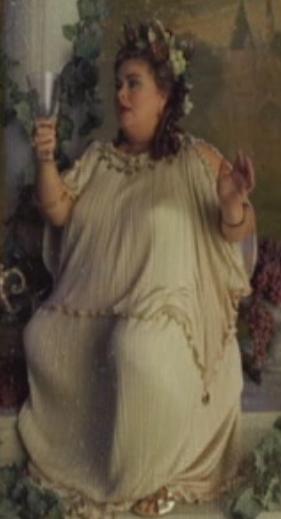
Anyway, on to Classics! Yet another element redesigned by Cuarón is the Fat Lady, who plays a bigger role in this story than any of the others. In Philosopher's Stone, she looked just the way I pictured her from the book, a large grey-haired lady in a pink dress, imagined as vaguely nineteenth century. Here, she has been re-cast, presumably because she needed a comic scene to re-establish her importance before she is attacked, so comic actress Dawn French was cast instead of Elizabeth Spriggs. However, since Cuarón can't leave anything alone, she's also been re-imagined and is now a neo-Classical figure. The style of painting fits the eighteenth or nineteenth century, a self-consciously Classicizing image which represents how eighteenth and nineteenth century artists viewed Greece and Rome (gorgeous landscape with vaguely Classical architecture in the background, figure in the foreground in white tunic and with her head covered in fruit - exactly who the Fat Lady is supposed to be, mortal or goddess, is not clear and presumably, since she's known as the Fat Lady, no one knows).

Intriguingly, the Fat Lady appears to consider herself actually to be Roman - judging by her criticism of the kids as 'plebs' when they fail to appreciate her singing (though, to be fair, a well educated person from the eighteenth or nineteenth century would probably use the same insult, so it's not a definitive conclusion!). I'm always a little confused about how far the various portraits in Harry Potter are supposed to think and feel as their subjects, or how connected they are with their status as paintings or photographs (I think it generally depends on the painting or photograph). The Fat Lady certainly seems to have chosen to identify with her Classical setting, even though it represents a later fantasy of the Classical world rather than any Classical reality.

Much more important to the plot, of course, is Buckbeak the Hippogriff. Hippogriffs are not really known from Classical Mythology, though name is half-Greek (hippo, from horse) and there is a line in Virgil's Eclogues that refers to mating a Gryphon and a mare. The Potterverse Hippogriff, however, is basically the same creature as the Classical Griffin, described by Aeschylus, Herodotus and Pausanias, among others. Werewolves (the name correctly identified by Snape as being from Anglo-Saxon, in which wer means man) are also talked about in ancient texts, most notably in the werewolf-story in Petronius' Satyricon. Potterverse werewolves are similar to Buffyverse werewolves in that they are completely normal outside the period of the full moon but uncontrollable monsters when wolves, though in the Potterverse, lycanthropy (werewolfism) is treated much more like a serious chronic illness than anything else (and there's a distinct metaphor about misunderstood and socially unacceptable illnesses going on there). Ancient texts tend not to present werewolves in such a friendly light. (I've also discussed Remus Lupin's name before).

Other bits and pieces of Classical Stuff get the odd mention. Hermione points out that the Egyptians used to worship cats. The current password for the Gryffindor common room, appropriately enough, is fortuna major (literally 'big luck', lots of luck, great luck or Great Luck, the personified goddess of luck - though Google suggests it may have more to do with a divinatory practice I'm not familiar with). Sybil Trelawny is, of course, named after the Sibyl, but the forms of divination she teaches are distinctly newish - crystal balls and tea leaves are slightly more modern obsessions, at least in the West (some say Druids used crystals, but somehow I doubt they were using lovely smooth spherical crystal balls). One of the many classes Hermione is taking is Ancient Runes - you'd think, considering the nature of most of their spells, that Latin would be more useful but, of course, Latin is a subject some children might learn in real schools. For her ancient language to sound sufficiently weird and magical, it had to be runes.

I can see why so many people list this as their favourite Harry Potter film. It's adopting one of the best books, which helps (I was genuinely shocked to discover that Ron had literally been sleeping with a bad guy for years). It is also truly magical and there are so many lovely touches - the giant giraffe wandering through the portraits is awesome and Hogsmeade in the snow is beautiful. Snape as Grandma is hilarious too (as is my favourite exchange 'Spiders! They want me to tap-dance! I don't wanna tap-dance!' 'You tell those spiders, Ron'). I love the way Snape throws himself in front of the kids he hates to protect them from the werewolf as well. Unfortunately, for me, there are just a few too many deeply irritating ticks (Gambon's accent, random extra students, unexplained plot points) for it to be my favourite, but it's a very, very good adaptation and certainly stands up best as a film by itself, outside of the series as a whole.

Sunday, October 24, 2010

Harry Potter and the Chamber of Secrets (dir. Chris Columbus, 2002)


This is probably my least favourite of the Harry Potter films, though I enjoyed the book on first reading. The film seems to have all the flaws of Philosopher's Stone (false and forced sounding delivery from several places, which I put down to direction as they've all been perfectly good in other things, far too much crammed into an episodic and overlong storyline and although the sets and architecture look great, the landscape and weather is not very authentic) without the essential charm and magical, almost Christmassy feel of the first. Some of the problems come from the source novel, of course - the House Elves, my least favourite aspect of Harry's world, are introduced here, Ron throws up slugs (just disgusting), there are masses of giant spiders, every single female character turns into a drooling idiot at the sight of Gilderoy Lockhart and although Hagrid starts out well, rescuing Harry from Diagon Alley comforting Hermione, this book features him at his most dangerously stupid and irritating (no, Hagrid, you shouldn't send schoolboys off to talk to giant man-eating spiders).

It's not all bad though. The first time I read the book, I was really impressed, mainly because the petrification of Hermione and the identification of Ginny as the (mind-controlled) culprit were genuinely surprising, and the finale is exciting and much more plausible than that of Philosopher's Stone (those spells 'protecting' the Stone make no sense at all, except Dumbledore's). The movie does this well, the random North by Northwest-style of the sets works, and I think Daniel Radcliffe does a pretty good job of the nearly-dead-acting required. The reaction of the female characters to Lockhart is infuriating, but the character himself is pretty funny and Kenneth Branagh plays him well (but then, I think I could probably watch Kenneth Branagh read the phone book). The Burrow looks great too and the casting is perfect (plus we get the wonderful lines 'Mummy, have you seen my jumper?' 'Yes, dear, it was on the cat!'). Casting an adult as Moaning Myrtle was a bit of a surprise, but because she's so translucent (and Shirley Henderson is very good) they just about get away with it. The duels are rather good too.

Another view of Lacock. They stopped filming there after this film, and just stuck to sets.

The idea of the cry of the mandrake that kills those who hear it is best attested from Shakespeare onwards, but it is thought to have had its root (hehe) in the ancient world. Josephus mentions the danger of the mandrake and the difficulty of digging it up, though not specifically the scream (Jewish War, 7.6.3), and Pliny the Elder just says people avoid having the wind in their face while digging it up (Natural History 25.94); he adds that it can be used to treat the eyes.

Pliny is a bit more forthcoming on the Basilisci Serpentis, which apparently lives in North Africa, moves with its middle up the air, and can kill a man with poison transmitted through a spear and his clothing (Natural History 8.78). What Pliny is describing, though, isn't a mythological animal, but an animal that Pliny believed rally existed, so there is no petrification by sight; that belonged only in the realm of myth. He also says it's not much more than twelve inches long. The possibly giant, petrifying version seems to be a later, medieval, development.

We do, of course, see one solidly classical mythological beast in this film - Fawkes the phoenix. Having said that, Herodotus describes the phoenix as a real, though extremely rare, bird, which creates a egg of myrrh in which it carries its father to the temple of Helios (the sun) in Egypt (2.73). But we have some proper mythological sources for it as well, including Ovid's Metamorphoses - though even Ovid describes the phoenix born from the ashes as the offspring of the recently deceased 500-year-old bird, not the same bird reborn (15.385ff). Philostratos thought it sang it's own funeral dirge, like a swan (Life of Apollonius of Tyana, 3.49) but it's Claudian, a fourth century poet, who implies that the reborn phoenix is the same animal as the 'father' phoenix, and significantly one of the two poems in which he does so is about the rape of Persephone, a myth that signifies the death and rebirth of vegetation with the passing seasons (The Phoenix and The Rape of Proserpine 2.78ff). All agree that the phoenix lives for at least five hundred years, in which case Harry's walking in on Fawkes just as he burns is a staggering coincidence.

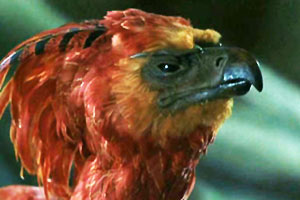
As far as I know, Rowling added the healing powers of phoenix tears and their ability to carry very heavy loads for plot-related purposes (I wonder if she was inspired in part by Tolkien's fondness for eagles ex machina?). Obviously, let me know in the comments if anyone knows of any other sources that list these as phoenix properties, but I'm not aware of any! Bizarrely, there are now, it seems, companies selling health products called 'phoenix tears' - Rowling has actually successfully added to a two and a half thousand year old myth (Tolkien must be turning green with envy in his grave). I like how Fawkes seems to be a very rare bird in the Potterverse - not the only one in the world, but phoenixes, it is implied, are few and far between and pretty special. This seems appropriate for a bird that can auto-regenerate and can fix any number of dire injuries by crying on them. Fawkes himself is rather beautiful. I'm so glad he's an animatronic creation rather than CGI - it makes him so much more solid and real, and the tilt of his head is rather endearing (though the CGI on his burning is very effective).

It really is far too long, but I can't hold too much against the film that gave us all Lucius Malfoy, the most wonderfully odious (and sexy, apparently - I'm more of a Snape woman myself) character in recent children's literature. It is hard to take it seriously, however, once you've seen French and Saunders' magnificent spoof, Harry Potter and the Secret Chamberpot of Azerbaijan. Which I recommend heartily, unless you're Rupert Grint, in which case, don't look and comfort yourself by remembering that it was a long time ago!

Sunday, October 17, 2010

Harry Potter and the Philosopher's Stone (dir. Chris Columbus, 2001)


This first Harry Potter film is not as accomplished as many of the later ones, being rather more cardboard cut-out in its style as well as somewhat overlong and bloated, but Columbus did manage to capture the magic of Harry Potter’s world, so I quite like it. Although this Hogwarts doesn’t look much like it’s in Scotland, the design of Diagon Alley is gorgeous, all rickety old houses and twisting streets and the castle of Hogwarts itself looks great (I had a lovely poster on my wall at university of Hogwarts at night, with all the first years in their boats rowing towards it). Casting and costumes both reflect the books perfectly (actually, I always pictured Professor McGonagall as Bebe Neuwirth, Lilith from Cheers and Frasier, but any excuse to watch Maggie Smith is a good one. And Snape really ought not to be any older than his mid-30s, but Alan Rickman is too completely perfect in the role for me to care. The glare at Harry and exquisite flick of the hair as he says, oozing malevolence, that ‘people will think you’re... up to something’ makes me grin every time. That man does the best Hair Acting I’ve ever seen).

As I re-watched the film, I wondered if wizards use owls for their postal service because owls symbolise wisdom – which does rather beg the question why Minerva McGonagall, named for Athena/Minerva, a goddess of wisdom and war who had a particular connection with owls, turns into a cat rather than an owl? But that’s really an issue with the books, not the films. Also in the category of things that hadn’t occurred to me before, how come Ron has a different accent to the rest of his family?!

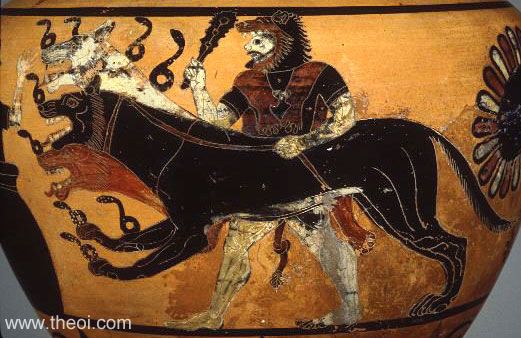
Much like the plural minotaurs who seem to be all over fantasy at the moment, Harry Potter and the Philosopher’s Stone features a giant three-headed dog called Fluffy who is, we can only presume, one of a larger species of giant three-headed dogs. (The alternative is that the Irish fella Hagrid met in the pub went down to Hades and stole Hades’ personal hound, taking him back up to the world and selling him to a gameskeeper who decided to keep him in a school. Which seems... unlikely). Cerberus is supposed to be especially large in myth, but the gigantic dog here is bigger that Cerberus is in most vase paintings. This is partly because Heracles brought Cerberus us from the underworld, rather than killing him, so he’s unlikely to be that enormous, but mainly because otherwise he wouldn’t fit on the vase. The humungous dog here is nice, though, a suitably scary guard-dog (and would, of course, look smaller next to fully grown adults rather than eleven year olds).

Centaurs come up time and again and their most interesting Harry Potter appearance is in The Order of the Phoenix, so I won’t look at them in too much detail here (see previous discussions). I also don’t want to dwell on the centaurs in this movie too much, as the CGI is absolutely awful. I don’t usually complain about dodgy special effects because I think viewers should just use their imaginations, but this is a special case. The centaur here looks utterly ridiculous and bizarrely ape-like, and is rather larger than he needs to be. The BBC produced a slightly iffy but certainly satisfactory centaur in the late 1980s by splicing together footage of a man and footage of a horse – I’d much rather look at that than at this weird CG thing.

I’ll indulge in some random non-Classic-y thoughts as well while I’m here. I always thought, in the books, that the robes the children wear as their school uniform were more like the adults’ robes, or Gandalf’s – full garments that replace other clothing. I think the combination of ordinary school uniforms with robes as cloaks over the top works though – it makes the children look a bit less strange, as their outfits look more like graduation outfits, which we do see in the real world, albeit not very often, and they can look more casual by taking off the robes. The books in the restricted section have chains on them – have they been stolen from the Library of Unseen University?! And I’ve always thought Professor Quirrell’s end was a bit too horrifically nasty, especially given the general tone of the film and young target audience. And the fact that Harry essentially murders him doesn’t seem to worry anyone – sure, it was self-defense, but was putting his hands all over his face strictly necessary? But perhaps I’m just excessively squeamish.

And on a half-Classics-y note: does anyone else have fun imagining that it’s actually Emperor Marcus Aurelius running Hogwarts with serene philosophical majesty? Just me? OK, never mind.

It is over-long and it is lacks a certain depth, but I like this first Harry Potter movie. Not as much as the others perhaps, but I do like it – thanks largely to John Williams’ score, it has the magical feel it needs to have and although the movie may have gone a bit too far in trying to be faithful to the books, including just a bit too much stuff, it is fun seeing these characters come to life as if they’re sprung up from the page. I’ve even been known to shed a tear or two when Hagrid gives Harry that photo album at the end.

Lacock, near Bristol, where the first two Harry Potter movies did some filming. I think the cauldron was put in there for the tourists. And that's one of my best friends' elbows in the corner!

Thursday, June 3, 2010

The Roman Mysteries: The Fugitive from Corinth

Another enjoyable and educational story, this entry into the Roman Mysteries series allows us to enjoy a road trip through some of the most famous and beautiful parts of Roman-period Greece. Spoilers follow.

Oddly enough, this one reminded me of Harry Potter in a couple of places (and not just because I'm re-reading Potter at the moment). The first was when, for a split second at the beginning of the story, I was worried that poor Captain Geminus really was a goner, as, like Potter, this is a children's series that is not afraid to kill likeable and good characters when the plot demands it (I also thought Arthur Weasley had really gone for good in The Order of the Phoenix). One other thing the two series have in common, though, is knowing exactly where to draw the line between killing off enough characters that the series doesn't feel too safe or predictable, but not killing off so many or such beloved characters that readers are put off - I think I've explained before why I refuse to read Philip Pullman any more?! (I also think killing Harry would have been a huge mistake, but that's a debate for another time).

Of course, I haven't finished the series yet, so watch Captain Geminus die at the beginning of the next book just to prove me wrong!

The other thing that reminded me of Potter was the characterisation of Flavia who, in this novel, reminded me a weeny bit of Harry in The Order of the Phoenix - coming into the very emotional, self-centred (in the sense of not being able to see other sides of things, rather than lack of genorosity) rather shouty phase of teenage years, a few years ahead of Harry of course, since girls go through certain aspects of teenage life earlier than boys. Also like Harry, Flavia has a pretty good excuse for behaving as she does, since she is still in shock and traumatised from the attack on her father.

This is a book in which the reader is expected to work out the mystery before the detective, clearly signposted early on when Flavia ignores the doctor's explanation that her father's amnesia is the result of a blow to the head and becomes convinced that he has been cursed and that she must find the culprit to get him to lift the curse (perfectly reasonable for a Roman child, but less so for a modern reader). Of course, modern readers will know, or their parents will tell them, that Flavia is wrong and the doctor is right, and so the reader is primed to look for the clues that Flavia misses, and even I managed to work out the solution before Flavia did (this is very, very unusual, I love mysteries but I'm rubbish at solving them, even the Agatha Christie ones). This is rather nice, allowing the reader to solve the puzzle ahead of their heroine and emphasising the fallibilty of our heroes, though it is an unfortunate side-effect that Flavia becomes a bit irritating over the course of the book as she refuses to see the truth. Nubia, meanwhile, is definitely my favourite character, as she is, as ever, the most sensible and level-headed of the children and the most perceptive.

The story takes us from Corinth to Delphi to Athens, accompanied by Jonathan's guide book, which is, sadly, a little under 100 years too old to be that of Pausanias, but is very similar. All three cities are clearly described, along with the route taken by the children (and their guide and bodyguard - as ever, the books remain sufficiently attached to reality that these children do not travel alone, though Flavia is in charge). We meet the real - as opposed to mythical - women of Greece, who are often veiled in public and who have less independence than their Roman counterparts - an excellent reminder of the differences between the two cultures, and the fact that Greece stayed Greece even under Roman rule. I also rather liked the references to the strong Spartan woman who's a mix of real Spartan indepedence and mythical beauty, it was a fun combination.

The Corinth canal - which didn't exist in Roman times of course - from our trip there 10 years ago

There were other fun touches too, my favourite being 'he will live long and prosper' in the Pythia's oracle, though that might just be my Trekkie brain over-reacting. Lupus finally gets something nice happening to him as well, thank goodness, though his reunion with his mother is so brief, it doesn't seem quite enough somehow and I'm holding out hope for more in the later books. Oh, and I've been watching too much Rome and Spartacus: Blood and Sand - every time Flavia says 'Great Juno's peacock!' I read 'Great Jupiter's cock!' This may be deliberate... All in all, another fun and intriguing entry into the series with a nice emotional undercurrent in the idenitity of Captain Geminus as the victim, giving the story greater interest and enotional depth.

Thursday, July 16, 2009

Harry Potter and the Half-Blood Prince (dir. David Yates 2009)


A few random thoughts on the new Harry Potter movie...


Warning: SPOILERS contained within. Only read this if you've already seen the movie, or don't care!


Went to see the new film last night and I loved it, though I did feel a bit like there were two scenes missing at the end (the fight between the Death Eaters and the kids/Aurors, and Dumbledore's funeral). I liked the extra bit at the Weasleys' house, but I was expecting Lupin to go all werewolf on the Death Eaters' collective asses, and was kinda disappointed when he didn't (because of Tonks' random reference to the first night of the cycle). That would've been cool. I loved how funny it was though - I was dreading all the teen romance, but it was done really well and it was hilarious. The felix felicis potion was also done really well - I think 'pincers' may be my favourite line in the film. ('Felix' means lucky, and 'felicis' is the genitive of 'felix', so I guess this means 'Lucky thing of lucky things'...) Also we finally got to see more of Snape and Draco, yay! (Mmmm, Alan Rickman).

There isn't as much Classics-y stuff in the last two books as in the earlier ones - something I'll talk about more when I do Book 7, which largely (though not entirely) substitutes it's own invented 'fairy tales' for actual myth or folklore. The main threat in Half-Blood Prince is more human than magic, though the wizards use magic instead of guns. The scene in the cave is reminiscent of a katabasis, that is, a part of the story where the hero goes down to the underworld, the land of the dead. The Greek underworld appears to welcome these visitors on a regular basis - Hercules, Theseus, Orpheus and Odysseus all pop down for a visit - and the scene showing all the Inferi (Potterverse zombies) surrounding Harry and Dumbledore and their tiny boat is definitely underworldy. (I want to do some more posts on pop culture examples of katabasis, so I won't say too much on that now!). A couple of my friends described the Inferi as 'all the Gollums' which I guess is a good point, though they looked somehow even grosser than Gollum to me. I did think that the Pensieve is looking more and more like Galadriel's mirror with each passing movie though.

I think Goblet of Fire is still my favourite of the films, and, unless the filmmakers do something amazing with the two parts of Deathly Hallows, I think it will stay that way. I really liked this one though, and I think it needs a second viewing to really enjoy it - on the second viewing, it's so much easier to just enjoy the film without constantly thinking about all the stuff that got moved around or taken out (and without the idiots who were sitting behind me and talked loudly all the way through the film). Oh, and I have to confess, I did cry a little bit - I was doing fine until everyone put their wands in the air to remove the Dark Mark with candle-like wandlight, at which point the tears started rolling!
Mmmm.

Thursday, June 4, 2009

Harry Potter: Books 4-5 - Centaurs and Sphinxes


Harry Potter and the Goblet of Fire is an odd one for me - the book is my least favourite of the series, but the film is my favourite of the films so far.

Being annoyingly serious for a moment, I can't stand the house elves sub-plot in the book, because I don't think slavery is a suitable subject to play for laughs. All of Ron's justifications for enslaving the house elves - that they like it, that they were born to serve etc - have been used of real slaves by real slave owners, and the way Hermione is treated by both the other characters and the narrator for trying to win rights for the house elves - laughed at and ignored - seems totally inappropriate to me, especially in a book aimed at a young audience.

I don't get the main plot of Goblet of Fire either - why on earth would Voldemort hatch such an incredibly complicated plan to get his hands on Harry, when surely Wormtail could just kidnap him in Hogsmeade? Why would the Triwizard Tournament have such ridiculously unbendable rules in the first place, how could Harry be magically bound by a contract he didn't sign and why didn't the Ministry cancel the tournament when it became obvious that something very dodgy was going on? For me, all of these are worse problems than the question of why Gandalf didn't just fly to Mordor on an eagle in The Lord of the Rings.

But, for some reason, in the film, none of this bothers me! I get swept up in the story and stop worrying about all these things and, best of all, the house elves sub-plot is gone! Patrick Doyle's music is sublime and the film has some really powerful sequences - Harry and Cedric racing each
other to get to the Goblet, Harry nearly becoming overcome with competitive ambition and abandoning Cedric, the entire scene in the graveyard, especially Ralph Fiennes who is amazingly good at playing pure evil (is there anything more chilling than his cry 'I want to see the light leave your eyes!') and, most brilliantly horrible of all, Harry appearing, clutching Cedric's body and weeping, among a crowd of cheering schoolchildren, parents and a brass band playing eerily cheerful music.

Goblet of Fire has the usual mix of Classical, Norse, Celtic and other mythologies, but the bit I'm picking up on today, ironically, isn't in the film. I also have to confess that I haven't read the book in a while and don't have it in front of me - I have several copies of Philosopher's Stone in several languages (including Latin and Ancient Greek) but Goblet of Fire is at my parents' house, so I'm relying on the internet to refresh my memory.

During the third task, in the maze, Harry encounters a Sphinx who asks him a riddle. Sphinxes (body of an animal, usually a lion, head of either a man or a woman) are known from art all over the ancient Mediterranean, including from Egypt, Mesopotamia, Minoan and Mycenean art on Crete and mainland Greece, and later Classical Greek art. In literature, the best known sphinx is the one that harrassed Thebes until she met Oedipus. Oedipus himself is much better known for the later parts of his story, but it is his defeat of the sphinx that gets him married to his mother in the first place (see the pretty decent Wikipedia article here).

The Greek sphinx's riddle is a simple and traditional riddle, in which the words of the riddle need to be understood symbolically in order to produce the answer. The riddle Harry's sphinx asks is a bit different:

"First think of the person who lives in disguise,
Who deals in secrets and tells naught but lies,
Next tell me what's always the last thing to mend,
The middle of middle and end of the end?

And finally give me the sound often heard,
During the search for a hard-to-find word.
Now string them together, and answer me this,
Which creature would you be unwilling to kiss?"
(Thanks to Mugglenet - the editorial here is somewhat out of date, but makes interesting reading.)

The answer Harry gives, correctly, is 'spider'. This is more like a series of crossword clues than a riddle, relying on word play. If this riddle had appeared in an ancient Greek text, it would make no sense at all as soon as it was translated into another language. The last bit is especially odd, as the one creature in all the Harry-Potter-verse that one would least want to kiss is obviously a Dementor. Sure, kissing a spider would be pretty unpleasant and certainly gives me nightmares, but its not a particuarly clever observation.

Its a nice idea to use a sphinx - a suitably scary-looking creature - and a riddle in the maze, playing on not only Greek mythology, but also echoing JRR Tolkien's The Hobbit, which features riddles heavily in what would turn out to be its most important chapter. I find the riddle itself somewhat disappointing though - for several rather better designed riddles, see the aforementioned Hobbit, 'Riddles in the Dark'.


Two enormous sphinxes guard the entrance to some of the Near Eastern galleries at the British Museum. The picture on the left, which unfortunately came out a bit dark, gives some sense of the scale of these - compare the size of the person with the statue.


Harry Potter and the Order of the Phoenix is actually one of my favourites of the books, while the film is not my least favourite, but definitely comes behind 3 and 4. The first time I read Order of the Phoenix I didn't like it - because it was too well written. JKR really excels at describing teenage-dom in all its glory and misery, and just as the Yule Ball (both film and book versions) reminds me of every teenage dance that left half the attendants in tears or sulks, the OWLs in Book 5 are just too well-described.

Explanation for non-Brits: OWLs are the wizardly version of British GCSEs, playing on the old exams taken by my parents that GCSEs replaced - O-Levels, standing for Ordinary Level (hence Ordinary Wizarding Level). Whereas most other sensible countries have 1 set of school-leaving exams, when I was at school we had 2, and now we actually have 3 (I was the in last year group to take old A-Levels, thank goodness). Students can leave school at 16, after taking GCSEs, or can choose to stay and take AS-Levels and A-Levels, and university requires A-Levels or equivalent.

Although I have done many, many exams since and have two degrees with a third hopefully coming up soon, I remember Year 11, GCSE year, as the most horrifically stressful of the lot (closely followed by MA year, FYI). I only took 3 A-Levels, but 9 and a half GCSEs, which is still less than many others do. The worst part was the pressure put on us by the teachers - 'this is the most important year of your life, how you do in these exams will affect your future career, you must study, you must work', etc etc etc. All of that comes across so clearly in Book 5 that I was taken right back to the age of 16 and I hated it. Later, I read it again, put a bit more distance between it and me, and loved it. I do have a bit of a fondness for ridiculously long fantasy books.

The most intriguing use of Greek mythology to me in Order of the Phoenix is the depiction of the centaurs. I grew up with a Narnian view of centaurs - wise, noble, vicious and brave in battle it's true, but absolutely peaceful unless forced to fight. Harry Potter's centaurs are actually closer to the Greek version. Greek centaurs were imagined as, for the most part, a gang of wild, drunken, violent rapists, presented as the opposite of human civilization. There were occasional exceptions, and both Narnian and Potterian centaurs get their astrological skill from Chiron, who seems to have tutored half the heroes of Greek mythology (see Wikipedia again). However, star-gazing aside and leaving out the rape and alcohol parts, Potter's centaurs are much closer to Greek centaurs than Lewis' noble heroes. Like Greek centaurs, they live in the wild forest, in opposition to human civilization (represented by Hogwarts) and whatever it is that they do to Umbridge is, thankfully, left undescribed.

I like the Classical rendering of the centaurs, and I like that they are so different to Narnian centaurs (while retaining the useful divinatory astrological knowledge) but I must admit, I'm always a little disturbed at the way Hermione deliberately leaves Umbridge to their mercy, and that they would have killed Hermione and Harry without Grawp (my least favourite character of all, by the way). But then, Umbridge was pretty nasty, and its a very effective scary set piece.


A Roman mosaic showing a very unusual image - a female centaur. Unfortunately I didn't write down the exact date of this piece. The mosaic is in the museum at Tunis and is therefore probably Imperial or Late, since Carthage was repopulated under Augustus.

Hmm, between anti-slavery campaigns and the woes of the British educational system, that ended up being a rather more earnest blog than I had anticipated! I'll have to find something more light-hearted to look at before tackling Jesus Christ Superstar...

Thursday, May 21, 2009

Harry Potter: Books 1-3


I am going to break Harry Potter into manageable chunks, and cover books and films together unless there's a major difference between the two. So here are some thoughts on Harry Potter and the Philosopher's Stone, Harry Potter and the Chamber of Secrets and Harry Potter and the Prisoner of Azkaban.

The US title for the first book drives me crazy. The Philosopher's Stone was something people actually believed might exist in the late medieval and early modern period - a stone that would turn lead to gold and produce the elixir of life.

Let's get some of the major Latin references out of the way first:

Albus = Latin for 'white'
Remus = one of the two brothers who founded Rome, who were suckled by a wolf
Lupus = Latin for 'wolf'
Vol-de-mort = French for 'Flight of death' (not Classical, but worth mentioning!)
Expecto patronum = Latin for 'I am expecting a guardian'
Oculus reparo = Latin for 'I repair the eye'

All the spells are Latin except for 'Avada Kedavra' (which is from the same root as Abracadabra). I won't list them all here, but if anyone is curious about a particular spell, ask me about it in the comments.

I love Harry Potter. Its not great literature - Rowling's writing is somewhat basic (count the number of times she has to say 'he, Harry' because she hasn't made the subject of her sentence sufficiently clear) and there isn't a single original idea in all seven books, but they're great, fun reads. As I spend all day reading thick and often impenetrable books for work, sometimes in different languages, I find it increasingly difficult to get into fiction books in the evening - it's so much easier to just put in a DVD. But there are no problems there with Harry Potter, the stories are exciting and fast-paced and time spent reading it just flies by.

Contrary to popular opinion, my favourite of the films is number four, The Goblet of Fire, but out of the first three I like Prisoner of Azkaban very much. The other two are fine, the first sets up the world of Harry Potter nicely, but they're a bit... bland.

Book One's Fluffy is presumably inspired by Cerberus, the dog that guarded the entrance to Hades, the Greek underworld (see description here). The name 'Fluffy' is great, but unfortunately what he's guarding isn't anywhere near as exciting as the underworld; just a bunch of supposedly protective charms and spells that three 11-year-olds can get through.

Book Two's basilisk is also Classically named - see Pliny the Elder's description here. The Wikipedia article is also good. The basilisk is pretty cool and pretty scary, though I always think it's cheating to have Fawkes destroy its sight. Still, it's a good scene, and I think Dan Radcliffe first showed some real acting skill in that movie, when he thinks he's dying and tries to persuade Ginny to leave without him - I feel really sorry for poor little Harry at that point!

Professor Snape, in the third film, is absolutely right about the origin of the word 'werewolf' (from the Anglo-Saxon wer, man), though werewolf stories were known in Greece and Rome too (see here and here, at LXI and LXII). The first time I read Book Three, before I started to study Ancient History and before I had done much Latin, I didn't realise Lupin was a werewolf - something I have since become somewhat embarassed about (see above)! I like Prisoner of Azkaban a lot - as a book, its one of my favourites. I was genuinely surprised by some of the plot twists and Rowling's treatment of lycanthropy ('werwolfism', from the Greek) as an illness puts an interesting twist on an old tale.

The use of Latin for the magic spells in Harry Potter is similar to its use for the same purpose in Buffy the Vampire Slayer. Latin is old, and therefore mysterious. Its also a language that relatively few people can really read, but that a lot of people know little bits of. A lot of us, for example, known the meaning of a motto that we've come across in Latin (like that of the RAF, Per Ardua Ad Astra - Through hard work to the stars). Anyone who's Catholic or who has enjoyed classical Catholic music, like a Requiem Mass, will have heard some Latin. So its an old mysterious language, but one that, at the same time, sounds familiar and which has some words that are almost recognisible - like 'oculus', eye, in 'oculus reparo', the spell to repair spectacles. This makes it especially effective as a magical language. The fun thing for me is translating the Latin spells back into English!


Me at my MA graduation, wearing the Gryffindor House scarf I knit myself and looking very Hogwarts, I think!

Next up: Monty Python's Life of Brian. More Harry Potter to follow at a later date!